“Words ought to be a little wild for they are the assaults of thought on the unthinking.” – JM Keynes

“Words ought to be a little wild for they are the assaults of thought on the unthinking.” – JM Keynes
“The decadent international but individualistic capitalism in the hands of which we found ourselves after the war is not a success. It is not intelligent. It is not beautiful. It is not just. It is not virtuous. And it doesn’t deliver the goods.”
“The day is not far off when the economic problem will take the back seat where it belongs, and the arena of the heart and the head will be occupied or reoccupied, by our real problems – the problems of life and of human relations, of creation and behaviour and religion.”
“The ideas of economists and political philosophers, both when they are right and when they are wrong, are more powerful than is commonly understood. Indeed, the world is ruled by little else. Practical men, who believe themselves to be quite exempt from any intellectual influences, are usually the slaves of some defunct economist. Madmen in authority, who hear voices in the air, are distilling their frenzy from some academic scribbler of a few years back… Sooner or later, it is ideas, not vested interests, which are dangerous for good or evil.”
-John Maynard Keynes
“I still find each day too short for all the thoughts I want to think, all the walks I want to take, all the books I want to read, and all the friends I want to see” – John Burrough
Posted in Quotes
“Now Faith, in the sense in which I am using the word, is the art of holding on to things your reason has once accepted, in spite of your changing moods” – C.S. Lewis
“Neurosis is always a substitute for legitimate suffering” – Carl Jung
Posted in Psychology, Quotes
‘Discipline is the basic set of tools we require to solve life’s problems. Without discipline we can solve nothing. With only some discipline we can solve only some problems. With total discipline we can solve all problems’
“Yet it is in this whole process of meeting and solving problems that life has its meaning. Problems are the cutting edge that distinguishes between success and failure. Problems call forth our courage and our wisdom; indeed they create our courage and our wisdom. It is only because of problems that we grow mentally and spiritually. When we desire to encourage the growth of the human spirit, we challenge and encourage the human capacity to solve problems, just as in school we deliberately set problems for our children to solve. It is through the pain of confronting and solving human problems that we learn. As Benjamin Franklin said, ‘Those things that hurt, instruct’. It is for this reason that wise people learn not to dread but actually to welcome problems and actually to welocme the pain of problems.
Most of us are not so wise. Fearing the pain involved, almost all of us, to a greater or lesser degree, attempt to avoid problems. We procrastinate, hoping they will go away. We ignore them, forget them, pretend they do not exist. We even take drugs to assist us in ignoring them, so that by deadening ourselves to the pain we can forget the problems that cause the pain. We attempt to skirt around problems rather than meet them head on. We attempt to get out of them rather than suffer through them.
This tendency to avoid problems and the emotional suffering inherent in them is the primary basis of all human mental illness.”
-The Road Less Travelled (M. Scott Peck, Page 4+5)
Posted in Intense, Psychology, Quotes, Wisdom
C.S. Lewis on the commercialization of Christmas:
“It is in fact merely one annual symptom of that lunatic condition of our country, and indeed of the world, in which everyone lives by persuading everyone else to buy things. I don’t know the way out. But can it really be my duty to buy and receive masses of junk every winter just to help the shopkeepers? If the worst comes to the worst I’d sooner give them the money for nothing and write it off as a charity. For nothing? Why, better for nothing than for a nuisance.”
-‘What Christmas means to me’ (1957)
 “To recast the Cartesian proposition “I think therefore I am” ubuntu would phrase it “I am human because I belong”. Put another way “a person is a person through other people”. No one comes into the world fully formed. We would not know how to think or walk or speak or behave unless we learned it from our fellow human beings. We need other human beings in order to be human. The solitary, isolated human being is a contradiction in terms” – Desmond Tutu
“No trumpets sound when the important decisions of our life are made. Destiny is made known silently” – Agnes de Mille
Everyday, each and every one of us makes decisions. Some are good, some are bad, but all are decisions that were made. We choose to do good or to do bad. We choose to live for the benefit of others, or to live for the benefit of ourselves. Ultimately, there comes a time of realisation where the possessor of the will decides to exercise his will irrevocably in one direction or another. Perhaps for some weak and ineffectual people, this moment never dawns and they continue to live a life of bland ambiguity, not truly knowing their left hand from their right.
“Could’st thou in vision see
Thyself the man God meant
Thou never more could’st be
The man thou art, content”
-Anon
I want to live a purpose-filled life.
I want to be a man of God
I want to constantly improve myself
The big decisions in life are not made in the limelight. They aren’t made in the presence of the powerful or the company of the influential. They are made sitting on your bed, looking at your hands and asking yourself the tough questions in life. What will I do? What will I be? What will I believe? What will I leave behind? Who am I?

“Our life is full of brokenness – broken relationships, broken promises, broken expectations. How can we live with that brokenness without becoming bitter and resentful except by returning again and again to God’s faithful presence in our lives.” – Henri Nouwen
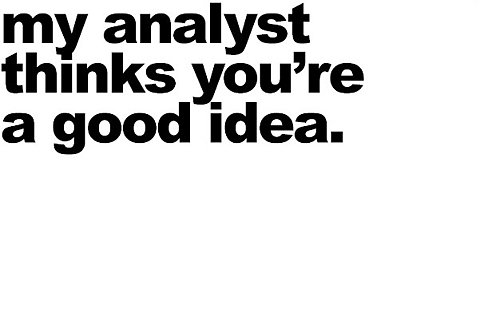
I love this picture! It captures so much in such a short quip. I think it resonates with me for two reasons:
It’s this second point that I want to talk about for a bit here. I’m not sure if it’s because of my genetic makeup (or is it make-up?), my upbringing, my education or more probable than any one of these alone, a combination of all of them, that I over-think things. I think about conversations long after I’ve had them [how did this person interpret what I said?], I think about the choices other people make [would I make different decisions? What made them decide that? How will this affect them?] I think about lots of things (mainly consciously, however I’m sure that there’s lots going on sub-consciously as well). One of these things is my future wife. I can just imagine some obnoxious economist meeting a girl and saying ‘my analyst thinks you’re a good idea’ – douchbag! People can work on paper and yet flop in reality, just like an idea can be perfectly laid out on paper and yet fail perfectly in reality…
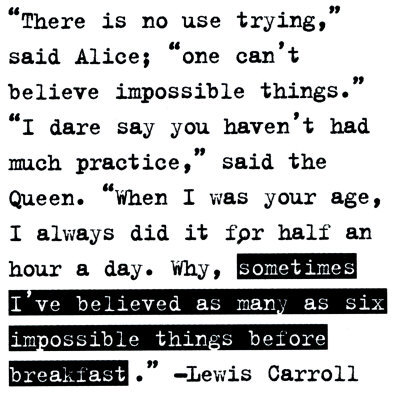
I have always liked Alice in Wonderland and thought that it has many profound insights. The Queen’s comments above are quite comical and yet thought provoking. Why is it that we base our entire notion of religion and belief on faith in God and yet proof and reason are needed for any other form of belief? If we are to believe in others, we demand a reason for that confidence. If we are asked to believe in, and support a notion/cause/group we require that they give us ample reason to do so. While I don’t think that any of these these are necessarily wrong, I think it does warrant a rethinking. Often we try to apply the principles of reason and logic to God because that is how we operate with everything else in the world. However, after our eyes have been opened to the greater reality of God and we have received the gift of faith, surely our point of reference should also change? No longer do we bow and scrape to the god of rationality – demanding that everything must make sense or else it is hogwash. Perhaps I should believe in someone based purely on the sense inside me that tells me (in that most indefinable, unsystematized, nonclinical way) to believe in them. How often do we step off that venerated branch of reason, logic and rationality into the unknown world? If I am honest, not very often…
“Precision is not reality” – Henri Matisse




 Nic Spaull