
(This is a series of six weekly emails I wrote in 2022 while walking the 700+km of the Camino de Santiago. I was on sabbatical and had time to think, to walk, to write, and to drink).
To my nearest and dearest,
Today is Day 27 and I am in Berducedo in Asturias drinking fresh orange juice and beer (separately). Not a bad summary for how things are going. Today we walked 30km over a beautiful mountain in cold thick mist and rain. Using socks for gloves and wearing 50% of what I brought with me meant I wasn’t uncomfortably cold, but did repeatedly wish it would end.
I am on a different Camino — the ‘original’ (Camino Primitivo), first walked by Alfonso II of Asturias in the ninth century. But let me rewind and start 10 days ago or so. While still on the Camino Francés I was tired of people and running low on emotional gas. I had just stayed at two albergues that were as challenging as they were charming.
The first albergue, a convent on the edge of town, is run by two 80-year-old micro-nuns in white habits and blue COVID masks. It is clear to me that the slow pace of life in Spain is taking its toll on me. Yesterday these two nuns took three hours to register 20 people, individually walking them up the stairs and showing them where they would be sleeping. They are 80, so this shuffle along the courtyard and up the stairs is its own pilgrimage. No one can break it to them that we will likely be able to find the rooms without assistance. Perhaps they want to get their 10,000 steps in.
Tired from walking and hot from waiting, I was losing my cool. Numerous people joined the line only to realize that this was not really an albergue but occupational therapy for two nuns. The ‘Youngs’ (a self-named group of drug-friendly Italian and Flemish twenty-somethings) left in search of more efficient nuns, which they no doubt found, because there are three convents in this town.
Following this initial tribulation my spirit was bent but not broken. What broke me was the 45-minute delay to exchange a €20 note for coins for the washing machine. The experience reaffirmed in my mind the importance of markets and capitalism. Kindness and care are the operating principles here, which is wonderful, except that it is also mind-numbingly slow and inefficient. In my mind inefficiency should be a sin at least as bad as anger or lust. It feels like a trial in patience here. While en route to our financial exchange, this nun was very happy to speak to each and every pilgrim. “¿Está todo bien?” she asks as she waddles along. Most pilgrims don’t speak Spanish so it’s a whole rigmarole to figure out what she’s saying (‘Everything OK?’). So everyone just smiles awkwardly, further delaying the process. Walking behind her as we approached the office I finally ended up saying “Yes, yes, everyone is fine. He’s fine, I’m fine, we’re all fine. Can we just go please.” To which she smiled and carried on walking. These nuns are bite-size so it’s difficult not to find it all at least partly endearing. But to the snaking line of tired, hungry, dirty peregrinos this wait was painful, long and unnecessary.
It is now 4:30am the next day and I am trapped in this wretched nunnery. After the sleeping pill wore off about an hour ago, my bunk mate’s piercing snore was all-encompassing. Yet the doors only open at 6am. This was a detail that was lost on me when the Spanish nun was translated by a Uruguayan pilgrim into broken English. Eventually I managed to break out of this holy prison and begin my day’s walk, happy to have the nuns behind me.
Because there are so many new people, there are so many opportunities to recreate and re-enact the social games of the past. I am now at a new albergue and here sits a group of three Americans around the legal age of voting, having sex, or buying a gun, depending on their state. They’re joined by a suave Dutch guy in his mid-twenties who can clearly both vote and shoot. I sit down with them to have a beer. For some reason I am trying to fit in, to be cool and to appear funny to them.
Why do I care what these jovial youths think? How can they be so immature yet still be the arbiters of cool? They embody effortless confidence, yet also spend 30 minutes laughing about a small plastic hand that fits on your finger. The 18-year-old girl moves it from one finger to the next and for some reason everyone finds this hilarious. Each transition funnier than the last. They don’t seem high, wired or drunk, just painfully young, yet I still laugh, not really knowing why, but here we are.
A good friend once told me, only half jokingly, that choosing life paths or romantic partners was really just choosing how you want to suffer. There’s little you can change about people and there will always be things you don’t like. Or as my supervisor once said, “Mense kom in pakkies.” I had asked for advice about supervising my own students and how he could be so Zen with clearly suboptimal students. “Mense kom in pakkies. You take the whole package because you can’t pick and choose what you want.” At the time I thought this was also probably useful dating advice.
But back to the youths. Even though they don’t show it, I know they have their own forms of suffering. Suave straight men have their own prisons even if they have different jailers. I wonder if envy is just lusting after other people’s prisons? I’m not convinced. Some prisons do genuinely seem more spacious than others.
After all of this I found myself in León on the back foot with a broken spirit. Everything seemed to point in one direction: leave. As I was mulling this over I saw a pack of pilgrims walk by and we knew some of them — another hot Italian (the hot ones are all Italian), the Taiwanese tour guide (Ray) who is extremely thoughtful and friendly, the Germans and a few South Koreans. Ray was pushing someone in a wheelchair and I thought, ‘Is she really doing the Camino in a wheelchair?’ It turns out that she was hit by a cycling pilgrim – of which there are many – and she is now in a wheelchair for a while, ending her Camino. Perhaps looking for someone to commiserate with, I sat next to her at dinner and struck up a conversation. Smiling, I said “You’re the first pilgrim I’ve met in a wheelchair?” She laughs. “I’m sorry about it, I heard you got hit by a bike?” As I shook her hand she winced, and only then did I realize her hand also had plasters on it. Her name was Janine and she was turning 50 this year. She had wanted to do the whole Camino this year after only doing the last 100km from Sarria about five years ago. “I actually didn’t enjoy any of it the last time, I hated it, but I still cried my eyes out when I reached the cathedral in Santiago.”
We had a long conversation about our lives and realized that, in our respective countries, our lives were actually quite similar. But she was different here, she said; she had a sense of being open and relentlessly positive. “I’m normally introverted and people think I don’t want to talk to them, but I do. Here everyone is friendly and that helps me be an open person. Even this accident — who knows why it happened, but what can I do about it now? I’m sad I can’t continue but that’s life. I have loved it all up to here. Maybe it means I’m meant to come back again one more time?” And she laughs.
Stefan, the German mindfulness photographer, starts speaking to her. “Did you bring a stone from California?” (You’re meant to bring a stone from your home country and carry it with you on your journey. At one point on the pilgrimage there is a big cross at the top of a huge pile of rocks. When you reach it you cast your rock onto the pile, unburdening yourself.) Janine replied that she still had it. “I don’t know what I’ll do with it though,” she says, as she rummages in her bag for it and holds it out to Stefan to look at. “Did you carve your name in the stone at home before you left?” “No, I just brought it from a park near my house. I carved that in my hotel room yesterday because I couldn’t leave my wheelchair and had nothing else to do, so I just spent the time scratching my name.”
This was so poignant and sad. Stefan offered to walk with her rock and put it on the pile when he got there. Janine thanked him and gave it to him. I couldn’t tell if she was reluctant to give it to this enthusiastic German, or grateful she wouldn’t be taking it home. Later on in the dinner Ray tells us he has been chatting to his friends who are further on in the Camino and now at Sarria (the last 100km). “You really need to book every albergue you can, there are loads of people this year. He sent me these two photos of him in Sarria.” I looked at the photos and looked back at him. “Is this seriously what’s coming?” “Yes, it’s a holy year, remember. Actually a holy COVID year!” And he laughs.
There is a Holy Year whenever the Feast of Saint James (25 July) falls on a Sunday. It happens every 5, 6 or 11 years depending on the calendar, and 2021 was one of them. But because of COVID, the powers that be decreed that both 2021 and 2022 would be Holy Years. Two for one in the holy economy. According to tradition (and Pope Calixtus II), if you do the pilgrimage in a holy year then as you walk through the Holy Doors of the Santiago Cathedral, all your sins are forgiven. Apart from the crowd looking for plenary indulgences, there are also those who were just waiting for COVID to be over and the Camino to be open. So 2022 became a bumper year. A Holy COVID year.
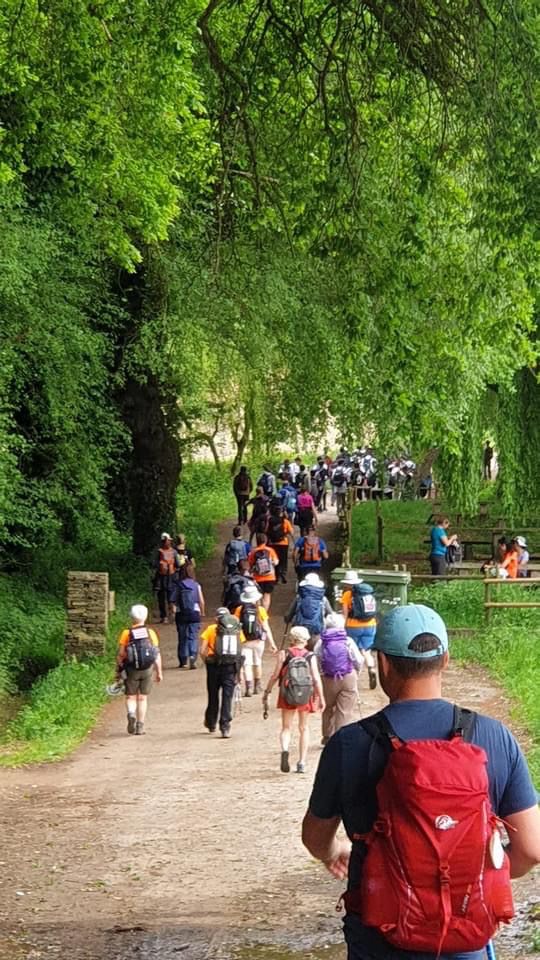
The photos were worrying but also helped settle things. I would not be fighting through crowds and haggling for accommodation. This was not the Haj and I wasn’t looking for the forgiveness of my sins.
Having said this, leaving then still felt like defeat or retreat, neither of which I like very much. Overwhelmed and indecisive, I felt the need to get away. I went on Airbnb and looked for an escape — far from cities, with a bath and a view. After a bit of scrolling and toggling, one on the northern coast of Spain jumped out: it had a bath with a view. Perched on a cliff with an outdoor bath and a huge view of the sea, it was also 15km from any shops. Escape perhaps; retreat, no.
I remembered reading a quote from J.R.R. Tolkien on escape and leaned into his generous interpretation.
“I have claimed that Escape is one of the main functions of fairy-stories, and since I do not disapprove of them, it is plain that I do not accept the tone of scorn or pity with which ‘Escape’ is now so often used. Why should a man be scorned if, finding himself in prison, he tries to get out and go home? Or if he cannot do so, he thinks and talks about other topics than jailers and prison-walls?”
I booked a two-hour bus to Gijón and a one-hour taxi to the little cottage, just outside Villaviciosa. I bought a Colm Tóibín novel and a book of Oliver Sacks’ essays, as well as three days’ worth of scrambled eggs, tomato pasta, chips, beer and wine. Man cannot live on bread alone.
I bathed often and spent the time thinking and listening to music. I made a fire, woke up late and hiked down to the stony beach, ambling over the rocky shelves. Pondering what the options were, I Googled a few things and found that Villaviciosa was actually the one point where the Camino Norte transitions to the Camino Primitivo, and that only 4% of pilgrims do the Primitivo (70% do the Francés). Allegedly it needed good shoes and training because it was hilly and hard, but crocs were what was available and I’d been walking long distances for two weeks now.
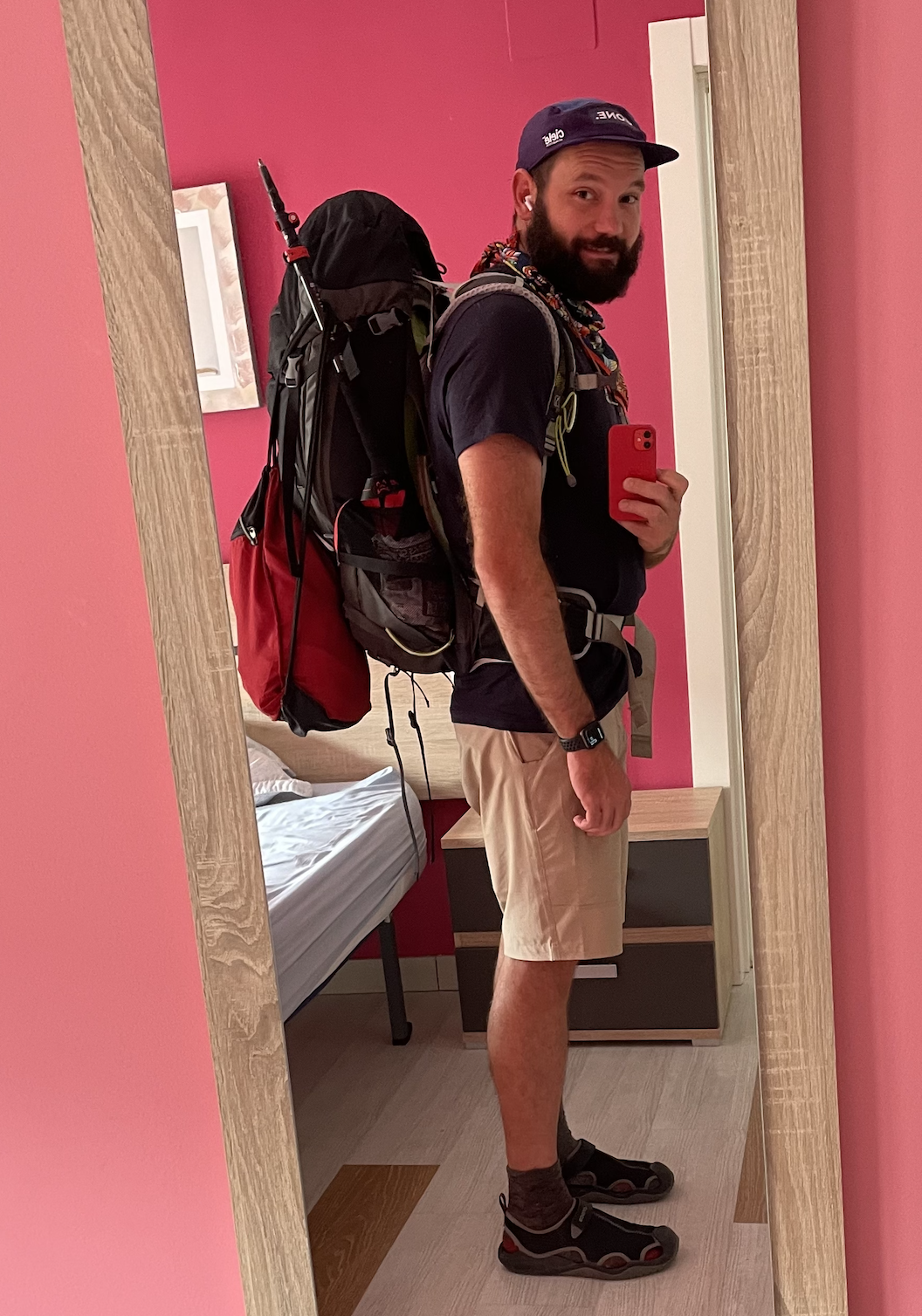
I decided I wasn’t ready to go home and that I would start the Primitivo the following day. How bad can a route be if you have foot coverings and walking poles? I used the Airbnb to wash my clothes and Marie Kondo my backpack. Shoes, deodorant, Brierley’s Camino Francés book, half the medicine cabinet, the book of essays. Gone. Mebo oil and Zambuk would have to cut it. I drained and dressed the blisters on my foot and hoped that some version of this was happening in my head. I phoned the taxi, went to the post office in Villaviciosa and shipped my shoes back to South Africa. This would be a crocs Camino.
//
I have been on the Camino Primitivo for a few days now. The route is sometimes rocky and always scarcely populated. Across the three days I have hiked alone and without interruption about 70% of the time. Coffee or lunch ends up being a tortilla and a chance encounter with a friendly person or an acquaintance. There are Irish boys avoiding Interrailing (their version of matric rave, but taking trains across Europe and partying as you go), and Germans who have taken two weeks away from their wives and kids.
I alternate between thinking either some subconscious process is underway and I should ride it out, or this is just a novel youthful holiday by another name and I have things to do — I need to write, and I’d prefer to write now rather than when I’m in London in June. I am ambivalent about wanting to stay and walk or return and write.
It’s uncanny how similar the social dynamics are between the Francés and the Primitivo. Being open, smiling, saying hello, and hey presto, a new collection of young interesting internationals congeals into a group. This time it’s a Dutch 27-year-old start-up bro, a 26-year-old Spanish boy who quit his job and sleeps outside on the Camino (bathing in rivers), and a young Czech recovering alcoholic who’s thinking of moving to Croatia. Finished off with two Hungarian girls, the first of which came because she asked for a sign (a seahorse) and five minutes later received it (an ice sculpture of a seahorse). The people are consistently friendly, upbeat and quirky. Inviting, open and honest.
Today was hard. Walking, persevering, in the cold, rainy mist. In the small concrete refuge on the mountain, a mother and daughter were waiting for a taxi because this was one of the few points where the route crossed a road. (“She nearly twisted her ankle twice so we figure it’s best to play it safe in the rain.”) Another pilgrim who didn’t pack warm clothes was apparently a bit hypothermic and had left in a taxi.
To be honest I have no idea what the next few days will lead to. Coming back to Cape Town, continuing with the Primitivo, or some unknown. I enjoy walking and meeting people but also miss my friends and writing.
It’s nearly lights out in this albergue, so let me say buenas noches.
Hugs to all,
Nic


Am loving these memories!!! Pretty hard core 💪