Category Archives: Economics

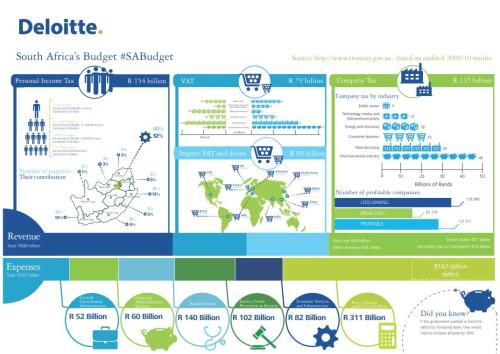
A suboptimal political economy equilibrium in South Africa (Infographic)

sa_march_29_four.jpg
The above infographic is quite interesting and has its uses, but is the main interest/focus of government “Considerations of equity and fairness” ?? Slightly Utopian, especially given the ‘political economy’ title! Where has all the politics gone?

From here with the sub-title ” A suboptimal political economy equilibrium”

The Iowa Car Crop

Economics at its best…

The Iowa Car Crop –  Steven E. Landsburg

 A thing of beauty is a job forever, and nothing is more beautiful than a succinct and flawless argument.  A few lines of reasoning can change the way we see the world.

            I found one of the most beautiful arguments I know while I was browsing through a textbook written by my friend David Friedman.  While the argument might not be original, David’s vision is so clear, so concise, so incontrovertible, and so delightfully surprising, that I have been unable to resist sharing it with students, relatives, and cocktail party acquaintances at every opportunity.  The argument involves international trade, but its appeal is less in its subject matter than in its irresistible force.

            David’s observation is that there are two technologies for producing automobiles in America.  One is to manufacture them in Detroit, and the other is to grow them in Iowa.  Everybody knows about the first technology; let me tell you about the second.  First, you plant seeds, which are the raw material from which automobiles are constructed.  You wait a few months until wheat appears.  Then you harvest the wheat, load it onto ships, and said the ships eastward into the Pacific Ocean.  After a few months, the ships reappear with Toyotas on them.

            International trade is nothing but a form of technology.  The fact that there is a place called Japan, with people and factories, is quite irrelevant to Americans’ well-being.  To analyze trade policies, we might as well assume that Japan is a giant machine with mysterious inner workings that convert wheat into cars.

            Any policy designed to favor the first American technology over the second is a policy designed to favor American auto producers in Detroit over American auto producers in Iowa.  A tax or a ban on “imported” automobiles is a tax or a ban on Iowa-grown automobiles.  If you protect Detroit carmakers from competition, then you must damage Iowa farmers, because Iowa farmers are the competition.

            The task of producing a given fleet of car can be allocated between Detroit and Iowa in a variety of ways.  A competitive price system selects that allocation that minimizes the total production cost.* It would be unnecessarily expensive to manufacture all cars in Detroit, unnecessarily expensive to grow all cars in Iowa, and unnecessarily expensive to use the two production processes in anything other than the natural ratio that emerges as a result of competition.

            That means that protection for Detroit does more than just transfer income from farmers to autoworkers.  It also raises the total cost of providing Americans with a given number of automobiles.  The efficiency loss comes with no offsetting gain; it impoverishes the nation as a whole.

            There is much talk about improving the efficiency of American car manufacturing.  When you have two ways to make a car, the road to efficiency is to use both in optimal proportions.  The last thing you should want to do is to artificially hobble one of your production technologies.  It is sheer superstition to think that an Iowa-grown Camry is any less “American” than a Detroit-built Taurus.  Policies rooted in superstition do not frequently bear efficient fruit.

            In 1817, David Ricardo—the first economist to think with the precision, though not the language, of pure mathematics—laid the foundation for all future thought about international trade.  In the intervening 150 years his theory has been much elaborated but its foundations remain as firmly established as anything in economics.  Trade theory predicts first that if you protect American producers in one industry from foreign competition, then you must damage American producers in other industries.  It predicts second that if you protect American producers in one industry from foreign competition, there must be a net loss in economic efficiency.  Ordinarily, textbooks establish these propositions through graphs, equations, and intricate reasoning.  The little story that I learned from David Friedman makes the same propositions blindingly obvious with a single compelling metaphor.  That is economics at its best.

            *This assertion is true, but not obvious.  Individual producers care about their individual profits, not about economywide costs.  It is something of a miracle that individual selfish decisions must lead to a collectively efficient outcome….

The Armchair Economist:  Economics and Everyday Life

From here

Lekker links…

  • Paul Collier reviews Acemoglu & Robinson’s new book “Why Nations Fail”. Very interesting (and firm) prediction about China: “That states need order to prosper is important but no longer controversial. That they need inclusive institutions is, in view of China’s success, wildly controversial. Their argument is that order without inclusive institutions may enable an economy to escape poverty, but will not permit the full ascent to modern prosperity
  • Private schools for the poor – interesting article from the Economist
  • Top 100 best NGO’s – in case you wanted to know…
  • Wisdom from Calvin and Hobbes
  • 50 most influential books of the last 50 years – useful link to have
  • NYT article (22 March) on Cape Town’s racial divide
  • M&G article (23 March) on Stellenbosch University and discrimination.
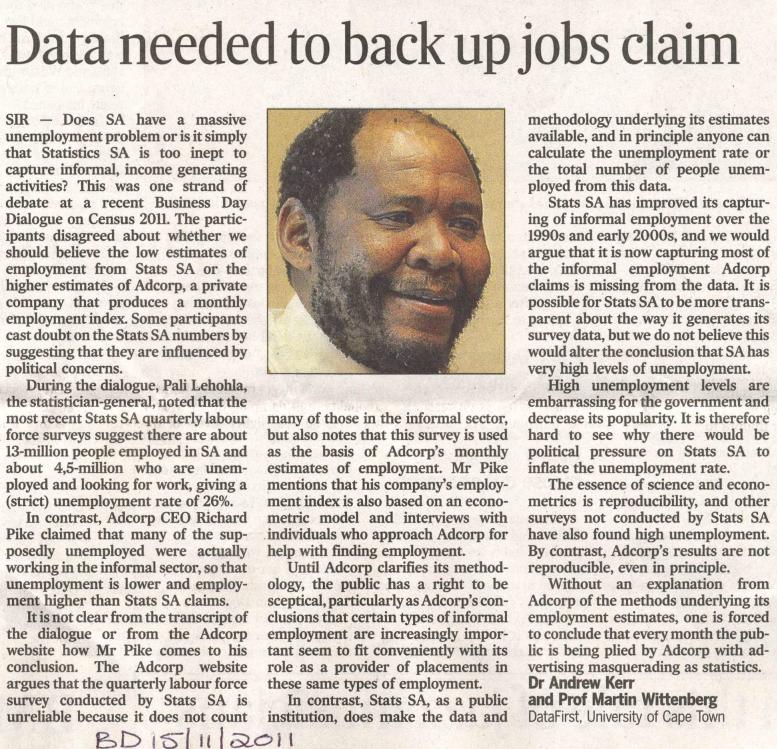
  • Latest installment (Business Day 19 March) on the Adcorp vs UCT econometricians debate…as well as a detailed response by the UCT guys. You can tell Martin and Andrew had fun writing this with sections titled “Science and Sales”, “Rigor and Rot”, “Openness and obfuscation”, “Models and Moonshine”, and “Errors of differences and indifference to errors” – Adcorp it seems you picked the wrong econometricians to mess with…just saying.
  • Cool music by Ben Howard, the Kongos,

Calvin and Hobbes on the gaping hole in contemporary art’s soul:

Calvin: People always make the mistake of thinking art is created for them. But really, art is a private language for sophisticates to congratulate themselves on their superiority to the rest of the world. As my artist’s statement explains, my work is utterly incomprehensible and is therefore full of deep significance.

N

Some things I’m reading…

    • “When you don’t have resources, you become resourceful.”
    • As the Bible notes, added Schleicher, “Moses arduously led the Jews for 40 years through the desert — just to bring them to the only country in the Middle East that had no oil. But Moses may have gotten it right, after all. Today, Israel has one of the most innovative economies, and its population enjoys a standard of living most of the oil-rich countries in the region are not able to offer.”
  • World Bank’s lead economist for South Africa writes an interesting article on low cost private schools in SA. Intelligent, informed and interesting article asking questions that need to be asked…(also see this FT article on private schools in SA)
  • Equal Education takes Minister of Education to court in an effort to force the Department to establish minimum norms and standards for school infrastructure (MG article). There are many ways to skin a cat – let’s see how this one turns out.
  • Vavi tells teachers to buckle down and change the status quo, albeit in rhetoric of the revolution (can’t we get passed this?)…some interesting stats but not sure what he really wants here.
  • Alain de Botton TED talk A kinder,gentler philosophy of success  “One of the interesting things about success is that we think we know what it means. A lot of the time our ideas about what it would mean to live successfully are not our own. They’re sucked in from other people. And we also suck in messages from everything from the television to advertising to marketing, etcetera. These are hugely powerful forces that define what we want and how we view ourselves. What I want to argue for is not that we should give up on our ideas of success, but that we should make sure that they are our own. We should focus in on our ideas and make sure that we own them, that we’re truly the authors of our own ambitions. Because it’s bad enough not getting what you want, but it’s even worse to have an idea of what it is you want and find out at the end of the journey that it isn’t, in fact, what you wanted all along.”
  • Paul Graham on writing 

Links I liked…

Some more links I liked…
  • Creating a More Equal and Productive Britain” – A lecture by Professor James Heckman. ‘There is hard evidence on soft skills’. Based on a big research project titled “Personality, Psychology and Economics
  • Rethinking School – a Harvard Business Review article about American K-12 education. Explains the importance of good teachers and how Americans should use new technologies and teaching methods in their classrooms. Still wondering about the links with SA and whether technology can be used to leapfrog educational development steps in South Africa – if only…
  • Why is research higher status than teaching? An interesting article by a Canadian economist. The one quip I really liked was the following on peer review:

 “Some might say this is the best way to measure research productivity. After all, how can we, as outsiders, judge the rigor and relevance of research outside our own specialized discipline? Peer review is the sine qua non, the best and only test of research excellence. I have some sympathy for this view – although it must be confessed that, sometimes, peers are idiots.

SA Budget infographic (Brilliant!)

From here

Advertising masquerading as statistics – Kerr Wittenberg 2011

Spatial segregation and school quality in South Africa

Fascinating paper – worth a read.

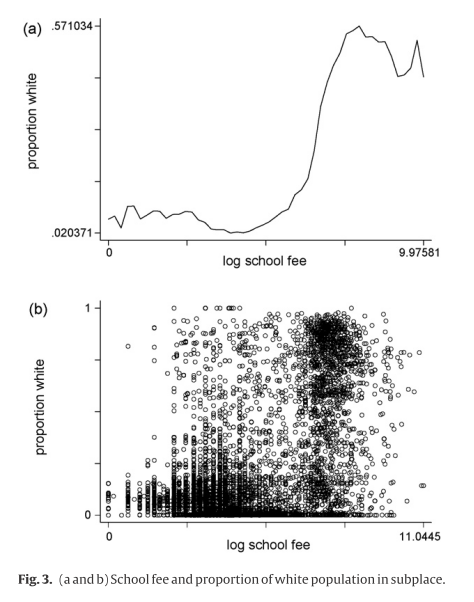
School quality, clustering and government subsidy in post-apartheid South Africa 

Abstract

This paper examines a range of historical and geographic factors that determine the quality of public school education in post-apartheid South Africa. Empirical analysis shows, first, that population groups are still spatially segregated due to the legacy of apartheid, which implies that, given the positive correlation between school quality and school fees, quality education is concentrated in formerly white, coloured and Indian schools in areas where the majority is non-African. Second, school quality, measured by the learner–educator ratio, improves as school fee and government subsidy increase. In this sense, school fee can be decreased with an increase in government subsidy to maintain school quality. It is also shown that government subsidy is allocated to schools with lower quality and fees, increasing the number of subsidized teachers. To address the current imbalance, financial support to disadvantaged locales and schools should be strengthened further.

Full paper here

Understanding South African schooling (1992)


In(equality)justice

“A similar lesson emerges from a classic experiment conducted by Franz de Waals and Sarah Brosnan. The primatologists trained brown capuchin monkeys to give them pebbles in exchange for cucumbers. Almost overnight, a capuchin economy developed, with hungry monkeys harvesting small stones. But the marketplace was disrupted when the scientists got mischievous: instead of giving every monkey a cucumber in exchange for pebbles, they started giving some monkeys a tasty grape instead. (Monkeys prefer grapes to cucumbers.) After witnessing this injustice, the monkeys earning cucumbers went on strike. Some started throwing their cucumbers at the scientists; the vast majority just stopped collecting pebbles. The capuchin economy ground to a halt. The monkeys were willing to forfeit cheap food simply to register their anger at the arbitrary pay scale.” (from here)

Why do inequality and injustice rile us so much? It seems that we have an in-built sense of fairness and justice. Perhaps in equality we find justice…

Gender and Time

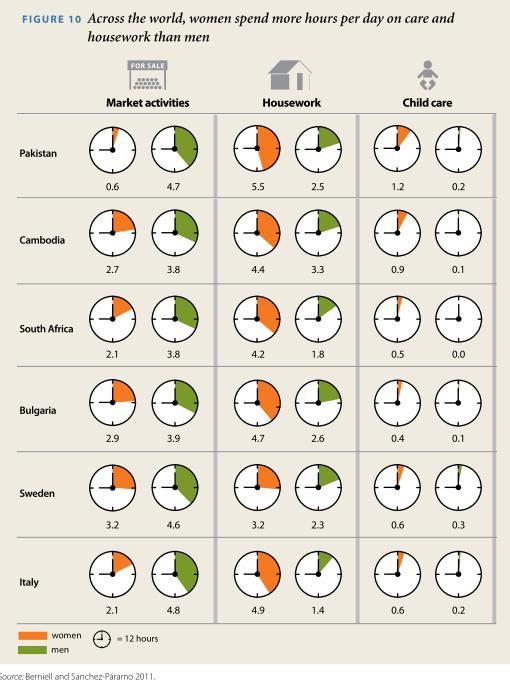
The recently released World Development Report 2012 has been released. This year’s theme is about Gender Equality and Development. I really like the above infographic. Italian women seem to spend a great deal of time on housework, while Pakistani men spend hardly any time on market activities. It’s also quite surprising how consistent the trends are between the genders and across countries.


List of OpenCourseWare educational sites (from UCT)

UCT has recently decided that they will allow students to download course materials from selected OCW sites without the downloads affecting their internet quotas. What a brilliant idea – hopefully Stellenbosch follows suit soon (To this end I’ve sent off a few emails to get the ball rolling). For those of us who are non-UCT students, and those who are new to OCW, the list of OCW sites they provide is auite useful – see “UCT list of main OCW sites” .

‘A Roadmap to a Life that Matters’ – Umair Haque

 by Umair Haque

So, are you psyched for the new Harry Potter movie? Like you, your kids, and approximately 99% of humanity, I confess: I too am captivated by the thought of a magical world where diligently memorized incantations can grant thunderous powers beyond the reach of mortals. “Accio, job growth!”

If only it were that easy. In our messy muggle world, there are no magic formulas. So, while many of you have been asking me for a roadmap to prosperity — and I’ve tried to offer a blueprint of a better kind of business — it might be that, despite what late-night infomercials and endless banner ads suggest, there’s probably no framework you can pick up off the shelf, pay a few bucks for, do a little dance around, and (voila!) prosper. The plain fact is that great achievement, deep fulfillment, lasting relationships, or any other aspects of an unquenchably, relentlessly well lived life aren’t formulaically executable or neatly quantifiable. First and foremost, they’re searingly, and deeply personally, meaningful. The inconvenient truth is: you’ll probably have to not just blaze your own trail — you’ll also probably have to plot your own map for own journey.

So while I can’t offer a roadmap, I can try and give you a pen and protractor instead to help you begin to create your own:

Put what, why, and who you love ahead of what, why, and who you don’t, and your roadmap will begin to write itself.

Now, my little principle might cause those with hand-made suits and beancounterly tendencies to leap out of their chairs and hit me with the tarantallegra jinx. But even the cynics might be willing to admit: given a mysteriously non-recovering “recovery” for a global economy perpetually poised on the brink of perma-crisis, the status quo’s out of ideas, out of options, and running out of time.

In an economy dedicated to the pursuit of more, bigger, faster, cheaper, nastier, the greatest hidden cost and unintended consequence is that something vital, enduring, resonant, and animating has gone missing from our lives — and it might just be the biggest thing: meaning in what we do, and why we’re here.

More, bigger, faster, cheaper, nastier has built an economy that might just be in furious pursuit of mediocrity. Five hundred channels and nothing on, corporations whose behavior plunges past merely unethical, or criminal, to sociopathic, big box stores larger than an airplane hangars, billions of dreary, me-too, not-so-great “goods” that fail to inspire, not enough McJobs to go around, financial markets that are more deft at blowing up scarce resources than at allocating them.

So what went wrong with our path to prosperity? I’d suggest: our economy might be in pursuit of mediocrity because too many of us put what, why, and who makes us want to go into a fetal crouch, plug our ears, and bang our foreheads against our knees above, beyond, and before what, why, and who we love.

There’s no magic formula for a life well lived, but my humble suggestion is that the above is probably the polar opposite: a surefire recipe for a life poorly lived, for intellectual, relational, social, ethical, and creative stagnation. Hence, what’s stagnating not just our economy — but our human potential. Too many of us (and some have argued, the best and brightest among us) are trained from birth to be — and rewarded with each bonus to remain — what economists call “rent-seekers,” experts at squabbling over (and winning) the last stale morsels of yesterday’s fading industrial age harvests, the mere mechanics and advocates of wealth extraction, instead of value creators, the architects and master builders, dreamers and doers, theorists and practitioners of the art of great human accomplishment.

Hence, I’d suggest: my tiny principle might not just a disposable epigram, but a diagnosis for dysfunction — and a challenge to all of you. The pursuit of more, bigger, faster, cheaper, nastier too often seems to demand putting what, why, and who we love at the end of the list, the underworld of the inbox, the bottom of the heap. That’s a recipe for stagnation, whether for people, communities, cities, countries, or the globe. But the converse might just hold, too: if nations and corporations want to punch past the glass ceiling of mere opulence, to what I calleudaimonic prosperity — lives that are meaningfully well lived — well, then people might just have to begin by making if not radically, then at least marginally more meaningful choices themselves.

Here’s what my little principle doesn’t mean: immediate, lowest-common-denominator self-gratification. That, for example, since you “love” Jersey Shore, you should spend all day, every day GTLing harder than the last. Sorry,lotus eaters. Instead, what it suggests is that if you “love” GTL that much, then, well, your roadmap might be clear. Whatever the method to your madness, whether inventing a better tanning bed, perfecting a better workout, or devising less water-intensive laundry, the authenticity principle says: don’t just mutely “consume” it — live it. Better it, reimagine it, blow the doors off it, and don’t stop until you’re within shouting distance of the point that it matters to the future of humanity.

The roadmap you need to follow is deeply, resonantly, profoundly, and irrevocably your own — the one that calls to you in every dreary meeting, every missed birthday, and every misplaced-but-not-quite-forgotten dream. It’s the one that leads you to your better self. It says: “Follow my lead. Let’s go somewhere that matters — not just somewhere that glitters.”

From here

World military expenditures – an American perspective!

The biggest military spenders

ON JUNE 8th China’s top military brass confirmed that the country’s first aircraft carrier, a refurbishment of an old Russian carrier, will be ready shortly. Only a handful of nations operate carriers, which are costly to build and maintain. Indeed, Britain has recently decommissioned its sole carrier because of budget pressures. China’s defence spending has risen by nearly 200% since 2001 to reach an estimated $119 billion in 2010—though it has remained fairly constant in terms of its share of GDP. America’s own budget crisis is prompting tough discussions about its defence spending, which, at nearly $700 billion, is bigger than that of the next 17 countries combined.

From The Economist


Yale jumps on the band-wagon

Yale has jumped on the Open-Course band-wagon, and what a wonderful band-wagon it is! Not only are they adding courses quite frequently, but their courses all contain a full set of downloadable video lectures. Wonderful! Yale’s motto ‘Lux Et Veritas’ (also in Hebrew on the logo) means ‘Light and truth’. Bravo!!

See the various departmental offerings below and the history course that has made its way onto my to-do list!


HIST 202 – European Civilization, 1648-1945
Professor John Merriman
Fall, 2008
This course offers a broad survey of modern European history, from the end of the Thirty Years’ War to the aftermath of World War II. Along with the consideration of major events and figures such as the French Revolution and Napoleon, attention will be paid to the experience of ordinary people in times of upheaval and transition. The period will thus be viewed neither in terms of historical inevitability nor as a procession of great men, but rather through the lens of the complex interrelations between demographic change, political revolution, and cultural development. Textbook accounts will be accompanied by the study of exemplary works of art, literature, and cinema. more >>

Poor Economics – book review

The Gospel according to Banerjee and Duflo*

This book review has subsequently been published in Development Southern Africa – see here

In their latest book, Poor Economics, Esther Duflo and Abhijit Banerjee present a highly-readable overview of the problems facing the world’s poor, as well as the most effective ways of overcoming those problems. The book covers the usual suspects of poverty research (health, education, nutrition, family-size, and financial access), and provides an overview of the findings from Randomized Control Trials. It reads as a nontechnical summary of their research over the last two decades and is completely free of economic jargon and theoretical grand-standing, making the book accessible to non-economists.

Those more familiar with RCT research will find the countless stories and anecdotes enlightening and informative. By painting a nuanced picture of the lives and choices of the poor, we are better able to understand the sometimes elusive logic that drives households, families and individuals to make the choices they do.

Yet it must be said that although the book is filled with colourful vignettes and moving anecdotes, the authors do not base their recommendations on a few personal encounters – as is so often the case in qualitative research. Rather, they use the anecdotes as emotionally-pleasing poster-boys for the less palatable RCT’s that litter the end-notes of every chapter and convince the reader that this is all based on highly legitimate stuff.

One of the lasting motifs of the book is the humanization of the poor. By placing their evidence in the wider sociological context that poor people inhabit, we begin to see that while the world of the poor is vastly different from that of our own, the contradictions and complexities inherent in all human behaviour are no less prevalent among the poor.

Another notable feature of the book is the companion website (www.pooreconomics.com). The site provides downloadable data for every chapter of the book, as well as data-visualisations and extensive references and research links. There is an entire section devoted to ‘Teaching the book’ which provides lecture notes, problem-sets, podcasts and assignments for every chapter of the book.  Keeping in step with the pragmatic ethos of the book, the website’s ‘What you can do’ section has links to a number of organisations involved in various projects around the world.

In their concluding chapter, the authors highlight ‘five key lessons’ which emerge from their research. The classification is both interesting and informative:

1)      Information deficiency – the poor often lack information, such as the benefits of immunization and early education, or the higher HIV prevalence among older men.

2)      Lack of access – they lack access to financial products such as savings and retirement accounts, as well as medically enhanced products like chlorinated water, iodized salt, and fortified cereals – all of which could substantially improve their lives.

3)      Missing Markets – Although there are success stories of markets emerging to meet the needs of the poor (microcredit for one), many times the conditions for a market to emerge on its own are simply not there. This deprives the poor of many services that would enhance their lives, especially health insurance and no-frills savings accounts.

4)      The three I’s: Rather than predatory elites, the Ideology, Ignorance, and Inertia of experts, aid-workers and local policy makers often explain why policies fail and why aid does not have the desired effect. Rather than continually pointing to abstract conspiracy theories that are difficult to prove, one should focus on the errors we know we are making.

5)      Incorrect expectations – the poor often do not know what they are entitled to from local government, as the authors conclude; ‘politicians whom no one expects to perform have no incentive to try improving people’s lives’. Furthermore, low expectations of their own capabilities, as well as their children’s educational capabilities, become self-fulfilling prophecies.

Throughout the book the authors highlight what solutions have worked in the past and why. They make numerous thoughtful proposals about the way forward, but their most valuable contribution is their pragmatism in tackling the global problem of poverty.  Although there are institutional deficiencies in many developing countries, these do not negate the possibility of improving governance and policy, they argue. Indeed, their research shows that improvements can be made in spite of these institutional deficits. Thoughtful policies that nudge people in the right direction can have large impacts; “We may not have much to say about macroeconomic policies or institutional reform, but don’t let the modesty of the enterprise fool you: Small changes can have big effects”.

After removing the straight-jacket of academic formality, Banerjee and Duflo provide a flowing and detailed portrait of the lives of poor people. They are content to confine their world-class research methods and award-winning techniques to the end-notes of the book and instead give centre stage to the problem at hand: global poverty. This combination of technical rigour, readability and pragmatism is likely to make this book a classic in development economics literature. By moving beyond platitudes and ideological dogmas, they show us that a small group of thoughtful, committed researchers can change the way we look at poverty, and hopefully, the way to eradicate it.

* Book review: ‘Poor Economics

A Radical Rethinking of the Way to Fight Global Poverty’

By: Abhijit V. Banerjee and Esther Duflo

-Nicholas Spaull

The Great Courses – ongoing education!


So I’ve just started to read The Bourgeois Virtues by Deidre McCloskey and in her acknowledgements at the beginning of the book she mentions ‘The Great Courses‘ and something about her listening to it while walking on a treadmill or some nonsense. So I thought to myself ‘I’ve never heard of this thing before?!’ So I quickly moved from bed to desk and in five seconds Google was telling me that there was a massive learning resource of which I was completely oblivious. Basically, it’s a for-profit site that sells different courses (i.e. a series of lectures) that are presented by exceptional (think ivy-league) lecturers. There’s a massive variety of topics and lecturers. They seem brilliant. Importantly (and unfortunately) they aren’t cheap. Depending on the course they range from $100 to $1000+  which is pretty damn expensive if you’re paying in Rands! No 3rd-world-country, boo-hoo, give-me-discount here! BUT, they are currently having a sale and it’s 70% off!!! Which is fantastic news. According to the website, the sale is ending ‘soon‘, but the term ‘soon‘ coming from a money-hungry, morally-starved organisation is a rather loose concept I’m guessing. Nevertheless, I thought I must take advantage of this opportunity (exactly what they want me to think- good little consumer-drone that I am). So I bought the course The Story of the Bible which had rave reviews and looked really interesting (and was only $30 due to the sale! Usually $130!). So I downloaded the first 5 episodes (there are 24 30min lectures in this series) and started listening to them, and they are great. Wunderbar! The professor is interesting, impartial, well-read and enthusiastic. But the story doesn’t end there…unfortunately for my credit card.

So I thought to myself I should really take advantage of this 70% off thing because paying full price will be so irritating when there was just a sale with such a large percentage off (the hook had sunk deep into my consumer-drone consciousness). I was mainly thinking about another course that Prof Johnson lectures called Jesus and the Gospels which is a 36 lectures series (30min each) and only $49.95 (originally $200!). So I bought that one…but then I also saw RAVE reviews for Classical Mythology (24 lectures $35) and History of Ancient Egypt (48 lectures $65) so I got those too 🙂 great stuff!!

I definitely think it was money well spent and I most definitely intend to listen to them at some stage this year. In my budgeting spreadsheet  I will record this under ‘Educational expenditures’ which is an investment (not a consumption) good. I also chalk up my UCT metrics course fees in that category. Too often we think that buying educational books (read: ‘all books that aren’t Mills & Boon’) is a luxury or we are spoiling ourselves. What CRAP! Utter nonsense. How is it that spending R40 000+ on your formal higher education is classified as a legitimate investment in your future, but buying things like downloadable lectures isn’t? For those familiar with the economics of education literature, I am aware that one can use the Signal-theory argument here to shoot me down (with downloadable lectures sending no credible signal), but for me personally I don’t give two hoots about signals – I’m not planning on going into the real world anytime soon (I’m still thinking of a better, more derogatory word for the ‘real’ world). I intend to inhabit academia as long as she will have me.

So I implore you (whoever you are) to do something about your ongoing education. It doesn’t have to be buying a course online (although that really would be a great start – just be sure to read the reviews first), it could be buying and reading a book about history or linguistics or cooking or whatever –  it doesn’t matter…just learn. When we stop actively learning, we start actively dying. Sad, but true.

Onward and upward…

Galbraith – economist, intellectual, legend!

John Kenneth Galbraith is one of the best, and most well-known economists to date. I really love the quotes below (which I got from here) and I think it’s plain to see why he was so popular.

A brief bio from Wikipedia: John Kenneth Galbraith (October 15, 1908 – April 29, 2006) was a Canadian-American economist. He was a Keynesian and an institutionalist, a leading proponent of 20th-century political liberalism. His books on economic topics were bestsellers from the 1950s through the 2000s and he filled the role of public intellectual from the 50’s to the 1970s on matters of economics.

Wealth, in even the most improbable cases, manages to convey the aspect of intelligence.

War remains the decisive human failure.

Under capitalism, man exploits man. Under communism, it’s just the opposite.

There are few ironclad rules of diplomacy but to one there is no exception. When an official reports that talks were useful, it can safely be concluded that nothing was accomplished.

The salary of the chief executive of a large corporation is not a market award for achievement. It is frequently in the nature of a warm personal gesture by the individual to himself.

The modern conservative is engaged in one of man’s oldest exercises in moral philosophy; that is, the search for a superior moral justification for selfishness.

Meetings are a great trap. Soon you find yourself trying to get agreement and then the people who disagree come to think they have a right to be persuaded. However, they are indispensable when you don’t want to do anything.

Of all classes the rich are the most noticed and the least studied.

People who are in a fortunate position always attribute virtue to what makes them so happy.

Politics is not the art of the possible. It consists in choosing between the disastrous and the unpalatable.

Power is not something that can be assumed or discarded at will like underwear.

The enemy of the conventional wisdom is not ideas but the march of events.

All of the great leaders have had one characteristic in common: it was the willingness to confront unequivocally the major anxiety of their people in their time. This, and not much else, is the essence of leadership.

By all but the pathologically romantic, it is now recognized that this is not the age of the small man.

Economics is extremely useful as a form of employment for economists.

Faced with the choice between changing one’s mind and proving that there is no need to do so, almost everyone gets busy on the proof.

If all else fails, immortality can always be assured by spectacular error.

If wrinkles must be written upon our brows, let them not be written upon the heart. The spirit should never grow old.

In all life one should comfort the afflicted, but verily, also, one should afflict the comfortable, and especially when they are comfortably, contentedly, even happily wrong.

In any great organization it is far, far safer to be wrong with the majority than to be right alone.

In economics, hope and faith coexist with great scientific pretension and also a deep desire for respectability.

In economics, the majority is always wrong.

Beckham and Business

OK, so this post doesn’t have much to do with the picture (although they both involve business and the environment, and I just think this picture is cool!). Also, while I don’t necessarily agree with the quote, he’s got a point and makes it in a very humorous way – kudos Schumpeter!

“STEVE COOGAN, a British comedian, once told a joke about David Beckham, a footballer who is unlikely to win a Nobel prize for physics: “They say, ‘Oh, David Beckham—he’s not very clever.’ Yeah. They don’t say, ‘Stephen Hawking—shit at football.’” Successful corporations are like Mr Beckham. Both excel at one thing: in Mr Beckham’s case, kicking a ball; in the corporations’ case, making profits. They may also be reasonably adept at other things, such as modelling sunglasses or forming task forces to solve environmental problems. But their chief contribution to society comes from their area of specialisation.”

– Schumpeter in The Economist (Oct 21st 2010)

The corruption of our moral sentiments

“The disposition to admire, and almost to worship, the rich and powerful, and to despise, or, at least, to neglect persons of poor and mean condition…is…the great and most universal cause of the corruption of our moral sentiments” – Adam Smith