


Me

-
Join 1,229 other subscribers
Twitter
Tweets by NicSpaullCategories
- 21st Century Skills (2)
- Architecture (1)
- Book review (6)
- Business (2)
- Christian (60)
- Cool websites (2)
- COVID-19 (12)
- Disability (1)
- ECD (3)
- Economics (44)
- Education (113)
- Environment (1)
- Funda Wande (7)
- Funding (2)
- Funny (15)
- Gender (4)
- Guest blog (6)
- Guest blog-post (2)
- Higher education (5)
- Inequality (1)
- Infographics (5)
- Intense (27)
- Interesting articles (6)
- LGBT (3)
- LGBTQ (10)
- link (5)
- Links I liked… (49)
- Matric (3)
- Me (37)
- Newspaper articles (12)
- NIDS-CRAM (6)
- Ongoing education (5)
- Personal (1)
- photo (214)
- Poetry (8)
- Politics (1)
- Popular press (5)
- Psychology (21)
- Q&A (28)
- Quotes (76)
- reading (14)
- regular (28)
- Research (9)
- Speech (1)
- Stanford (1)
- Teaching (4)
- Technology (1)
- Uncategorized (216)
- Wisdom (19)
Blogroll
Cool websites...
My books
Archives
- August 2023 (1)
- July 2023 (1)
- June 2023 (1)
- May 2023 (4)
- February 2023 (2)
- December 2022 (2)
- November 2022 (2)
- July 2022 (2)
- February 2022 (2)
- September 2021 (2)
- July 2021 (3)
- June 2021 (1)
- May 2021 (3)
- April 2021 (2)
- February 2021 (3)
- September 2020 (2)
- July 2020 (8)
- June 2020 (2)
- May 2020 (3)
- March 2020 (3)
- February 2020 (2)
- January 2020 (2)
- December 2019 (1)
- November 2019 (1)
- October 2019 (2)
- September 2019 (1)
- August 2019 (2)
- July 2019 (2)
- June 2019 (1)
- May 2019 (1)
- April 2019 (3)
- March 2019 (2)
- February 2019 (1)
- January 2019 (3)
- December 2018 (2)
- October 2018 (1)
- September 2018 (2)
- July 2018 (2)
- June 2018 (3)
- May 2018 (3)
- April 2018 (1)
- March 2018 (1)
- January 2018 (3)
- December 2017 (2)
- November 2017 (2)
- September 2017 (2)
- August 2017 (3)
- July 2017 (3)
- June 2017 (1)
- May 2017 (2)
- April 2017 (2)
- March 2017 (1)
- January 2017 (5)
- October 2016 (1)
- September 2016 (4)
- July 2016 (6)
- June 2016 (1)
- May 2016 (7)
- April 2016 (5)
- March 2016 (4)
- February 2016 (3)
- January 2016 (4)
- December 2015 (8)
- November 2015 (4)
- October 2015 (2)
- September 2015 (3)
- August 2015 (2)
- July 2015 (4)
- June 2015 (3)
- May 2015 (3)
- April 2015 (7)
- March 2015 (3)
- February 2015 (2)
- January 2015 (9)
- December 2014 (9)
- November 2014 (5)
- October 2014 (1)
- September 2014 (2)
- August 2014 (4)
- July 2014 (2)
- June 2014 (6)
- May 2014 (8)
- April 2014 (5)
- March 2014 (10)
- February 2014 (6)
- January 2014 (6)
- December 2013 (6)
- November 2013 (7)
- October 2013 (7)
- September 2013 (4)
- August 2013 (5)
- July 2013 (2)
- June 2013 (5)
- May 2013 (2)
- April 2013 (1)
- March 2013 (2)
- February 2013 (3)
- January 2013 (5)
- December 2012 (2)
- November 2012 (4)
- October 2012 (2)
- September 2012 (2)
- August 2012 (2)
- July 2012 (4)
- June 2012 (2)
- May 2012 (4)
- April 2012 (9)
- March 2012 (3)
- February 2012 (13)
- January 2012 (50)
- December 2011 (87)
- November 2011 (123)
- October 2011 (3)
- September 2011 (6)
- August 2011 (7)
- July 2011 (1)
- June 2011 (5)
- May 2011 (7)
- April 2011 (7)
- March 2011 (2)
- February 2011 (8)
- January 2011 (5)
- November 2010 (1)
- October 2010 (3)
- September 2010 (6)
- August 2010 (8)
- July 2010 (2)
- June 2010 (4)
- May 2010 (3)
- April 2010 (11)
- March 2010 (8)
- February 2010 (7)
- December 2009 (26)
Stellenbosch University

Fear no man.
Posted in regular
Gender and Time
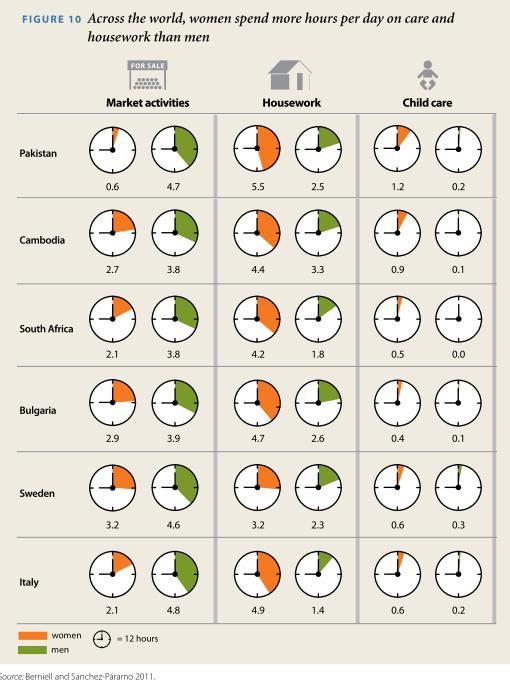 The recently released World Development Report 2012 has been released. This year’s theme is about Gender Equality and Development. I really like the above infographic. Italian women seem to spend a great deal of time on housework, while Pakistani men spend hardly any time on market activities. It’s also quite surprising how consistent the trends are between the genders and across countries.
How regularly do school children eat in Southern Africa?
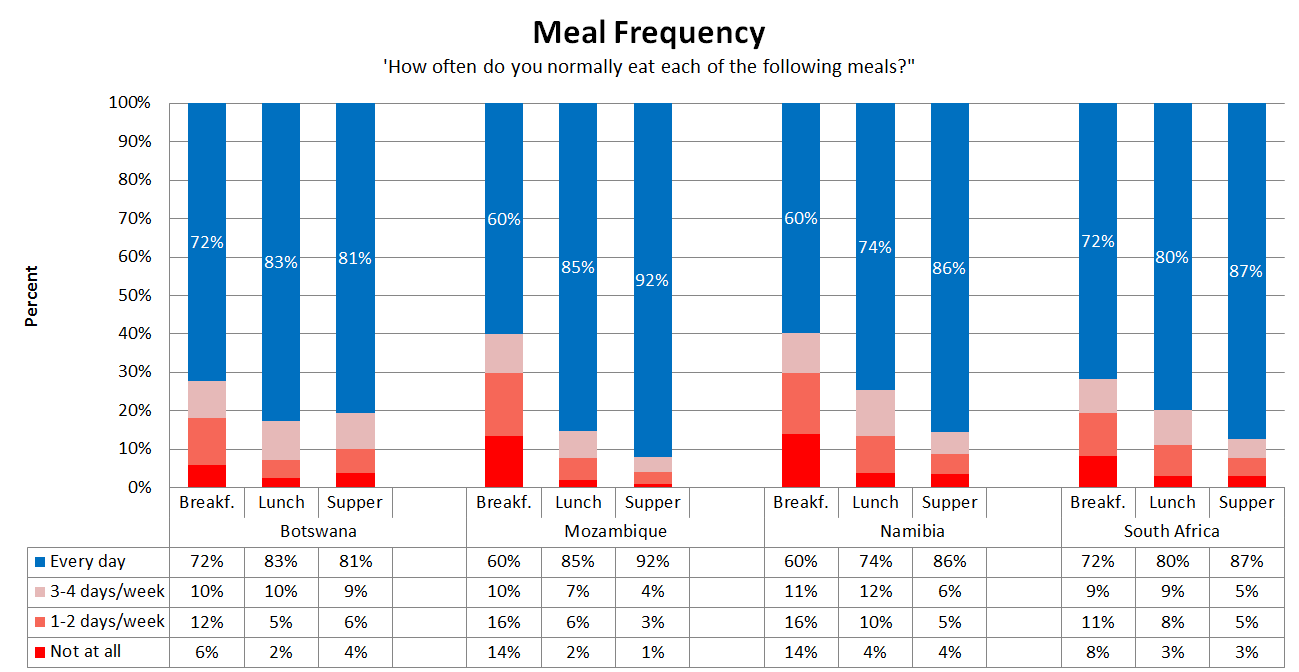
I’m currently working on a paper for SACMEQ which compares the educational performance of Botswana, Mozambique, Namibia and South Africa. I decide to include one or two things on here for those who are interested. The above graph shows the meal frequency of Grade 6 students (approx 13 yrs old) in each of the countries – click to enlarge. One or two observations:
The importance of nutrition for cognitive development has been well established in the literature. Del Rosso (1999, p. 5) provides a concise summary of the impact of poor nutrition:
“Children who lack certain nutrients in their diet (particularly iron and iodine), or who suffer from protein-energy malnutrition, hunger, parasitic infections or other diseases, do not have the same potential for learning as healthy and well-nourished children. Weak health and poor nutrition among school-age children diminish their cognitive development either through physiological changes or by reducing their ability to participate in learning experiences – or both … Children with diminished cognitive abilities and sensory impairments naturally perform less well and are more likely to repeat grades and drop out of school than children who are not impaired; they also enrol in school at a later age, if at all, and finish fewer years of schooling.”
In response to this, and partially as an initiative to alleviate child hunger, many low income countries have implemented school feeding programs, including Botswana and South Africa. Figure 26 below shows the proportion of Grade 6 students that reported receiving at least one free school meal per day. Botswana has the highest proportion (91%), followed by South Africa (78%), Namibia (25.64%), and Mozambique (12.64%). The success of Botswana’s school feeding program is widely acknowledged, and has also been credited with improving school attendance rates in the country (Zuze, 2010, p. 3).
Although free school meals can make up for a lack of nutrition at home, the majority of a child’s nutrition will come from the home-context. The SACMEQ III survey provides a useful measure of meal frequency. One question in the student questionnaire asked “How often do you eat each of the following meals?” (breakfast, lunch and supper), with the four options being ‘every day of the week’, ‘3 or 4 days per week’, ‘1 or 2 days per week’, and ‘not at all’. The results of this question split by country are shown in Figure 27 below. Three observations are worth noting:
1) There is a high proportion Mozambican and Namibian students who do not eat breakfast regularly, if at all. Indeed, 30% of Grade 6 children in Mozambique and Namibia reported that they only at breakfast once or twice a week, or not at all, compared to 19% in South Africa and 18% in Botswana. This can have a detrimental effect on learning. As Del Rosso (1999, p. 5) notes: “Even temporary hunger, common in children who are not fed before going to school, can have an adverse effect on learning. Children who are hungry have more difficulty concentrating and performing complex tasks, even if otherwise well nourished”.
2) 14% of Namibian children reported that they only at lunch once or twice a week, or not at all, compared to 11% for South Africa, 8% for Mozambique, and 7% for Botswana.
3) There is a surprisingly low proportion of Batswana students who reported having supper every day (81%), compared to Namibia (86%), South Africa (87%), and Mozambique (92%).
It is perhaps counter-intuitive that Mozambique should have the highest proportion of students receiving lunch and supper ‘every day’. However, this may be because many Mozambican children do not receive a morning meal and thus their parents are more likely to give them mid-day and evening meals. If this were the case, one might expect Namibia to show a similar trend since it also has a low proportion of students receiving breakfast ‘every day’, yet it does not seem to exhibit such a trend.
Although meal frequency is an important indicator of nutritional intake, it provides no indication of nutritional content. Within our four country sample, it is not unreasonable to assume that there is a positive relationship between nutritional-content of the average meal and GDP per capita. For example, it is more likely that South African children have access to iodized salt and fortified cereals than do their Mozambican counterparts. Therefore, although 92% of Mozambican children report that they receive supper ‘every day’ (compared to 87% of South African children), one should be aware that these meals most probably have differing nutritional content.
These results can be found in this SACMEQ Working Paper
Posted in Education
Go to the places that scare you

“Confess your hidden faults.
Approach what you find repulsive.
Help those you think you cannot help.
Anything you are attached to, let it go.
Go to the places that scare you.”
-Advice from her teacher to the Tibetan Yogini Machik Labdron
in ‘The Places that Scare You” By Pema Chodron
Peace for the wicked?

Alec Motyer on Isaiah
“The rewritten brief of the Servant (49:1-6) arose out of the recognition (48:22) that there is no peace for the wicked. Consequently, there can be no unconditional call into blessing. Wickedness, objectively considered, has been dealt with by the Servant’s death; wickedness subjectively considered, calls for repentance. If we may say that chapter 54 details the objective, God-given benefits of the Servant’s work, chapter 55 answers to its subjectivity in emphasizing the response which brings those benefits into personal experience. There is free entrance into life (1-5) through the moral and spiritual response of turning to God (6-11).
‘…we come to the Lord as we are, but not to stay as we are…’
A real ingredient in the divine happiness

“To please God…to be a real ingredient in the divine happiness…to be loved by God, not merely pitied, but delighted in as an artist delights in his work or a father in a son – it seems impossible, a weight or burden of glory which our thoughts can hardly sustain. But so it is.
C.S. Lewis, ‘The Weight of Glory”
Get Lost in a Library…

“A library is many things. It’s a place to go, to get in out of the rain. It’s a place to go if you want to sit and think. But particularly it is a place where books live, and where you can get in touch with other people, and other thoughts, through books… A library is a good place to go when you feel bewildered or undecided, for there, in a book, you may have your questions answered. Books are good company, in sad times and happy times, for books are people — people who have managed to stay alive by hiding between the covers of a book.” ~ E.B. White
From ‘Letters to the Children of Troy’
Posted in Quotes
‘Nuclear Man’

“From time to time a man enters into your life who, by his appearance, his behavious and his words, intimates in a dramatic way the condition of modern man. Such a man was Peter for me. He came to ask for help, but at the same time he offered a new understanding of my own world! Peter is twenty-six years old. His body is fragile; his face, framed in long blond hair, is thin with a city pallor. His eyes are tender and radiate a longing melancholy. His lips are sensual, and his smile evokes an atmosphere of intimacy. When he shakes hands he breaks through the formal ritual in such a way that you feel his body as really present. When he speaks, his voice assumes tones that ask to be listend to with careful attention.
As we talk, it becomes clear that Peter feels as if the many boundaries that give structure to life are becoming increasingly vague. His life seems a drifting over which he has no control, a life determined by many known and unknown factors in his surroundings. The clear distinction between himself and his milieu is gone and he feels that his ideas and feelings are not really his; rather, they are brought upon him. Sometimes he wonders: “What is fantasy and what is reality?” Often he has the strange feeling that small devils enter his head and create painful and anxious confusion. He also does not know whom he can trust and whom not, what he shall do and what not, why to say “yes” to one and “no” to another. The many distinctions between good and bad, ugly and beautiful, attractive and repulsive, are losing meaning for him. Even to the most bizarre suggestions he says: “Why not? Why not try something I have never tried? “Why not have a new experience, good or bad?”
In the absence of clear boundaries between himself and his milieu, between fantasy and reality, between what to do and what to avoid, it seems that Peter has become a prisoner of the now, caught in the present without meaningful connections with his past or future. When he goes home he feels that he enters a world that has become alien to him. The words his parents use, their questions and concerns, their aspirations and worries, seem to belong to another world, with another language and another mood. When he looks into his future everything becomes one big blur, an impenetrable cloud. He finds no answers to why he lives and where he is heading. Peter is not working hard to reach a goal, he does not look forward to the fulfillment of a great desire, nor does he expect that something great or important is going to happen. He looks into empty space and is sure of only one thing: If there is anything worthwhile in life it must be here and now.
I did not paint this portrait of Peter to show you a picture of a sick man in need of psychiatric help. No, I think Peter’s situation is in many ways typical of the condition of modern men and women. Perhaps Peter needs help, but his experiences and feelings cannot be understood merely in terms of individual psychopathology. They are part of the historical context in which we all live, a context which makes it possible to see in Peter’s life the signs of the times, which we too recognise in our own life experiences, What we see in Peter is a painful expression of the situation of what I call ‘nuclear man.’
…Nuclear man is a man who has lost naive faith in the possibilities of technology and is painfully aware that the same powers that enable man to create new lifestyles carry the potential for self-destruction…
…Only when man feels himself responsible for the future can he have hope or despair, but when he thinks of himself as the passive victim of an extremely complex technological bureaucracy, his motivation falters and he starts drifting from one moment to the next, making life a long row of randomly chained incidents and accidents.
When we wonder why the language of traditional Christianity has lost its liberating power for nuclear man, we have to realize that most Christian preaching is still based on the presupposition that man sees himself as meaningfully integrated with a history in which God came to us in the past, is living under us in the present, and will come to liberate us in the future.
…A preaching and teaching still based on the assumption that man is on his way to a new land filled with promises, and that his creative activities in this world are the first signs of what he will see in the hereafter, cannot find a sounding board in a man whose mind is brooding on the suicidal potentials of his own world…Obviously the level of awareness and visibility is different in different people, but I hope you will recognize in your own experiences and the experiences of your friends some of the traits which are so visible in Peter’s life style. And this recognition might also help you to realize that Christianity is not just challenged to adapt itself to a modern age, but is also challenged to ask itself whether its unarticulated suppositions can still form the basis of its redemptive pretensions.”
– Henri Nouwen ‘The Wounded Healer”
Posted in Christian, Intense, Psychology, Quotes
List of OpenCourseWare educational sites (from UCT)
UCT has recently decided that they will allow students to download course materials from selected OCW sites without the downloads affecting their internet quotas. What a brilliant idea – hopefully Stellenbosch follows suit soon (To this end I’ve sent off a few emails to get the ball rolling). For those of us who are non-UCT students, and those who are new to OCW, the list of OCW sites they provide is auite useful – see “UCT list of main OCW sites” .
Posted in Economics, Ongoing education
‘A Roadmap to a Life that Matters’ – Umair Haque

by Umair Haque
So, are you psyched for the new Harry Potter movie? Like you, your kids, and approximately 99% of humanity, I confess: I too am captivated by the thought of a magical world where diligently memorized incantations can grant thunderous powers beyond the reach of mortals. “Accio, job growth!”
If only it were that easy. In our messy muggle world, there are no magic formulas. So, while many of you have been asking me for a roadmap to prosperity — and I’ve tried to offer a blueprint of a better kind of business — it might be that, despite what late-night infomercials and endless banner ads suggest, there’s probably no framework you can pick up off the shelf, pay a few bucks for, do a little dance around, and (voila!) prosper. The plain fact is that great achievement, deep fulfillment, lasting relationships, or any other aspects of an unquenchably, relentlessly well lived life aren’t formulaically executable or neatly quantifiable. First and foremost, they’re searingly, and deeply personally, meaningful. The inconvenient truth is: you’ll probably have to not just blaze your own trail — you’ll also probably have to plot your own map for own journey.
So while I can’t offer a roadmap, I can try and give you a pen and protractor instead to help you begin to create your own:
Put what, why, and who you love ahead of what, why, and who you don’t, and your roadmap will begin to write itself.
Now, my little principle might cause those with hand-made suits and beancounterly tendencies to leap out of their chairs and hit me with the tarantallegra jinx. But even the cynics might be willing to admit: given a mysteriously non-recovering “recovery” for a global economy perpetually poised on the brink of perma-crisis, the status quo’s out of ideas, out of options, and running out of time.
In an economy dedicated to the pursuit of more, bigger, faster, cheaper, nastier, the greatest hidden cost and unintended consequence is that something vital, enduring, resonant, and animating has gone missing from our lives — and it might just be the biggest thing: meaning in what we do, and why we’re here.
More, bigger, faster, cheaper, nastier has built an economy that might just be in furious pursuit of mediocrity. Five hundred channels and nothing on, corporations whose behavior plunges past merely unethical, or criminal, to sociopathic, big box stores larger than an airplane hangars, billions of dreary, me-too, not-so-great “goods” that fail to inspire, not enough McJobs to go around, financial markets that are more deft at blowing up scarce resources than at allocating them.
So what went wrong with our path to prosperity? I’d suggest: our economy might be in pursuit of mediocrity because too many of us put what, why, and who makes us want to go into a fetal crouch, plug our ears, and bang our foreheads against our knees above, beyond, and before what, why, and who we love.
There’s no magic formula for a life well lived, but my humble suggestion is that the above is probably the polar opposite: a surefire recipe for a life poorly lived, for intellectual, relational, social, ethical, and creative stagnation. Hence, what’s stagnating not just our economy — but our human potential. Too many of us (and some have argued, the best and brightest among us) are trained from birth to be — and rewarded with each bonus to remain — what economists call “rent-seekers,” experts at squabbling over (and winning) the last stale morsels of yesterday’s fading industrial age harvests, the mere mechanics and advocates of wealth extraction, instead of value creators, the architects and master builders, dreamers and doers, theorists and practitioners of the art of great human accomplishment.
Hence, I’d suggest: my tiny principle might not just a disposable epigram, but a diagnosis for dysfunction — and a challenge to all of you. The pursuit of more, bigger, faster, cheaper, nastier too often seems to demand putting what, why, and who we love at the end of the list, the underworld of the inbox, the bottom of the heap. That’s a recipe for stagnation, whether for people, communities, cities, countries, or the globe. But the converse might just hold, too: if nations and corporations want to punch past the glass ceiling of mere opulence, to what I calleudaimonic prosperity — lives that are meaningfully well lived — well, then people might just have to begin by making if not radically, then at least marginally more meaningful choices themselves.
Here’s what my little principle doesn’t mean: immediate, lowest-common-denominator self-gratification. That, for example, since you “love” Jersey Shore, you should spend all day, every day GTLing harder than the last. Sorry,lotus eaters. Instead, what it suggests is that if you “love” GTL that much, then, well, your roadmap might be clear. Whatever the method to your madness, whether inventing a better tanning bed, perfecting a better workout, or devising less water-intensive laundry, the authenticity principle says: don’t just mutely “consume” it — live it. Better it, reimagine it, blow the doors off it, and don’t stop until you’re within shouting distance of the point that it matters to the future of humanity.
The roadmap you need to follow is deeply, resonantly, profoundly, and irrevocably your own — the one that calls to you in every dreary meeting, every missed birthday, and every misplaced-but-not-quite-forgotten dream. It’s the one that leads you to your better self. It says: “Follow my lead. Let’s go somewhere that matters — not just somewhere that glitters.”
From here
A Mighty Fortress is Our God

A Mighty Fortress is our God
-Martin Luther
A mighty fortress is our God, a bulwark never failing;
Our helper He, amid the flood of mortal ills prevailing:
For still our ancient foe, doth seek to work us woe;
His craft and power are great, and, armed with cruel hate,
On earth is not his equal.
Did we in our own strength confide, our striving would be losing;
Were not the right Man on our side, the Man of God’s own choosing:
Dost ask who that may be? Christ Jesus, it is He;
Lord Sabaoth, His Name, from age to age the same,
And He must win the battle.
And though this world, with devils filled, should threaten to undo us,
We will not fear, for God hath willed His truth to triumph through us:
The Prince of Darkness grim, we tremble not for him;
His rage we can endure, for lo, his doom is sure,
One little word shall fell him.
That word above all earthly powers, no thanks to them, abideth;
The Spirit and the gifts are ours through Him Who with us sideth:
Let goods and kindred go, this mortal life also;
The body they may kill: God’s truth abideth still,
His kingdom is forever.
Posted in Christian
World military expenditures – an American perspective!

The biggest military spenders
ON JUNE 8th China’s top military brass confirmed that the country’s first aircraft carrier, a refurbishment of an old Russian carrier, will be ready shortly. Only a handful of nations operate carriers, which are costly to build and maintain. Indeed, Britain has recently decommissioned its sole carrier because of budget pressures. China’s defence spending has risen by nearly 200% since 2001 to reach an estimated $119 billion in 2010—though it has remained fairly constant in terms of its share of GDP. America’s own budget crisis is prompting tough discussions about its defence spending, which, at nearly $700 billion, is bigger than that of the next 17 countries combined.
From The Economist
Posted in Economics, Infographics
Sunday best
 Something that struck me this morning is the hypocrisy in much of the current charismatic church. We ridicule traditional churches who dress up in suits and ties – ‘Sunday best’ – to impress everyone, yet we have our own brand of ‘Sunday best’ – the caricatures of our lives. We paint these wonderful pictures of strength, success and happiness for everyone to see, but whether or not they are true is immaterial. This seemingly small flaw in our churches is so nefarious that we should be repenting ad nauseum. God help us!
I include three things: the first is an excerpt from ‘What’s So Amazing About Grace?’ and the second and third are lyrics from two profound songs:
1-
“A prostitute came to me in wretched straits, homeless, sick, unable to buy food for her two-year old daughter. Through sobs and tears, she told me she had been renting out her daughter – two years old!- to men interested in kinky sex. She made more renting out her daughter for an hour than she could earn on her own in a night. She had to do it, she said, to support her drug habit. I could hardly bear hearing her sordid story. For one thing, it made me legally liable – I’m required to report cases of child abuse. I had no idea what to say to this woman.
At last I asked if she had ever thought of going to a church for help. I will never forget the look of pure, naive shock that crossed her face. “Church!” she creid. “Why would I ever go there? I was already feeling terrible about myself. They’d just make me feel worse.”
*From Phillip Yancey’s excellent book ‘What’s So Amazing About Grace?‘
2-
CASTING CROWNS
“Stained Glass Masquerade”Is there anyone that fails
Is there anyone that falls
Am I the only one in church today feelin’ so smallCause when I take a look around
Everybody seems so strong
I know they’ll soon discover
That I don’t belongSo I tuck it all away, like everything’s okay
If I make them all believe it, maybe I’ll believe it too
So with a painted grin, I play the part again
So everyone will see me the way that I see themAre we happy plastic people
Under shiny plastic steeples
With walls around our weakness
And smiles to hide our pain
But if the invitation’s open
To every heart that has been broken
Maybe then we close the curtain
On our stained glass masqueradeIs there anyone who’s been there
Are there any hands to raise
Am I the only one who’s traded
In the altar for a stageThe performance is convincing
And we know every line by heart
Only when no one is watching
Can we really fall apartBut would it set me free
If I dared to let you see
The truth behind the person
That you imagine me to beWould your arms be open
Or would you walk away
Would the love of Jesus
Be enough to make you stay
3-
Jason Gray – The Golden Boy And The Prodigal Lyrics
There are two sides to every person
Like the two sides of a dime
Heads or tails it depends upon
Who’s watching at the time
Though I hate to say it
Mine is no exception
One part is the prodigal
The other part: deceptionLike the prince and the pauper
Like Jacob and his brother
Each hide a different heart
Each a shadow of the other
Me and my doppelganger
Both share the same blood
One I have hated
The other have I lovedOne of them’s the Golden Boy
The man I’d like to be I show him off in the parades
For all the world to see
The other is much weaker
He stumbles all the time
The source of my embarrassment
He’s the one I try to hideThe Golden boy is made of straw
His finest suit will surely burn
His vice is the virtue
That he never had to earn
The prodigal’s been broken
And emptied at the wishing well
But he’s stronger for the breaking
With a story to tellI’m not easy with confessions
It’s hard to tell the truth
But I have favored the golden boy
While the other I’ve abused
And he takes it like a man
Though he’s longing like a child
To be loved and forgiven
And share the burden for awhileSo take a good look in the mirror
Tell me who you see
The one who Jesus died for
Or the one you’d rather be
Can you find it in your heart
To show mercy to the one
The Father loved so much
That he gave his only son…
Yale jumps on the band-wagon
Yale has jumped on the Open-Course band-wagon, and what a wonderful band-wagon it is! Not only are they adding courses quite frequently, but their courses all contain a full set of downloadable video lectures. Wonderful! Yale’s motto ‘Lux Et Veritas’ (also in Hebrew on the logo) means ‘Light and truth’. Bravo!!
See the various departmental offerings below and the history course that has made its way onto my to-do list!
- Departments
- Astronomy
- Biomedical Engineering
- Chemistry
- Classics
- Ecology and Evolutionary Biology
- Economics
- English
- Environmental Studies
- History
- History of Art
- Italian Language and Literature
- Molecular, Cellular and Developmental Biology
- Music
- Philosophy
- Physics
- Political Science
- Psychology
- Religious Studies
- Sociology
- Spanish and Portuguese
 |
HIST 202 – European Civilization, 1648-1945 Professor John Merriman Fall, 2008This course offers a broad survey of modern European history, from the end of the Thirty Years’ War to the aftermath of World War II. Along with the consideration of major events and figures such as the French Revolution and Napoleon, attention will be paid to the experience of ordinary people in times of upheaval and transition. The period will thus be viewed neither in terms of historical inevitability nor as a procession of great men, but rather through the lens of the complex interrelations between demographic change, political revolution, and cultural development. Textbook accounts will be accompanied by the study of exemplary works of art, literature, and cinema. more >> |
Posted in Economics, Ongoing education
 Nic Spaull