Category Archives: Education

Read on…

The Godfather speaks…Schleicher on PISA 2009

If you have any interest in education and international educational research, watch this video. Andreas Schleicher (director of PISA) presents the PISA 2009 results at a conference. You can download the powerpoint here.

The Emperor has no clothes…

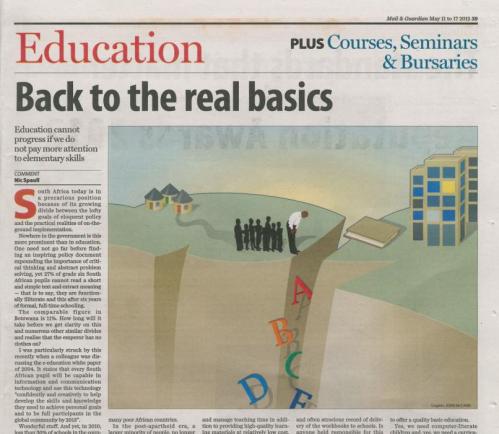
I wrote an article for this week’s Mail & Guardian with the original title “The Emperor has no clothes on” which subsequently got changed to “Back to the real basics” which is perhaps less obscure but far less sexy. Nevertheless I am quite attached to the analogy from Anderson’s fairy tale and I am committed to using it with reference to the SA education system at some point in the future. The article is available on the M&G website here, and in PDF version here. There is also a nice article from The MercuryLack of accountability hitting pupils hard” which quotes some of my research. All in all it was a good week…

Educational intentions of all OECD countries…

Belgium intends to conclude a pact with the providers of education and the trade unions on the teacher career. China seeks to vigorously improve the pre-service education for teachers and expand early childhood education for all children. Denmark wants to make elevating the status of the teaching profession a top national priority and underlines that educational pathways from age 0 to 18 need to strike a careful balance between social and subject-matter skills. Estonia aspires to a comprehensive reform of pre-service, in-service and co-operative professional development, following the model of the most advanced education systems. Finland seeks to develop new collaborative models for school development and teacher education development, a better alignment between curricula goals and educational assessment, and improved pedagogical use of social medial. Germany will bring the German Ministers and union leaders together to move the dialogue among the social partners beyond rhetoric. Hungary seeks to better align and reinforce the context, process, feedback and relationships among key players, aiming for genuine collaboration among stakeholders. Japan will further advance its holistic reform of preparation, recruitment and professional development. Korea wants to strengthen collaboration between school leadership and local communities. The Netherlands will introduce peer reviews for school leaders and teachers as the primary instrument for quality assurance. New Zealand will further develop a systemic approach to making successful practice common practice. Norway intends to work on career paths for teachers that can be combined with distributed and collaborative leadership and focus on how to implement national reforms all the way into the classroom. Poland will place the premium on preparing teachers for 21st century skills. Singapore seeks to further advance its whole system approach to education reform to achieve impact and sustainability. Sweden wants to do more to attract top students into the teaching profession and to create incentives to reward high performing teachers throughout their careers. Switzerland will seek new ways to create careers for teachers and to integrate other professionals into teaching. The United Kingdom seeks to promote an atmosphere and the conditions for teachers to be actively trusted and respected. The United States seeks to build a coherent and systemic process for engaging all actors in comprehensive large scale change, challenging every assumption, big or small. Of course, none of these pronouncements imply a formal commitment on the part of governments or unions, but they underline the intention of Ministers and Union leaders to move the education agenda forward. The 2013 Summit will tell how fast these visions turn into reality.”

-Andreas Schleicher (AKA the grand master of international education) here

Low cost private schools – an alternative view

See excerpt below from Lewin and Little below (NOT Romney)

“Some have argued that low price private schools make a significant contribution to increased access to education by the poor but the evidence for this is often partial and incomplete and fails to demonstrate that such schools generate additional school places rather than provide a choice for those who would otherwise go to government school. It is also clear that those households with little or no cash income are unlikely to be able to afford the costs of the fees necessary to support unsubsidized private schooling…However the analysis shows that it is only households in the top two quintiles of income where the probability of attending private schools begins to increase. Private schools do indeed offer a choice for the relatively wealthy but have little or no impact on the access to education of the poor. The development of private schools has resulted in richer households opting out of the government schools removing the possibility of influential community voices being heard who have a stake in government schooling. It appears that these developments are neither pro-poor nor equitable and that it is clear that the state remains the provider of last resort” (Lewin & Little, 2011: 335).

 This is a very interesting point and one which is not made in the South African press when the topic is discussed (see these articles from EconomistEconomistWorld Bank, and FT). While there have been a number of authors calling for the increase in low cost private schools, less emphasis is made about the research behind these claims. After reading Lewin & Little’s (2011) editorial I am less optimistic about the role of ‘low’ cost private schools in South Africa or, for that matter, most other sub-Saharan African countries. Their argument about the ‘influential community voices’ leaving the public system has many parallels with the fear of ‘white-flight’ during the transition after apartheid. In order to prevent white students (and teachers) fleeing to the private sector when school fees were abolished/equalized, the SA Schools Act made provision for the charging of school fees to supplement government funds. This prescient policy kept many white students and teachers in the public system, which helped to set a bar for appropriate standards of teaching, learning and assessment. It is widely acknowledged that it would have been detrimental if the majority of South Africa’s human capital (teachers) fled to the private sector. We need to think about the unintended consequences of these policies (like low-fee private schools) before jumping on the band-wagon. I’m still undecided about the place of low-fee private schools, but am slightly more skeptical than I was before I read this.
Lewin, K & Little A. 2011. Access to education revisited: Equity, drop out and transitions to secondary school in South Asia and Sub-Saharan Africa. International Journal of Educational Development 31(2011) 333-337

Roundup of Easter…

  • My Masters thesis is now available online. Equity & Efficiency in South African primary schools : a preliminary analysis of SACMEQ III South Africa Although I suspect most people say this, it really is interesting and accessible 🙂
  • Wonderful and insightful article on “The Law’s Majestic Equality” which opens with a quote from Anatole France “The majestic equality of the laws prohibits the rich and the poor alike from sleeping under bridges, begging in the streets and stealing bread” – stimulating read which reminds me of Deuteronomy 1:17 “You shall not be partial in judgement. You shall hear the small and the great alike. You shall not be intimidated by anyone, for the judgement is God’s” Also see Exodus 23:8 and Deuteronomy 16:19. I think I am going to try and include this in my lecture on social policy and inequality.
  • Great Article by Ferial Haffajee on the state of SA’s self-narrative. Attention ANC: We are a serious country with serious potential.
  • Economist article from last year titled “Schooling the whole family: Teaching is improving but slowly. Getting parents involved could speed things up”. So many parallels between Mexico and SA. Many useful ideas in here for discussion and thought-experiments…
  • Jonathan Jansen writes a short article on “Seven costly mistakes” [in SA education since the transition] – mostly just common sense, but people like to listen to him.
  • Charming 2 minute video on organ donation – “Pass it on when you’re done with it” then register to become an organ donor here – it takes 3 minutes and you could drastically improve someone’s quality of life!
  • Innovation in US higher education – the birth of a new Ivy League university “Minerva University” (Economist article) which has as its motto “Critical Wisdom”. We really do need (more ) innovation in higher education across the board.
  • Top ten of urban businesses – sensible futuristic thinking like increasing data use in/by cities and the proliferation of ‘community nodes’ which act as “cafes, wireless work stations, libraries, book stores and micro farmers markets”

Lekker links…

  • Paul Collier reviews Acemoglu & Robinson’s new book “Why Nations Fail”. Very interesting (and firm) prediction about China: “That states need order to prosper is important but no longer controversial. That they need inclusive institutions is, in view of China’s success, wildly controversial. Their argument is that order without inclusive institutions may enable an economy to escape poverty, but will not permit the full ascent to modern prosperity
  • Private schools for the poor – interesting article from the Economist
  • Top 100 best NGO’s – in case you wanted to know…
  • Wisdom from Calvin and Hobbes
  • 50 most influential books of the last 50 years – useful link to have
  • NYT article (22 March) on Cape Town’s racial divide
  • M&G article (23 March) on Stellenbosch University and discrimination.
  • Latest installment (Business Day 19 March) on the Adcorp vs UCT econometricians debate…as well as a detailed response by the UCT guys. You can tell Martin and Andrew had fun writing this with sections titled “Science and Sales”, “Rigor and Rot”, “Openness and obfuscation”, “Models and Moonshine”, and “Errors of differences and indifference to errors” – Adcorp it seems you picked the wrong econometricians to mess with…just saying.
  • Cool music by Ben Howard, the Kongos,

Calvin and Hobbes on the gaping hole in contemporary art’s soul:

Calvin: People always make the mistake of thinking art is created for them. But really, art is a private language for sophisticates to congratulate themselves on their superiority to the rest of the world. As my artist’s statement explains, my work is utterly incomprehensible and is therefore full of deep significance.

N

Some things I’m reading…

    • “When you don’t have resources, you become resourceful.”
    • As the Bible notes, added Schleicher, “Moses arduously led the Jews for 40 years through the desert — just to bring them to the only country in the Middle East that had no oil. But Moses may have gotten it right, after all. Today, Israel has one of the most innovative economies, and its population enjoys a standard of living most of the oil-rich countries in the region are not able to offer.”
  • World Bank’s lead economist for South Africa writes an interesting article on low cost private schools in SA. Intelligent, informed and interesting article asking questions that need to be asked…(also see this FT article on private schools in SA)
  • Equal Education takes Minister of Education to court in an effort to force the Department to establish minimum norms and standards for school infrastructure (MG article). There are many ways to skin a cat – let’s see how this one turns out.
  • Vavi tells teachers to buckle down and change the status quo, albeit in rhetoric of the revolution (can’t we get passed this?)…some interesting stats but not sure what he really wants here.
  • Alain de Botton TED talk A kinder,gentler philosophy of success  “One of the interesting things about success is that we think we know what it means. A lot of the time our ideas about what it would mean to live successfully are not our own. They’re sucked in from other people. And we also suck in messages from everything from the television to advertising to marketing, etcetera. These are hugely powerful forces that define what we want and how we view ourselves. What I want to argue for is not that we should give up on our ideas of success, but that we should make sure that they are our own. We should focus in on our ideas and make sure that we own them, that we’re truly the authors of our own ambitions. Because it’s bad enough not getting what you want, but it’s even worse to have an idea of what it is you want and find out at the end of the journey that it isn’t, in fact, what you wanted all along.”
  • Paul Graham on writing 

Links I liked…

Some more links I liked…
  • Creating a More Equal and Productive Britain” – A lecture by Professor James Heckman. ‘There is hard evidence on soft skills’. Based on a big research project titled “Personality, Psychology and Economics
  • Rethinking School – a Harvard Business Review article about American K-12 education. Explains the importance of good teachers and how Americans should use new technologies and teaching methods in their classrooms. Still wondering about the links with SA and whether technology can be used to leapfrog educational development steps in South Africa – if only…
  • Why is research higher status than teaching? An interesting article by a Canadian economist. The one quip I really liked was the following on peer review:

 “Some might say this is the best way to measure research productivity. After all, how can we, as outsiders, judge the rigor and relevance of research outside our own specialized discipline? Peer review is the sine qua non, the best and only test of research excellence. I have some sympathy for this view – although it must be confessed that, sometimes, peers are idiots.

And in other news…

Interesting education articles in the news…

1. Work on one thing at a time until finished.
2. Start no more new books, add no more new material to “Black Spring.”
3. Don’t be nervous. Work calmly, joyously, recklessly on whatever is in hand.
4. Work according to Program and not according to mood. Stop at the appointed time!
5. When you can’t create you can work.
6. Cement a little every day, rather than add new fertilizers.
7. Keep human! See people, go places, drink if you feel like it.
8. Don’t be a draught-horse! Work with pleasure only.
9. Discard the Program when you feel like it — but go back to it the next day. Concentrate. Narrow down. Exclude.
10. Forget the books you want to write. Think only of the book you are writing.
11. Write first and always. Painting, music, friends, cinema, all these come afterwards.

 From Henry Miller on Writing, his 11 commandments:

Spatial segregation and school quality in South Africa

Fascinating paper – worth a read.

School quality, clustering and government subsidy in post-apartheid South Africa 

Abstract

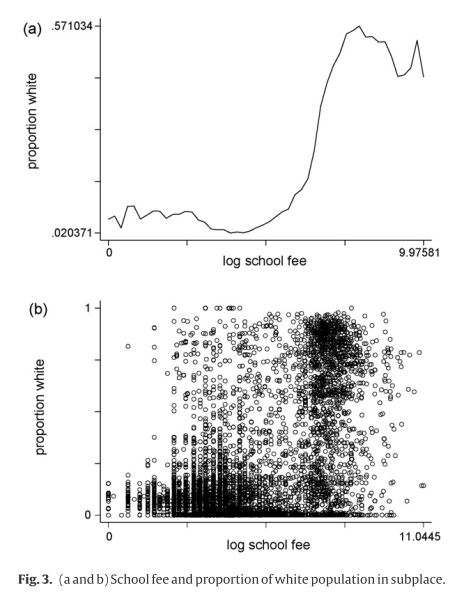
This paper examines a range of historical and geographic factors that determine the quality of public school education in post-apartheid South Africa. Empirical analysis shows, first, that population groups are still spatially segregated due to the legacy of apartheid, which implies that, given the positive correlation between school quality and school fees, quality education is concentrated in formerly white, coloured and Indian schools in areas where the majority is non-African. Second, school quality, measured by the learner–educator ratio, improves as school fee and government subsidy increase. In this sense, school fee can be decreased with an increase in government subsidy to maintain school quality. It is also shown that government subsidy is allocated to schools with lower quality and fees, increasing the number of subsidized teachers. To address the current imbalance, financial support to disadvantaged locales and schools should be strengthened further.

Full paper here

Understanding South African schooling (1992)


How regularly do school children eat in Southern Africa?

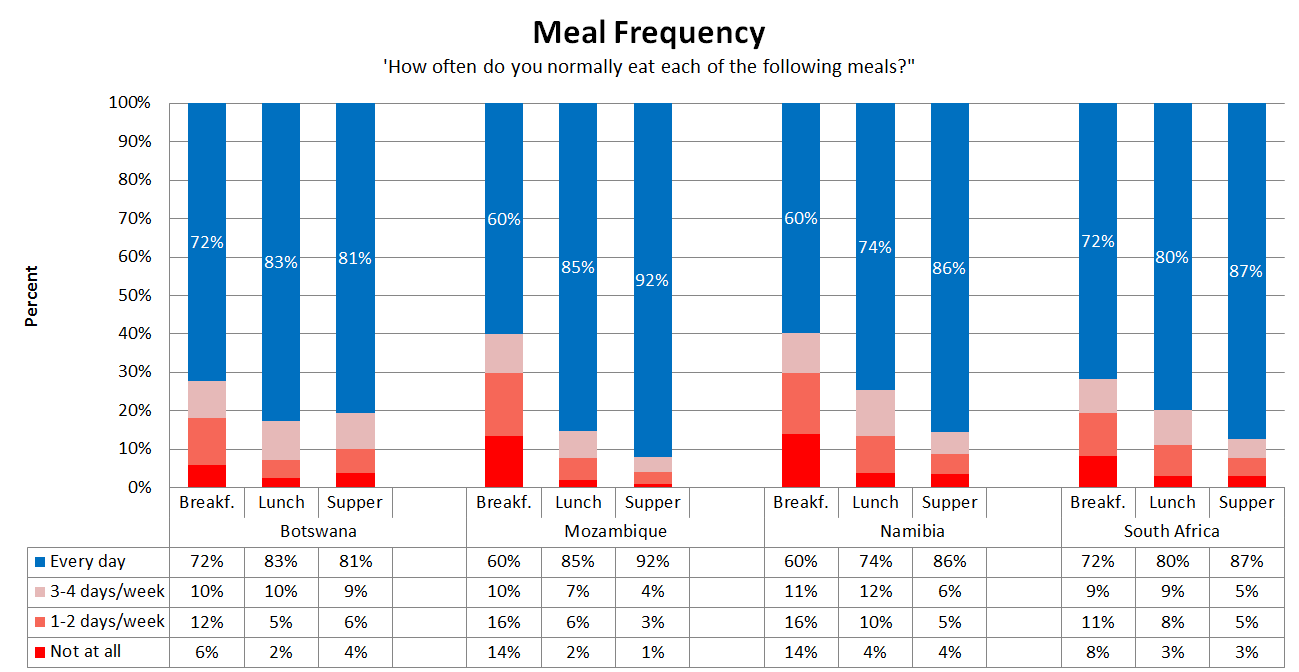
I’m currently working on a paper for SACMEQ which compares the educational performance of Botswana, Mozambique, Namibia and South Africa. I decide to include one or two things on here for those who are interested. The above graph shows the meal frequency of Grade 6 students (approx 13 yrs old) in each of the countries – click to enlarge. One or two observations:

The importance of nutrition for cognitive development has been well established in the literature. Del Rosso (1999, p. 5) provides a concise summary of the impact of poor nutrition:

“Children who lack certain nutrients in their diet (particularly iron and iodine), or who suffer from protein-energy malnutrition, hunger, parasitic infections or other diseases, do not have the same potential for learning as healthy and well-nourished children. Weak health and poor nutrition among school-age children diminish their cognitive development either through physiological changes or by reducing their ability to participate in learning experiences – or both … Children with diminished cognitive abilities and sensory impairments naturally perform less well and are more likely to repeat grades and drop out of school than children who are not impaired; they also enrol in school at a later age, if at all, and finish fewer years of schooling.”

In response to this, and partially as an initiative to alleviate child hunger, many low income countries have implemented school feeding programs, including Botswana and South Africa. Figure 26 below shows the proportion of Grade 6 students that reported receiving at least one free school meal per day. Botswana has the highest proportion (91%), followed by South Africa (78%), Namibia (25.64%), and Mozambique (12.64%). The success of Botswana’s school feeding program is widely acknowledged, and has also been credited with improving school attendance rates in the country (Zuze, 2010, p. 3).

Although free school meals can make up for a lack of nutrition at home, the majority of a child’s nutrition will come from the home-context. The SACMEQ III survey provides a useful measure of meal frequency. One question in the student questionnaire asked “How often do you eat each of the following meals?” (breakfast, lunch and supper), with the four options being ‘every day of the week’, ‘3 or 4 days per week’, ‘1 or 2 days per week’, and ‘not at all’. The results of this question split by country are shown in Figure 27 below.  Three observations are worth noting:

1)      There is a high proportion Mozambican and Namibian students who do not eat breakfast regularly, if at all. Indeed, 30% of Grade 6 children in Mozambique and Namibia reported that they only at breakfast once or twice a week, or not at all, compared to 19% in South Africa and 18% in Botswana. This can have a detrimental effect on learning. As Del Rosso (1999, p. 5) notes: “Even temporary hunger, common in children who are not fed before going to school, can have an adverse effect on learning. Children who are hungry have more difficulty concentrating and performing complex tasks, even if otherwise well nourished”.

2)      14% of Namibian children reported that they only at lunch once or twice a week, or not at all, compared to 11% for South Africa, 8% for Mozambique, and 7% for Botswana.

3)      There is a surprisingly low proportion of Batswana students who reported having supper every day (81%), compared to Namibia (86%), South Africa (87%), and Mozambique (92%).

It is perhaps counter-intuitive that Mozambique should have the highest proportion of students receiving lunch and supper ‘every day’. However, this may be because many Mozambican children do not receive a morning meal and thus their parents are more likely to give them mid-day and evening meals. If this were the case, one might expect Namibia to show a similar trend since it also has a low proportion of students receiving breakfast ‘every day’, yet it does not seem to exhibit such a trend.

Although meal frequency is an important indicator of nutritional intake, it provides no indication of nutritional content. Within our four country sample, it is not unreasonable to assume that there is a positive relationship between nutritional-content of the average meal and GDP per capita. For example, it is more likely that South African children have access to iodized salt and fortified cereals than do their Mozambican counterparts. Therefore, although 92% of Mozambican children report that they receive supper ‘every day’ (compared to 87% of South African children), one should be aware that these meals most probably have differing nutritional content.

These results can be found in this SACMEQ Working Paper