Category Archives: Uncategorized

“Some Children Are More Equal Than Others” [moving documentary on SA Educ]

Screen Shot 2015-02-18 at 11.07.21 AM

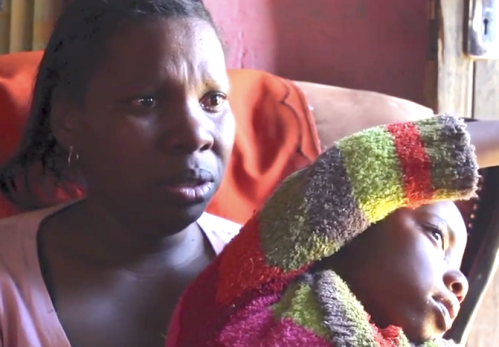
Today Stefan Gottfried released his short documentary on education in South Africa, aptly named “Some Children Are More Equal Than Others.” I came into contact with Stefan last year when he was working with the Legal Resources Centre. It happened to be at the same time I was visiting mud-schools in the Eastern Cape late last year (blog post here). The documentary was produced on a shoestring budget but clearly conveys the tragedy and anguish of hundreds of thousands of parents in South Africa. The motif that runs through much of the documentary is that the low quality of education offered to the majority of South Africa’s children becomes a poverty trap and prevents any form of social mobility. It reminded me of something I wrote 2 years ago:

“While the low-level equilibrium that South Africa finds itself in has its roots in the apartheid regime of institutionalised inequality, this fact does not absolve the current administration from its responsibility to provide a quality education to every South African child. After 19 years of democratic rule most black children continue to receive an education which condemns them to the underclass of South African society, where poverty and unemployment are the norm, not the exception. This substandard education does not develop their capabilities or expand their economic opportunities, but instead denies them dignified employment and undermines their own sense of self- worth. In short, poor school performance in South Africa reinforces social inequality and leads to a situation where children inherit the social station of their parents, irrespective of their motivation or ability. Until such a time as the Department of Basic Education and the ruling administration are willing to seriously address the underlying issues in South African education, at whatever political or economic cost, the existing patterns of underperformance and inequality will remain unabated” (from here).

Although I see the tragic education stats on a daily basis, it really hits home when you see the pain and anguish of black parents who see and understand that education is the route out of poverty for their kids and are trying their hardest to get their children into “good” schools but failing at every turn. Watch the documentary and ask yourself “What can I do to change this tragic, dangerous and deeply unfair situation?”

Curro private school assigns kids to classes based on race. WTF?!

race

It would seem that as far as education is concerned 2015 is not off to a good start. First we had the MEC for education in KZN explaining that her “visions of an ideal education system” include 18th century pseudo-science, namely streaming 6 year old children based on the size and shape of their skulls (phrenology) and the style of their handwriting (graphology). She has subsequently apologized to “everyone who felt offended” but did not retract the statement. Now this week Eyewitness News reports that a private school in Pretoria – Curro Roodeplaat – is assigning children to classes based on race?! They report that a group of 30 parents have signed a petition demanding an explanation from the school and the company. The explanation given by the company (Curro is one of the few for-profit private school chains in the country) was equally dumb-founding.  Curro Holdings’ regional manager Andre Pollard explained their rationale as follows:

“It’s not because we would like to segregate the whites, it’s just because of friends. Children are able to make friends with children of their culture.”

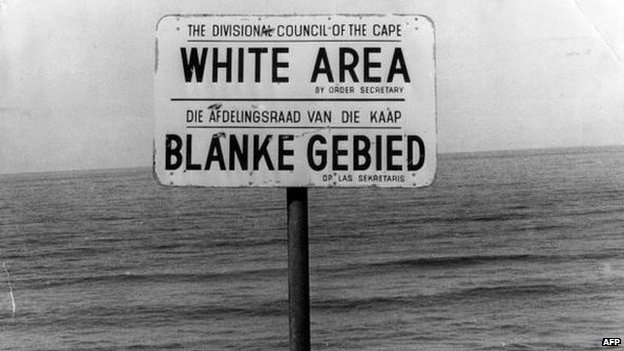
This sounds like a social/friendship-based version of ‘separate development.’ Fifty-two years ago the Bantu Education Act was made into law, segregating children based on the colour of their skin. Still today we are dealing with the aftermath of that one piece of legislation. By conflating education and subjugation it transformed our schools from sites of learning to sites of activism and resistance. It destroyed the culture of teaching and learning and created a lingering fear of education as an instrument of political subjugation.

With a history such as ours how can a school possibly argue that separating children based on race or ‘culture’ is necessary?! The sheer nerve that their regional manager can justify this racial segregation saying that children find it easier to make friends with children of their own culture is astounding and shameful. This is not the first time I have heard about racial discrimination in Pretoria’s Curro schools, but it is the first time I have seen it reported in the media. Currently there are 43 Curro schools across the country raising revenue of over R400 million in 2014. The company recently invested R1,5 billion in expanding their facilities with an aim of reaching 80 schools by 2020.  Only 4% of South African students attend Independent (i.e. non-public) schools but the vast majority of those are not-for-profit schools with about 0,4% attending for-profit schools like Curro.

While we might be tempted to brush this off as an isolated instance at a single Curro school, we need to ask why this behaviour is seen as acceptable by their regional manager? Curro needs to unequivocally condemn these practices and ensure that they are not practiced at any of their other schools. Looking at the speeches and policies at the time of our transition one can clearly see that education was (and is) seen as one of the most promising channels of integration, nation-building and transformation. The actions of this school show utter contempt for the democratic project in South Africa. There are many amazing Independent schools in this country who offer high quality education in a socially inclusive and culturally sensitive way. It would seem that Curro Roodeplaat is not one of them.

Special issue of SA Journal of Early Childhood Education: Call for abstracts

call for abstracts

The relatively new open-access SA Journal of Childhood Education has recently put out a call for abstracts (see below) for their special issue on “Priorities and policy-making in South African Education” (Guest editors: Nick Taylor and Thabo Mabogoane). Given the policy relevance of this special issue, researchers at ReSEP (including myself) will be submitting a number of abstracts for work we are currently doing and intend to do. If you’re doing work in this field I’d encourage you to do the same, it’s likely to be a great issue!

//

Special issue: Call for Papers “Priorities and Policy-making in South African Education”

 Guest editors: Nick Taylor and Thabo Mabogoa

Despite considerable expenditures and efforts to improve performance and reduce inequality, there is limited evidence of substantial improvements in educational outcomes, or the equalisation thereof. Periodic reviews of the evidence have shown a number of recurring themes that are especially characteristic of schooling in South Africa. These include unequal access to socially, emotionally and cognitively stimulating environments (both in the home and at school), insufficient resources, low levels of curriculum coverage, low levels of teacher content knowledge, inadequate support and training opportunities for in-service teachers, challenges associated with learning and teaching in a second language, low levels of accountability and high dropout in upper secondary school (among many others).

While education officials are often aware of these challenges, most policy-makers find it difficult to synthesise this evidence, which is necessary for prioritisation and resource allocation. Making sense from research is particularly challenging  when it is presented in isolation from other problem areas and only speaks to other research within its ‘silo’.  It is now widely acknowledged that if government policies are to have the largest possible impact, they need to be based on rigorous evidence and peer-reviewed research. Furthermore the National Development Plan (the government’s guiding framework) has emphasised the need for the “process of prioritisation and sequencing” if the plan is to be implemented. Such a process of prioritisation and sequencing requires rich, inter-connected evidence on education in South Africa.

Consequently, this call for papers focuses on education research in South Africa that speaks directly to policy-making and prioritisation. Papers that synthesise existing evidence across research areas in education are especially welcome.

Instructions for authors: www.sajce.co.za

Journal administrator: childhooded@uj.ac.za

Online submissions and author registration: www.sajce.co.za

Deadline for abstract submission: 31 March 2015
Deadline for full papers (of accepted abstracts): 30 June 2015
Intended publication date: November 2015

The SAJCE is accredited by the Department of Higher Education and Training and  has applied, through the Academy of Science of South Africa  (ASSAF) for listing  on the open journals platform, ScIELO 

Starting Behind and Staying Behind: Insurmountable learning deficits in mathematics (new Working Paper)

Screen Shot 2014-12-11 at 10.44.44 AM

A Working Paper that I co-wrote with Janeli Kotze was released today on the Stellenbosch Economic Working Paper site (available here). The paper has also been accepted for publication in the International Journal of Educational Development and should be out next year. I will include some excerpts from the paper for those who’d prefer the short version…

Abstract:

This study quantifies a year’s worth of mathematics learning in South Africa (0.3 standard deviations) and uses this measure to develop empirically-calibrated learning trajectories. Two main findings are, (1) only the top 16% of South African Grade 3 children are performing at an appropriate Grade 3 level. (2) The learning gap between the poorest 60% of students and the wealthiest 20% of students is approximately three Grade-levels in Grade 3, growing to four Grade-levels by Grade 9. The paper concludes by arguing that the later in life we attempt to repair early learning deficits in mathematics, the costlier the remediation becomes.

Excerpts:

Few would argue that the state of mathematics education in South Africa is something other than dire. This belief is widespread among academic researchers and those in civil society, and is also strongly supported by a host of local and international assessments of mathematical achievement extending back to at least 1995 (Howie & Hughes, 1998; Reddy, 2006; Fleisch, 2008; Spaull, 2013; Taylor et al., 2013). Many of these studies, and particularly those that focus on mathematics, have identified that students acquire learning deficits early on in their schooling careers and that these backlogs are the root cause of underperformance in later years. They argue that any attempts to raise students’ mathematical proficiency must first address these deficits if they are to be successful (Taylor et al., 2003). The present study adds further evidence to this body of work by using nationally representative data to provide some indication of the true size and scope of these learning deficits.

In South Africa, research in this area has generally focussed on in-depth localized studies of student workbooks and classroom observation (Ensor et al., 2009). For some examples, Carnoy et al. (2012) observe mathematics learning in Grade 6 classrooms from 60 schools in one South African province (North West) and compare these classrooms to 60 schools in neighbouring Botswana. On a smaller scale, Venkat & Naidoo (2012) focus on 10 primary schools in Gauteng and analyse coherence for conceptual learning in a Grade 2 numeracy lesson. Similarly Schollar (2008) conducted interviews and classroom observations as well as analysed a large sample of learner scripts to determine the development (or lack thereof) of mathematical concepts through the Grades.

Where the present research differs from these earlier studies is that it focuses on quantifying national learning deficits in general, rather than in specific learning areas. While the latter are essential for understanding what the problems are and how to fix them, analyses at the national level are also needed if we are to understand the extent and distribution of the problem, both of which are imperative for policy-making purposes. This is only possible by analysing multiple nationally-representative surveys of student achievement, which is the focus of the present study. The two core research questions that animate this study are as follows:

  • How large are learning deficits in South Africa and how are they distributed in the student population?
  • Do learning deficits grow, shrink or remain unchanged as students progress to higher Grades?

To answer these questions we analyse four nationally representative datasets of mathematics achievement, namely: (1) the Systemic Evaluation 2007 (Grade 3), (2) the National School Effectiveness Study 2007/8/9 (Grade 3, 4 and 5), (3) the Southern and Eastern African Consortium for Monitoring Educational Quality (SACMEQ) 2007 (Grade 6), (4) and the Trends in International Mathematics and Science Study (TIMSS) 2011 (Grade 9).

The extant research on mathematics learning in South Africa strongly supports this conclusion with numerous researchers highlighting the inadequate acquisition of basic skills and the consequent negative effects on further learning. Taylor & Vinjevold (1999) summarise the findings from 54 studies[1] commissioned by the President’s Education Initiative and conclude that:

“At all levels investigated by [The President’s Education Initiative], the conceptual knowledge of students is well below that expected at the respective Grades. Furthermore, because students are infrequently required to engage with tasks at any but the most elementary cognitive level, the development of higher order skills is stunted” (Taylor & Vinjevold, 1999, p. 231).

This lack of engagement with higher order content is the prime focus of Reeves and Muller’s (2005) analysis of Opportunity-to-Learn (OTL) and mathematics achievement in South Africa, where OTL is the curriculum actually made available to learners in the classroom. Taylor et al. (2003, p. 129) in their book Getting Schools Working summarise succinctly the debilitating effects of cumulative learning deficits:

“At the end of the Foundation Phase [Grades 1-3], learners have only a rudimentary grasp of the principles of reading and writing … it is very hard for learners to make up this cumulative deficit in later years … particularly in those subjects that … [have] vertical demarcation requirements (especially mathematics and science), the sequence, pacing, progression and coverage requirements of the high school curriculum make it virtually impossible for learners who have been disadvantaged by their early schooling to ‘catch-up’ later sufficiently to do themselves justice at the high school exit level.’

And lastly, Schollar (2008) summarises the findings of the Primary Mathematics Research Project which looked at over 7000 learners from 154 schools in South Africa and concludes as follows:

“Phase I concluded that the fundamental cause of poor learner performance across our education system was a failure to extend the ability of learners from counting to true calculating in their primary schooling. All more complex mathematics depends, in the first instance, on an instinctive understanding of place value within the base-10 number system, combined with an ability to readily perform basic calculations and see numeric relationships … Learners are routinely promoted from one Grade to the next without having mastered the content and foundational competences of preceding Grades, resulting in a large cognitive backlog that progressively inhibits the acquisition of more complex competencies. The consequence is that every class has become, in effect, a ‘multi-Grade’ class in which there is a very large range of learner abilities and this makes it very difficult, or even impossible, to consistently teach to the required assessment standards for any particular Grade. Mathematics, however, is an hierarchical subject in which the development of increasingly complex cognitive abilities at each succeeding level is dependent on the progressive and cumulative mastery of its conceptual frameworks, starting with the absolutely fundamental basics of place value (the base-10 number system) and the four operations (calculation)” (Schollar, 2008, p. 1).

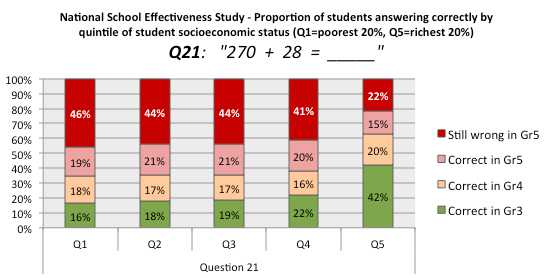
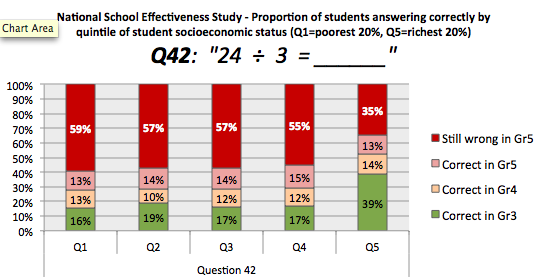
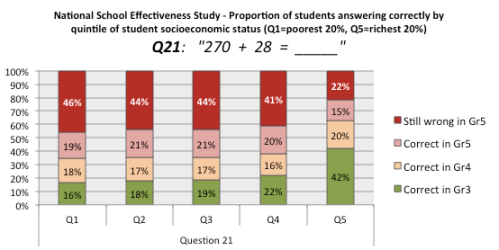
To provide an alternative measure of performance, we provide two examples of no-language items in NSES and show when students answer the question correctly – i.e. in Grade 3, Grade 4, Grade 5 or not by the end of Grade 5. Given that one needs to follow the same students from Grade 3 to 5 we limit the sample here to the panel sample of NSES students (8383 students). Figure 3 below shows a simple question testing two and three digit addition with no carrying. This is within the Grade 3 curriculum which states that students should be able to “perform calculations using the appropriate symbols to solve problems involving addition of whole numbers with at least three digits.” Although this is a Grade 3 level item and contains no language content, only 20% of Quintile 1-4 students could answer this correctly in Grade 3, with the proportion in Quintile 5 being twice as high (42%) but still low. While there is evidently some learning taking place in Grade 4 and 5, more than 40% of Quintile 1-4 children still could not answer this Grade 3 level problem at the end of Grade 5. In Quintile 5 this figure was only 22%.

Figure 3
Screen Shot 2014-12-11 at 11.29.06 AM

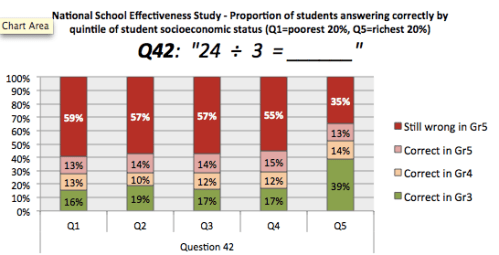
Figure 4 below shows a similar situation where the vast majority of Grade 3 children cannot answer this Grade 3 level problem. While some children learn the skill in Grade 4 or 5, the majority of children still cannot answer this problem at the end of Grade 5, despite it being set at the Grade 3 level.

Figure 4
Screen Shot 2014-12-11 at 11.30.35 AM

 Moving from learning deficits to learning trajectories

While the previous sections have identified the proportion of students that are not operating at a Grade 3 level, they do not provide much guidance in terms of learning trajectories into later Grades. The figures above show that some students are only learning part of the Grade 3 curriculum in either Grade 4 or Grade 5 and that many never seem to acquire these skills. However one cannot say to what extent they are also acquiring Grade 4 level skills in Grade 4 and Grade 5 level skills in Grade 5, although this is unlikely. This is because the NSES test was set at a Grade 3 level with only a small number of questions set at the Grade 4 level. One could use SACMEQ (Grade 6) and TIMSS (Grade 9) as measures of mathematical proficiency at higher levels, but these tests are not calibrated to be comparable to each other, or to earlier tests like the NSES. This is problematic since learning trajectories require data points distributed across the full range of educational phases which are comparable to each other both in terms of the content tested and the difficulty level of the tests. One alternative method to partially overcome the lack of inter-survey comparability is to measure the size of learning deficits in each data set using intra-survey benchmarks.

Applying the above method we calculate the difference in average achievement between Quintiles 1 (poorest 20% of students) and quintile 5 (wealthiest 20% of students) for the different surveys and then convert these into a common standard-deviation metric. The difference between quintiles 1 and 5 is 28 percentage points in NSES Grade 3, 130 SACMEQ points in Grade 6, and 122 TIMSS points in Grade 9. These different metrics are not directly comparable and there is no simple way of equating the scores. Consequently we convert the differences into within-survey standard deviations and then, using the 0.3 standard deviation benchmark as one year of learning, one can say that this difference was equal to 4 Grade-levels in Grade 3[1] (NSES), 4.4 Grade-levels in Grade 6 (SACMEQ) and 4.7 Grade-levels in Grade 9 (TIMSS).

Lewin (2007) provides a useful conceptual model for the trajectory needed to reach a particular goal – in this case matric (Grade 12). He refers to an ‘on-track-line’ and an ‘off-track-line’ where the off-track-line is any line below the on-track-line. In the present example, the on-track-line is calibrated to be equal to the average performance of Quintile 5 students.

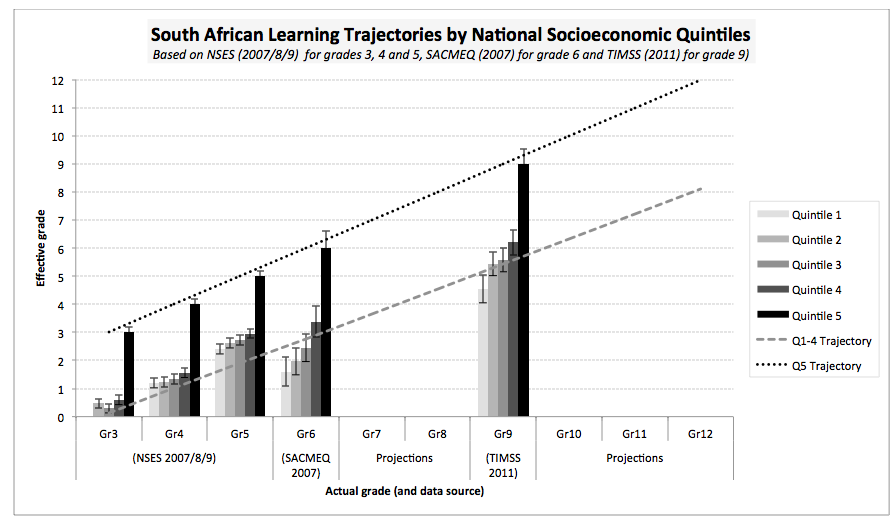
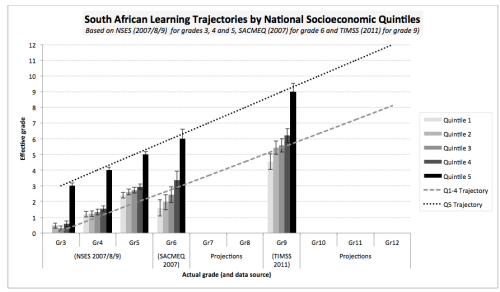
To illustrate the above in a graph, we set the average Quintile 5 achievement to be equal to the Grade-appropriate benchmark such that the learning trajectory of these students are on the “on-track” trajectory and will reach matric (Grade 12) performing at roughly a Grade 12 level. We then calculate the difference between this ‘benchmark performance’ and the average performance of Quintiles 1, 2, 3 and 4 and then convert this difference into Grade-level equivalents using 0.3 standard deviations as equal to one Grade-level of learning. In doing so, we essentially create a learning trajectory spanning from Grade 3 (NSES) to Grade 9 (TIMSS) with linear projections for those Grades where we do not have data (Grade 7, 8, 10, 11 and 12). The exact figures for all calculations are provided in the online appendix. Figure 6 below shows the likely learning trajectories of the average student in each quintile of student socioeconomic status.

Figure 6 shows that the average student in Quintile 1, 2 and 3 is functioning at approximately three Grade-levels lower than the Quintile 5 benchmark in Grades 3, 4, 5 and 6. Observing average performance by quintile in Grade 9 shows that the difference between Quintile 1, 2 and 3 students and Quintile 5 students (the benchmark) has now grown to more than four Grade-levels. If it is assumed that Quintile 5 students in Grade 9 are functioning at roughly a Grade 9 level, then Quintile 1 and 2 students are functioning at roughly a Grade 4.5 level in Grade 9. The trajectory lines, one for Quintile 5 and one for the average of Quintiles 1-4, show that in Grade 3 there already exist large differences in performance (approximately three Grade-levels) and that by the time children enter Grade 9 this gap in performance has grown to about four Grade-levels. The linear trend in performance between these two groups suggests that if the same number of students in Quintiles 1-4 in Grade 9 continued in schooling until Grade 12 (i.e. no drop out between these two periods) they would be functioning at approximately 4.9 Grade levels lower than their Quintile 5 counterparts in Grade 12 (1.5 standard deviations lower).

Figure 6

Screen Shot 2014-12-11 at 10.44.44 AM

Returning to Lewin’s (2007) notion of an “on-track” progress line, perhaps the most important conclusion arising from this conceptual framework is that any performance below the “on-track” line creates an increasing gradient of expectation as the pupil moves into higher grades. This expectation is what is required by the curriculum to reach the goal (passing the grade 12 exam, for example) relative to where the student is at the present. As students’ learning deficits grow, the gradient of what needs to be achieved to reach the goal then progressively steepens to the point where it enters what Lewin (2007, p. 7) refers to as a ‘Zone of Improbable Progress.’ For example, the improvement that is required to bring the average Grade 9 Quintile 1 student in South Africa up to the required benchmark by Grade 12 is unrealistic given that they are performing at roughly a Grade 5 level in Grade 9. By contrast, the gradient of achievement required to bring the average Quintile 1 Grade 3 pupil up to the required benchmark by matric is slightly more manageable. The clear conclusion arising from this analysis is that intervening early to correct and prevent learning deficits is the only sustainable approach to raising average achievement in under-performing schools.

What we would add to this conclusion is that the root cause of these weak educational outcomes is that children are acquiring debilitating learning deficits early on in their schooling careers and that these remain with them as they progress through school. Because they do not master elementary numeracy and literacy skills in the foundation and intermediate phases, they are precluded from further learning and engaging fully with the Grade-appropriate curriculum, in spite of being enrolled in school. Lewin (2007, p. 10) refers to these children as ‘silently excluded’ since they are enrolled and attending school but learning little. Importantly, these children are precluded from further learning, not because of any inherent deficiency in their abilities or aptitudes, but rather because of the systematic and widespread failure of the South African education system to offer these students sustained and meaningful learning opportunities. Indeed, many children from poorer backgrounds have both the ability and the desire to succeed, and when provided with meaningful learning and remediation opportunities, do in fact succeed (see Spaull et al, 2012 for an example).

The clear policy recommendation which proceeds from these findings confirms what is becoming increasingly accepted, that any intervention to improve learning in South Africa needs to intervene as early as possible. Given South Africa’s egregiously high levels of inequality, it should come as no surprise that poor children in South Africa find themselves at a nexus of disadvantage, experiencing a lack of social, emotional and cognitive stimulation in early childhood. These children then enter a primary school system that is unable to equip them with the skills needed to succeed in life, let alone to remediate the large learning deficits they have already accumulated to date.

When faced with limited resources and a choice of where to intervene in the schooling system, the counsel from both the local and international literatures is unequivocal; the earlier the better. The need to focus on the primary Grades, and especially the pre-primary years, is not only driven by the fact that underperformance is so widespread in these phases, but also because remediation is most possible and most cost-effective when children are still young (Heckman, 2000). Due to the cumulative negative effects of learning deficits – particularly for vertically-integrated subjects like mathematics – it is not usually possible to fully remediate pupils if the intervention is too late (i.e. in high school), as too many South African interventions are. Nobel Laureate Professor James Heckman summarises the above succinctly when he explains that:

“Policies that seek to remedy deficits incurred in early years are much more costly than early investments wisely made, and do not restore lost capacities even when large costs are incurred. The later in life we attempt to repair early deficits, the costlier the remediation becomes” (Heckman, 2000, p. 5).

Full paper available here.

Matric markers STILL not tested – my 2014 rant

matric markers pic

Every year for the past four years the department of basic education has tried — unsuccessfully — to implement competency tests for matric markers. Each year the teacher unions derail these well-intentioned plans, with the South African Democratic Teachers’ Union (Sadtu) raising the biggest ruckus.

The department’s logic is flawless: the integrity of the marking and moderation procedures of the National Senior Certificate exam depends crucially on the ability of markers to assess student responses accurately. Furthermore, without directly testing the content knowledge and marking competency of teachers one cannot be sure that the quality of matric markers is such that matric pupils receive the marks they deserve.

Importantly, the tests the department proposes would be conducted in a confidential, dignified and equitable manner that would not undermine the professionalism of applicants.

Sadtu counters that all teachers are equally capable of marking the matric exams and thus there is no need for minimum competency tests for prospective markers. This flies in the face of everything we know about teachers’ content knowledge and the pedagogical skills of large parts of the South African education system.

In a 1999 book, Getting Learning Right, Penny Vinjevold and Nick Taylor summarised the results of 54 studies commissioned by the Joint Education Trust, and wrote: “The most definite point of convergence across the President’s Education Initiative studies is the conclusion that teachers’ poor conceptual knowledge of the subjects they are teaching is a fundamental constraint on the quality of teaching and learning activities, and consequently on the quality of learning outcomes.” By implication this includes their ability to mark complex material accurately.

More recently, a 2011 report [p13] by the Southern and Eastern African Consortium for Monitoring Educational Quality found that only 32% of grade six mathematics teachers in South Africa had desirable levels of mathematics content knowledge, compared with 90% in Kenya and 76% in Zimbabwe.

Similar findings
I could go on and mention the numerous provincial studies that have been conducted in the North West, the Eastern Cape, KwaZulu-Natal and elsewhere that all find the same thing — extremely low levels of teacher content knowledge in the weakest parts of the schooling system — which, crucially, make up the majority of South Africa’s schools.

Given this situation, one wonders how Sadtu can argue that all matric teachers are equally competent to mark the matric exams or that they should not be tested. The union stance is that a system of teacher testing will disadvantage teachers from poor schools who cannot compete with those from wealthier schools. Although it is certainly true that the department has failed to provide meaningful learning opportunities to teachers in these underperforming schools, jeopardising the marks of matric pupils to make this stand is misguided, unethical and potentially even illegal.

These are important but separate issues and should be dealt with in different forums. But it is worth noting that the Western Cape has been testing prospective matric markers in the province since 2011, the only province in the country to do so.

The logic of the unions on this matter is perplexing. On numerous occasions they have rightly argued that teachers in poorer schools have not had meaningful learning opportunities and, therefore, that teachers are unequally prepared to teach, and by implication also unequally prepared to mark. Yet now they are arguing that all matric teachers are equally capable of marking the matric exams? So which is it? You can’t have it both ways. They either are or are not equally competent to mark matric exams. If it is the former, one cannot ensure children will receive the marks they are due; and if it is the latter, then one simply cannot argue that teachers should not be assessed prior to being appointed as markers.

On this question, a colleague of mine asked the following question: “How does the department employ people to teach matric when they are not considered competent to mark?” The uncomfortable answer is that, unfortunately, many matric teachers are neither competent to mark nor to teach — and this is because of no fault of their own. The blame instead falls squarely at the feet of the department, which has not provided them with quality professional development opportunities.

If one looks at the specifics of appointing matric markers, the union objections become even more bizarre. Although all matric teachers are legally allowed to apply to be matric markers, who is appointed and the criteria used for making these appointments are solely at the department’s discretion. Provided that these criteria are aligned with the position and are not discriminatory on such grounds as race, gender and sexual orientation, the department can select whomever it decides is most capable of doing the job.

Selection criteria
Currently the selection criteria relate to qualifications, teaching experience and language proficiency, but — bizarrely — not content knowledge. Given the nature of the work — assessing student responses for grading purposes — it seems only logical that applicants should be able to demonstrate this competency prior to being appointed for possessing it.

Because of the importance of the matric exam’s results for the life chances of individual pupils both in terms of further education opportunities and labour-market prospects, the department should put its foot down and take a stand for the 700 000 or so part-time and full-time students who are writing matric this year: it should insist that the 30 000-odd matric markers be tested prior to appointment.

Pupils, parents and school governing bodies have every reason to be concerned when there is no formal testing process to ensure that the teachers who will mark their all-important matric exams have the competence to do so in a consistent, fair and unbiased manner. Whether or not competency tests for matric markers are implemented has nothing to do with the unions and everything to do with the fairness of the marking and moderation procedures.

In sum, should prospective matric markers be tested prior to appointment? Yes. Is this a union issue? No. Will this be the last we hear of it? Unfortunately not.

The most tragic part of the above article is that I wrote it in November 2013 (published in the M&G here) and yet I can republish it here with one amendment; changing the sentence in the first line “for the past three years” to “for the past four years.” Matric markers are STILL not assessed before they are appointed, despite practically everyone agreeing that they should be tested. The second and third largest teacher unions (NAPTOSA and SAOU) both do not oppose teacher testing) Most notably the Ministerial Task Team report on the NSC (2014) who concluded that “Only the Western Cape selected its markers in 2013 based upon competency tests and was possibly disadvantaged by the strictness of the marking in its final overall results. A multifaceted, urgent and substantial intervention is called for to deal with the significant problems with the marking and the impact of this on the validity and reliability of the results” (Page 150 of the report). Why is it that the Minister can’t do the right thing on an issue that is UNAMBIGUOUSLY clear, rather than caving to SADTU?! This situation is utterly utterly disgraceful.

School visits in the rural Eastern Cape (Nov 2014) – some reflections (Post 1 of 2)

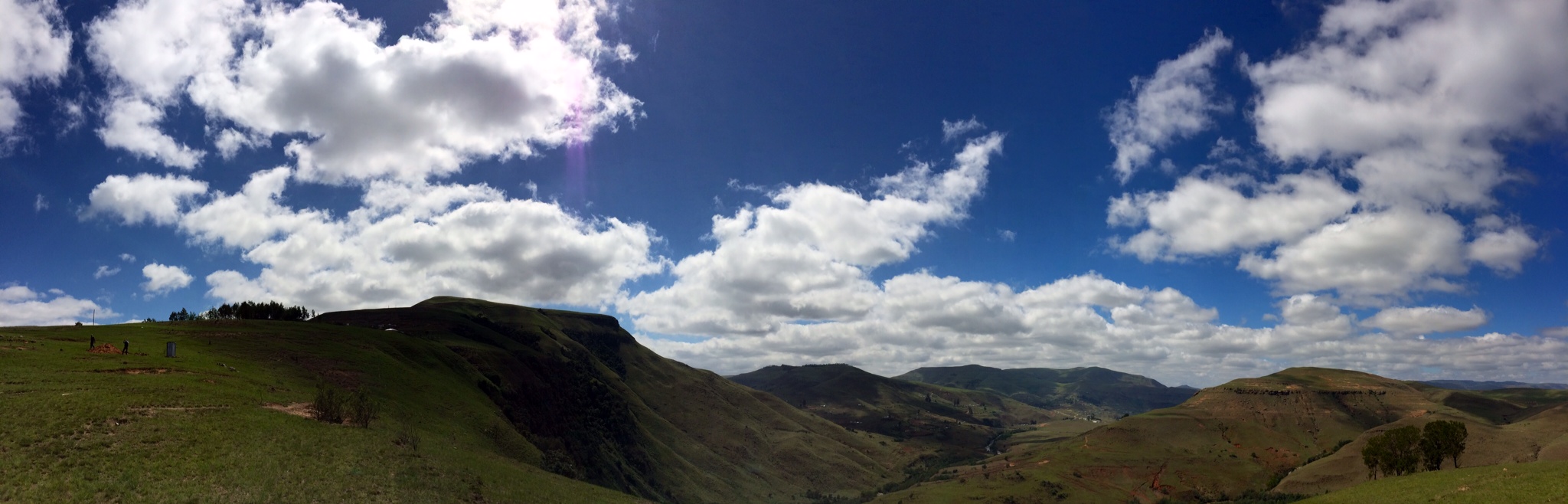
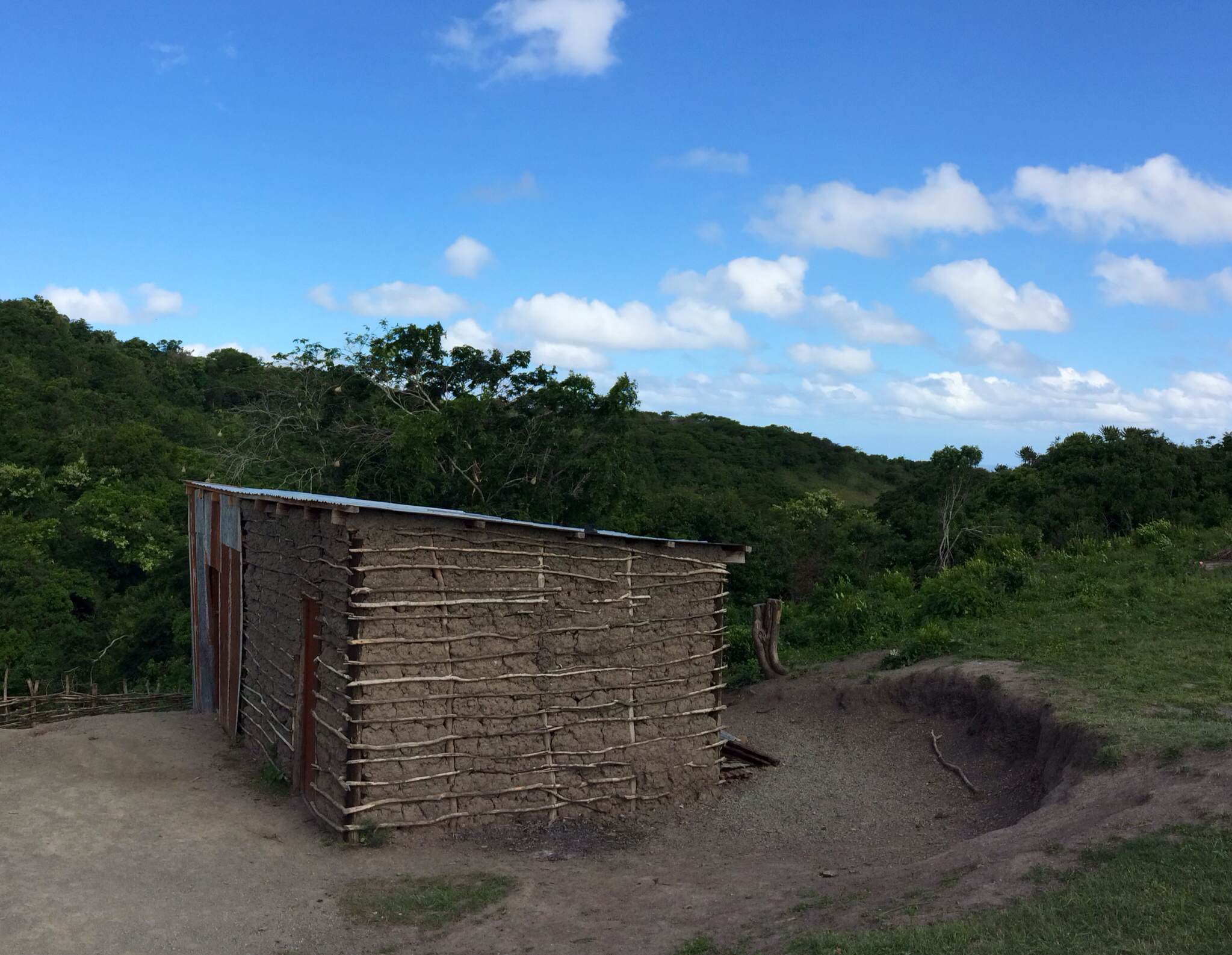
vistaLast week I was fortunate enough to visit 9 primary schools in one of the remotest parts of our country – the rural Eastern Cape. Some of the schools had no toilets, others had no electricity and many were simply falling apart. The trip was planned by the Legal Resources Centre who are visiting 200 schools in the rural Eastern Cape as part of an ongoing court-case around the eradication of mud-schools in the country (see here for an overview of the litigation). (Given that this is an ongoing court-case and to respect the anonymity of teachers and principals I won’t mention the names of the schools in my discussion below). My interest in tagging along was to find out more information about the learning outcomes in these schools, and the views and concerns of teachers and principals. I am increasingly of the opinion that large-scale quantitative research, if not complemented by on-the-ground experience, misses much of the picture and so I wanted to try and understand where things breakdown and why. We often have wonderful policies but disastrous implementation and abysmal outcomes – why is that? Where is the break in the chain and what causes it?

In each school I spoke to the principal and a teacher and looked for evidence of work in the students’ exercise books and workbooks and spoke to some of the students. I would say that a lot of what we found is reiterated in the literature (often countless times) and I’ll include links to that literature as I go through some of what I found…

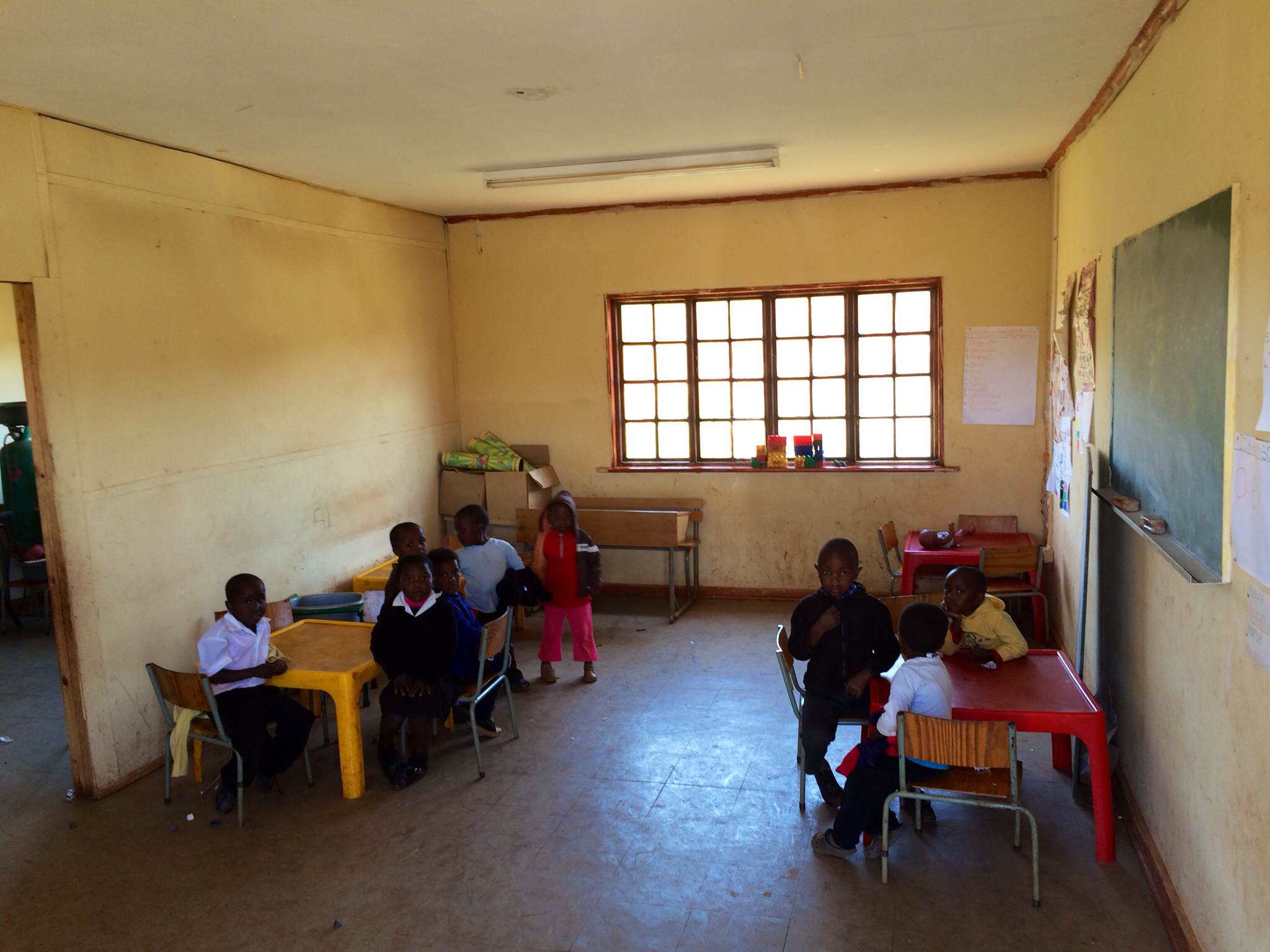
(1) The learning environments in almost all of these nine schools was truly shocking. The picture below shows the classroom environment in one of the schools – the grade 1’s are on the left of the picture and the grade 2’s are on the right. (All the schools we visited were multi-grade schools where one teacher teaches two or three grades, usually in one classroom – the principal is always a teacher as well. This is seen as the only feasible option when learner numbers in an area are very low). This school does not have enough buildings or classrooms and so this classroom also doubles up as the  kitchen and sometimes also as the staff room. The person in the green on the left of the picture was a volunteer who helps make the food for the children. The National School Nutrition Programme (NSNP) provides a hot meal to over 9 million South African students every day – this is one of the major successes of the Department of Basic Education and one for which we should all be proud (see also Kha Rhi Gude – ditto, thanks Veronica McKay!). The problem with the setup at this school, as the principal told us, is that the children stop concentrating as soon as they can smell the food being made – (usually prepared from 9am to be ready before 10am), but this school has no other option – there are no other rooms to use.

multigrade and school feeding

One school we visited overcame this problem by building their own “kitchen” using mud and sticks…

mud kitchen

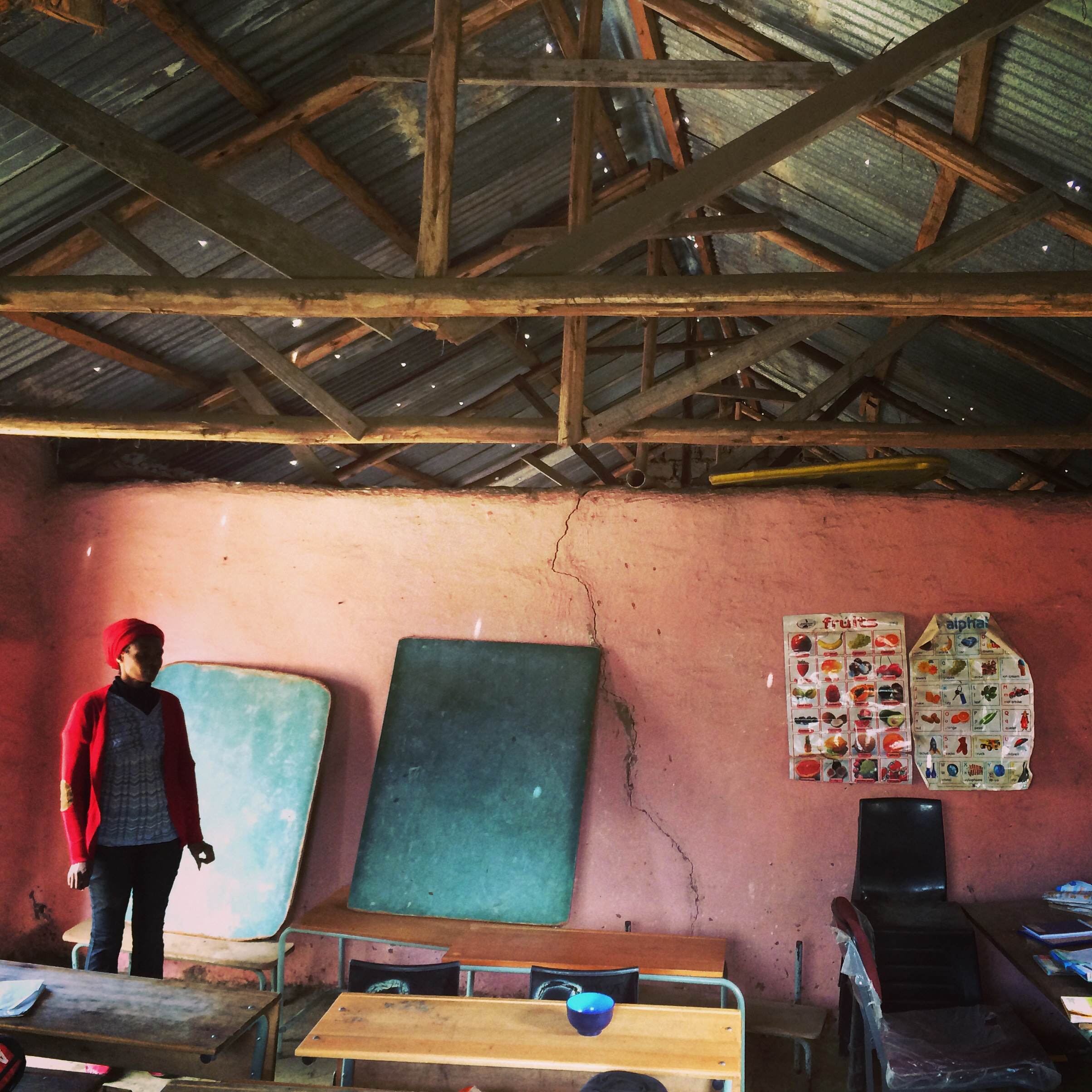
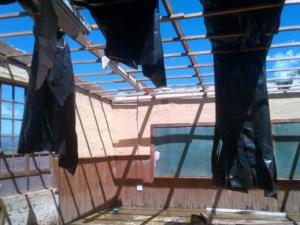
Some of the schools we visited had no toilets whatsoever (“The children use the bush”). This is despite the fact that often the municipality has installed toilets for nearby residents (sometime 150m away) but won’t build any for the school because that is not their mandate! Talk about a lack of government integration/communication. In some schools it is not the lack of space or toilets that was the problem but the inadequate roofing. In this school the tin roof on the one side of the classroom is full of holes. I asked the teacher what she does when it rains and she said, “Oh, then we all sit on this side of the classroom.” She teaches both Grade 1 and Grade 2 in this classroom.

classroom

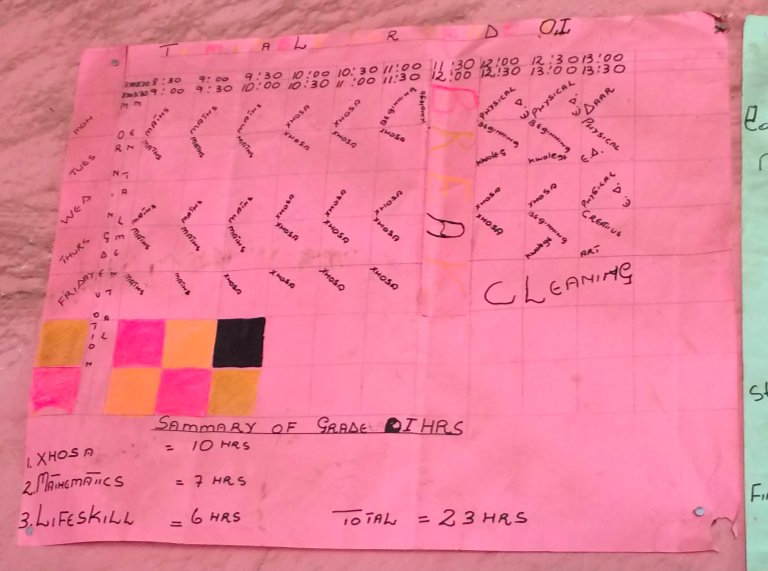
In my discussion with this teacher, I asked her when they start teaching English at the school. According to the curriculum document (CAPS) teachers are required to teach English for  2/3 hours per week in grades 1 and 2 and 3/4 hours in grade 3. The teacher replied and said that she teaches English FAL from Grade 1. However when I was walking around the classroom and came across the timetable for grades 1 and 2 I saw that English did not feature in the timetable. This is problematic. Unless children slowly start increasing their vocabulary and competence in English in grades 1-3, the transition to English as medium-of-instruction in grade 4 is extremely difficult.

Screen Shot 2014-11-27 at 11.23.19 AM

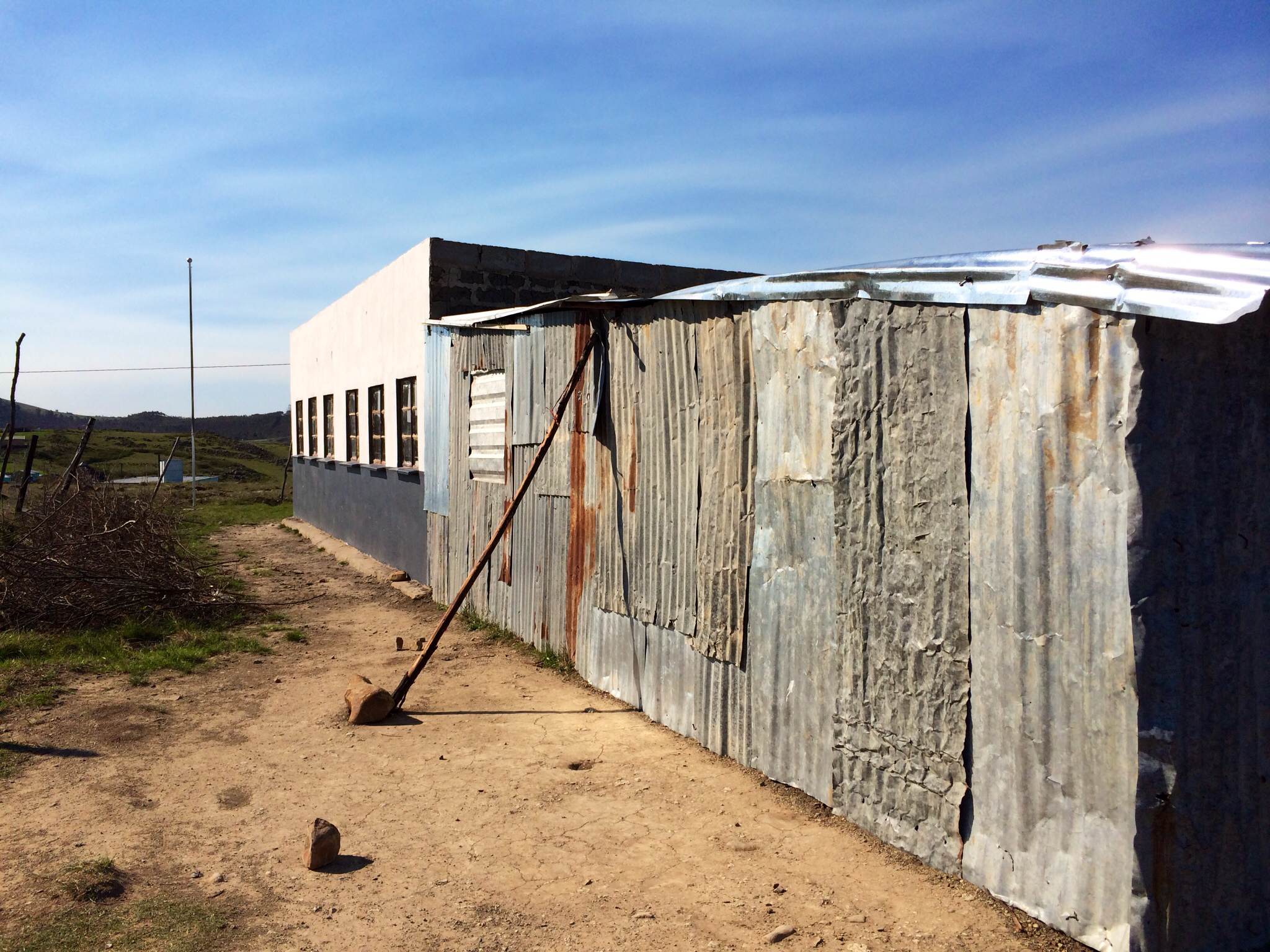
In another school we visited they had built on a tin-classroom extension onto the brick school in order to accommodate the learners. The tragic story behind this school is that it was built by the community because the next closest primary school is across the river in the valley and too many children were drowning trying to cross it to get to school. Unbelievably tragic.

tin classroom 2

tin classroom

(2) There is extremely little learning taking place in these schools.

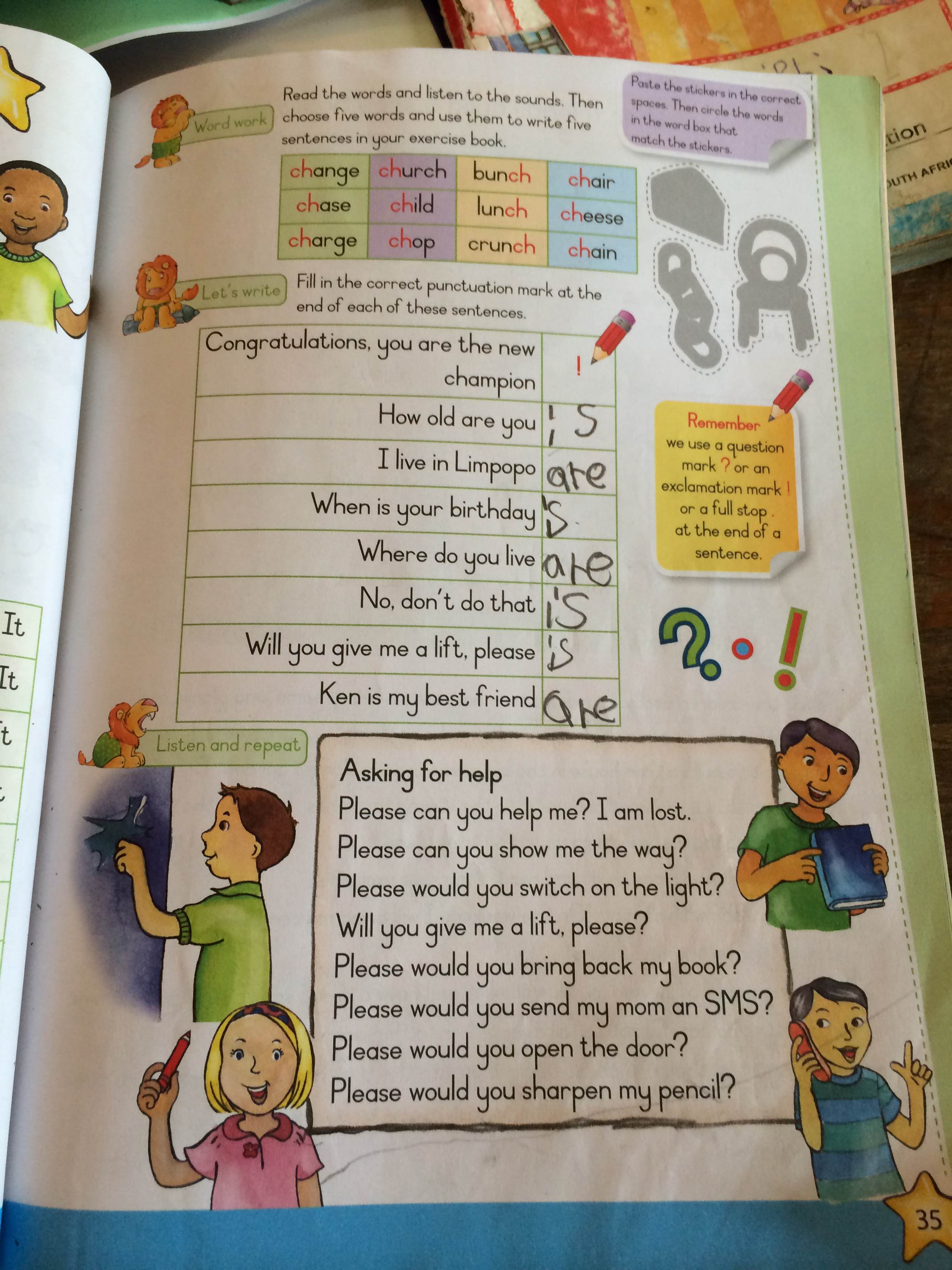
In every school that I went to (except for one) there was very little evidence of learning or work. Paging through a student’s workbook, you will typically find that of the 80 pages in the Term 1/2 workbook, only 15-20 pages will have anything written on them (this despite the fact that we are now in term 4). The pages with the work on them are spread throughout the book so that you will find one or two pages of work and then 10 pages that are blank and then another page of work etc. It’s also not as if these students are working extensively in exercise books – in the exercise books that I looked at you will find one exercise every two weeks (sometimes once a month) and it will be extremely basic. In grade 1 it would be things like drawing a picture and writing a word. However, even when students are working in the workbook, it’s clear that they don’t actually know what they are doing. To provide some examples:

First is first…

first is first

workbook is are

The student below is clearly just writing whatever has been underlined, irrespective of what it means.

reading

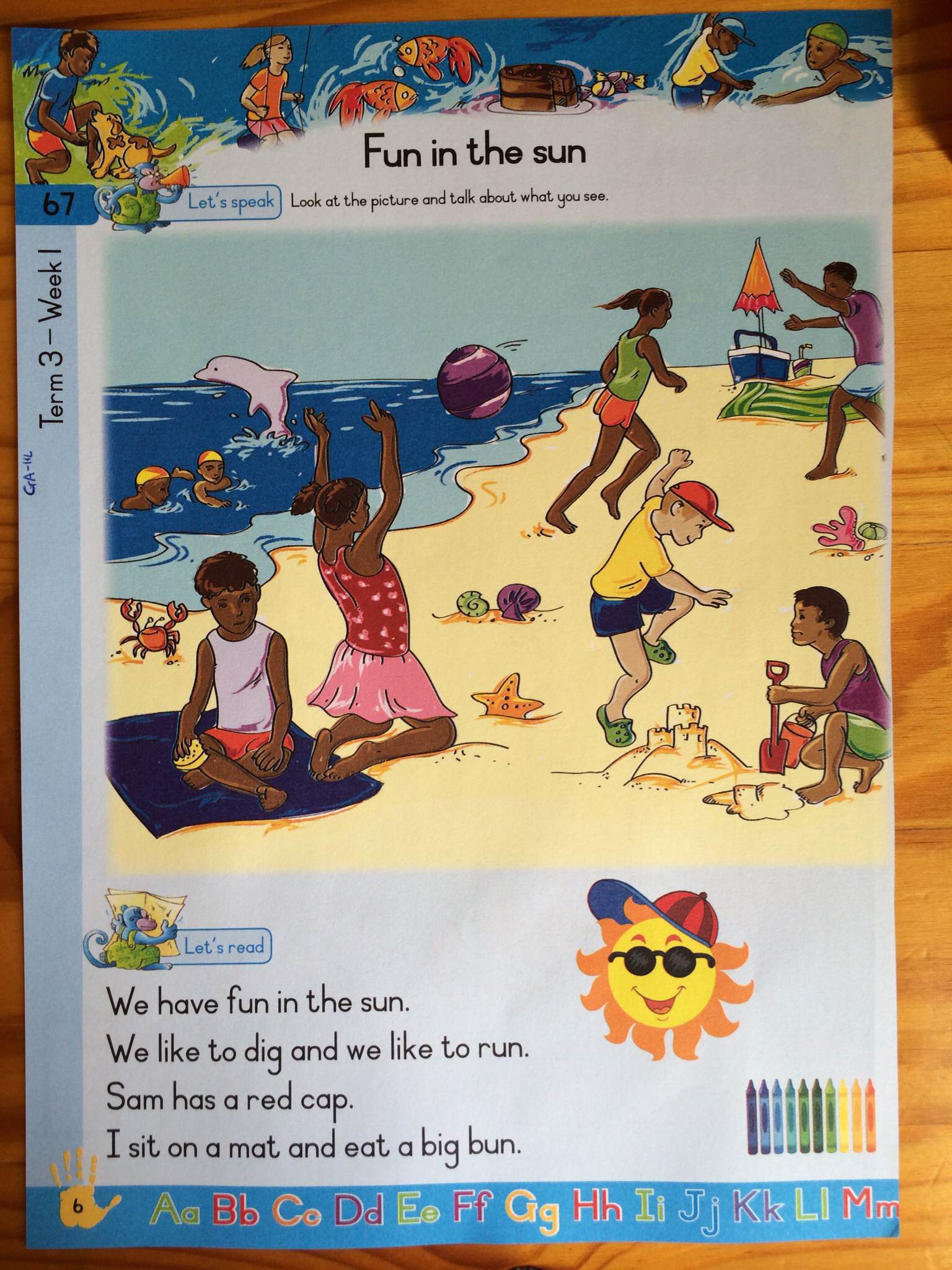
In most of the schools I asked the Foundation Phase teacher if she thought that her Grade 3 students would be able to read this short story in English:

fun in the sun

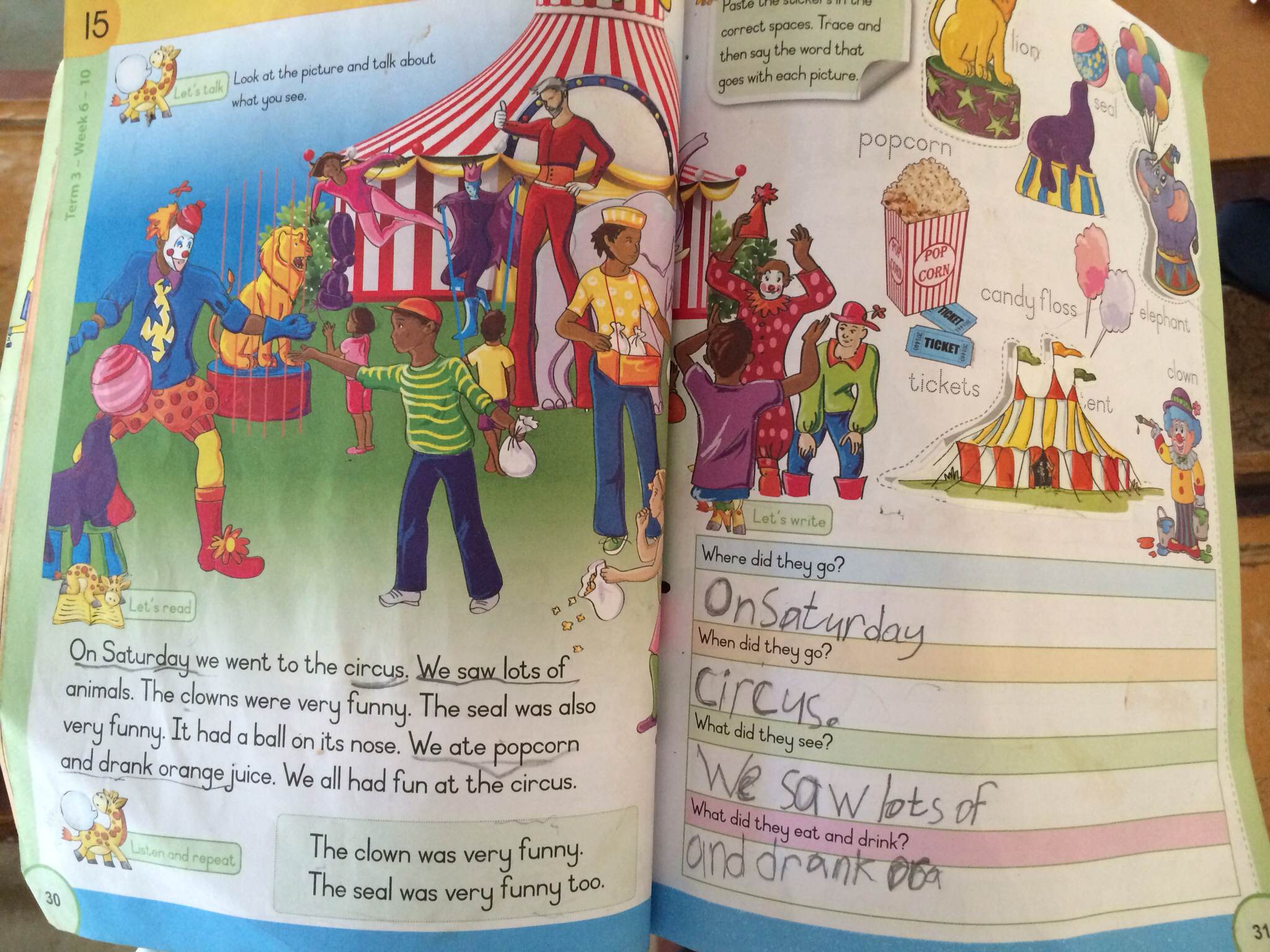
Most of the teachers said that they thought their Grade 3 students would be able to read it. I asked if she could pick one student to read the story with me outside. To get the children relaxed I starting with an extremely elementary text, “The kids read books” (exercise from Gr 1 FAL book) which almost all the children could read. Then they would try and read the “Fun in the Sun” story (exercise from Gr1 HL workbook). Most of the selected children from the 9 schools (likely to be the better performing kids in the class) could read the story aloud in English – sometimes very slowly. However only 1 of the 9 students could answer the question “What colour is Sam’s cap?” and the same student was the only one who could answer the question “What colour is the mat?” Clearly these children are not ‘reading for meaning’ – i.e. they are illiterate. And this is in November 2014. These students will switch to English as medium of instruction in February 2015 when they enter grade 4 (see here for a nationally representative discussion and here for an excellent qualitative study on reading)

(3) Union meetings and departmental meetings are only ever held during school hours. One of the things that I was interested to find out was how often teachers and principals attend departmental meetings/training and union meetings and when these meetings are held. In this case all of the teachers I spoke to were part of SADTU (for a breakdown of SADTU membership by province see here). I asked the principals and teachers the following question “On which day of the week are departmental meetings usually held?” “On which day of the week are union meetings held?” Without any exceptions, all principals and all teachers said that the meetings happened during weekdays (various weekdays Mon-Fri) and during school hours  (usually 9am-1/2pm). There were approximately 4 union meetings a year and 3-4 departmental meetings or training days a year. One principal told me “In 2013 there were 5 workshops. This year we have had three workshops about how to mark the ANAs.” Yet another principal: “We have shut the school 4 or 5 times this year because there was training for the principal and one teacher on the same day and we are only 3 teachers.” This was something that I expected to hear but still found it very frustrating that everyone thought that it was totally OK to have meetings during school time. I think the one that infuriated me most was when someone told us that SADTU had organized a prayer meeting during school time and invited teachers to attend.

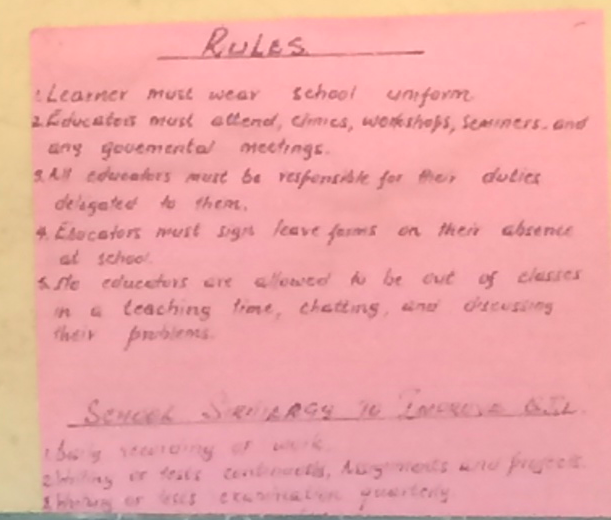
I include below the “Rules” poster that was put up on the wall in one of the schools we visited:

Screen Shot 2014-11-27 at 12.18.32 PM

If you battled to read it it says “(1) Learner must wear school uniform. (2) Educators must attend, clinics, workshops, seminars, and any governmental meetings. (3) All educators must be responsible for their duties delegated to them. (4) Educators must sign leave forms on their absence from school. (5) No educators are allowed to be out of classes in a teaching time, chatting, and discussing their problems.” I reserve the right to comment on this at a later date – there is so much to be said, mainly about priorities.

When I asked one teacher why they did not have the meetings on Saturdays the teacher replied “Because we are not paid to work on Saturdays. Why would we go if we are not paid?” Now I didn’t say this at the time, but that’s actually wrong. As part of teacher’s employment package, they are paid for 80 hours of ongoing professional development  (see page ix of this report). When I asked teachers what they did with the students when they went on training, they said that the other teachers looked after them or they told them not to come to school that day. In one of the schools that we visited the Grade R teacher was at a meeting and so the Grade R class was left unattended (the other two teachers were teaching their own classes). There were no books in the classroom and the students were just keeping themselves busy talking to each other and walking around:

grade r unattended

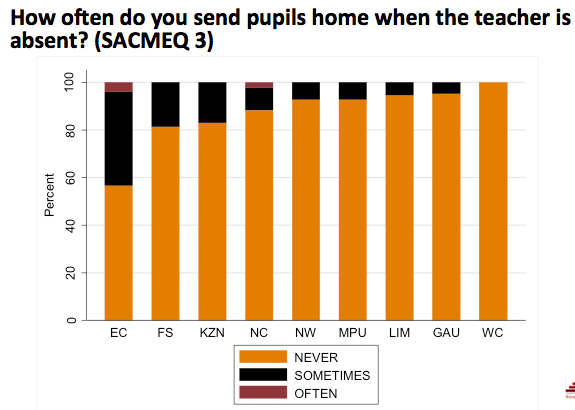
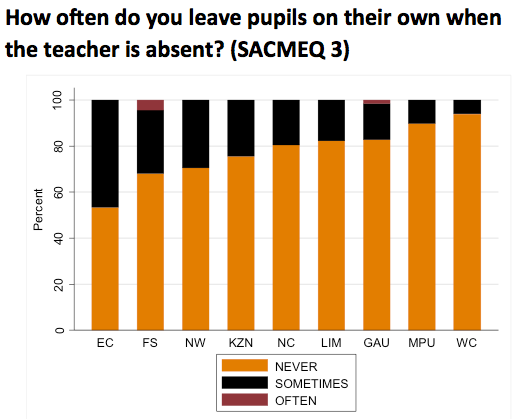
The SACMEQ study of 2007 asked principals a variety of questions about what they did with students when teachers were absent. There were 392 schools included in the study drawn as a nationally representative sample of primary schools in the country (see report here). I include the breakdown of the answers to those questions by province:

Screen Shot 2014-11-27 at 12.07.57 PM

Screen Shot 2014-11-27 at 12.08.29 PM

More than 40% of principals in the Eastern Cape said they they send students home “sometimes” and leave students unattended “sometimes” when a teacher is absent (on any given day about 10-12 % of teachers are absent from school – see 2010 HSRC report here). A number of people working in the field have told me that if you ever want to do teacher training or have meetings it must happen during school hours or else the teachers will not come. Something is seriously rotten in the state of Denmark. However not all principals are as complacent and compliant as these principals. One remarkable principal I spoke to had the following to say about teacher absenteeism: “Each and every week there is a memorial service. We are dying like flies. But you cannot have a teacher away every single week. I cannot.”

(4) Intense union involvement in the appointment of educators, principals and district officials. One of the common threads that came through in many of my discussions was the involvement of the unions – particularly SADTU – in the appointment and promotion of teachers, principals and district officials. This did not come as much of a surprise – there is currently a Ministerial Task Team looking into the sale of teaching posts. The thing I was interested in is how this actually happens. One of the people I spoke to was particularly insightful on this…let me include some excerpts from our conversation:

Nic: “You mentioned that the unions are involved in appointments and promotions, can you tell me how that works?”

X: “When you are selecting a Head of Department (HOD) for the school there are 2 parents from the SGB and 1 teacher, the principal is there but cannot vote. In the rural Eastern Cape many of the parents are not well educated. They know nothing about laws so it is just the principal and the teachers.  SADTU can very easily influence the parents through the teacher. If SADTU does not get the person that they want they will say there was an irregularity in the interview process. I once encouraged the parents to appoint a good mathematics teacher for my school and they did, but they were not SADTU’s choice so they had the teacher removed. They re-advertised the post but without subject specification because there was no SADTU member who had maths or science. I am now stuck with someone who is babysitting mathematics and my results are terrible. My ANAs are very low in mathematics. And you cannot challenge it.” [“Why can’t you challenge SADTU?”] They will go for you. They will accuse you of sexual misconduct and there must be an enquiry. They will accuse you of financial mismanagement. They will go for small things to catch you. You know you need 3 quotations if you buy something and you must write it down so that if you only have two or forgot to write it down, they will catch you. Most principals will make a small mistake. But these are honest mistakes. But they will catch you.”  “The Department is listening and and the union is managing. SADTU does not want to listen, they want to lead and they want to manage.”

Me: “Can you tell me about the appointment of district officials, curriculum advisors etc. do you know anything about how that works?” Response: “Yes, those are also appointed by SADTU. Everyone is looking for posts and if you want a post somewhere, SADTU can make it happen.”

Another principal had recently appointed a new teacher and I asked about the process and he/she said “We get given a list from the district office and pick someone from the list.” [“How were the people on the list selected?”] “We are in a rural area, we don’t know how those people got on the list.”

Unless we can figure out a way to eradicate these illegal practices and prosecute those involved, the Eastern Cape will remain completely dysfunctional. When I hear these stories piling up one on top of the other – always the same tune just in a different key – my blood starts to boil. People playing politics while Rome is burning. No one could possibly come up with any moral or ethical defence for the kinds of corrupt and collusive practices that permeates the entire education bureaucracy in the Eastern Cape (and many other provinces I’m sure). And the most tragic thing of all is that the burden of this cancer falls most heavily on the poorest of the poor, whose children will never receive a basic quality of education and never be able to develop their talents and personalities. They are condemned to unemployment, indignity and hereditary poverty…and so the cycle continues…

//

I intend to write a follow-up post where I discuss the infuriating issue of Nkandla-size mud-school replacements, as well as some of my other observations about the recent trip…

Further reading:

“Every child must read” – my M&G article

reading

(The article below appeared in the Mail & Guardian on the 21st of November 2014 – available on the M&G website here).

If you’re reading this sentence it means that somewhere, somehow, you learnt to read. Bravo! You acquired the magical skill of translating scribbles into language and making meaning from the print symbols on the pages and screens that permeate our lives.

It really is quite remarkable that a few scrawls on a page can make us weep with joy or seethe with rage as we engage with the heroes, villains and ideas of bygone or future eras. Imagine what your life would be like if you could not read. Imagine what school would have been like if you couldn’t read.

And yet, unfortunately, this is not an imaginary experience for thousands of South African children. It is their daily, lived experience. Constantly struggling to understand the words on a page, let alone deciphering the deeper meaning behind these funny dots and dashes. And this is not their fault.

The human brain is hard-wired to acquire language and almost all children can learn to read in just a few years if provided with the right teaching, resources and encouragement. However, many South African children do not attend schools where these necessary conditions are present. A number of South African studies have revealed that children who cannot read and write properly by grade four end up playing catch-up for the rest of their school days. These children never quite grasp what is expected from them, even as they are told they are failing and must try harder.

Let me explain some of the recent research findings on this very important topic.
In 2011 South Africa participated in an international study called PrePirls (pre-progress in international reading literacy study), which is aimed at assessing the reading ability of grade four children. The study examined a nationally representative sample of 341 primary schools drawn from across the country.

The reason for choosing to assess grade four is not arbitrary, but rooted in an understanding of when and how children learn to read.  The first three years of schooling are regarded as the “learning to read” phase, when children acquire the ability to decode text and convert print symbols into language.  In grade four they enter the “reading to learn” phase as they start acquiring new information through the skill of reading.

Children who cannot read properly by grade four are severely disadvantaged, because they cannot read fluently or read for meaning, and therefore don’t benefit much from higher grades. This places them in perpetual catch-up mode until they begin to approach matric and drop out of school in grades 10 and 11, as 50% of South African students do. Unfortunately the results of PrePirls are truly sobering.

If one looks at the reading achievement of these schools and splits the 341 schools into the better performing half (169 schools) and the worse performing half (172 schools) of the sample, the results speak for themselves. In the top half of schools, 10% of students were completely illiterate. That is to say that they could not locate and retrieve an explicitly stated detail in a short and simple text. These children cannot read at all.

In the bottom half of schools, an unbelievable 51% of students were completely illiterate! After four years of formal, full-time schooling, every second child in these 172 schools was completely illiterate. These 172 schools are statistically representative of half of South African primary schools. (These tests were done in the language that they had been learning in during grades one to three — an African language for most children, before switching to English in grade four).

These children who don’t learn how to read properly are then promoted to the next grade, but never manage to get their heads above water for the rest of their school days.

What to do?

Firstly we have to get the basics right in the Foundation Phase (grade one to three). We need a national reading campaign where all stakeholders (parents, teachers, principals, government officials, the minister, the president) all rally behind this goal: “Every child must read and write by the end of grade three.”

This is the very same goal that Brazil used as the core goal for primary schooling — with much success. One prominent South African researcher, Elizabeth Pretorius, has identified four necessary criteria to ensure all children learn to read:

(1) Teachers need to understand when and how children acquire reading and comprehension skills, as well as understand how to teach reading;

(2) Children need easy access to interesting books in their own language and in English;

(3) Children need to be constantly motivated to read, with reading seen as a pleasurable activity by students and teachers, and

(4) Children need to be given plenty of opportunities to read in and outside of the classroom.

Sadly there is currently no systematic evidence about which of the many interventions currently being implemented in South Africa actually work, and if they do work, which is best. It is of fundamental importance that a national reading strategy be based on scientific evidence regarding what most improves the acquisition of reading in South African schools.

If we do not get reading right in grades one to three, any intervention later in the system will only have a small impact on learning, and consequently the life chances of the poor.  The later in life we attempt to repair early learning deficits, the costlier the remediation becomes. We simply must ensure that every child timeously acquires that magical skill of translating scribbles into language. Our education system depends on it.
//

For an excellent (and much more detailed) article on reading see Elizabeth Pretorius’ original article here

The best SA research article I’ve read this year

dsc_1831

This article by Elizabeth Pretorius (UNISA) is easily one of the best academic articles I’ve read this year! I would strongly recommend that anyone interested in (1) reading/literacy, (2) the education crisis in SA, or (3) how to get out of the mess we are currently in, should read this article!

Pretorius, E. 2014. Supporting transition or playing catch-up in Grade 4? Implications for standards in education and training. Perspectives in Education. 32 (1), pp 51-76.

ABSTRACT

This paper describes an intervention programme that was originally intended to support transition to English as language of learning and teaching (LoLT) in Grade 4 in a township school, using a pre- and post-test design. Because the pre-tests revealed very poor literacy levels in both Zulu home language and English, the intervention programme was modified in an attempt to fast-track the learners to literacy levels more appropriate to their grade. This paper outlines the intervention, presents the pre- and post-test results of the English literacy assessments, reflects on the effects of the intervention, and briefly considers some of the reasons for the initial poor literacy performance. Finally, a model for literacy development in high-poverty contexts is proposed to minimise the need to play catch-up in the Intermediate Phase.

JPAL Executive Education Course (on RCT evaluations)

CEI-Conversations-with-J-PAL
After submitting my PhD a few weeks ago I am slowly getting back into the swing of things. That includes blogging and the Q&A series. But for now I thought I would pass on this advert for JPAL’s latest Executive Education Course. JPAL is a great organization and I would highly recommend this course to those professionals who wants to get a better understanding of how randomised control trails work.
//
J-PAL Africa Executive Education Course
Location: School of Economics, University of Cape Town
Course Dates: 19-23 January 2015
Application Deadline: 4 November 2014
 
We are pleased to invite you to apply to the upcoming J-PAL Executive Education course in Evaluating Social Programmes, which will provide you with a thorough understanding of randomised evaluations. Our Executive Education courses are valued by people from a variety of backgrounds: managers and researchers from international development organizations, governments, as well as trained economists looking to retool. If you have colleagues or friends who may be interested in applying to this course, we encourage you to pass this invitation on to them as well.
 
The course is a 5-day, full-time course and will run from the 19 – 23 January 2015 at the University of Cape Town in South Africa. The purpose of the course is to provide participants with a thorough understanding of why and how to use randomisation in an impact evaluation and to provide pragmatic step-by-step training for conducting their own randomised evaluation. J-PAL affiliates with extensive experience in using randomised impact evaluations to test the effectiveness of social programmes, in Africa and globally, will teach the course.
 
You may view more information about the course content and fees here. You can also access the course applications through that website, or by following this link here. The deadline for applications is 4 November 2014. We receive far more applications to the course than we can accommodate, and we encourage applicants to apply early. We will notify participants of whether their application has been accepted by November 7th, after which payment of the course fee (see course fees here) will need to be made by 2 December, before a place on the course can be confirmed.  Once acceptance is confirmed, participants are responsible for making their own travel and accommodation arrangements.
 
We hope to receive your application for the course soon. Do let us know if you have questions about the course. 
 
Warm regards,
Laura Poswell
J-PAL Africa Executive Director

Big Brother is watching (Links I liked)

obama-big-brother-is-watching-you_1637245851

  • Earth meet Big Brother, Big Brother – Earth. WIRED’s latest article on Edward Snowden is profoundly shocking. The NSA has the potential to track “everyone” in a city using the MAC address from cellphones, it “accidentally” sunk the Internet in Syria while trying to spy on Syrian civilians, and frequently passes unredacted data on to Israel about Palestinian American citizens. WTF.
  • The non-monetary benefits of learning may be difficult to measure, but they shape and determine what we recognize to be the quality of our life” – from “Why academic achievement matters (via Harry Patrinos).
  • After watching the trailer to Boyhood I’ve fallen in love with this song by Family of the Year.
  • Henry Miller on friendship – worth reading (thanks Clint Clark)
  • Next year’s IEA conference is happening in Cape Town (22-23 June 2015). For those who are doing work on IEA data (PIRLS/TIMSS) the deadline for submission is 1 December 2014.
  • The Free State Department of Basic Education is clearly trying to game the ANAs – see this article. We really need to be thinking about the potential unintended consequences of the ANAs. I think the ANAs are a positive development in the SA education system, but we need to be paying closer attention to the potential unintended consequences of the ANAs and how we can minimize these unintended consequences. For one thing, the ANAs are not ready to be used as an accurate indicator of student or school performance across the grades or over time. 
  • In case you were wondering what your skin looks like with and without sunscreen, see here. *will never not wear sunscreen again, or use double negatives*
  • The impact of national and international assessment programmes on education policy, particularly policies regarding resource allocation and teaching and learning practices in developing countries” – Systematic review of the evidence by ACER 2014

There’s STILL madness in WEF rankings

wef

I don’t usually repost articles that I’ve written in the past but given that the World Economic Forum has recently released it’s 2014/15 Global Competitiveness report I thought it makes sense. The article below first appeared in the M&G on the 13th of June. If you’re part of the media and want to quote me on something RE the 2014/15 rankings you can use any of the following:

  • “These results are completely and utterly preposterous. Of course South Africa’s education system is in crisis and performing worse than other middle-income (and some low-income) countries) but it definitely isn’t the worst in the world.”
  • “The methods used to calculate these education rankings are subjective, unscientific, unreliable and lack any form of technical credibility or cross-national comparability.”
  • “The mistakes in the WEF’s methodology are so egregious that one needs only look at the list of countries and their respective rankings to appreciate how ridiculous they really are – failed states rank above modernising middle-income countries. How on earth do Japan and Cote d’Ivoire have the same ranking for the quality of their maths and science instruction? This is not science, this is an unscientific opinion survey”
  • “The WEF has seriously undermined its own technical credibility by reporting these ridiculous education rankings. Until it rectifies its methodology, no one should take the rankings seriously.”

//

In the past two weeks the South African media has had a field day lamenting the state of maths and science education in the country. This is because the World Economic Forum (WEF) recently ranked South Africa 148th (out of 148 countries) on the quality of its maths and science education.

Let me cut to the chase and say, unequivocally, that the methods used to calculate these education rankings are subjective, unscientific, unreliable and lack any form of technical credibility or cross-national comparability. I am not disputing that South Africa’s schooling system is currently in crisis (it is), or that South Africa performs extremely weakly relative to other low- and middle-income countries (it does). What I am disputing is that these “rankings” should be taken seriously by anyone or used as evidence of deterioration (they shouldn’t).

The mistakes in the WEF’s methodology are so egregious that one needs only look at the list of countries and their respective rankings to appreciate how ridiculous they really are. How is it possible that the quality of maths and science education in failed states such as Chad (ranked 127th on the WEF list), Liberia (125th) and Haiti (120th) is better than modernising middle-income countries such as Brazil (136th) and Mexico (131st)? How do countries such as Madagascar (82nd) and Zambia (76th) outrank countries such as Israel (78th), Spain (88th) and Turkey (101st)?

Preposterous
Although these preposterous rankings sound like an April Fool’s joke gone wrong, they are reported without qualm on page 287 of the WEF Information Technology Report 2014. Even a cursory analysis of the faulty ranking methodology the WEF employed shows how it is possible to arrive at these outlandish “rankings.” The WEF asked between 30 and 100 business executives in each country to answer questions (relating only to their own country), using a scale of one to seven to record their perceptions, with one representing the worst possible situation and seven the best possible situation.

The question relating to maths and science education was phrased as follows: “In your country, how would you assess the quality of maths and science education in schools?” with “one” being “extremely poor – among the worst in the world”, and “seven” being “excellent – among the best in the world”.

In South Africa, 47 business executives were surveyed for these rankings. On the question relating to maths and science, the average score among these 47 executives was 1.9, indicating that the vast majority of these South African business executives believed that the quality of maths and science education in the country was “among the worst in the world.” Yet this is really just a measure of the perceptions of these 47 businessmen, as the department of basic education has correctly pointed out.

By contrast, when the 55 Malawian and 85 Zambian business executives were surveyed, they were more optimistic about the maths and science education provided to students in their countries, yielding average scores of 3.2 and four respectively.

Outperform
This explains why Malawi ranks 113th and Zambia ranks 76th whereas South Africa ranks 148th. Yet we know from objective cross-national standardised testing in the region that Zambia and Malawi are two of the few countries that South Africa actually does outperform.

Clearly the ratings given by these business executives are subjective and dependent on their particular mental reference points, which obviously differ by country. These 47 South African executives were not asked to rank South Africa relative to other specific countries – such as Madagascar, Malawi or Mali – only relative to “the world”.

Although the perceptions of business executives are important in their own right, it is ludicrous to use these within-country perceptions to rank “the quality of maths and science education” between countries; particularly when we have objectively verifiable, cross-nationally comparable scientific evidence for maths and science performance for at least 113 countries.

Looking at South Africa specifically, we participate in two major cross-national standardised testing systems that aim to compare the mathematics and science performance of South African students with that of students in other countries. The Trends in International Mathematics and Science Study (Timss) tests grade eight students from middle- and high-income countries, and the Southern Africa Consortium for Monitoring Educational Quality (Sacmeq) study tests grade six students from 15 countries in sub-Saharan Africa.

Worse than South Africa
Of the countries participating in Sacmeq, South Africa came 8th in maths, behind much poorer countries such as Kenya (2nd), Swaziland (5th) and Tanzania (3rd), but ahead of Mozambique (10th), Namibia (13th), Zambia (14th) and Malawi (15th). Although this situation is no cause for celebration, it does show that these countries – which outrank South Africa in the WEF rankings – are in fact doing worse than South Africa in reality.

If we look beyond Africa to the Timss rankings, South Africa performs abysmally. Of the 42 countries that participated from around the world (including 21 developing countries), South Africa came joint last with Honduras in 2011. This should shock us to the core. But it does not mean that we have the worst education system in the world. Rather, we have the worst education system of those 42 countries that take part in these assessments.

There is a big difference. Only 21 developing countries took part in these assessments, but there are around 115 developing countries in the WEF tables. The fact that Mali, Madagascar, Liberia and Haiti (for example) do not take part in these assessments means that business executives in these countries have very little reliable information on the quality of education in their countries.

In South Africa the basic education department has wisely chosen to take part in these assessments so that we have reliable information on the performance of our education system, however low that performance might be.

Continuing participation
This is one thing that the department should be commended for –that is, for continuing to participate in these assessments, which provide valuable information, despite being lambasted by their findings.

Perhaps the best example of how flawed the WEF methodology is is illustrated by comparing Indonesia and Japan on the WEF rankings and on the well-respected Organisation for Economic Co-operation and Development’s Programme for International Student Assessment (Pisa) rankings, which also tests math and science, as does Timss.

In the WEF rankings, executives in Indonesia and Japan both gave an average score of 4.7 for the quality of maths and science education in their respective countries. This placed Japan 34th and Indonesia 35th of the 148 countries. Yet, of the 65 countries participating in the 2012 round of the Pisa maths and science testing, Japan came 7th (out of 65) and Indonesia came 64th. Go figure.

Although there are some early signs of improvement in the South African education system, we know that things remain dire. South African students perform worse than all middle-income countries that participate in assessments, and even worse than some low-income African countries.

But to claim that South Africa has the worst quality of maths and science education in the world, and to use executives’ perceptions over scientific evidence to do so, is irrational and irresponsible.

The WEF has seriously undermined its own technical credibility by reporting these ridiculous education rankings. Until it rectifies its methodology, no one should take the rankings seriously.

We need more than a stab in the dark (M&G article co-authored with Hamsa Venkat)

maths teacher

We need more than a stab in the dark” – Hamsa Venkat & Nic Spaull

[This article first appeared in the Mail & Guardian on the 8th of August 2014.]

Almost everything that is associated with mathematics in South Africa is either contentious or depressing or both. One could talk about the flawed World Economic Forum rankings, the confusion around the pass mark in matric, or the fact that only 3% of Grade 9 students reached the “High” or “Advanced” mathematics benchmark in the 2011 round of international student testing in Timss. However it is not our intention to bang the now familiar drum of low and unequal performance – the refrain that best characterises our schooling system. Of course we need to know how bad things really are, but we also need to know why they are so bad, and perhaps more importantly how we get ourselves out of this quagmire.

In grappling with these issues we believe that the national discourse around schooling needs to turn towards our most critical resource: teachers. No education system can move beyond the quality of its teachers. At its most basic level this is essentially what schooling is; the student and the teacher in the presence of content. Harvard’s Professor Richard Elmore has argued again and again that there are really only three ways to improve student learning at scale: (1) raise the level of content that students are taught, (2) increase the knowledge and skills that teachers bring to the teaching of that content, or (3) increase the level of students’ active learning of the content. In the South African context the evidence points towards huge deficits in the latter two areas: teacher content knowledge and pedagogical skill as well as low levels of curriculum coverage and cognitive demand.

Without ambiguity or the possibility of misinterpretation, all studies of mathematics teachers in South Africa have shown that teachers do not have the content knowledge of mathematics needed to impart to students even a rudimentary understanding of the subject. Unfortunately, almost all of these studies have been small-scale localised initiatives aimed at testing teachers in only a few schools or at most in one district. One recent exception was the 2013 analysis by Nick Taylor and Stephen Taylor of the SACMEQ 3 (2007) data – the most recent nationally representative data on teacher content knowledge. At the end of their paper they concluded that, “The subject knowledge base of the majority of South African grade 6 mathematics teachers is simply inadequate to provide learners with a principled understanding of the discipline.” In a paper we published this week we extended Taylor and Taylor’s work and analysed the nationally representative SACMEQ data from a curricular perspective. We wanted to know what grade 6 mathematics teachers know relative to the curriculum that their students are expected to master (CAPS).

This is important to determine what level in-service and pre-service teacher training should focus on. Preliminary results from a Joint Education Trust study show that pre-service training courses offered by five South African institutions had large differences in the amount and the nature of mathematics on offer. Furthermore, in-service education is commonly piecemeal, and frequently related to ‘managing’ the curriculum and assessment rather than with promoting understanding and communication of mathematics.

The findings from our analysis were sobering. Based on the 401 Grade 6 teacher responses in the SACMEQ 3 sample, we found that 79% of South African grade 6 mathematics teachers have a content knowledge level below the grade 6/7 level band even though they are currently teaching grade 6 mathematics. It is also worth noting that our definition of grade-level-mastery was a relatively low benchmark – teachers only needed to score 60% of the items in a grade band correct to be classified as competent in that band. Breaking this grade band analysis down further, the following patterns of results were seen:

  • 17% of the teachers had content knowledge below a grade 4 or 5 level
  • 62% of the teachers had a grade 4 or 5 level of content knowledge
  • 5% of the teachers had a grade 6 or 7 level of content knowledge
  • 16% of the teachers had at least a grade 8 or 9 level of content knowledge

Our analysis also confirmed particular weaknesses on problems relating to ratio and proportion, and multiplicative reasoning more generally – the kind of thinking that underlies many tasks involving fractions and decimal working as well.

While sobering, this analysis is useful for policy purposes and useful for thinking pragmatically about primary mathematics teacher education and development. The results suggest the need to begin work at the level of concepts at lower levels (Grades 4 and 5) in order to build more solid foundations of key ideas, rather than starting with higher-level mathematics.

We would argue that many of the problems we see in South African schools often have their roots in low levels of teacher content knowledge. When teachers lack confidence in the subject they are teaching this leads to two consequences. Either they do not cover those parts of the curriculum with which they are uncomfortable or they restrict classroom interactions to low-level problems that limit students’ opportunity to learn. Gaps in content knowledge also lead to highly disconnected mathematics teaching. This works against helping students to see connections between mathematical ideas, connections that are important for flexible and efficient problem-solving.

There are some signs of mobilization in the education field. The Association of Mathematics Educators of South Africa established a mathematics teacher education group in 2013 and has begun gathering information on pre-service course offerings. The Joint Education Trust study nearing completion is doing the same for the Intermediate Phase level. The Department of Basic Education has started preliminary work on developing tests which can be used to identify which teachers have critically low levels of content knowledge. All these initiatives are commendable and show promise, but the key obstacle to progress remains a lack of evaluation of in-service teacher training programs.

We know that content knowledge is not the whole story: good mathematics teaching requires a host of practical and interactional skills, but deep and connected content knowledge is a critical base. In researching our paper, we were unable to find evidence of any intervention that has been shown to raise mathematics teacher content knowledge at any scale in South Africa. Not a single one. Programs need to be piloted and evaluated before they are scaled up and only scaled up if they actually work. They should also be evaluated at different scales. Models that work for 10 schools may not work for 100 schools. What works in Gauteng may not work in the Eastern Cape. In the absence of rigorous evaluation we are shooting in the dark on a wing and a prayer. Our teachers deserve better.

There are moves towards more open discussions about problems related to teachers’ mathematical knowledge and greater consensus around the need for longer term interventions and evaluation of our development models and efforts. We believe that our findings and those of others, contentious as they might be, are important to face and acknowledge if we are to develop intervention models and content that build from the ground as it currently stands towards the improved mathematical outcomes that we all so desperately want to see.

//

Professor Hamsa Venkatakrishnan holds the position of SA Numeracy Chair at Wits University. Nic Spaull is an education researcher in the Economics Department at Stellenbosch University. Their joint research paper can be found at: http://www.ekon.sun.ac.za/wpapers/2014/wp132014/wp-13-2014.pdf 

Links to all my presentations 2012-2014

Job Vacancy: Education Innovation Researcher/Programme Manager

CEI-Logo-Final_2_X2


In the interest of getting the best people into education I am reposting a job vacancy for a Research/Programme Manager for Education Innovations program at the Bertha Centre at UCT’s Graduate School of Business (see details below). If you have a job-vacancy in education that you’d like to advertise on the blog please send me an email and I’ll post it.

//

The Bertha Centre for Social Innovation and Entrepreneurship at the UCT Graduate School of Business is advertising for a job vacancy (see documents here and here). The role would involve managing (HR, budgets, reporting etc.) the Center for Education Innovations (www.educationinnovations.org) team and leading the research into policy, emerging trends and impact within the education sector in Southern Africa. If you know of any potential candidates, please circulate within your network.

Closing date: 14 July 2014

Please see attachments: UCT Application form and Job Advertisement, email any queries and applications to berthacentre@gsb.uct.ac.za

Many Thanks,

CEI_SA Team

(My M&G article) Education rankings: There’s madness in WEF methods

My article on the World Economic Forum (WEF) education ranking fiasco appeared in the Mail & Guardian on the 13th of June (reposted here – original on M&G website here).

mg wef

“In the past two weeks the South African media has had a field day lamenting the state of maths and science education in the country. This is because the World Economic Forum (WEF) recently ranked South Africa 148th (out of 148 countries) on the quality of its maths and science education.

Let me cut to the chase and say, unequivocally, that the methods used to calculate these education rankings are subjective, unscientific, unreliable and lack any form of technical credibility or cross-national comparability. I am not disputing that South Africa’s schooling system is currently in crisis (it is), or that South Africa performs extremely weakly relative to other low- and middle-income countries (it does). What I am disputing is that these “rankings” should be taken seriously by anyone or used as evidence of deterioration (they shouldn’t).

The mistakes in the WEF’s methodology are so egregious that one needs only look at the list of countries and their respective rankings to appreciate how ridiculous they really are. How is it possible that the quality of maths and science education in failed states such as Chad (ranked 127th on the WEF list), Liberia (125th) and Haiti (120th) is better than modernising middle-income countries such as Brazil (136th) and Mexico (131st)? How do countries such as Madagascar (82nd) and Zambia (76th) outrank countries such as Israel (78th), Spain (88th) and Turkey (101st)?

Preposterous
Although these preposterous rankings sound like an April Fool’s joke gone wrong, they are reported without qualm on page 287 of the WEF Information Technology Report 2014. Even a cursory analysis of the faulty ranking methodology the WEF employed shows how it is possible to arrive at these outlandish “rankings.” The WEF asked between 30 and 100 business executives in each country to answer questions (relating only to their own country), using a scale of one to seven to record their perceptions, with one representing the worst possible situation and seven the best possible situation.

The question relating to maths and science education was phrased as follows: “In your country, how would you assess the quality of maths and science education in schools?” with “one” being “extremely poor – among the worst in the world”, and “seven” being “excellent – among the best in the world”.

In South Africa, 47 business executives were surveyed for these rankings. On the question relating to maths and science, the average score among these 47 executives was 1.9, indicating that the vast majority of these South African business executives believed that the quality of maths and science education in the country was “among the worst in the world.” Yet this is really just a measure of the perceptions of these 47 businessmen, as the department of basic education has correctly pointed out.

By contrast, when the 55 Malawian and 85 Zambian business executives were surveyed, they were more optimistic about the maths and science education provided to students in their countries, yielding average scores of 3.2 and four respectively.

Outperform
This explains why Malawi ranks 113th and Zambia ranks 76th whereas South Africa ranks 148th. Yet we know from objective cross-national standardised testing in the region that Zambia and Malawi are two of the few countries that South Africa actually does outperform.

Clearly the ratings given by these business executives are subjective and dependent on their particular mental reference points, which obviously differ by country. These 47 South African executives were not asked to rank South Africa relative to other specific countries – such as Madagascar, Malawi or Mali – only relative to “the world”.

Although the perceptions of business executives are important in their own right, it is ludicrous to use these within-country perceptions to rank “the quality of maths and science education” between countries; particularly when we have objectively verifiable, cross-nationally comparable scientific evidence for maths and science performance for at least 113 countries.

Looking at South Africa specifically, we participate in two major cross-national standardised testing systems that aim to compare the mathematics and science performance of South African students with that of students in other countries. The Trends in International Mathematics and Science Study (Timss) tests grade eight students from middle- and high-income countries, and the Southern Africa Consortium for Monitoring Educational Quality (Sacmeq) study tests grade six students from 15 countries in sub-Saharan Africa.

Worse than South Africa
Of the countries participating in Sacmeq, South Africa came 8th in maths, behind much poorer countries such as Kenya (2nd), Swaziland (5th) and Tanzania (3rd), but ahead of Mozambique (10th), Namibia (13th), Zambia (14th) and Malawi (15th). Although this situation is no cause for celebration, it does show that these countries – which outrank South Africa in the WEF rankings – are in fact doing worse than South Africa in reality.

If we look beyond Africa to the Timss rankings, South Africa performs abysmally. Of the 42 countries that participated from around the world (including 21 developing countries), South Africa came joint last with Honduras in 2011. This should shock us to the core. But it does not mean that we have the worst education system in the world. Rather, we have the worst education system of those 42 countries that take part in these assessments.

There is a big difference. Only 21 developing countries took part in these assessments, but there are around 115 developing countries in the WEF tables. The fact that Mali, Madagascar, Liberia and Haiti (for example) do not take part in these assessments means that business executives in these countries have very little reliable information on the quality of education in their countries.

In South Africa the basic education department has wisely chosen to take part in these assessments so that we have reliable information on the performance of our education system, however low that performance might be.

Continuing participation
This is one thing that the department should be commended for –that is, for continuing to participate in these assessments, which provide valuable information, despite being lambasted by their findings.

Perhaps the best example of how flawed the WEF methodology is is illustrated by comparing Indonesia and Japan on the WEF rankings and on the well-respected Organisation for Economic Co-operation and Development’s Programme for International Student Assessment (Pisa) rankings, which also tests math and science, as does Timss.

In the WEF rankings, executives in Indonesia and Japan both gave an average score of 4.7 for the quality of maths and science education in their respective countries. This placed Japan 34th and Indonesia 35th of the 148 countries. Yet, of the 65 countries participating in the 2012 round of the Pisa maths and science testing, Japan came 7th (out of 65) and Indonesia came 64th. Go figure.

Although there are some early signs of improvement in the South African education system, we know that things remain dire. South African students perform worse than all middle-income countries that participate in assessments, and even worse than some low-income African countries.

But to claim that South Africa has the worst quality of maths and science education in the world, and to use executives’ perceptions over scientific evidence to do so, is irrational and irresponsible.

The WEF has seriously undermined its own technical credibility by reporting these ridiculous education rankings. Until it rectifies its methodology, no one should take the rankings seriously.

Nic Spaull is an education researcher in the economics department at Stellenbosch University. He can be followed on Twitter (@Nic­Spaull) and his research can be found at nicspaull.com/research

Q&A with Michael Myburgh

myb

The aim of the Q&A series is to get an inside look into some of South Africa’s leading education academics, policy-makers and activists. This is the fourteenth interview in the series. Michael Myburgh is the CEO of NAPTOSA Gauteng.

1)    In your career, why did you choose to focus on education and how did you get where you are now?

 My choice of teaching was influenced by firstly a need to have my university education funded (bursaries for teaching were relatively easily available) and secondly by one particular teacher whose passion for teaching was inspirational, both inside and outside the classroom. He became a mentor when I entered the teaching profession. My plans at that stage were to obtain a degree in Mathematics, teach for the required 4 years and then get a “real job”. I started teaching and stayed in schools for 23 highly satisfying years in the classroom as well as school management, and then a change to tertiary education as Vice-Rector at the Johannesburg College of Education.  Throughout the years in schools and the College I had a parallel interest in teacher politics. The exciting period was from 1986 through 1994 when the teacher association I was involved with was attempting to break out of its apartheid mould.  First came a flirtation with the teacher unity forum, which lead to the formation of SADTU. This exercise came to an end one week before its launch!  Then came the work to provide a home for the so-called professional teacher associations and the founding of NAPTOSA, first as a federation and then as a unitary body.  In 1997 I left the profession to take on the post of chief executive of a teacher union which evolved into NAPTOSA in Gauteng.

 2)    What does your average week look like?

Sometimes it seems to be “death by committee”.  In truth the real work is the interaction with teachers. As an educator union we deal with teachers who are volunteers and give of their time to the union in order to promote a better teaching environment as well as those members who need assistance. Although the staffing corps of the Union deals with the usual unionist aspects of negotiations, advice to members and representing them in hearings and disputes when necessary, the exciting work is the professional development of members and other teachers.  A good deal of the week is taken up in the planning and organisation of 8 professional conferences held during the year and which focus on teacher development. That planning also includes a programme of professional development courses, activities and seminars held on most afternoons during the term.  Some of these are in collaboration with Wits and other organisations but all focus on needs expressed by teachers with an aim to improve teaching and learning.

3)    While I’m sure you’ve read many books and articles in your career, if you had to pick one or two that have been especially influential for you, which one or two would they be and why?

 The books and articles I read usually reflect my two overarching interests and the most influential at any one time are often those I am currently reading.  The first of these is the role and effectiveness of ongoing professional development of teachers.  The current interest in communities of practice and the role of the “expert” in these is a focus.  A book by Helen Timperey et al, “Teacher Professional Learning and Development”, is one I am reading which explores professional development of teachers.

The second interest is the teaching of Mathematics, how people learn mathematics (or construct their knowledge) and the formation of misconceptions in the learning of the subject.  A book by Paul Ernest, “Social Constructivism as a Philosophy of Mathematics” has led to a re-examination of my notions of the nature of mathematics and whether this influences how one teaches. Of more general interest to me is a book by the Russian mathematician now living in the US, Edward Frenkel, “Love and Math”, which is an account of how he became enthralled in the learning of mathematics through mentors and their challenges to him to solve problems in higher maths and  now his involvement in one of the great frontiers of maths research.

 4)    Who do you think are the current two or three most influential/eminent thinkers in your field and why?

 I am not at all sure that in the field of unionism I believe there are eminent thinkers, certainly none I would regard as such.  There are those who promote a particular socialist philosophy.  I have difficulty in promoting workerest views in an education setting.  The conflict with a child-centred set of beliefs is all too apparent.

In education generally the work of the Finnish educationist Pasi Sahlberg interests me.  I have been following some of his work at Harvard where he was a visiting professor recently.  His account of Finland’s 40-year period of change in education which resulted in a phenomenal success story and education system is instructive in relation to our own halting efforts at education change.  In particular, the creation of teaching as a respected and sought after profession where a master’s degree is the entry level is important!  The work of Andy Hargreaves remains a favourite.

 5)    What do you think is the most under-researched area in South African education?

 Teacher training, both initial and continuing, need to be intensively researched.  What knowledge base do teachers need to effectively practice as educators?  Does initial teacher training prepare students for their roles as teachers?  The debate of a professional degree versus a general degree and postgraduate diploma is not yet dead and should be part of the research.  Implicit in these questions is the selection of students for teacher training.  Is it possible to identify what qualities an applicant should exhibit.  In Finland, for example, the selection criteria, including both academic and vocational interests, are stringent.

 6)    What is the best advice you’ve been given?

 Never stay in a job if you don’t enjoy what you are doing or your efforts are not appreciated. I have tried to follow that advice.  Life is far too short to be unhappy and to feel unfulfilled for a great part of each day.  Staying in education, whether it was teaching, management or teacher politics was the correct choice.

 7)    As the Chief Executive Officer of NAPTOSA Gauteng, can you explain some of the under-appreciated challenges faced by teacher unions in South Africa?

 The negative press that teaching attracts when a teacher is accused of some heinous behaviour frequently implies that the teaching corps is labelled as rotten, or when references are made to “teacher unions” when more often than not the author is referring to SADTU but for some reason or other would prefer to hide behind the generic.  Having said that, teacher unions in general do have an image problem which they are not dealing with effectively.

The dilemma of marrying the unionist functions with a desire to be a professional association is greater in some unions, such as NAPTOSA, than in some others but this remains an issue which teacher unions are having to face including their approach to the question of what is professionalism.

 The lack of funding for professional development activities, offered by most unions for their members and teachers in general, inhibits more ambitious programmes.  While the Department of Basic Education had proposed a funding model for teacher unions to assist with professional development this occurred once only and then quietly died.  The few provincial education departments that do provide funds for the development of teachers (eg Gauteng and Western Cape) usually tie these up in expensive programmes which are department controlled.  The Western Cape has shown some promise by outsourcing several of their programmes while Gauteng has brought all of their programmes back in-house (eg the literacy and mathematics primary school project).

 8)    If you weren’t in education what do you think you would be doing?

 That is difficult to say.  It’s been such a long time since my plan of getting a “real” job. I suppose it would have been something related to mathematics research or when I finally accepted that I wouldn’t make it at that level in the discipline…

 9)    Technology in education going forward – are you a fan or a sceptic?

 A very cautious fan – I have little doubt about the value of many forms of technology, whether used by teachers or students when it aids the learning process and construction of knowledge.  Efforts though to downplay or even replace the human element appear to me to be an attempt to mechanise teaching and learning.

 10) If you were given a R10 million research grant what would you use it for?

The question of what constitutes good professional development for teachers and how this might lead to a sustainable improvement in teaching and learning is not well understood especially in the complex South African situation.  Researching the variety of different forms of ongoing teacher development and how each influences teaching and learning over a period of time is necessary.  While it is true that a number of doctoral studies have and are being conducted, a comprehensive research programme might provide an insight into one of the big questions in our system: how do we improve the quality of teaching and learning?

 11) Having considerable experience in basic education in South Africa, do you think there have been any major changes in the “mind-set” surrounding basic education in South Africa in the last 15 years? If so, what do you think those changes have been and what has caused them?

 The changes in the “mind-set” surrounding Basic Education has, amongst others, their roots in societal change, curriculum changes and the massification of education.

 Societal change and the culture of human rights have created an imbalance between rights and responsibilities.  While teachers point to the restrictions that children’s rights place on discipline in the classroom, they themselves are also part of the imbalance.  The increasing lack of autonomy is leading teachers in a retreat from taking responsibility for their own teaching.

 Curriculum change has contributed to this phenomenon.  From the heady days of OBE where teachers supposedly mediated the broad curriculum statement to the current situation where the curriculum statement (CAPS) instructs teachers what to teach and when to teach, what to assess, how to assess and how frequently. Teachers who are well educated, trained and experienced are able to resist the intrusion into their professional domain.  There are not nearly as many as there should be.

 The massification of education has been a huge achievement but the inequalities in the system still exist, and combined with the increasing lack of a sense of responsibility, quality education is perceived to be the victim.

 12)Although NAPTOSA is the second largest teacher union in South Africa, it is dwarfed in size by the much larger SADTU. Would you say that NAPTOSA and SADTU are well-aligned in terms of targeted “outcomes”? Why or why not?

 There are good reasons for the existence of more than one teacher union.  It is true that some of these are historical and in some cases are artefacts of the apartheid past.  The primary areas of difference between SADTU and NAPTOSA are the philosophy and principles that each claims as important.  More importantly it is how each union reacts in a variety of situations.  SADTU is often referred to as militant or worker oriented, while NAPTOSA has been accused of being “compliant” because of its child-centred approach.

//

Some of the other academics/policy-makers/activists on my “to-interview” list include Thabo Mabogoane, Veronica McKay, Volker Wedekind, John Kruger, Jonathan Jansen, Khulekani Mathe, Percy Moleke, and Joy Oliver. If you have any other suggestions drop me a mail and I’ll see what I can do.

Links I liked…

tiny grass

  • Great interview with my supervisor Servaas van der Berg on his work in Social Policy. I really enjoyed this quote: “You know that in the end the country will get through these and other contortions…The question is actually how many years it will take and how much time will be lost in the process.” (I clearly haven’t found the patience to cope with these ‘lost years’ yet – they make me so mad!)
  • An illuminating open-letter written by Pieter Odendall (2012) to Stellenbosch University’s Rector Russel Botman asking why it is that we still continue to honor the architects apartheid on the University’s campus. Really well worth the read. I completely agree with him.
  • Six videos of Douglas Willms explaining things like “Raising and levelling the learning bar” and “Informing decisions with leading indicators.” High up on my “to-watch” list.
  • Stephen Taylor & Co are currently in the beginning phases of a Randomized Control Trial (RCT) to evaluate early grade reading strategies in South Africa. Even if this isn’t your field I’d encourage you to look through this 6-page summary document since it gives a nice overview of their approach. They are also looking for a project associate to run the project (part-time) for the next 6-months or so. If you feel you’re qualified drop him a mail (he’s a really nice guy).
  • Interesting Paul Krugman NYRB review of Piketty’s new magisterial book “Capital in the 21th Century.” It’s now on my ‘to-read’ list. In the book Piketty quips that economics “has yet to get over its childish passion for mathematics and for purely theoretical and often highly ideological speculation, at the expense of historical research and collaborations with the other social sciences”
  • White privilege: unpacking the invisible knapsack” – I definitely want to blog about this at some stage.
  • 20 ways to turn your life into a Wes Anderson movie – I especially enjoyed #5 (Only ever engage in complicated love affairs) and #19 (Be childish – run away, build forts, live in treehouses).
  • Applications are now open for the two-week 2014 LSE-UCT July School in Cape Town, run in South Africa this summer by LSE and the University of Cape Town from 30 June – 11 July (deadline for early applications 24 April). The programme’s ten courses enable participants to explore the challenges and opportunities faced by Africa today from a range of social science perspectives. For more information and to apply online please go to www.lse.ac.uk/LSEUCTJulySchool or email us at LSE-UCT.July.School@LSE.ac.uk.
  • The Economist takes a measured approach to the Pistorius hoo-haa: “Whatever the verdict in the Pistorius-Steenkamp case, expect news coverage to focus on South Africa’s high levels of violence. Things are indeed pretty dire. But the truth is that for men and women alike, things are less bad than they used to be“.

Stellenbosch homophobia: A response in 8 GIFs

dominated

Judging from the positive response to my previous blog post, it would seem that I am not the only one who wants to be celebrated and not just tolerated. As someone who enjoys a bit of controversy, I am so very glad that my friend and colleague Johan Fourie pushed back a little and probed some of my sweeping statements related to Stellenbosch and specifically those related to language, race and culture. I believe that only in teaching do we learn, and only in defending our positions do they become truly our own. So thanks Johan – the wheels of progress are oiled with opposition, confrontation and critique.

Let me start by saying that I do love Stellenbosch. It is one of the most beautiful places in the world that I have ever been to and it has been my home for four years. I am indebted to the professors here who have taught me practically everything I know about education and social policy. In a country of horrific violent crime and incompetence, the campus is an oasis of safety and functionality. It is efficient, productive and entrepreneurial. It is also unequal and conservative.

I’m also glad Johan goaded me on this issue since I’ve been meaning to write about it for a while. Rather than paraphrase his arguments (and miss the Barry Roux reference) I’ll include his comments verbatim below and then address the points one by one.

“Hi Nic. An excellent post as usual, challenging and thought-provoking. But let me be devil’s advocate and ask whether your experience of Stellenbosch as ‘conservative, White, Afrikaans … that is subversively and insidiously homophobic (and White)’ is not your experience of ‘Stellenbosch’ but rather your experience of the church and the social networks linked to it. Even if you want to portray Stellenbosch as white, which means you ignore the black and Coloured communities, and even if you want to portray Stellenbosch as Afrikaans, which means you ignore the large presence of English-speaking whites (Rhenish?) and Xhosa-speaking blacks, how can I, white and Afrikaans and living in Stellenbosch as I am, not take offence at your assertion that I thus partake in this ‘subversively and insidiously homophobic’ behaviour? I put it to you that, perhaps, your social network of earlier were biased towards those less tolerant of homosexuality than the average Stellenbosch inhabitant you would have encountered in a counterfactual world had you arrived as homosexual Nic, a world in which, presumably, you would not have attended a church that are explicitly homophobic. So instead of ‘Stellenbosch is homophobic’, your reason to move to Cape Town is more an attempt to avoid ‘a sub-culture of Stellenbosch that I do not want to be confronted with again’. That is a more than good enough reason to move, of course, but different to the one you are currently proposing. Because, if you want to label ‘white and Afrikaans’ as homophobic, are you not committing the exact generalised prejudice you warn against?”

hmm very interesting

There are a number of points here, let me try and address them systematically:

1) Stellenbosch homophobia: sub-culture or mainstream?

I think the first point and over-arching theme of Johan’s criticism is that my views are based on my experience of a particular sub-culture of Stellenbosch (homophobic churches and associated social networks) and that this is not an accurate representation of mainstream Stellenbosch culture. I have to disagree. Let me use a well-known example to illustrate my point. One of the traditions in Stellenbosch is called “Soen in Die Laan” meaning ‘kiss in the avenue” where students congregate in one particular street on a specific day at a certain time and they kiss each other. I’m not sure how it started, perhaps a quaint throwback to earlier times of sexual repression, who knows. In any event, during my first year at Stellenbosch (2010), two gay UCT students decided to kiss each other at ‘Soen in Die Laan’ which caused a big stir in the town. It made the front page of Die Matie, the university’s student newspaper and proceeded to go viral. Now, I put it to you that if my experience of below-the-surface homophobia in Stellenbosch was merely a sub-culture then the backlash to this innocent kiss would only have been seen in church newsletters and Sunday sermons rather than the front page of the student paper? Yes, some of the reactions were positive, but much of it wasn’t, for example “Copies of the newspaper were ruined, defaced and slashed as students discussed the impropriety of the image and how it had made them ‘throw up’ “ (from here). It’s perhaps useful here to mention that this was an innocent kiss between two consenting adults? I’m sorry, WTF?! Perhaps a more recent example – last year I heard about two guys being thrown out of Terrace (a nightclub in Stellenbosch) and beaten up for kissing on the dance floor. These are just the visible surface-breaching manifestations of homophobia on campus. But Johan, if you don’t believe me, perhaps some first-hand experience may convince you – why not walk down Victoria Street around lunch time holding hands with another guy and pretend you’re in a relationship and see the looks you get. Nuff said.

2) Booby-trap consolation prize: bad is better than worse

I think one of the comments Johan made was also quite revealing: “Perhaps your social network of earlier were biased towards those less tolerant of homosexuality than the average Stellenbosch inhabitant you would have encountered in a counterfactual world had you arrived as homosexual Nic.” That is almost certainly true but misses the point of my argument. I do think that the average student in Stellenbosch is more tolerant than the average church-goer, but the whole point of my post is that I do not want to simply be “tolerated” as if that were something to strive for or accept. I think people should be endorsed, affirmed and celebrated for who they are, not merely tolerated. Basically, this entire excerpt from Johan’s comment is taking place in the “tolerating” (i.e. accepting) domain rather than the “celebrating” (i.e. affirming) domain.

3) Portrayal of Stellenbosch as White, Afrikaans and conservative – T/F?

Another point Johan raises is that my depiction of Stellenbosch as White/Afrikaans/conservative is inaccurate and ignores the racial, linguistic and political diversity of the campus. I disagree. Acknowledging, identifying and referring only to dominant majorities doesn’t “ignore” minorities it just highlights rhetorically the dominant role of the majority and the marginalization of the minority, which is exactly what I was trying to do here. Regarding the race issue, I blogged about this last year during “Maties Diversity Week” where I dug up the racial statistics in Stellenbosch (I was personally curious) and summarised the findings in the graph below.

racial-breakdown-su-and-uct

I only include UCT as a benchmark comparator to show that even in English-speaking universities (UCT) – where language is less of a barrier – White students predominate. Yet, I was still surprised by the lack of transformation over this 4-year period (2009-2012). In 2012, more than two thirds of the students at Stellenbosch were White. (Remember Whites make up less than 15% of the South African population). It would’ve been nice to look at the linguistic breakdown of the White group at Stellenbosch and disaggregate it into first-language English and first-language Afrikaans students but alas I didn’t have time to look into it.

So looking specifically at race, yes, there are some Black and Coloured students on Campus in Stellenbosch, but for every Black student there are almost 5 White students. This is just in purely racial terms. Given that universities (like most social organizations) have strong institutional inertia/memory, the dominant culture at the university is Afrikaans culture. I am not saying that is a bad thing, only that that is the case. I also don’t think that we should equate racial “share” with cultural “share” at the university for the reason that there are often cultural economies of scale with threshold effects below which there is little legitimate cultural diversity.

Apart from a lack of cultural diversity, I also think that there is a lingering sense of half-cloaked racism on campus.  Let me provide some examples:

1)   A friend of mine at the university relayed a story of being told that one of the nightclubs on campus was “full” when it clearly wasn’t and that the main reason for this was that there were a group of eight or so Black students who wanted to get in and that they were “too black.”

dance nigga

2)   It was only last year that I had my own taste of this remnant racism. Given that I was living very close to campus I was walking home at around 9:30pm one evening and as I got close to the Dagbreek student residence on Bosman Street I heard a dog barking loudly about 20 meters in front of me. The closer I got I saw that there was a large dog barking viciously at a Black student on the pavement outside Dagbreek, preventing him from getting in. This dog was clearly aggressive and kept trying to lunge to bite the student, at which point he would jump away terrified. Worried for the student and seeing that the dog was clearly only barking at him because he was Black (for the non-South Africans out there this kind of thing happens – dogs can be socialised too!) I jumped in-between the barking dog and the student and I started shouting at the dog and holding my book up as if to hit it and also shouting: “Who the fuck does this dog belong to?!” After about 1 minute of this ordeal two White Dagbreek students waltzed past and then standing on either side of the student said “Ag, don’t worry about it Sizwa [not real name], he’s only barking at you because you are Black (laughs).” This was meant as a consolation as they escorted him into his own res – he was also a Dagbreek student. I later found out that this dog (Wolf) is actually owned by a Dagbreek student and kept at Dagbreek.

thats messed up

3)   Last year there was considerable commotion at the University convocation where many alumni and parents weren’t happy with the proposed rule that would require all residences to have racial quotas where at least 25% of their students would have to be from previously disadvantaged backgrounds. The main concerns that I could pick up (at least those publicly expressed) were that this would change the “culture” of the residences and that this was seen as a bad thing. Now I agree with them that I do think this rule will start to change the culture in res. Where I differ is that I think that’s marvellous and should be welcomed. I don’t think that you can live in South Africa – a beautiful multicultural, linguistically diverse and ethnically heterogeneous country – and not be exposed to different cultures and languages. To try and remain walled off from the rest of the world in order to preserve your culture is a losing strategy. Modernise, adapt, re-invent, re-discover, incorporate, synthesise, change. Or stagnate and die.

yoda dance

4) The exception to the rule doesn’t negate the rule

In his reply Johan also explains that he is partially offended that he, being a White Afrikaner in Stellenbosch, is assumed to partake in this insidious homophobia. This is a misunderstanding of dominant culture and individual variation since Johan is an exception to the rule (and there are many many others). I know Johan to be a liberal, open-minded and progressive person who has been very supportive to me and to other mutual friends who are gay. He’s a stand-up kind of guy. I also know that mainstream Stellenbosch/Afrikaans culture is conservative and subversively (i.e. not overtly) homophobic. These two things are not contradictory. This just means that Johan is in the upper tail of the cultural distribution being more educated and having travelled to many more countries than the average Stellenbosch resident or student (the latter being more important when looking at culture IMHO). If you grow up in a small, conservative, patriarchal town with religious parents and strong Christian moral guidelines, you are likely to bring that conservatism with you when you come to university. Ironically this conservatism is only tolerated to the extent that it is non-inhibiting. Parental/cultural views around drugs, alcohol and sex are clearly inhibiting and thus are usually the first to be revised.

legs

But things like the importance of friends, family, education, language and culture are not personally inhibiting and thus the cultural dividend they pay and the identity capital they maintain warrants their retention. Unfortunately there is little perceived benefit to challenging one’s inherited views on race, homosexuality and gender. Why address these uncomfortable topics if you don’t have to? Cognitive dissonance is a bitch.

panda

My conclusion on Stellenbosch culture is that the over-riding motto is live-and-let-live, to an extent. We (the disembodied cultural majority) are happy for you (the disembodied cultural minority) to express yourselves and your culture, as long as it does not infringe on our (majority) culture. If it does, we’ll have problems. If not, we love diversity. Obviously none of this is codified, but rather enforced through the insidious norms and expectations of most students, parents and staff.

no to the rainbow

Do I think this will change in the future? Yes – of course, it is inevitable. Am I going to stick around and wait for it to do so? No – ‘aint nobody got time for that!

A way forward…

Until the powers that be are serious enough to start tackling the extremely uncomfortable realities of race, language, history and culture in an open and transparent way, we shouldn’t be surprised at the occasional pressure-release expressions of homophobia and racism. I often wonder why there isn’t a permanent exhibition/museum highlighting the central role that Stellenbosch University played in apartheid (see here for one countervailing example). The central figures and fathers of apartheid – Verwoerd, Malan, Treurnicht, Hertzog – were all students at Stellenbosch, which has been described as the “crucible for Afrikaner nationalist ideas” in the 20th century. Do we think these students were inculcating themselves?! This is an awkward reality conveniently left out of the official “History of Stellenbosch University” webpage. [Disclaimer: This is a new area of interest to me so perhaps some of you out there (Johan?) know of existing SU programs that do exactly this that I’ve missed? Or articles, documentaries etc. Please post in the comments section if you do.]

//

What I’ve written above is reflective of my experience of Stellenbosch, which is one slice of the spectrum and by no means representative. I think the best way to figure out how Stellenbosch is experienced by different people is simply to ask them. I have no idea what Stellenbosch feels like for Muslims or lesbians or Black students? If you have anything you’d like to share about how you experience Stellenbosch please do leave a comment – I’m interested to hear your thoughts on this.

Help at last for gem in the dust (Daily News March 27)

classroom

The following article appeared in the Daily News on the 27th of March and highlights the tireless work that a friend of mine Anne Immelman has been doing in a rural school in KZN (Meadowsweet Combined School). Anne was a high-school Mathematics teacher at St Mary’s School in KZN and now that she has retired she helps out at Meadowsweet. Well done Anne – we need hundreds more active citizens doing what they can, where they are, with what they have. (The above picture shows some of the damage sustained to one of the classrooms during a recent storm). 

//

“On the backroads of KwaZulu-Natal, just off the R600, 20km from the farming town of Winterton, there is a gem: a school that has produced a 100 percent matriculation five years in a row. Meadowsweet Combined School is dilapidated, but shone brightly among the 116 schools in the province which achieved perfection with the class of 2013. The school outperformed KZN’s 6 125 other schools, many of them with resources and facilities that make Meadowsweet pathetic by comparison. It has 500 pupils and the teacher-pupil ratio, with between 60 and 88 to a class, makes its results astonishing.

Meadowsweet is defying the odds, triumphing over ramshackle neglect. It is making fools of school peers who blame poor outcomes on facility inadequacies. Something really good is happening there, a chemistry that should be analysed, bottled and spread to the rest of the province and the country.

Part of the answer is Anne Immelman, a retired maths teacher who volunteers at the school. She wrote to the Daily News to draw attention to this roughest of diamonds, and her dutiful intervention has caught the attention of education bosses in Pietermaritzburg. Meadowsweet, it turns out, has for years been on the department’s waiting list. Immelman’s cry for help has expedited it, with building of 17 new classrooms, two administrative blocks, four multipurpose rooms, fencing, and ablution facilities to replace the pit latrines, to start in May.

This school is the most deserving of recipients, with staff and pupils alike brushing aside bleak conditions, refusing ample excuses available to them for falling short of excellence. Praise to Meadowsweet for its outstanding achievements. And thanks to Anne Immelman for her citizen activism, drawing attention to this gem in the dust, and catching the eye of the right officials.”

Article from here.

SACMEQ data archive available for download

sacmeq

The SACMEQ data for 14 sub-Saharan African countries is now available for download for anyone who registers on the SACMEQ website (it only takes 5 minutes). This is a tremendously rich dataset and I’d encourage anyone who is interested in the quality of education in Africa to download it and explore. For some background reading I’d recommend the following: