Poor Economics – book review

The Gospel according to Banerjee and Duflo*

This book review has subsequently been published in Development Southern Africa – see here

In their latest book, Poor Economics, Esther Duflo and Abhijit Banerjee present a highly-readable overview of the problems facing the world’s poor, as well as the most effective ways of overcoming those problems. The book covers the usual suspects of poverty research (health, education, nutrition, family-size, and financial access), and provides an overview of the findings from Randomized Control Trials. It reads as a nontechnical summary of their research over the last two decades and is completely free of economic jargon and theoretical grand-standing, making the book accessible to non-economists.

Those more familiar with RCT research will find the countless stories and anecdotes enlightening and informative. By painting a nuanced picture of the lives and choices of the poor, we are better able to understand the sometimes elusive logic that drives households, families and individuals to make the choices they do.

Yet it must be said that although the book is filled with colourful vignettes and moving anecdotes, the authors do not base their recommendations on a few personal encounters – as is so often the case in qualitative research. Rather, they use the anecdotes as emotionally-pleasing poster-boys for the less palatable RCT’s that litter the end-notes of every chapter and convince the reader that this is all based on highly legitimate stuff.

One of the lasting motifs of the book is the humanization of the poor. By placing their evidence in the wider sociological context that poor people inhabit, we begin to see that while the world of the poor is vastly different from that of our own, the contradictions and complexities inherent in all human behaviour are no less prevalent among the poor.

Another notable feature of the book is the companion website (www.pooreconomics.com). The site provides downloadable data for every chapter of the book, as well as data-visualisations and extensive references and research links. There is an entire section devoted to ‘Teaching the book’ which provides lecture notes, problem-sets, podcasts and assignments for every chapter of the book.  Keeping in step with the pragmatic ethos of the book, the website’s ‘What you can do’ section has links to a number of organisations involved in various projects around the world.

In their concluding chapter, the authors highlight ‘five key lessons’ which emerge from their research. The classification is both interesting and informative:

1)      Information deficiency – the poor often lack information, such as the benefits of immunization and early education, or the higher HIV prevalence among older men.

2)      Lack of access – they lack access to financial products such as savings and retirement accounts, as well as medically enhanced products like chlorinated water, iodized salt, and fortified cereals – all of which could substantially improve their lives.

3)      Missing Markets – Although there are success stories of markets emerging to meet the needs of the poor (microcredit for one), many times the conditions for a market to emerge on its own are simply not there. This deprives the poor of many services that would enhance their lives, especially health insurance and no-frills savings accounts.

4)      The three I’s: Rather than predatory elites, the Ideology, Ignorance, and Inertia of experts, aid-workers and local policy makers often explain why policies fail and why aid does not have the desired effect. Rather than continually pointing to abstract conspiracy theories that are difficult to prove, one should focus on the errors we know we are making.

5)      Incorrect expectations – the poor often do not know what they are entitled to from local government, as the authors conclude; ‘politicians whom no one expects to perform have no incentive to try improving people’s lives’. Furthermore, low expectations of their own capabilities, as well as their children’s educational capabilities, become self-fulfilling prophecies.

Throughout the book the authors highlight what solutions have worked in the past and why. They make numerous thoughtful proposals about the way forward, but their most valuable contribution is their pragmatism in tackling the global problem of poverty.  Although there are institutional deficiencies in many developing countries, these do not negate the possibility of improving governance and policy, they argue. Indeed, their research shows that improvements can be made in spite of these institutional deficits. Thoughtful policies that nudge people in the right direction can have large impacts; “We may not have much to say about macroeconomic policies or institutional reform, but don’t let the modesty of the enterprise fool you: Small changes can have big effects”.

After removing the straight-jacket of academic formality, Banerjee and Duflo provide a flowing and detailed portrait of the lives of poor people. They are content to confine their world-class research methods and award-winning techniques to the end-notes of the book and instead give centre stage to the problem at hand: global poverty. This combination of technical rigour, readability and pragmatism is likely to make this book a classic in development economics literature. By moving beyond platitudes and ideological dogmas, they show us that a small group of thoughtful, committed researchers can change the way we look at poverty, and hopefully, the way to eradicate it.

* Book review: ‘Poor Economics

A Radical Rethinking of the Way to Fight Global Poverty’

By: Abhijit V. Banerjee and Esther Duflo

-Nicholas Spaull

Awesome images (4)

I find myself doing this a lot these days. Smiling. Things aren’t always great, and sometimes I get stressed, but there’s always more to be grateful for than we realize.

The work notch is scaling up from time-for-contemplation to all-systems-go. In between marking essays and exams, learning for my own exams, and creating a crazy-cool curriculum for next semester, somehow I need to figure out what’s going on in education in South Africa – no mean feat I can promise you! And then there is this hovering sense of unknownness I can feel every now and then. I know it’s coming but have no idea what on earth it is. 

Family reunion this weekend! Really, really looking forward to it!

Awesome images (3)

Awesome images (2)

That’s true, nobody said it was easy, but somehow we have this notion ingrained in our public consciousness – life is not supposed to be so difficult. Um, ya…fail – it is. Whenever something bad happens or life isn’t just a box of chocolates, we think that’s not normal – reality check – it is. Life is difficult. Life is hard. Pain is necessary for growth. We need each other and we need God. So the next time I start hitting the slippery parts of this track of life I’m going to tell myself: ‘Nobody said it was easy’ but I’m going to add another phrase: ‘but it is worth it‘.

image from Workisnotajob

Awesome images (1)

So today I discovered: workisnotajob. It’s a wonderful smorgasboard of creativity. I was practically clicking my heels as I went to work today after I discovered the awesome site. You really should check it out. Seriously. So I’ve decided that for the next week I’m going to post at least one image a day (from Workisnotajob) with a very brief comment of my own.

I hope you like it.

Here goes…

There are a few things that I am sure of in this life.

I know that people are more important than possessions.

A life filled with meaningful relationships is full and organic whereas a life filled with possessions is hollow and static.

Openness trumps secrecy. Always.

Life without God is not only meaningless, it is largely unmanageable (if you haven’t got to the unmanageable part, just wait).

Technology and the Internet are an integral part of the future – dismiss them at your peril.  

Life without learning is is like drinking the best wine in the world and thinking it tastes the same as an Al-Cheapo no-name brand.

So yes, I agree with the picture. The future does belong to the few willing to distinguish sense from nonsense.

Vulnerability

The last 30 days in my life have been very eventful. I am beginning to gain intellectual momentum and starting to understand how to learn. Notwithstanding the above, I think that this video is one of the top three most significant things I’ve read or seen this year. Brene Brown, a ‘vulnerability researcher’ explains her findings in 20 minutes on TEDx. The truth contained in her talk has the power to transform the way we live and how we evaluate what is happening to us. Highly, highly recommended!!

A brief overview from Brain Pickings

“Brené Brown‘s fantastic talk from TEDxHouston deconstructs vulnerability to reveal what she calls “wholeheartedness”: The capacity to engage in our lives with authenticity, cultivate courage and compassion, and embrace — not in that self-help-book, motivational-seminar way, but really, deeply, profoundly embrace — the imperfections of who we really are”

Around the world with 40 Lonely Planet Bloggers…

So I have an econometrics test in a couple hours, but couldn’t help quickly scrolling through this 88-page photo journal capturing the adventures of 40 travel bloggers. Loads of photos that just make you want to book a plane ticket to somewhere, anywhere!

The world’s a big place, how much of it have you seen?

Why can’t I hear God?

A very cool interview with Eugene Peterson – perhaps the wisest Christian alive today.

Interview with Eugene Peterson
Why Can’t I Hear God?
By Nancy Lovell

Readers of the best selling Bible, The Message, find themselves holding onto lines from his fog-slicing Bible paraphrase and many other works.

Recently, we asked the man himself: What are devotions and why do they matter in our daily work?

Why do so few people who believe in God bother to know Him?

The most obvious answer is that we’re in a hurry and not used to listening. We’re trained to use our minds to get information and complete assignments; but the God revealed to us in Jesus and our Scriptures is infinitely personal and relational. Unless we take the time to be quiet, in a listening way, in the presence of God, we never get to know him. The same question is why so few married couples really know their spouses. People get divorced after 20 years of marriage, and the rejected spouse says, “I never knew this was coming. I thought everything was fine.” But there was not much listening in those 20 years.

Devotions are the discipline of being quiet and listening for what we don’t hear in the streets, in the media, in the workplace.

What about people who sincerely set apart time, read the Bible, stay still, and hear nothing? They ask themselves whether God’s voice is anything more than their own thoughts.

We’re not good at this. We’ve had no practice doing it. No wonder we only hear our own thoughts. This is why the church is so insistent that we do this whether anything happens or not. Supported by 2000 years of history, we know that God does commune with us in our listening. But because we’re so unused to this way of communion, we don’t hear it. So it takes time.

How would you direct someone trying to start?

I would say: Get your Bible and find a place. If you can’t do this daily (some people can’t because of their life circumstances; mothers with young children are obvious instances), try for at least 20-30 minutes, two or three times a week, or four. Don’t make demands on yourself too high. Don’t ask questions about, “How long is this going to take?” Believe that something does happen in that silence—usually through Scripture, but not always—in prayerful, attentive listening, knowing that you’re in the presence of God. I ask for a commitment of six months; don’t come back in three weeks and say nothing’s happened.

I’ve never had anyone who’s done this at least six months who came back to me and said, “I did it and nothing happened; I’m going on to something else.” Not many who give this a fair test ever say that nothing happens.

Also, when I’ve asked people to do this as their pastor, I also ask them to worship regularly. This is a place where the whole community is gathered and listening and being in the presence of God.

Is that how you started?

I was lucky. In the family I grew up in, I started when I was about 14 …mostly with the Psalms, but all the Scriptures become part of it.

In your writing and speaking, you must have seen moments when a person realizes, “Yes, I want more and I want God.” What turns on the light for people?

Often the motivation is that people are tired of the way they’re living. They think there’s got to be more than just the motions they’re going through and the work they’re doing. There’s a craving and hunger that they identify with God. There’s enough pain or boredom or something to motivate them to do something that the culture’s not telling them to do.

I got a letter recently from a friend of 40 years. She had been a parishioner of mine for a long time. Then she was ill, and divorced; and she quit, just gave up. She quit reading the Bible, quit going to church. Six months ago she wrote me a lovely letter that she was sitting with a group of friends and, in her words, “a rooster crowed”—it all came back and she was a Christian again and aware of the presence of God. Isn’t that a wonderful phrase? A rooster crowed.

Who knows what went into that statement of hers? Twenty years of unhappiness, pain, suffering, disillusionment …but still there was the need. She would have said during that time she didn’t believe in God. But the rooster crowed. That’s why we use the term the Holy Spirit to explain times like this.

Given that it’s hard to discipline ourselves to silence, listening—and to daily time in quiet—tell us about your devotions on this website.

I wrote those in the early morning for 20 years, maybe 25 years. And what I was trying to do was be present to the Scripture, listen to God, and to write as honestly as I could. I wasn’t thinking about anybody else but me. It’s really hard to be honest as a writer. You get these wonderful ideas, and you love to manipulate words and see if you can make it sound good. It’s hard to be honest, especially working for God. That was the thing I was most aware of. “Eugene: Don’t say anything that is not relational, immediate, honest; stay present to the text and be honest before God.” I believed if I could be honest, I could draw some other people to honesty, too.

In one of your early devotions, you point out that Cain wasn’t listed as one of the descendants of Adam, and you ask why. But you never bring it up again, much less offer an answer.

That’s part of this life: You ask God questions and you go without a lot of answers …you learn to live with the mystery of a God who doesn’t tell us all the details. Kids ask their parents a lot of questions. And sometimes parents say to their kids, “Just trust me. You don’t know enough to understand the answer. So just live awhile.” Being a Christian and reading the Bible is not a way to get all your questions answered. There are few answers in the Bible. God is wanting to draw us into a relationship of faith, intimacy, and love. That doesn’t come through information alone. It comes through trust, obedience, and the willingness to be present in the mystery of God. It comes through letting Him reveal himself to us as we’re able to receive the revelation. If God just dumped all the answers on us at once, we probably couldn’t handle it. We’d misuse it. We’d think we had control of it now.

© 2001 – 2011 H. E. Butt Foundation. All rights reserved. Reprinted with permission from Laity Lodge and TheHighCalling.org

The Great Courses – ongoing education!


So I’ve just started to read The Bourgeois Virtues by Deidre McCloskey and in her acknowledgements at the beginning of the book she mentions ‘The Great Courses‘ and something about her listening to it while walking on a treadmill or some nonsense. So I thought to myself ‘I’ve never heard of this thing before?!’ So I quickly moved from bed to desk and in five seconds Google was telling me that there was a massive learning resource of which I was completely oblivious. Basically, it’s a for-profit site that sells different courses (i.e. a series of lectures) that are presented by exceptional (think ivy-league) lecturers. There’s a massive variety of topics and lecturers. They seem brilliant. Importantly (and unfortunately) they aren’t cheap. Depending on the course they range from $100 to $1000+  which is pretty damn expensive if you’re paying in Rands! No 3rd-world-country, boo-hoo, give-me-discount here! BUT, they are currently having a sale and it’s 70% off!!! Which is fantastic news. According to the website, the sale is ending ‘soon‘, but the term ‘soon‘ coming from a money-hungry, morally-starved organisation is a rather loose concept I’m guessing. Nevertheless, I thought I must take advantage of this opportunity (exactly what they want me to think- good little consumer-drone that I am). So I bought the course The Story of the Bible which had rave reviews and looked really interesting (and was only $30 due to the sale! Usually $130!). So I downloaded the first 5 episodes (there are 24 30min lectures in this series) and started listening to them, and they are great. Wunderbar! The professor is interesting, impartial, well-read and enthusiastic. But the story doesn’t end there…unfortunately for my credit card.

So I thought to myself I should really take advantage of this 70% off thing because paying full price will be so irritating when there was just a sale with such a large percentage off (the hook had sunk deep into my consumer-drone consciousness). I was mainly thinking about another course that Prof Johnson lectures called Jesus and the Gospels which is a 36 lectures series (30min each) and only $49.95 (originally $200!). So I bought that one…but then I also saw RAVE reviews for Classical Mythology (24 lectures $35) and History of Ancient Egypt (48 lectures $65) so I got those too 🙂 great stuff!!

I definitely think it was money well spent and I most definitely intend to listen to them at some stage this year. In my budgeting spreadsheet  I will record this under ‘Educational expenditures’ which is an investment (not a consumption) good. I also chalk up my UCT metrics course fees in that category. Too often we think that buying educational books (read: ‘all books that aren’t Mills & Boon’) is a luxury or we are spoiling ourselves. What CRAP! Utter nonsense. How is it that spending R40 000+ on your formal higher education is classified as a legitimate investment in your future, but buying things like downloadable lectures isn’t? For those familiar with the economics of education literature, I am aware that one can use the Signal-theory argument here to shoot me down (with downloadable lectures sending no credible signal), but for me personally I don’t give two hoots about signals – I’m not planning on going into the real world anytime soon (I’m still thinking of a better, more derogatory word for the ‘real’ world). I intend to inhabit academia as long as she will have me.

So I implore you (whoever you are) to do something about your ongoing education. It doesn’t have to be buying a course online (although that really would be a great start – just be sure to read the reviews first), it could be buying and reading a book about history or linguistics or cooking or whatever –  it doesn’t matter…just learn. When we stop actively learning, we start actively dying. Sad, but true.

Onward and upward…

Counterfeit Gods

“When people say, ‘I know God forgives me, but I can’t forgive myself,’ they mean they have failed an idol, whose approval is more important to them than God’s. Idols function like gods in our lives, and so if we make career or parental approval our god and we fail it, then the idol curses us in our hearts for the rest of our lives. We can’t shake the sense of failure”

“The idols that drive us are complex, many-layered, and largely hidden from us”

-Tim Keller in ‘Counterfeit Gods‘ – PROFOUND!!

Good thing –> ultimate thing = idol {& it’s EASTER!}

“In Ezekiel 14:3, God says about the elders of Israel, ‘These men have set up their idols in their hearts.’ Like us, the elders must have responded to this charge, ‘Idols? What Idols? I don’t see any idols.’ God was saying that the human heart takes good things like a successful career, love, material possessions, even family, and turns them into ultimate things. Our hearts deify them as the center of our lives, because, we think, they can give us significance and security, safety and fulfillment, if we attain them.”

I’m reading Tim Keller’s ‘Counterfeit Gods‘ at the moment (Intro chapter free here). What a brilliant book (and what a brilliant man!). There is a section on Jonah (pg 133) which is truly insightful and heart-wrenching. The story of Jonah, and Keller’s skillful application in applying it to the human condition has cut me to the heart. If you’ve got the book, re-read pages 133-153. If I scan it sometime in the future I’ll put it up here.

On a different note, it’s raining today here in Stellenbosch. I really don’t mind the rain. I often actually enjoy it. It has many benefits: it forces me to read/work, it stops the neighbors dogs barking, and the screaming-crying kids now scream and cry inside not in the freaking garden (which is wonderful).

AND more importantly than all of the above (#best4last) it’s EASTER SUNDAY! When Jesus rose from death – “He has risen! He is not here” the angel told the two Mary’s. Jesus had conquered sin. As He says in Revelation 1:18:

“I am the Living One; I was dead, and behold I am alive for ever and ever! And I hold the keys of death and Hades.”

Praise God!! Thank-you Jesus!

Sometimes people get confused about what happened when, and don’t know why Good Friday and Easter Sunday are so special. See below for a brief chronology, (found here).

– Good Friday 

In the early hours before sunup, Jesus is betrayed by the “Judas Kiss” and arrested. At sunrise, he is disowned by Peter. When brought before Caiaphas, the Jewish High Priest, and his Council, he is condemned. He says that he will rise from death after three days.

They hand him over to the Roman authority, Pontius Pilate, who sends him to Herod (Antipas, the son of Herod the Great). Then Pilate asks the crowd who he is to pardon: a murderer, or Jesus? The crowd betrays Jesus and he is sentenced to death.

Jesus is brought to Calvary, where on the “third hour” (9 am) he is crucified. He is mocked as he hangs between the Bad Thief and the Good Thief, whom he blesses. On the “sixth hour” (noon), darkness covers the land. Jesus cries out “My God, My God, why have You forsaken Me?”

After drinking sour wine, he commits his spirit to his Father and dies. Matthew (27:51-52) reports an earthquake that destroys the Temple. Many understand now that Jesus was the Son of God. His body is taken down and anointed. He is buried in a cave. This is the first day of death.

– Holy Saturday 

The Jewish Council remembers his vow to return and has the tomb guarded and sealed with a heavy stone. His followers stay in the “Easter Vigil”. Second day of death.

– Easter Sunday

On the third day of death, Mary Magdalene and the other Mary see an angel roll away the stone in front of the tomb. The angel tells them Jesus is already resurrected and is on his way to Galilee. On their way to tell the others, Jesus appears to them.

Easter Sunday marks the beginning of Eastertide or the Easter Season of 7 weeks, ending with Pentecost.

Spiritual Audit

During a recent preach my mind started to wander onto a different wavelength. Usually I force myself to stay focussed or (if it’s really bad) start some Scripture reading, but this time I let my thoughts get some speed. I did this because it felt right, it felt important, and the questions which I wrote down (see below) seemed penetrating and revealing – things I try not to brush off easily.

Basically, it occurred to me  that companies have their books audited once a year, but we Christians hardly ever audit our spiritual lives with the same rigor, and that is if we audit them at all! A financial audit is defined as ‘An unbiased examination and evaluation of the financial statements of an organization’. Similarly, I would define a spiritual audit as ‘An unbiased examination and evaluation of your spiritual life’. I hate airy-fairy terms, which invite confusion and speculation, so let me define what I mean by the terms ‘spiritual life’. My spiritual life consists of all those factors that affect me spiritually. When I ask how my spiritual life is doing I’m asking if I am spiritually healthy now (the present), and if the way that I am living my life now is setting me up for future success (the future). Because the physical and the spiritual cannot be separated (for example it would be impossible to split my spirit from my body) – we must necessarily include physical things in the spiritual audit. How I use and manage my time and money have direct implications on my spiritual health. It’s debatable whether that link is causal or if, instead, the way that I use my time and money is simply symptomatic of my existing state of spiritual health. Something to think about but I won’t elaborate on it here.

So I thought of a bunch of questions. The answers to these questions, and the way we answer them (how long it takes, if we get defensive, if we think of excuses etc.) is an indication of the state of our spiritual lives. I wrote this list for myself first and foremost (although I’ve included some questions that obviously don’t apply to me (like for husbands and wives). This is for now, but also for the future. The questions (and the realities they reveal) do not have an expiry date – the factors that affect our spiritual lives may change slightly in shape or form, but their broad outline remains unchanged. So here is my list…if you also want to answer them, take a minute and commit yourself to answering in total truth. I solemnly swear to tell myself the whole truth, and nothing but the truth, so help me God! {and on that note, please do help me God!}

Spiritual Audit

GENERAL

  •  Are there any serious disappointments (personal, professional, and spiritual/church) in your life that you have not dealt with?
    • What are they?
    • Why haven’t you dealt with them?
  • Do you prioritise your health? Especially in terms of exercise and diet?

Some statements: (1=strongly disagree, 10=100% agree)

  • I am where I thought I would be at ___ (insert current age)
  • If all areas of my life (especially private) where made public I would not feel ashamed.
  • I am quick to listen, slow to speak, and slow to become angry (James 1).
  • I willingly submit to my church leaders with joy.
  • I regularly take time out to see the bigger picture.
  • Unbelievers have a big influence on me
  • I have a big influence on unbelievers
  • (for wives) I willingly submit to my husband with joy
    • I understand and support my husband in ways that show my support for Christ (Msg)
  • (for husbands) I willingly lay down my life for my wife, and do it with joy
    • I go all out in my love for my wife (Msg)
  • (If married) I regularly affirm my spouse verbally (in private and in public)
  • (If married) I regularly take time out to spend with my spouse and see the bigger picture
  • (If married) I encourage, uplift and invest in my spouse
  • (If married) I am sometimes harsh with my spouse
  • (If married) I often pray with my spouse

 RELATIONSHIPS/PEOPLE

  •  Are there any unresolved relationship issues that you have with anyone? (believers or unbelievers)
    • If so, have you done everything in your power to rectify that relationship?
    • If you haven’t, why not?
  • How many meaningful and deep relationships do you have with people in your church?
    • Are you making new meaningful and deep relationships?
  • How many meaningful and deep relationships do you have with people outside your church? (especially unsaved).
    • Are you making new meaningful and deep relationships?

Some statements: (1=strongly disagree, 10=100% agree)

  • I often tell my friends how much I appreciate them, and what I appreciate about them.
  • I often tell my family how much I appreciate them, and what I appreciate about them.
  • I make an effort to be friends with people even if I don’t naturally ‘click’ with them.
  • I really care that unbelievers become saved.
  • I prioritize people above everything else in my life (except God)

 TIME

  • What are the three most time-consuming activities in your week?
    • Are they legitimate uses of your time?

Some statements: (1=strongly disagree, 10=100% agree)

  •  I am very disciplined with the way I spend my time.
  • I sleep too much.
  • I am happy with how much dedicated time I spend with God each day.
  • I have a routine that I stick to each week/day.
  • I often make time to spend with people.
  • If someone judged my priorities based on how I spend my time, I think that would be an accurate reflection.

FINANCIAL

  • CS Lewis said ‘If we live at the same level of affluence as others who have our level of income, we are probably giving away too little’. Am I living at the same level of affluence as others (unbelievers) who have my level of income? Am I giving away enough? (what is enough??)
  • Are you currently in debt (other than for a car or house)?
  • Do you spend money before you earn it?
  • Would you say that you are financially responsible?
  • Have all your financial dealings in the past year been entirely above reproach?

Some statements: (1=strongly disagree, 10=100% agree)

  • I believe God would approve of the way I spend my money.
  • I never envy rich people.
  • I feel less attached to money than I did a year ago.
  • I often give more respect to rich people than poor people.
  • Sometimes I think that my problems would go away if I had more money.
  • I think God will bless me financially if I sin less.
  • I often give money to the poor.
  • I am disciplined with my money.
  • I think the poor are poor because they are lazy or don’t have a good work ethic.
  • I think the poor is more the church’s responsibility rather than my responsibility.
  • I am very generous.
  • If someone judged my priorities based on how I spend my money, I think that would be an accurate reflection.

SPIRITUAL STUFF

  • What are your spiritual gifts? (1 Cor 12:1 & Rom 12:6-8)
  • Do you exercise your spiritual gifts? Are you blessing the Church by exercising your gifts?
  • Do you serve in some way in your local church?

Some statements: (1=strongly disagree, 10=100% agree)

  • I think my dreams are important because God can speak to me through dreams.
  •  I can feel (in my spirit) the presence of the Holy Spirit.
  • I frequently doubt my spiritual giftings.
  •  I am completely satisfied with my spiritual progress in the last year
  •  I am definitely less proud / arrogant / greedy / selfish / lustful / insecure / angry / depressed  than I was last year. (go through each one)
  •  I am definitely more patient / generous / loving / joyful / kind / gentle / self-controlled / humble / grateful / than I was last year. (go through each one)
  • I have a healthy prayer life.
On a scale of 1-10 (where 10 is excellent and 1 is dismal) how would you rate your spiritual life on the whole?
***THE END***
I think I might ask Oli if we can do this at Lifegroup sometime so any suggestions about questions to add or delete are welcome!

Galbraith – economist, intellectual, legend!

John Kenneth Galbraith is one of the best, and most well-known economists to date. I really love the quotes below (which I got from here) and I think it’s plain to see why he was so popular.

A brief bio from Wikipedia: John Kenneth Galbraith (October 15, 1908 – April 29, 2006) was a Canadian-American economist. He was a Keynesian and an institutionalist, a leading proponent of 20th-century political liberalism. His books on economic topics were bestsellers from the 1950s through the 2000s and he filled the role of public intellectual from the 50’s to the 1970s on matters of economics.

Wealth, in even the most improbable cases, manages to convey the aspect of intelligence.

War remains the decisive human failure.

Under capitalism, man exploits man. Under communism, it’s just the opposite.

There are few ironclad rules of diplomacy but to one there is no exception. When an official reports that talks were useful, it can safely be concluded that nothing was accomplished.

The salary of the chief executive of a large corporation is not a market award for achievement. It is frequently in the nature of a warm personal gesture by the individual to himself.

The modern conservative is engaged in one of man’s oldest exercises in moral philosophy; that is, the search for a superior moral justification for selfishness.

Meetings are a great trap. Soon you find yourself trying to get agreement and then the people who disagree come to think they have a right to be persuaded. However, they are indispensable when you don’t want to do anything.

Of all classes the rich are the most noticed and the least studied.

People who are in a fortunate position always attribute virtue to what makes them so happy.

Politics is not the art of the possible. It consists in choosing between the disastrous and the unpalatable.

Power is not something that can be assumed or discarded at will like underwear.

The enemy of the conventional wisdom is not ideas but the march of events.

All of the great leaders have had one characteristic in common: it was the willingness to confront unequivocally the major anxiety of their people in their time. This, and not much else, is the essence of leadership.

By all but the pathologically romantic, it is now recognized that this is not the age of the small man.

Economics is extremely useful as a form of employment for economists.

Faced with the choice between changing one’s mind and proving that there is no need to do so, almost everyone gets busy on the proof.

If all else fails, immortality can always be assured by spectacular error.

If wrinkles must be written upon our brows, let them not be written upon the heart. The spirit should never grow old.

In all life one should comfort the afflicted, but verily, also, one should afflict the comfortable, and especially when they are comfortably, contentedly, even happily wrong.

In any great organization it is far, far safer to be wrong with the majority than to be right alone.

In economics, hope and faith coexist with great scientific pretension and also a deep desire for respectability.

In economics, the majority is always wrong.

Same tune, different key…

Our Father, Chief Executive and Architect of heaven, may Your righteous name be held in highest honour everywhere. Come and rule here, change things to the way you desire them to be, on earth as You do in Heaven. Give us this day what we need for today; tomorrow is in Your hands. Please forgive us our sins, as we forgive those who sin against us. When we’re tempted, rescue us or remove us from temptation. And in all things we give You the credit, because you are God and we are not.

A prayer from a friend of mine who was reflecting on the Lord’s prayer. So revealing to hear the truth in different words, like the same tune but in a different key.

Lovely-jubbly. Tally-ho! **

Hello to all my blog-readers. I think I could count all of you on my fingers, and better still, I could name you 🙂 Nevertheless, I don’t care. I told a friend who was starting a blog, let’s call her Bernice, that you should blog as much for yourself as for others. Who cares if no one reads it, write it for yourself. Write it for your self-in-ten-years. Write it for your kids, you future spouse, some random Zimbabwean who happens to drop by your blog out of pure serendipity. Whoever, whenever, just write.

I think that writing is to our thoughts as exercise is to our body. It helps to expunge our brains of all the nonsense that’s up there and allow some of the more meaningful thoughts to touch the surface. In our wonderful, comfortable, information-saturated existence, we are hardly ever thoughtless. There’s usually something going through our brain – work, play,church,eat,drink,learn,read,etc – so generating thought is not hard. The problem is, is that our thinking is dragged down to the lowest common denominator of our world – basically advertising and consumption. So we need to reclaim the higher ground that we have lost to this denigrating force. And I think one of the ways we do this is by writing (reading also, but that’s a whole other kettle of fish!).

When we write, especially for an audience, we have to distill truth, meaning, humor, sorrow, love or hatred, or any other notion, into words. We beat our disorganized thoughts into shape with the tools of grammar and language. We allow others to follow our thought processes: to think like we did, to see what we saw, and hopefully, to realize what we realised. Poets, novelists, prophets, researchers; all people who use the written word and try to convey something, perhaps it is meaning or a narrative, revelation, truth or discovery. In every instance, the very act of writing is a step of faith. We are saying, ‘let me write this down so that another may be enriched’ (even when that other is simply another version of you). Implicit in that statement is that we want others to benefit from our experience. Perhaps someone can identify with your pain as you coped haphazardly with the death of a loved one…or maybe you can help someone expand their understanding of a problem by your systematic research.

So I think writing is important. I think thinking is far more important than writing, but usually they go hand in hand. Because it’s important, and because our society doesn’t value taking time out, we must discipline ourselves to write. We must also discipline ourselves to think. One such initiative to discipline me to write is the pelting-pact-of-persistence. Yes, I realize the name is completely bizarre – although the author must have a fondness for alliteration by the sounds of things! Anyways, it’s just an agreement with two friends (who also blog, see here and here) that we will blog at least once a week (and they are caning me, although I think I get double points for mentioning the name in the eternal halls of the interweb). So this constitutes my week’s blog. I have  also done some other writing (see here), and while that is probably more important than this (although I think this is also important), I think I prefer writing like this. For one thing you don’t have to pore over every sentence – you can just say it and let the chips fall where they may.

Anyhoo…not too much else to report on…econometrics test coming up on Wednesday. I really hope that the learning disposition falls on me sometime soon, otherwise the panic-disposition is sure to follow. Also teaching, Two Oceans trail run and something else I can’t remember right now…

Cheerio all you good people…

PS – I have no idea why the picture is relevant but it is

**PPS – the title comes from a lovely Economist article, I include the excerpt below: (David Cameron was visiting Tahrir Square in Egypt)

““Are you happy now?” Mr Cameron asked a teenage boy whose face was painted in the colours of the Egyptian flag. The boy proving happy but silent, Mr Cameron settled for a handshake. An older relative stepped in to inform curious reporters that the youth “loves the new freedom”, adding, “Lovely-jubbly, tally-ho, tally-ho.”

Why were there 2 tablets of stone?

“The first question is: why two tablets of stone? Surely, God could have written it all on one tablet, especially since the tablets were written on both sides (Exod 32:15). Personally I like the following explanation, which offends so many people that it must be politically correct:
“After having written the commandments, God wonders what to do with them. He first turns to the British, who look at the commandments and say: ‘Ah, we are not allowed to lie? This is not for us’. Next, he turns to the Germans, who say ‘Ach, no killing? Sorry, but no’. Then, he tries the French: ‘Oh we can’t sleep with other women?’ Finally, God turns to the people of Israel, who ask: ‘What does it cost?’ ‘Nothing’, says God. ‘Then give us two!’

-Magnus, in reply to Kennedy’s “Sinning in the Basement: What are the Rules? The Ten Commandments of Applied Econometrics”

I had a good laugh when I read this 🙂


Series of little deaths…

“My deep desire to be united with God through Jesus did not spring from disdain for human relationships, but from an acute awareness of the truth that dying in Christ can be, indeed, my greatest gift to others. In this perspective, life is a long journey of preparation – of preparing oneself to truly die for others. It is a series of little deaths in which we are asked to release many forms of clinging and to move increasingly from needing others to living for them. The many passages we have to make as we grow from childhood to adolescence, from adolescence to adulthood, and from adulthood to old age offer ever-new opportunities to choose for ourselves or to choose for others. Questions keep coming up during these passages and confront us with hard choices: Do I desire power or service; do I want to be visible or remain hidden; do I strive for a successful career or do I keep following my vocation? In this sense we can speak about life as a long process of dying to self, so that we will be able to live in the joy of God and give our lives completely to others”

“I know now that the words spoken to Jesus when he was baptized are words spoken to me and to all who are brothers and sisters of Jesus. My tendencies towards self-rejection and self-deprecation make it hard to truly hear these words and let them descend into the center of my heart. But once I have received these words fully, I am set free from my compulsion to prove myself to the world and can live in it without belonging to it. Once I have accepted the truth that I am God’s beloved child, unconditionally loved, I can be sent into the world to speak and to act as Jesus did. The great spiritual task facing me is to so fully trust that I belong to God that I can be free in the world – free to speak even when my words are not received; free to act even when my actions are criticized, ridiculed or considered useless; free also to receive love from people and to be grateful for all the signs of God’s presence in the world. I am convinced that I will truly be able to love the world when I fully believe that I am loved far beyond its boundaries.”

-Henri Nouwen – “Reaching Out” (Ch5 – Recovery)

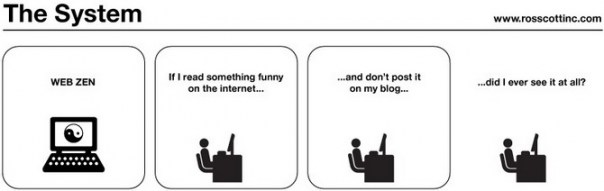
Web Zen…

Do not covet your ideas…


To the Excellencies and officials of Europe…

‘To the Excellencies and officials of Europe: We suffer enormously in Africa. Help us. We have problems in Africa. We lack rights as children. We have war and illness, we lack food…We want to study, and we ask you to help us to study so we can be like you, in Africa.”

-Message found on the bodies of Guinean teenagers Yaguine Koita and Fode Tounkara, stowaways who died attempting to reach Europe in the landing gear of an airliner