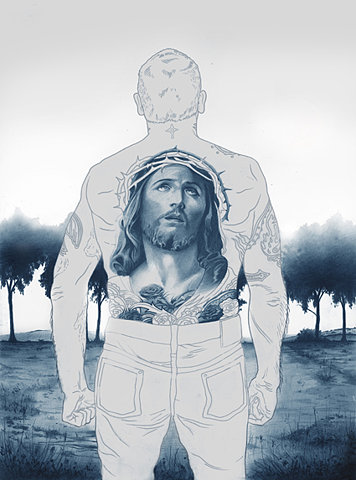
Banksy…

The Lamb…

“Behold, the Lamb of God Who takes away the sin of the world!” John 1:29

“… the Lamb slain from the foundation of the world.” Revelation 13:8

“For God so loved the world that he gave his one and only Son, that whoever believes in him shall not perish but have eternal life. John 3:16

What an awesome picture…portraying the awesome truth.

Comrade Ogilvy

“It struck him as curious that you could create dead men but not living ones. Comrade Ogilvy, who had never existed in the present, now existed in the past, and when once the act of forgery was forgotten, he would exist just as authentically, and upon the same evidence, as Charlemagne or Julius Caesar.” –  George Orwell (1984)

Wowaweewa


And we know that God causes all things to work together for good to those who love God, to those who are called according to His purpose. For whom He foreknew, He also predestined to become conformed to the image of His Son, that He might be the first-born among any brethren; and whom He predestined, these He also called; and whom He called, these He also justified; and whom He justified, these He also glorified. What then shall we say to these things? If God is for us, who is against us? He who did not spare His own Son, but delivered Him up for us all, how will He not also with Him freely give us all things?Who will bring a charge against God’s elect? God is the one who justifies; who is the one who condemns? Christ Jesus is He who died, yes, rather who was raised, who is at the right hand of God, who also intercedes for us. Who shall separate us from the love of Christ? Shall tribulation, or distress, or persecution, or famine, or nakedness, or peril, or sword? Just as it is written, “For Thy sake we are being put to death all day long; we were considered as sheep to be slaughtered.” But in all these things we overwhelmingly conquer through Him who loved us. For I am convinced that neither death, nor life, nor angels, nor principalities, nor things present, nor things to come, nor powers, nor height, nor depth, nor any other created thing, shall be able to separate us from the love of God, which is in Christ Jesus our Lord.” –Romans 8:28-39

It feels like I am realizing this for the first time all over again! Wowaweewa!

And what manner of men will they be?

“And what manner of men will they be? Men mighty in the Scriptures, their lives dominated by a sense of the greatness, the majesty and holiness of God, and their minds and hearts aglow with the great truths of the doctrines of grace. They will be men who have learned what it is to die to self, to human aims and personal ambitions; men who are willing to be ‘fools for Christ’s sake’, who will bear reproach and falsehood, who will labour and suffer, and whose supreme desire will be, not to gain earth’s accolades, but to win the Master’s approbation when they appear before His awesome judgment seat. They will be men who will preach with broken hearts and tear-filled eyes, and upon whose ministries God will grant an extraordinary effusion of the Holy Spirit, and who will witness ‘signs and wonders following’ in the transformation of multitudes of human lives.” (Arnold Dallimore’s biography of George Whitfield, page 16)

How you made them feel…

“They may forget what you said, but they will never forget how you made them feel” – Carl Beuchner

Wow this is so true! When I think back on all the lectures I’ve attended and preaches I’ve listened to, the ones that stick out aren’t the slickest ones or the most profound (although these are great!), the ones I remember are when something stirred in me. When people are able to engage us on a spiritual and/or emotional level, it leaves an imprint in our lives that long outlasts the latest intellectual or theological ‘revelation’.

Certainly we should not order our lives around our emotions, but neither should we neglect them. Western society in general and particularly some streams of reformed theology have cast a disapproving light on the emotions of man. They are almost seen as a yet-to-be-redeemed element of humanity. They are often unpredictable and lead us to do irrational things. Being led without reason is wrong, no doubt, but being led by reason alone is equally wrong. God has made us to be physical, psychological, spiritual, emotional beings.

So, when we engage with others, perhaps rather than trying to convince them of our sound logic or impeccable reasoning, we should engage them on a deeper level. This is a narrow road and can easily lead to manipulation and propaganda, but, nevertheless, the need to engage people on a deeper level than simply the intellect is ever-present. Subject to abuse -yes. But necessary for effective Christian living – also yes.

Shining like the sun…

“I have the immense joy of being man, a member of a race in which God Himself became incarnate. As if the sorrows and stupidities of the human condition could overwhelm me, now I realize what we all are. And if only everybody could realize this! But it cannot be explained. There is no way of telling people that we are walking around shining like the sun.” – Thomas Merton (in Nouwen’s ‘Reaching Out’)

3 o’clock…

I have nothing against Muslims, one of my best friends is Muslim, but this is seriously funny! 🙂

Costly experiences, vulnerability and convictions…

“The more costly an experience is to us, the greater its significance in our lives and the more it occupies our minds – and also the more we are afraid of its being misunderstood, or that it will be cheapened by some misapplied remark or suspicion. The more refined and subtle our minds, the more vulnerable they are. When we are alone we are haunted by doubts about the genuineness of our deepest intuitions and feelings…Thus, although we are made to suffer by reason of the discordance between our personage and our person…nevertheless, we carefully foster it for fear of having our person hurt if we reveal its most precious treasures. This is often what happens with our artistic, philosophical or religious convictions. We feel they are still too fragile to stand up to being judged and even brutally contradicted by others. But our convictions are never really clear and firm until they have been expressed and defended.“

-Paul Tournier (The Meaning of Persons)

For me this is very true. Those experiences which have made the deepest impressions in our lives are usually the ones we are least willing to address. Whether implicitly through repression or explicitly through denial, we simply do not want to face up to the pain of talking about our darkest moments, fears or doubts. And yet God, in His infinite wisdom, created us in such a way that communication and sharing are prerequisites for full healing, wholeness and hence happiness. First we need to find people who we can trust and who will truly hear us, and then we need to be those people to others.

Cold warming…

The corruption of our moral sentiments

“The disposition to admire, and almost to worship, the rich and powerful, and to despise, or, at least, to neglect persons of poor and mean condition…is…the great and most universal cause of the corruption of our moral sentiments” – Adam Smith

All my friends are dead.

Working hard, or hardly working?

When I saw this photo, I was reminded of a great philosophy about work. I think the quote goes back to Confucius who said something to the following effect: “Enjoy the work that you do and you will never work a day in your life”. I agree with this type of thinking. I know that not everyone has the privilege of being able to do work that they enjoy, but many people have the possibility within their grasp but choose not to grab it for any number of reasons. Insecurity. Fear. Conformity. Who knows? Well, you do.

I want to occupy my time doing work that I would do even if I wasn’t been paid for it. Pay is a bonus 🙂 I know it’s not always stable or predictable but I flat out refuse to work for 50 weeks in the year so I can spend 2 weeks actually living my life.

Keep it real peeps…

Ships in the night…

“In 1968 Stringfellow Barr, an historian and president of St John’s College in Maryland, wrote a Socratic critique of American discourse: “There is a pathos in television dialogue: the rapid exchange of monologues that fail to find the issue, like ships passing in the night; the reiterated preface, ‘I think that…,’ as if it mattered who held which opinion rather than which opinion is worth holding; the impressive personal vanity that prevents each ‘discussant’ from really listening to another speaker”. [Economist, 19th December 2010, Socrates in America: Arguing to Death]

This is incredibly profound. Especially if it is true, as I suspect it is, that true conversation can create understanding, bring healing and bring to reality unspoken, unknown truths that lurk in the recesses of our minds…engage people. Connect. Fellowship. Commune. Partake.

A different drum…

‘If a man does not keep pace with his companions perhaps it is because he hears a different drummer. Let him step to the music which he hears, however measured or far away’ – Henry David Thoreau

This notion of dancing to a different drum is giving me comfort and helping me to understand, process and conceptualize my own life and the lives of some of my friends. When I was travelling in Europe last year with a very good friend of mine, she told me something extremely profound. While I was going on about how weird and eccentric all these Europeans were and judging them, she just said “It’s not wrong, it’s different“. Needless to say she was bang on the money, and subsequently this has become my motto whenever I travel.

For most of my life different and wrong were synonymous. Society, religion, families, friends and companies all have a vested interest in valuing conformity. While they may differ on what type of conformity, it is conformity nonetheless. In His supreme wisdom, God has made us different. This is a fact. We have different personalities, different strengths, different looks, different families, different everything. God doesn’t make mistakes (fortunately for us!). We need to be comfortable embracing our individuality, which is that part of ourselves which is different to others. Too often we conform to what we believe is expected from us or what is ‘correct’ or acceptable. We need to recognize uniqueness, both our own and others. Not only in physical attributes but also in cultures, ideas, feelings and thoughts. I am too quick to box people into my own framework of reference. First into ‘Right’ or ‘Wrong’ and then into an innumerable number of subsequent boxes in each branch. This process is not so bad (this is basically what thinking is) what’s bad is that the first branch of the tree is ‘Right or Wrong’. Premature-judgement is my double-barreled middle name!

Sometimes different is wrong. We cannot be so sensitive to differences that we adopt relativism in its extreme. There is absolute truth: Truth, and there is absolute knowledge: Knowledge. These systems or entities are not man-made or man-defined – they are creations of God. We dare not tread on His toes and try to categorize as unequivocal ‘Truth’ that for which there is a legitimate difference of opinion. That would truly be foolish.

Maybe you also have friends who are breaking the mold and you don’t know what to make of it. Then you, like me, should conclude: Perhaps they are just dancing to a different drum. Let them dance!

Headship and Submission

It seems many people (Christian and non-Christian) have qualms about the issue of headship and submission when talking about husbands and wives (see Ephesians 5:22). I recently read a particularly interesting quote by John Piper on this topic that will hopefully bring some clarity:

‘When sin entered the world it ruined the harmony of marriage not because it brought headship and submission into existence, but because it twisted man’s humble, loving headship into hostile domination in some men and lazy indifference in others. And it twisted woman’s intelligent, willing submission into manipulative obsequiousness* in some women and brazen insubordination in others. Sin didn’t create headship and submission; it ruined them and distorted them and made them ugly and destructive…[we are now involved] not in the dismantling of the original, created order of loving headship and willing submission, but a recovery of it from the ravages of sin’’ – John Piper

*since we should all be adding to our dictionaries of life AKA our vocabularies- obsequiousness is defined as “abject or cringing submissiveness”

Scars

“Out of suffering have emerged the strongest souls; the most massive characters are seared with scars.”-Kahlil Gibran

Judgment and Empathy

When we judge people, we forgo the opportunity to understand them and their situation. When we judge people, we are assuming a position of superiority such that, since we are no longer ‘on their level’, we are unable to understand what they must be feeling, how they might have been hurt in the past or what the journey of life has been like for them so far. In short, we lose the ability to empathize with them. This is the gist of my latest epiphany, which I’ll try and explain below…

Empathy: The picture above is that of a Rubic’s Cube for the blind. As I’m sure we all know a Rubic’s cube normally has different colours on each square, with the aim being to make each side only one color. This seemingly innocuous game is exceedingly difficult fora blind person. To have to feel the braille on each square to know what color it is and then remember the position of each color and so on.

If I saw a blind child playing with this Rubic’s Cube, I would instantly think “Ag shame, I feel so sorry for that child – life must be so difficult for him”. Traditionally we would call this pity.

For those not familiar with South African culture, and more specifically, the Afrikaaner sub-culture (of which I am becoming increasingly acquainted) the words ‘Ag shame’ are almost universally applied to situations of pity. If someone has had a really bad day, if someone’s dog dies, whatever it is ‘Ag shame’ can usually be said, with differing degrees of sincerity depending on the situation. The problem with ‘Ag shame’ is that if one looks a little deeper, you’ll see that we are actually putting ourselves in a superior position to the other person. If we say ‘Ag shame look at that beggar’ (we are rich and don’t have the problems of poverty), ‘Ag shame man, he failed his exams’ (we passed our exams) etc etc. While the analogy only goes so far, and there are notable exceptions, I still believe that often when we pity someone, we are actually judging the person in our heart since we see ourselves as superior. To put it more mildly, because we identify ourselves as being in a position of superiority, we are unable to sympathize or empathize with them.

The reason why I am telling you all this, is that recently I have started to realise the importance of empathy in the life of the Christian. Empathy is defined as:

empathy: identification with and understanding of another’s situation, feelings, and motives

Using the example of the Rubic’s Cube above, pity is feeling sorry for the kid, empathy is truly understanding what it must be like for that kid. What it’s like to wake up and not see light or color. What it feels like to never have seen what your face looks like in a mirror, or to never be able to appreciate the vistas of nature. What it will be like for him to be unable to see his child ride a bike one day or see the expression on his daughter’s face when she gets married – that is the beginning of empathy. Because this is so difficult, people often say that you can only emapthise with someone if you have actually been through what they are going through, otherwise you are sympathizing. For example, my grandparents are dead therefore I can empathise with someone else whose grandparents have recently passed away. If I hadn’t suffered that loss I would only sympathise.

While technically the above distinction between empathy and sympathy may be true, I am going to take it that it is possible (albeit difficult) to empathise with someone who is going through, or has gone through, something you haven’t. So you may be asking, why do you care so much about empathizing, and the answer is that I believe it is fundamental if we are to heal broken people and since we too are broken people, to experience healing ourselves.

As I mentioned earlier, when we judge people we lose the ability to empathise with them. Empathizing with people is ESSENTIAL if they are to feel comfortable opening up and revealing their innermost painful secrets and those areas in their life which are fraught with insecurity and doubt. This opening up is necessary if the person is to be healed, whole and free.

On a more practical level, it is in true dialogue or conversation that  empathy becomes vital. When someone’s person/spirit feels that you will not judge them and that this is a safe environment, they will open up to you and talk about their hopes and fears, their dreams and desires. When people feel they are being understood and that they are valued, frank conversation can be profoundly significant. Particularly when people are talking about their failings, their past or their insecurities, empathy and non-judgement are prerequisites for such a conversation.  Not only does empathy encourage people to open up, miraculously, it is one of the key ingredients of healing. The Holy Spirit works through us most powerfully when we are filled with compassion (compassion and empathy are closely linked!). Think about it in your own life: which are the conversations that changed your life, the ones where people told you all the neatest theology and the 10-steps to well-being or the ones where you true friends just listened to you? On this topic Paul Tournier in “The Meaning of Person’s” says:

“The people who have helped me most are not those who have answered my confessions with advice, exhortation or doctrine, but rather those who have listened to me in silence, and then told me of their own personal life, their own difficulties and experience….those who impose upon us their ready made solutions, writes one of my patients, ‘those who impose upon us their science or their theology, are incapable of healing us”

This is so true and yet in most situations, instead of listening, we still persist in offering advice and theological pointers. I am a firm believer in the importance of theology, teaching and seeking advice, but often we are too quick to offer these when they are not called for. By that I mean that providing theological advice is not what people need when they come to you to share their innermost feelings. To quote Tournier again:

“Paradoxical though it may seem, the true dialogue is by no means a discussion…it is important here to make a distinction between intellectual argument and personal encounter. Answer ideas with ideas, but answer the person with the person. Then often the heart’s true response is silence.”

I think that one of the reasons we do this, is because we don’t know how else to respond and when faced with such uncertainty we revert to what we know: advice and theology. To use a proverb: “When you’ve got a hammer, every problem looks like nail”. More than likely it is because we have not empathized with people. I think if we truly knew what some people have gone through we would not be so quick and flippant to offer our 2 cents of advice.

So I think what I’m saying here is that every day we are faced with situations where we can either judge people or try to understand them- but they are mutually exclusive. The Gospels frequently talk of Jesus being filled with compassion. Seeing a naked adulteress doesn’t arouse compassion unless you try to understand her and her situation: ‘How desperate must she be to have sold her own body?!’, ‘How degrading this must be for this poor woman?’ etc. And this is not just for that woman 2000 odd years ago in Israel, it is also for us here and now: Jesus is our high priest who sympathizes with our weaknesses (Heb 4:15). There are numerous scriptures speaking of showing mercy, compassion and love (all closely linked with empathy) and many other scriptures deploring us judging others, being prideful and not freely showing the grace which we have so freely received.

So the next time you are faced with the choice: judgement or empathy…please try and understand.

The Christian: a paradox

Below is an excerpt from a letter to Diogenetos….it’s from the second century! The letter is about Christians and how our lives are characterized by paradox:
“And yet there is something extraordinary about their lives. They live in their own countries as though they were only passing through. They play their full role as citizens, but labor under all the disabilities of aliens. Any country can be their homeland, but for them their homeland, wherever it may be, is a foreign country. Like others, they marry and have children, but they do not expose them. They share their meals, but not their wives. They live in the flesh, but they are not governed by the desires of the flesh. They pass their days upon earth, but they are citizens of heaven. Obedient to the laws, they yet live on a level that transcends the law. Christians love all men, but all men persecute them. Condemned because they are not understood, they are put to death, but raised to life again. They live in poverty, but enrich many; they are totally destitute, but possess an abundance of everything. They suffer dishonor, but that is their glory. They are defamed, but vindicated. A blessing is their answer to abuse, deference their response to insult. For the good they do they receive the punishment of malefactors, but even then they, rejoice, as though receiving the gift of life.”
Very thought provoking!

Change, pain and growth…

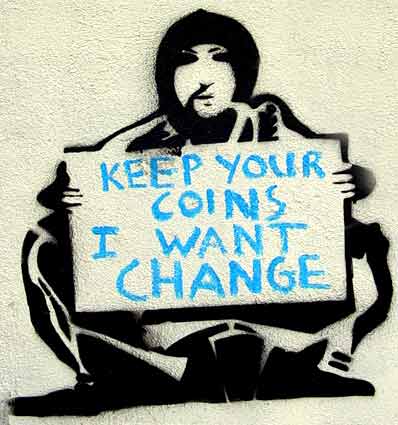
I really love this picture!  I know it is primarily politically orientated, but like most things which are true, it has almost universal application.  For me, it spotlights my tendency to appease the problems in my life with coins rather than real change.  Genuine change means I have to face the problem head on, it means I need to go through a process of legitimate suffering and often mourning. These processes are painful and I hate pain. I avoid pain at almost any cost. Physical pain, emotional pain or spiritual pain…I hate pain***. I know this is simply part of the human condition and something that everyone faces. In the right context it is an extremely important quality we have: “touch a hot stove–>Pain–>REMOVE HAND!”…but in other situations this wonderful attribute stunts our growth. Sometimes we have to walk through the valley of the shadow of death before we get to the green pastures (Psalm 23).

*** Aside: I’m really big into psychology at the moment…and it’s really helping me to understand so much more about myself and others…for example, I wrote the previous sentence about my tendency to appease personal problems with coins rather than genuine change, using ‘we’ instead of ‘I’. This may seem like a small thing or that I’m being pedantic by even identifying this, but it is actually very indicative of a problem that I have. By identifying myself with others who have similar problems {or more accurately attributing my problems to others as well} it feels more acceptable, less ‘wrong’ and less urgent to face the issue at hand…I need to accept personal responsibility for my problems and stop seeing myself as part of a crowd of people – personal responsibility for our present state of being is a hallmark of mental health and maturity…I will try to use ‘I’ and not ‘we’ and ‘me’ rather than ‘they’, when talking of my own problems

I know this truth, and have known it for a while, yet I still avoid the pain associated with growth and maturity. I throw a few coins to the wise man inside of me who is not asking for my coins but asking for real change. I can appease my conscience for a few more days, telling myself that I really care about my poverty and that I want to do something about it, but inside – in the recesses of my person I know I need to face it. To go into the cave and look at the monster and say “I see you. I see the size of you. I see you are ugly as sin. But more importantly I see that the hand of God is with me to defeat you. And I will defeat you”.

This reminds me of the lions in the Pilgrim’s Progress. Read below:

“So I saw in my dream that he made haste, and went forward, that if possible he might get lodging
there. Now before he had gone far, he entered into a very narrow passage, which was about a furlong
off the Porter’s lodge, and looking very narrowly before him as he went, he espied two lions in the
way. Now, thought he, I see the dangers that Mistrust and Timorous were driven back by. (The
lions were chained, but he saw not the chains.) Then he was afraid, and thought also himself to go
back after them; for he thought nothing but death was before him. But the Porter at the lodge, whose
name is Watchful, perceiving that Christian made a halt, as if he would go back, cried unto him,
saying, Is thy strength so small? Mark 4:40. Fear not the lions, for they are chained, and are placed
there for trial of faith where it is, and for discovery of those that have none: keep in the midst of
the path, and no hurt shall come unto thee.
Then I saw that he went on, trembling for fear of the lions, but taking good heed to the directions
of the Porter; he heard them roar, but they did him no harm.”

This willingness to face the problems in my life is not a once-for-all decision. Every day, in every challenge, whenever the Holy Spirit highlights the monster lurking in the dark corners of my life, I need to decide whether I will face it head-on and deal with it, or throw some coins at the problem.

Perhaps you also have some monsters in your life…lurking under that facade that has become so normal. Don’t throw some coins at the problem when God highlights issues in your life – face it with open eyes and unafraid – God is with you. And then we will say as David said to Goliath:

1 Samuel 17:45-48 (NIV)

45 David said to the Philistine, “You come against me with sword and spear and javelin, but I come against you in the name of the LORD Almighty, the God of the armies of Israel, whom you have defied. 46 This day the LORD will hand you over to me, and I’ll strike you down and cut off your head. Today I will give the carcasses of the Philistine army to the birds of the air and the beasts of the earth, and the whole world will know that there is a God in Israel. 47 All those gathered here will know that it is not by sword or spear that the LORD saves; for the battle is the LORD’s, and he will give all of you into our hands.”

“In the company of Jesus there are no experts, only beginners” – Jason Upton ‘Between the graveyard and the garden’