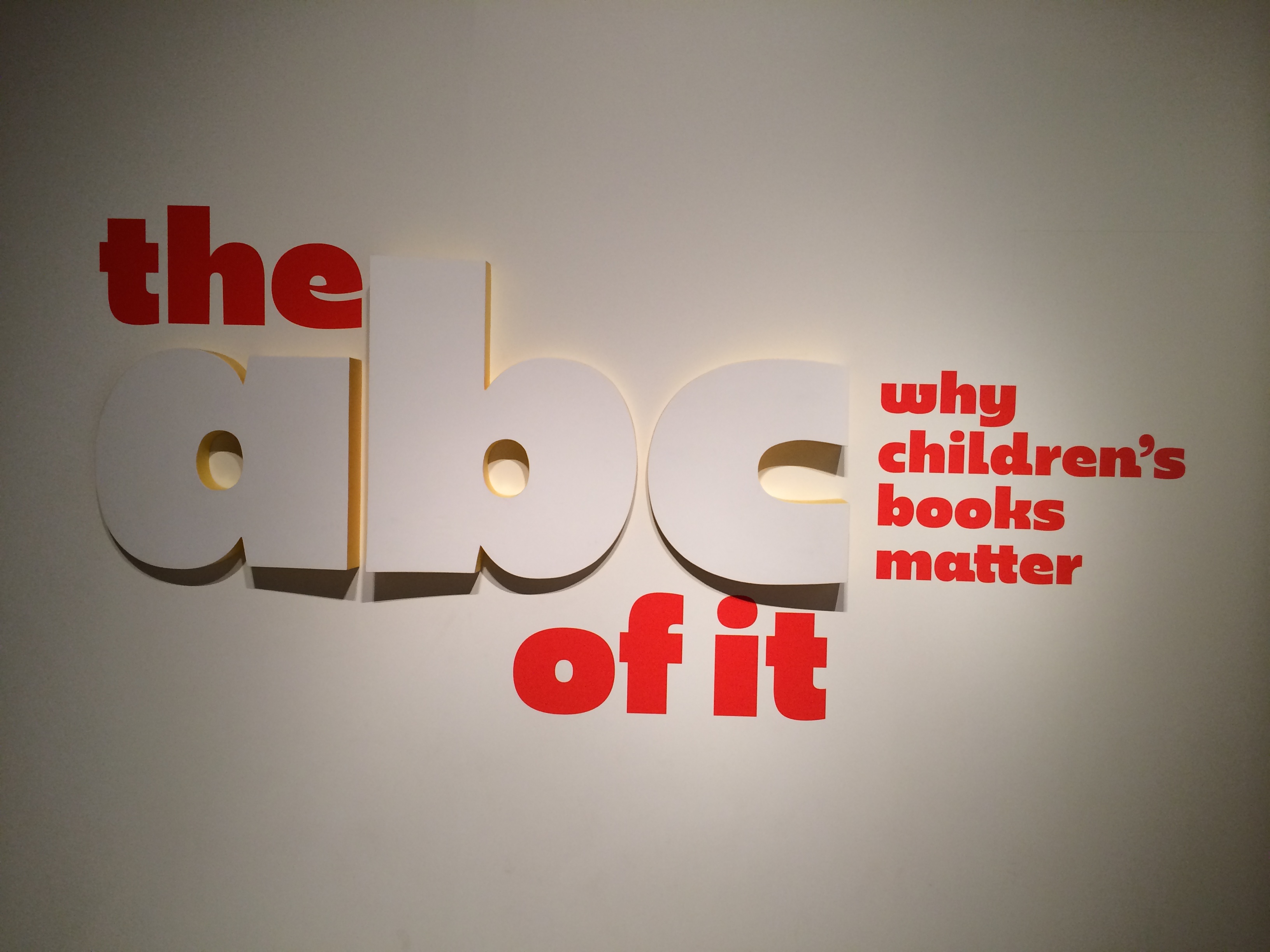
“Why Children’s Books Matter” – exhibition at NYPL

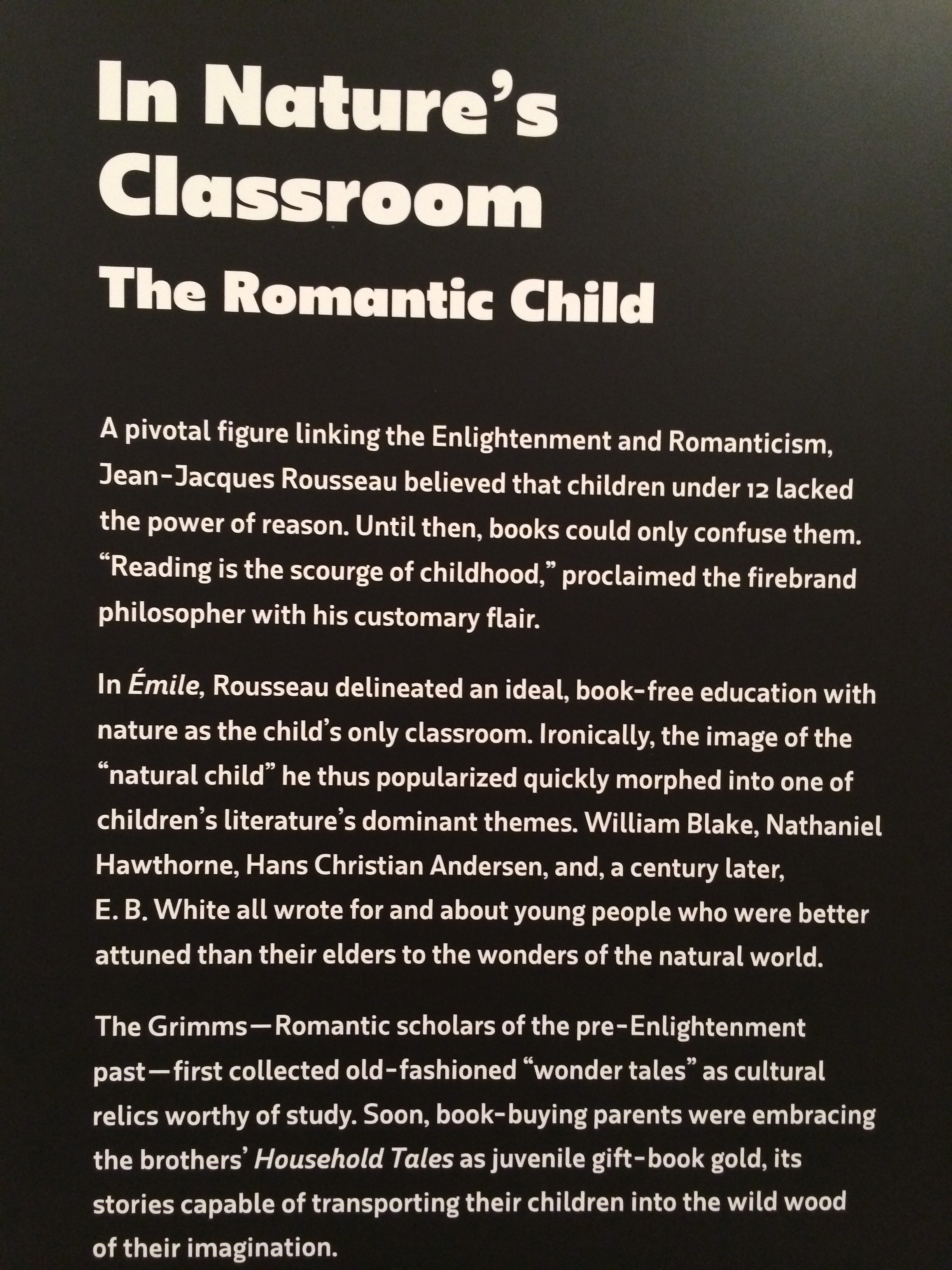
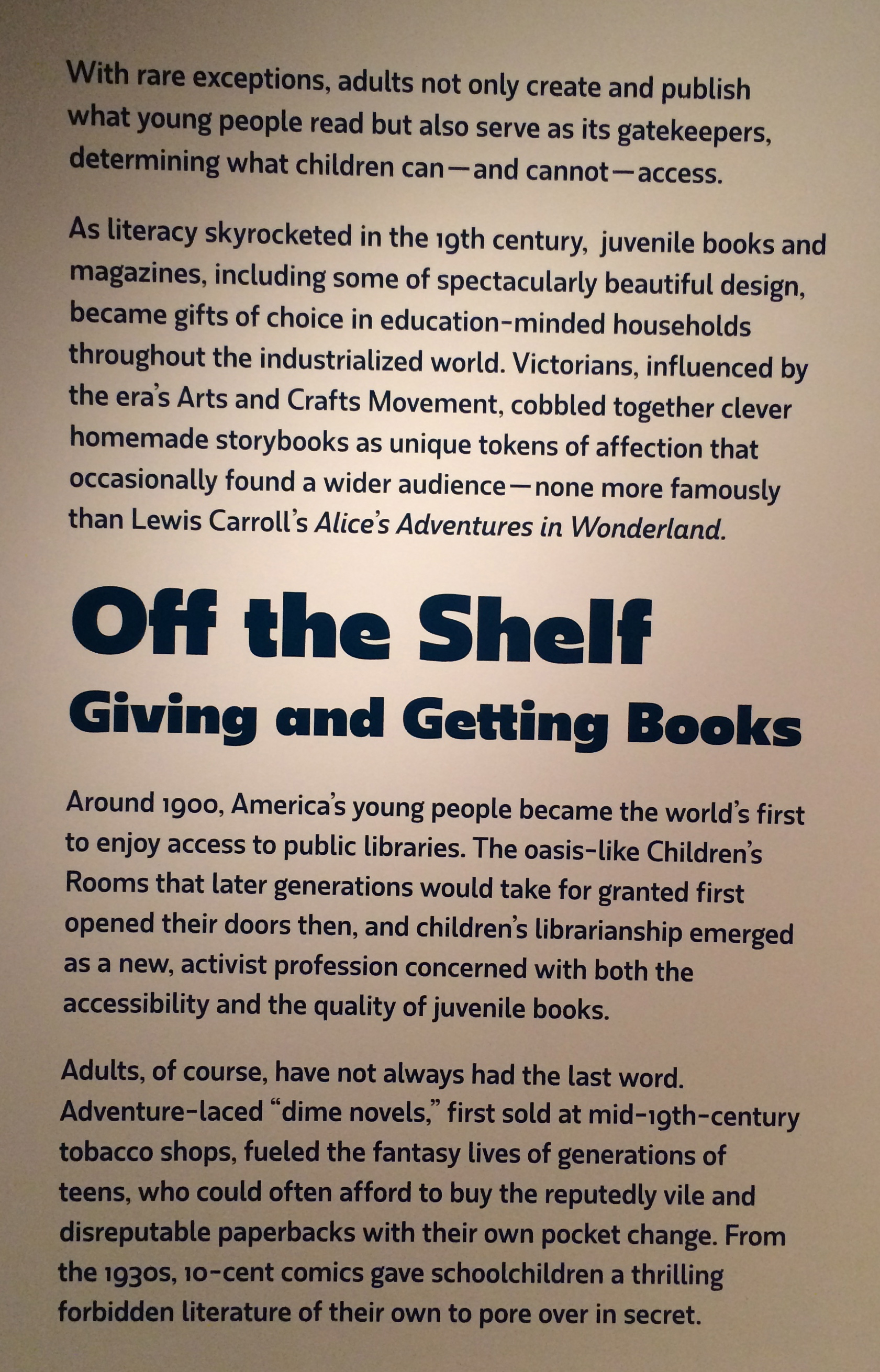
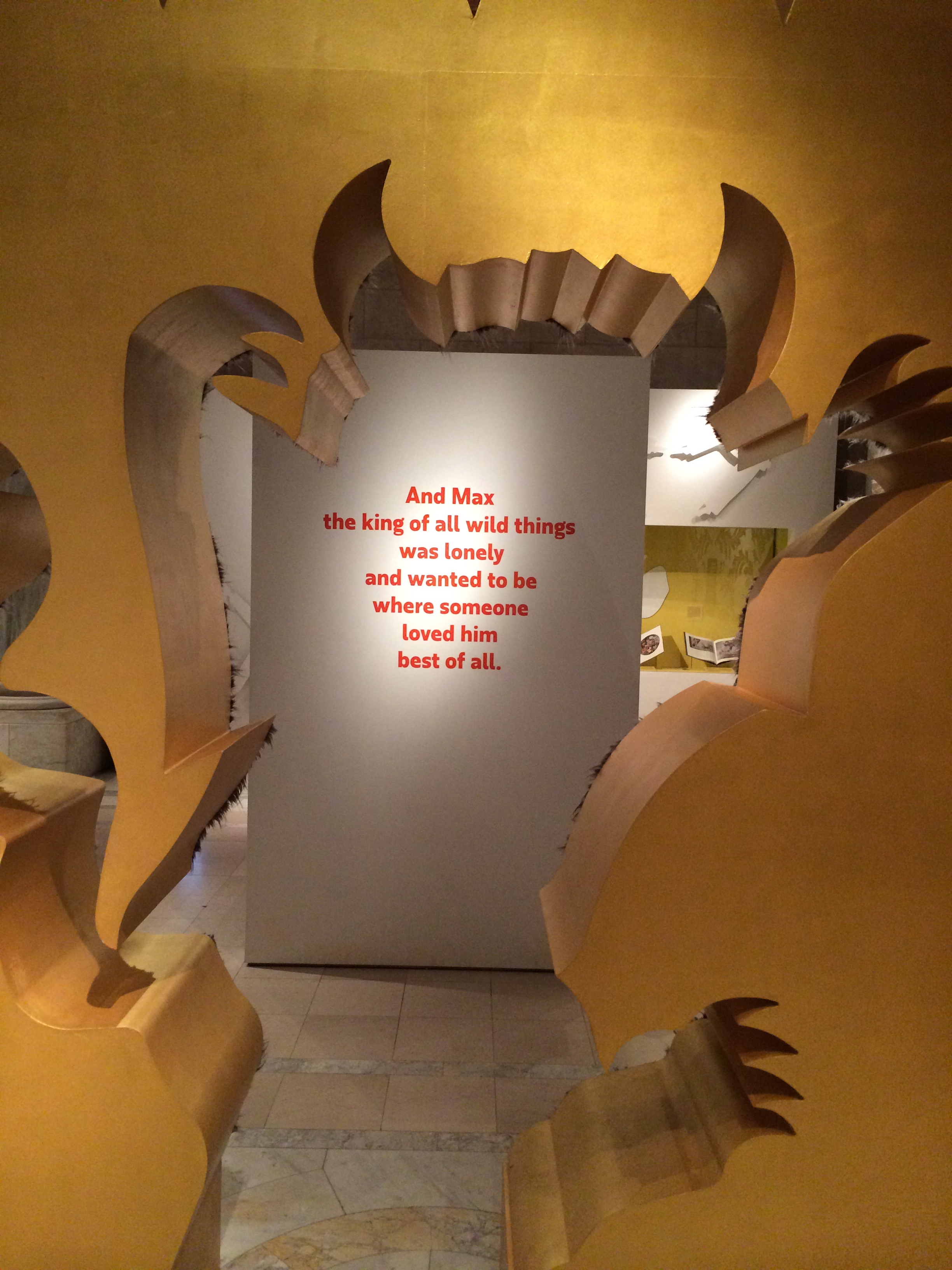
IMG_3326This past week I was in New York en route to Boston and managed to get across to the incredible New York Public Library because they were having a special exhibition on children’s books: “The ABC of it: Why Children’s Books Matter” which I absolutely loved. While I am naturally interested in children’s literature (from a pedagogical, sociological and political perspective), the reason for my visit was because I am now an uncle and figured I need to get clued up on children’s literature for my (incredibly) cute nephew Lincoln William Spaull who will obviously be a reader. So here are a selection of photos of the exhibition and some of my comments…

IMG_3327

IMG_3333

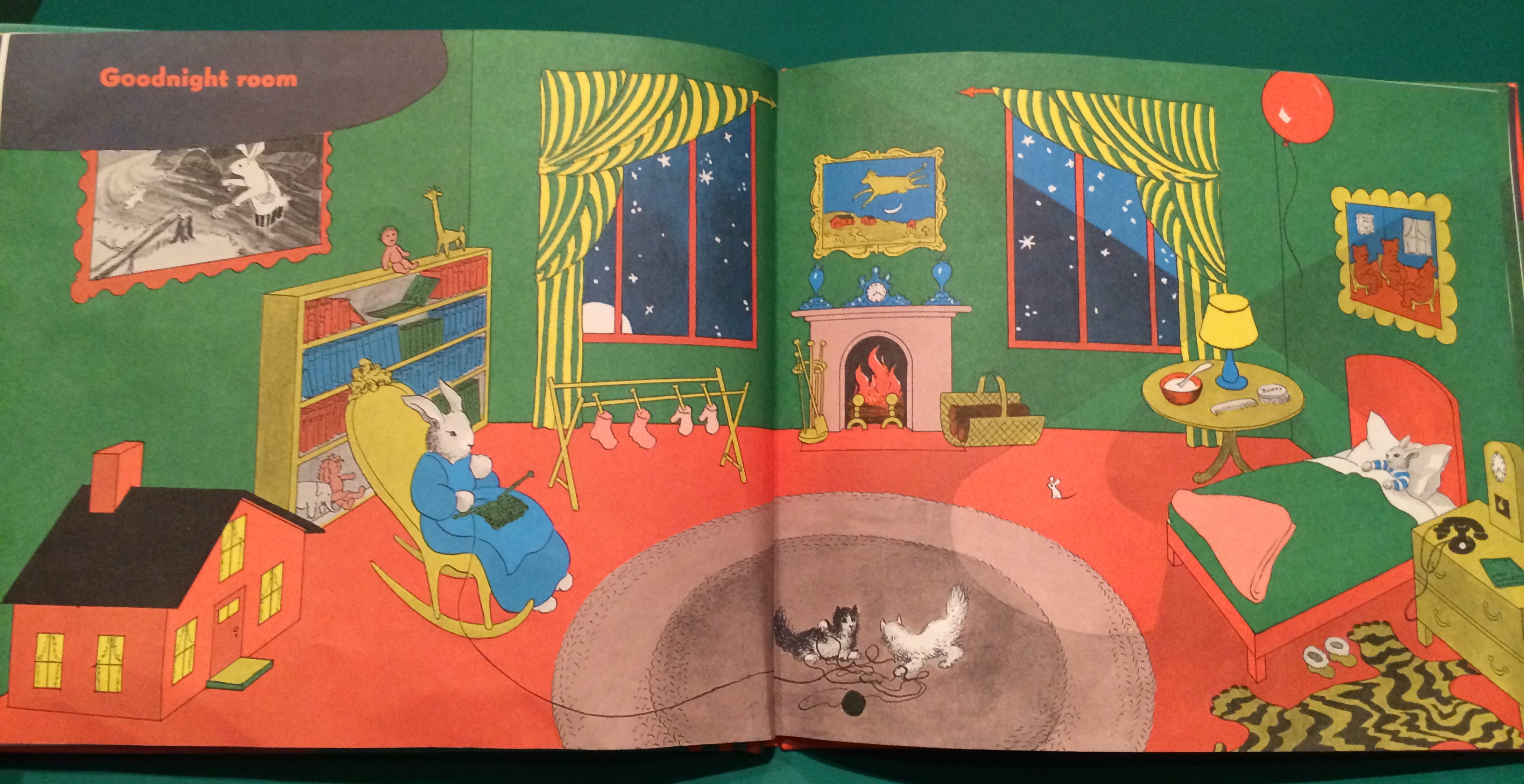
One of the exhibits which I really loved was the discussion about the book “Goodnight Moon” which is such a sweet bedtime story about a rabbit saying goodnight to everything in his room, a wonderfully playful and beautifully coloured room.

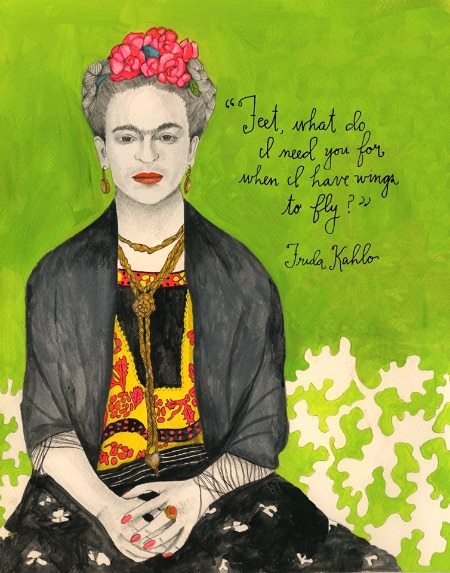
IMG_3336It actually reminded me of Frida Kahlo and her boldness…

fridaBut getting back to “Goodnight Moon”, the guide told us a fascinating story about a parent who read the story to her young son before he went to bed but then later she heard him crying and walked in to find him sitting on the bed with the book open and a foot on each page. The little boy loved the story so much that he was trying to climb into the room and was upset because he couldn’t get inside. I thought it epitomised the idea that children do not make the same distinctions as we do between fiction and reality – they are one and the same. Another story illustrating the same thing is the book “Little Fur Family” by Margaret Wise Brown. The author was so well known and established that she managed to convince the publisher to cover her book in real rabbit fur (this was 1946!). The exhibition has stories of parents writing in and telling how their children thought the book was a real-live animal – one preschooler tried to feed the book and another child gave it as a present to her cat!

IMG_3375

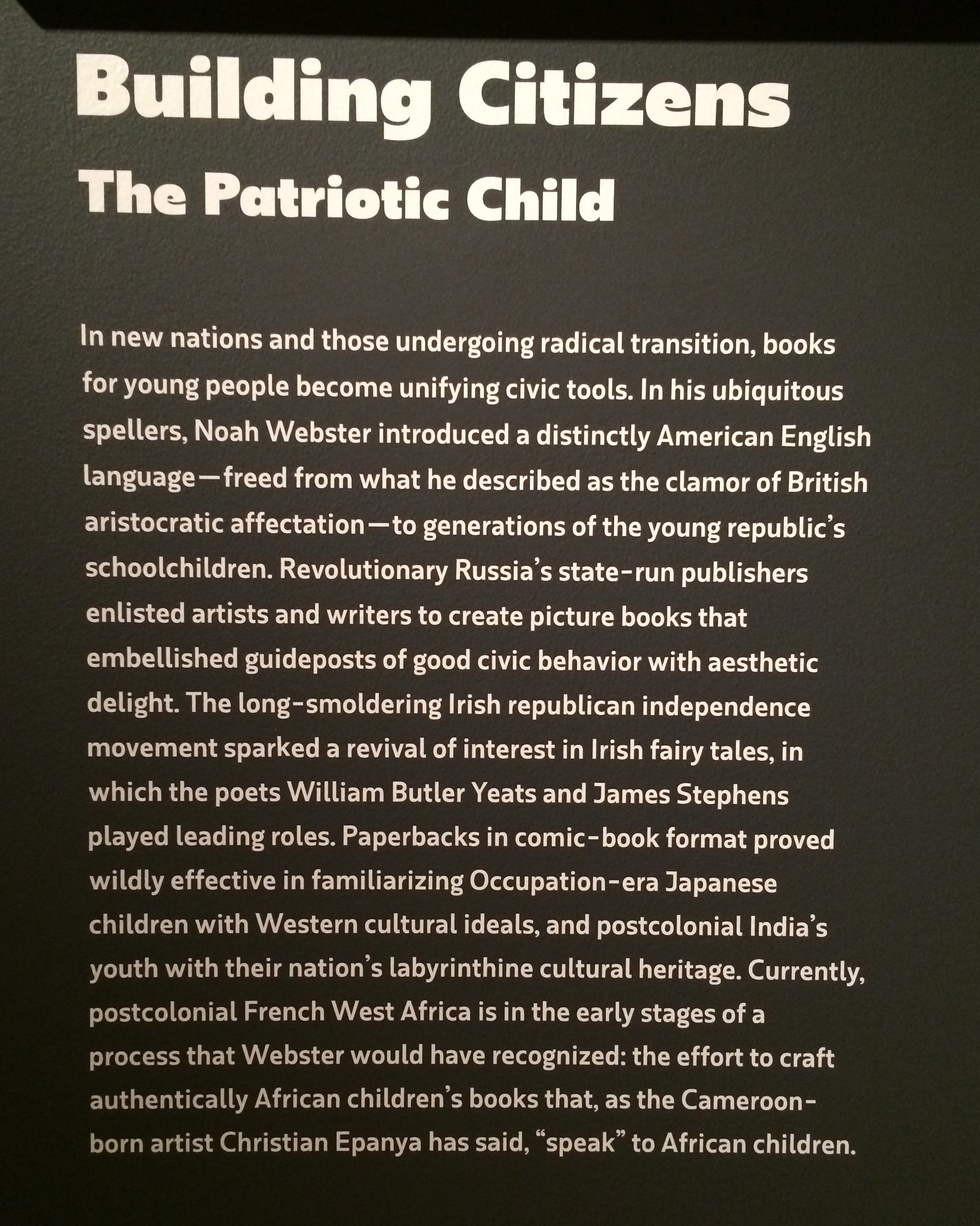
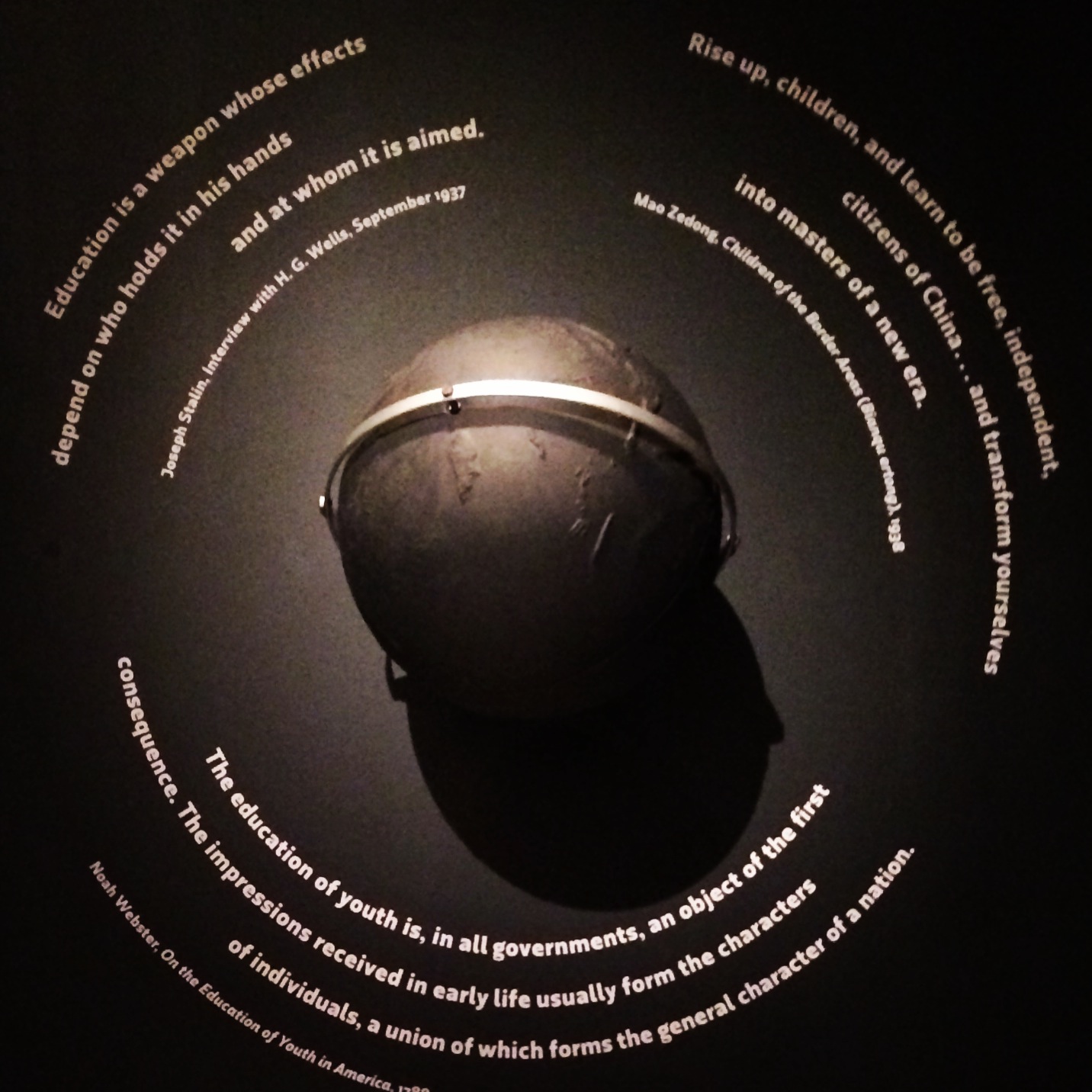
Education is also completely political, with some lovely examples from China, USSR and Japan (among others) where children’s literature was used as an instrument of indoctrination and nation-building.

IMG_3341

IMG_3398

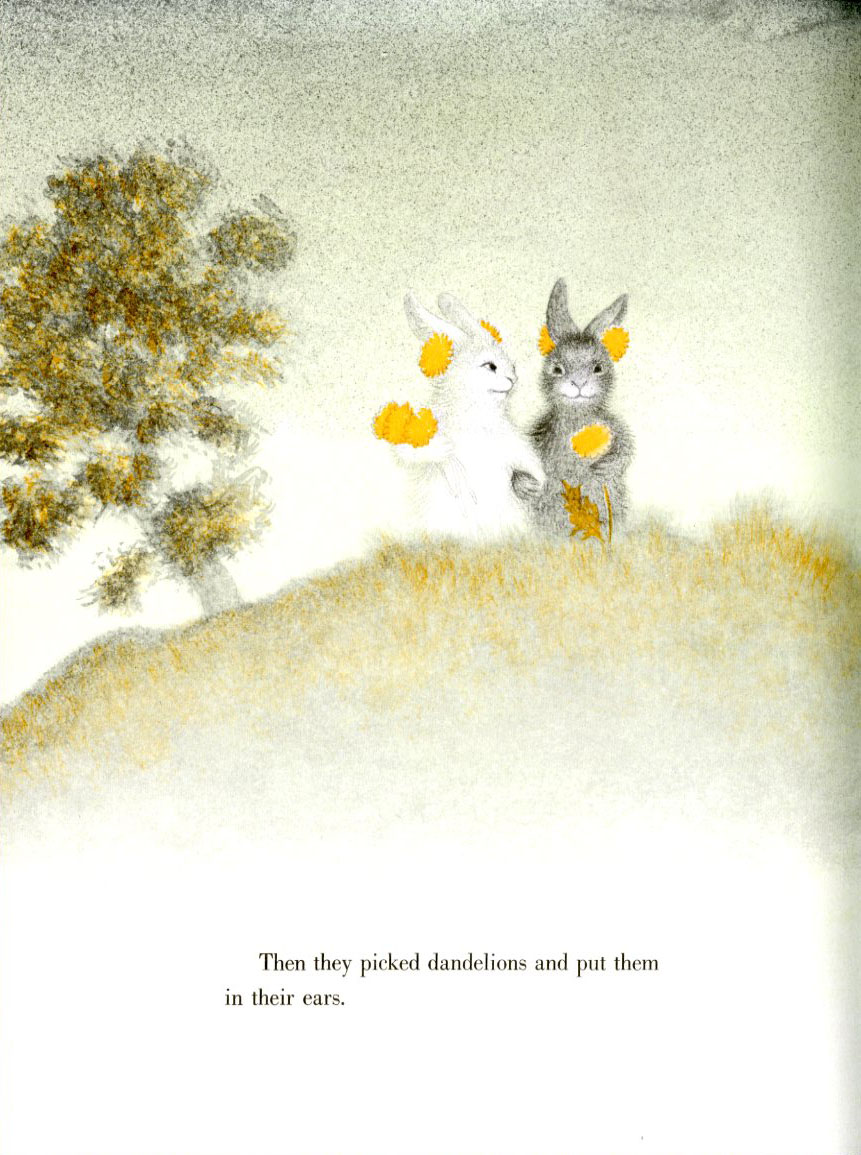
There was also a section on books that had been banned over the years because they were controversial, usually for political, religious or moral reasons. One classic one is “The Rabbit’s Wedding” (1958), where a black rabbit and a white rabbit get married:

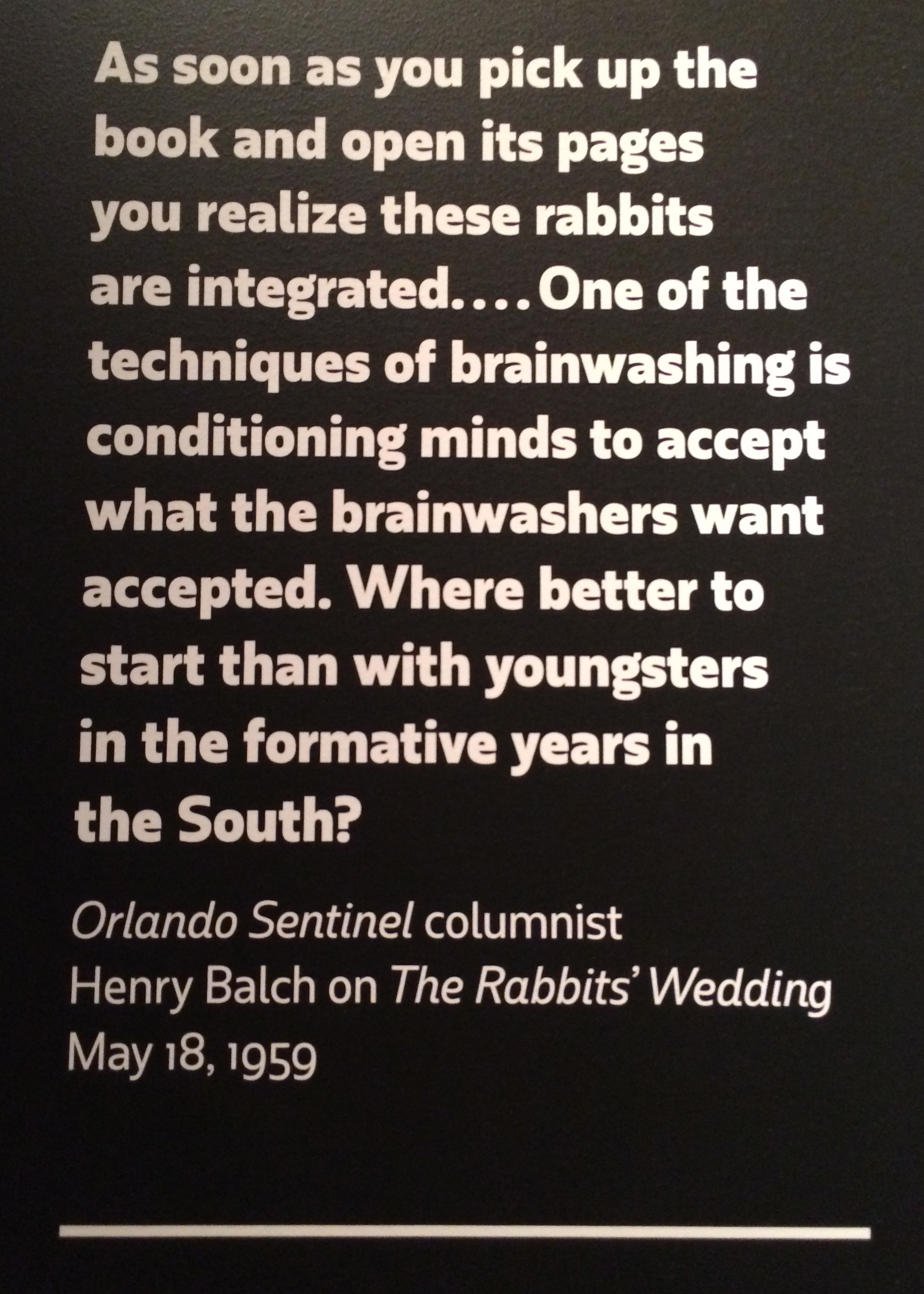
rabbits-wedding0181This caused an uproar in the South of of the US where segregationists tried to get the book banned. In the end it was put in a special reserve section of the library. See this quote on the issue:

IMG_3366

This got me thinking about the representation of gay, bi and transgender characters in children’s books and the objections made by some conservative parents. In that sense, children’s books are a sort of battle-ground where adults fight it out and decide what is and is not OK for children to read and be influenced by.

A few other snippets from the exhibition:

IMG_3352

IMG_3355

IMG_3357

IMG_3349


Links I liked…

sticks

  • The above vase was made from ice-cream sticks – pretty epic.
  • This week I attended the Harvard African Development Conference and heard a bunch of cool talks : (1) Raul Pantaleo opened my eyes to a bunch of cool context-specific, culturally-relevant, architecture projects that they they’ve done around the world (TAM associati). Check out some of the their projects here. (2) The folks at Mass Design are also doing amazing work using architecture in new and interesting ways – think integrating sociology, ecology, the environment and design – pretty epic. (And they are crazy young which is always a plus!). Also watch this 5-min PopTech talk by Founder Michael Murphy on “Architecting Health” (3) interesting website aiming to “construct a web of knowledge” to learn new concepts – http://www.metacademy.org/about randomly started chatting to a guy at a cafe at MIT (Maths PhD student, of course) and it turns out he’s interested in  machine learning in education…
  • In 15 years the question of whether or not a surfer (or anyone) is gay will be so irrelevant that people will wonder why you are even asking it. See this short clip which is a rough-shod attempt at changing the gay narrative.
  • Great 2 page summary/highlights of the 2014 Budget for South Africa (thanks Treasury)
  • Helpful website listing post-doc opportunities in the US focussing on educational sciences.
  • “Gender-specific books demean all our children. So the Independent on Sunday will no longer review anything marketed to exclude either sex” (see here). Finally some sense.
  • Stem-cells in mothers breast milk (New Scientist article) “Cultured samples also grew into different tissues including bone, neuron, heart and pancreatic cells”
  • Great article by Servaas Van der Berg & Eldridge Moses (2012). How better targeting of social spending affects social delivery in South Africa.(accessible & important!)
  • Pretty interesting idea of offering a coding summer-school in CT – iExperience – with all the touristy bells-and-whistles that come along with trying to attract kids from America.
  • Interesting article on “The Rise of the Open Source Coder Generation” – thanks Christine

Help at last for gem in the dust (Daily News March 27)

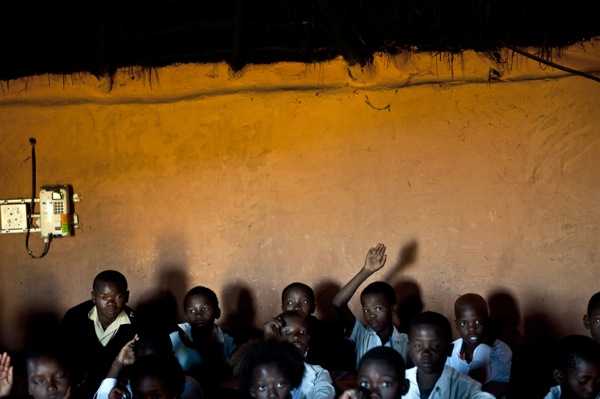
classroom

The following article appeared in the Daily News on the 27th of March and highlights the tireless work that a friend of mine Anne Immelman has been doing in a rural school in KZN (Meadowsweet Combined School). Anne was a high-school Mathematics teacher at St Mary’s School in KZN and now that she has retired she helps out at Meadowsweet. Well done Anne – we need hundreds more active citizens doing what they can, where they are, with what they have. (The above picture shows some of the damage sustained to one of the classrooms during a recent storm). 

//

“On the backroads of KwaZulu-Natal, just off the R600, 20km from the farming town of Winterton, there is a gem: a school that has produced a 100 percent matriculation five years in a row. Meadowsweet Combined School is dilapidated, but shone brightly among the 116 schools in the province which achieved perfection with the class of 2013. The school outperformed KZN’s 6 125 other schools, many of them with resources and facilities that make Meadowsweet pathetic by comparison. It has 500 pupils and the teacher-pupil ratio, with between 60 and 88 to a class, makes its results astonishing.

Meadowsweet is defying the odds, triumphing over ramshackle neglect. It is making fools of school peers who blame poor outcomes on facility inadequacies. Something really good is happening there, a chemistry that should be analysed, bottled and spread to the rest of the province and the country.

Part of the answer is Anne Immelman, a retired maths teacher who volunteers at the school. She wrote to the Daily News to draw attention to this roughest of diamonds, and her dutiful intervention has caught the attention of education bosses in Pietermaritzburg. Meadowsweet, it turns out, has for years been on the department’s waiting list. Immelman’s cry for help has expedited it, with building of 17 new classrooms, two administrative blocks, four multipurpose rooms, fencing, and ablution facilities to replace the pit latrines, to start in May.

This school is the most deserving of recipients, with staff and pupils alike brushing aside bleak conditions, refusing ample excuses available to them for falling short of excellence. Praise to Meadowsweet for its outstanding achievements. And thanks to Anne Immelman for her citizen activism, drawing attention to this gem in the dust, and catching the eye of the right officials.”

Article from here.

Q&A with Doron Isaacs

Screen Shot 2014-03-23 at 5.05.43 PMThe aim of the Q&A series is to get an inside look into some of South Africa’s leading education academics, policy-makers and activists. This is the eighth interview in the series.  Doron Isaacs is the Deputy General Secretary of Equal Education (Twitter: @DoronIsaacs).

1)   Why did you decide to go into education and how did you get where you are?

It wasn’t so much a decision to go into education, as a decision to work in a poor community in order to help young people organise themselves to claim their rights and fight inequality. This involved building a small organisation, which became Equal Education.

When I was in my final year of law school at UCT I became interested in the role the legal system could play in the hands of progressive social movements. I wrote a paper about the efforts in the United States, during the second half of the 20th century, to use the courts to integrate and equalise schooling. It was eventually published in the SA Journal of Human Rights. That work helped me to understand that I didn’t want to practise as a lawyer at that time, that law alone is a fairly weak instrument, and that deep progressive social change is only produced through large movements of informed and organised poor and working-class people.

2)   What does your average week look like?

It is usually very full. I work in Khayelitsha at the EE head office. There are many meetings each week. One is with about 50 core staff members of Equal Education. Another is with a team of facilitators – post-matrics who have grown up in EE, and now organise high school students – to plan content for the weekly youth group meetings that take place across the city. Sometimes I attend a march, or facilitate a discussion. On Thursday evenings we have seminars which are open to the public. There are many projects EE runs, from our youth film school, to the school libraries, to camps and seminars, campaigns, court cases, and work elsewhere in South Africa. In addition to being a staff member at EE, I was elected, at the July 2012 Congress, onto its National Council and Secretariat, and those governance structures meet periodically. I also sit on the boards of other organisations: the Equal Education Law Centre and Ndifuna Ukwazi. I try to read every day, and occasionally find time to do some writing. I have seldom been bored over the past six years.

3)   While I’m sure you’ve read many books and articles in your career, if you had to pick two or three that have been especially influential for you which two or three would they be and why?

When EE began in early 2008 the question of what to do about OBE was important and topical. I was curious to understand how pedagogy with such progressive intentions was damaging working class children. A book called Education and Social Control, by Rachel Sharp and Anthony Green, which looked at so-called progressive education in the UK in the 1970’s, was a truly fascinating account of why extreme learner-centeredness can be socially retrogressive.  A piece by Jo Muller, which connected me to Gramsci’s thoughts on the subject, was very helpful.

You know, just seeing the numbers on inequality had a big impact on me. EE used access to information law to make data on literacy and numeracy in the Western Cape publicly available. It showed that in 2009 only 2.1% of grade 6 kids in places like Khayelitsha were passing maths at 50%. Ursula Hoadley’s PhD thesis, which was a study of four Cape Town primary schools, showed me how inequality operates in education. Fiske and Ladd’s book, Elusive Equity, is still helpful in beginning to think about inequality. And I remember my eyes opening wide while reading a paper by your supervisor Servaas van der Berg where he showed that the socio-economic status of a school had a greater impact on academic performance than the socio-economic status of an individual child did (here, pg5). That really struck me, because it meant that investing in educational equality was a rational way to leverage social equality more generally.

When it comes to building organisation that can change society, there are so many good books. Two that come to mind are Steven Friedman’s Building Tomorrow Today about how the independent trade union movement was built here in the 1970s and 80s, and Parting the Waters, an epic account of the US Civil Rights Movement.

4)   Who do you think are the current two or three most influential/eminent thinkers in your field and why?

My ‘field’ is not just ‘education’! Equal Education is about changing society, through changing the education system. We’re interested in the political economy of education. Many of us are excited to read Thomas Piketty’s new book, Capital in the 21st Century. That is serious thinking! There is a young education academic at Stanford named Frank Adamson – he’s great. We are incredibly lucky to have been able to learn directly from some marvellous thinkers and activists like Zackie Achmat, Mandla Majola, Rob Petersen, Paula Ensor, Vuyiseka Dubula, Mary Metcalfe, Mark Heywood, Peliwe Lolwana, Zwelinzima Vavi, Geoff Budlender and many others.

5)   What do you think is the most under-researched area in South African education?

Well, take this provocative proposition: Achieving equal education would be a more potent way to build a socialist society than nationalising the mines or redistributing rural land. I’m not commenting on those last two right now, except to say that equal, quality, integrated education, from pre-school to tertiary level, would be a more radical and effective political program.

Okay that’s my provocation. Is anyone in South Africa doing research on education as a political and economic question? Is anyone even exploring what a transformed education system could look like? What its social impact could be? It’s being debated in healthcare around the NHI. Of course we need to fix teaching, textbooks and all that. But there is no imaginative thinking beyond that.

6)   What is the best advice you’ve been given?

In 2008 we had one youth group in Khayelitsha. After a few months equalisers chose our first campaign, which was to fix 500 windows at Luhlaza High School. I’m not sure if I can call it advice, because it was their decision, but it was a vital lesson: in organising you start with small, visible things that can be achieved, and build from there.

7)   If you ended up sitting next to the Minister of Education on a plane and she asked you what you think are the three biggest challenges facing South African education today, what would you say?

I think the Minister is fairly aware of major challenges facing education: teacher subject-content knowledge and motivation, text and textbook availability, school infrastructure conditions, and many others.

What I’d rather do is discuss certain dangers I see down the road. Testing is looming larger in our educational landscape. The matric results are the annual Holy Grail and the ANAs are on their way. I have concerns. Such intense focus on a few headline statistics could mean those stats lose their integrity. Matric results can be manipulated at all levels, including by schools who hold students back or push them out, driving up drop-out rates. Students are being pushed into Maths Literacy. In some cases schools are being closed because it’s a way to get rid of poor performance. What does she think?

There is a danger that this chorus of dismay about the public education system, and the need to fix it, turns into its opposite: a chorus for the false solution of privatising the schools. I think she’d agree, but I’d like to hear her thoughts on that.

The one thing I’d give her a hard time about is parents. I just don’t understand why the DBE doesn’t run massive campaigns to involve parents in education. There should be workshops in every community, often, about how to support your child, and how to support the local school. There is so much that could be done. EE has parent branches, but this is needed on a mass scale.

8)   If you weren’t in education what do you think you would be doing?

I would love to have studied pure science. I’d also like to write history or biography. And I could see myself running a newspaper.

9)   Technology in education going forward – are you a fan or a sceptic?

I’m in favour of technology, starting with providing electricity to the 3,544 schools currently without it. After that it would be great if the 75% of schools with no e-mail address could get connected, and if the 46% of schools with no telephone could get one.

I think technology has a lot to offer but I’m yet to be convinced that it can replace the teacher. Those first few years of school need to give children the joy and spontaneity of learning, but also and equally the discipline of learning. It is a gift to be inducted into being able to sit at a desk, on your own, concentrating, mastering, acquiring, processing. A genuinely educational classroom, created by a teacher, is an environment that poor and working class children will encounter nowhere else.

10) If you were given a R5million research grant what would you use it for?

I’m very curious to know whether the crisis of unemployed youth (3.1 million aged between 15 and 24 not in employment, education or training) can be partially dealt with by involving young people in our schools. Why can’t there be a national youth service with young people as sports coaches, librarians, teaching assistants, food-producing gardeners and much else?

11) Equal Education has been one at the forefront of the Minimum Norms and Standards case – do you think that we are likely to see more of this kind of “legal accountability” going forward? Furthermore do you think this is a positive development or not?

With EE the balance tilts towards people power, and away from lawyers. It’s been primarily a campaign of people, but the legal work which the LRC assisted us with also mattered. It enabled us to set out facts and arguments in a structured process, producing a powerful window onto education in this country. My colleague Yoliswa Dwane’s founding affidavit and replying affidavit are worth reading. The supplementary material put before the court by Debbie Budlender and Ursula Hoadley was great.  I think the achievement of norms and standards for school infrastructure is big and very positive. We’re still busy with that work, because the new law must now be implemented!

12) Equal Education is a grass-roots organization with considerable links to the community and to students. In many countries around the world there is often a disconnect between what is happening at a national-policy level and what the reality is on the ground – do you believe this is also the case in South Africa? And if so, in which areas is this disconnect most apparent? 

Government policy is often complicated. Take teacher post-provisioning for example. There is a mathematical formula used to calculate how many government-funded teaching posts a public school gets. It sits in an appendix to a regulation made in terms of the Employment of Educators Act. It is hard to find and harder to understand! And it is not pro-poor. And yet this formula plays a massive role in determining how about 80% of the education budget is spent.

An organisation like EE has to make policy accessible and open to debate. In Detroit a wonderful academic named Tom Pedroni runs a project to make education policy accessible to communities and activists. I wish progressive South African academics would set up a similar project together with EE.

13) What would you say are the three major difficulties faced by civil-society organizations in South Africa?

The work we do is very tiring and sometimes depressing. But somehow I feel motivated to work hard, and I like the people I’m with every day. All organisations struggle for funding – it is an ongoing battle and there is not yet a culture of giving to social justice organisations. We have over 200 people who give monthly to EE and we desperately need more. Another challenge is to connect our work to a broader social justice agenda. For example, our divided education system still rests on apartheid geography. Poor people live on the edges of cities and so aren’t zoned to attend better schools. Housing and urban land activists need to get together with education activists. This race and class-divided society also challenges how an organisation like EE must go about its work. We can’t pretend that we have our own little utopia where race, class and gender oppression have ceased to exist. We have to overcome these things amongst ourselves as we try to overcome them in society.

//

Some of the other academics/policy-makers on my “to-interview” list include Servaas van der Berg, Martin Gustafsson, Thabo Mabogoane, Veronica McKay, Hamsa Venkatakrishnan, Volker Wedekind, John Kruger, Linda Biersteker, Jonathan Jansen and Jon Clark. If you have any other suggestions drop me a mail and I’ll see what I can do.

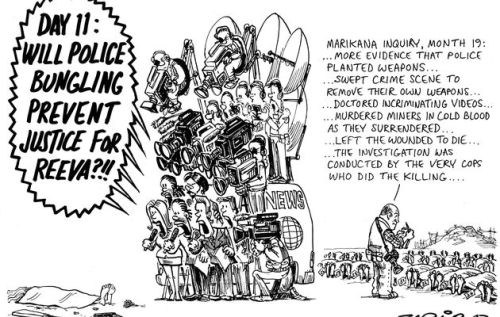
Pistorius vs Marikana – Zapiro on justice?

Zapiro140317tt


(From here)

I’m reminded of the article “The Law’s Majestic Equality” which opens with a quote from Anatole France: “The majestic equality of the laws prohibits the rich and the poor alike from sleeping under bridges, begging in the streets and stealing bread

Q&A with Elizabeth Henning

elbie

The aim of the Q&A series is to get an inside look into some of South Africa’s leading education academics, policy-makers and activists. This is the seventh interview in the series.  Elizabeth Henning is a professor of Educational Linguistics at the University of Johannesburg and head of the Centre for Education Practice Research (Twitter: @ElbieHenning).

1)   Why did you decide to go into education?

Decide? No, it happened.

The only bursaries available for kids who had no money were for nursing and teaching. Ruling party was clever. They insisted on good school records for their future teachers. In my matric year only two people got six distinctions in the then Transvaal white system. Both became teachers.

 2)   What does your average week look like?

Meeting with field workers, editing manuscripts, meeting with field workers, writing annual, quarterly (feels like daily) research reports, writing proposals for funding, squeezing funding into field work cost categories, looking for translators, trying to read current research on cognitive development of young kids, meeting with fieldworkers, trying to do some classroom research, reading policy docs and trying to align them with educational reality, stressing/hyperventilating  about the effect and the cost-effectiveness of Tante ANA, meeting with field workers.

3)   While I’m sure you’ve read many books and articles in your career, if you had to pick one or two that have been especially influential for you which one or two would they be and why?

Two oldies.

Jan Amos Komensky’s Didactica Magna, because he got it. There’s a teacher, there’s a learner and then there is content. Get on with it.

Lev Semenovich Vygotsky’s two books. He got it too. Pity he died so young. Specifically he said it so well – the ‘word’ that comes to you as you start to have ‘activity’ (Tätigkeit, ‘doingness’) is cognitively loaded and the way you use it will make a lot of the meaning for you (for me the central tenet of his work – semiotic mediation). And then his (so ahead of his time and spot-on with current neuroscience, but also coming from his knowledge of German philosophy) understanding that there’s some core knowledge (‘spontaneous concepts’ the English versions of his work say) and then there’s symbolic knowledge you get by instruction. And they meet in your early years on the planet and then what you do with them depends a lot on where you are on the planet.

4)   Who do you think are the current two or three most influential/eminent thinkers in your field and why?

Please can I mention four?

Elizabeth Spelke because she straddles education with developmental cognitive psychology and a bit of neuroscience and still manages to see the Vygotskian undertones of language and culture.

Jerome Bruner because he stayed with new ideas throughout his life and became critical of the ‘cultish’ ways of the new Vygotskians.

Stanislas Dehaene because he made the neuroscience of reading and of mathematical cognition accessible for anyone who can read.

Oh, and Bond and Fox because they were able to get ordinary folk like me hooked on Rasch modelling for test validity and I wish DBE would read them.

5)   What do you think is the most under-researched area in South African education?

Kids. Or ‘learners’ if you must.

Not issues ‘about’ them like other people’s ideologies. ‘Them’ as unit of analysis. Not their ‘learning outcomes’ or ‘scores’ for the ‘national learner’. Them.

This includes South African made and standardised and normed instruments  to serve as measures for diagnosing South African kids’ knowledge and find out where they are struggling, individually, so they can get help fast.

And this includes the effects of using imported English tests (or their down-watered versions) to capture the competences, abilities, attitudes etc etc.

Research questions:

When was the last standardised instrument with which to capture primary school  children’s competence in (insert here what you wish) developed and what was the theoretical bases of this tests?

6)   What is the best academic advice you’ve been given?

Read Goethe, Schiller, Shakespeare, Chekov, Strindberg, Van Wyk Louw and study the visual arts and music if you want to get to know the human condition from which you can then derive educational ideas. Beware of the pedagogists.

7)   If you ended up sitting next to the Minister of Education on a plane and she asked you what you think are the three biggest challenges facing South African education today, what would you say?

Foundation phase teacher development to understand kids not methods.

Foundation phase classroom size:  have you ever taught a kid the part-part whole concept of number, Ma’am. Now do it with 35 kids, Ma’am. While you are also crowd controlling them and code-switching ‘cause, Ma’am, they aren’t all really isiZulu speaking kids –  their parents just said so to get them into this school.

Foundation phase teacher education –  please give more bursaries and more lecturers to educate the students  and to inspire and love them and help them to make a stunning identity and pay these teachers more than others because, Ma’am, they build the foundation for your house of education. Thank you Ma’am Angie.

8)   If you weren’t in education what do you think you would be doing?

Farm with veggies and train new veggie farmers. Organic, of course.

 9)   Technology in education going forward – are you a fan or a sceptic?

Quite a fan but also a control freak.

 10) If you were given a R5million research grant what would you use it for?

Check out the Grade R and Grade 1 kids with a good representative sample – as they come in from home and before we inject them with our curriculum and our ‘methods’ of teaching.

Oh yes, and go visit the educational philosopher(s) who write about the ‘learnification’ of education and probe them on what makes their minds tick this way.

//

A full list of Prof Henning’s academic research can be found here. I particularly enjoyed her recent blog post “Matric begins in Grade 1

//

Some of the other academics/policy-makers on my “to-interview” list include Servaas van der Berg, Martin Gustafsson, Thabo Mabogoane, Veronica McKay, Hamsa Venkatakrishnan, Volker Wedekind, John Kruger, Linda Biersteker, Jonathan Jansen and Jon Clark. If you have any other suggestions drop me a mail and I’ll see what I can do.

Links I liked…

Child Bride

  • Revealing faux-magazine-cover exposing the horror of young children forced into marriage. For more see “Too young to wed
  • A cogent letter from an Indian judge and mother of a gay son – “In India if you’re gay you’re a criminal
  • Does America have to take sides in the Ukrainian crisis?” – Jerusalem Post: Only the best article I’ve read on the Ukrainian crisis…scathing, incisive and revealing. If you only read one article on the topic, this should be it…
  • Great NYT article by Maureen Dowd on American Political dynasties: “The Clintons don’t get defeated. They get postponed.
  • Why 30 is not the new 20 – scary (but enlightening) TED talk by Meg Jay
  • Chimamanda Adichie weighs in on the criminalization of homosexuality in Nigeria and Uganda.
  • Why is there a homophobe on the Global Fund? Great article on DailyMaverick
  • A Shifting Landscape: A Decade of Change in American Attitudes about Same-Sex Marriage and LGBT Issues” – fascinating report by the Public Religion Research Institute. Such encouraging findings and definitely a sign of things to come…
  • The boring development manifesto” – a wonderful and easy to read explanation why so many of the West’s efforts don’t work – Development Bloat is sexy, slog-and-grind incremental progress isn’t.
  • Quote of the week: “The distribution of income is determined by immensely complex processes in which government activity interacts with relatively autonomous initiatives and adjustments by ‘the myriad forces of the market’. There does not exist a well-tested, widely endorsed body of theory to model all of these processes. But it is clear that governments cannot readily control all of them, and there are limits to what governments may be able to do to change distributions. We must avoid assuming that if there is a change, or no change, government policy is responsible. Nor should we assume that government policies are either coherent or necessarily successful.” (Bromberger (1982: 167)


Dear UKZN, you know you’re doing it wrong when…

got any other bad ideas (stark)

For those of you who haven’t been keeping abreast of the recent student protests at UKZN (primarily around student funding, housing and fees), you may be interested to hear the latest development which is as sad as it is infuriating. On the 23rd of February four UKZN Masters’ students wrote an open letter to the Vice Chancellor Professor Makgoba criticising university policies and the VC himself. In response to the dissent, the UKZN Student Discipline Office has charged the four students with defamation and ordered them before the Student Discipline Court (see the list of disciplinary charges here).

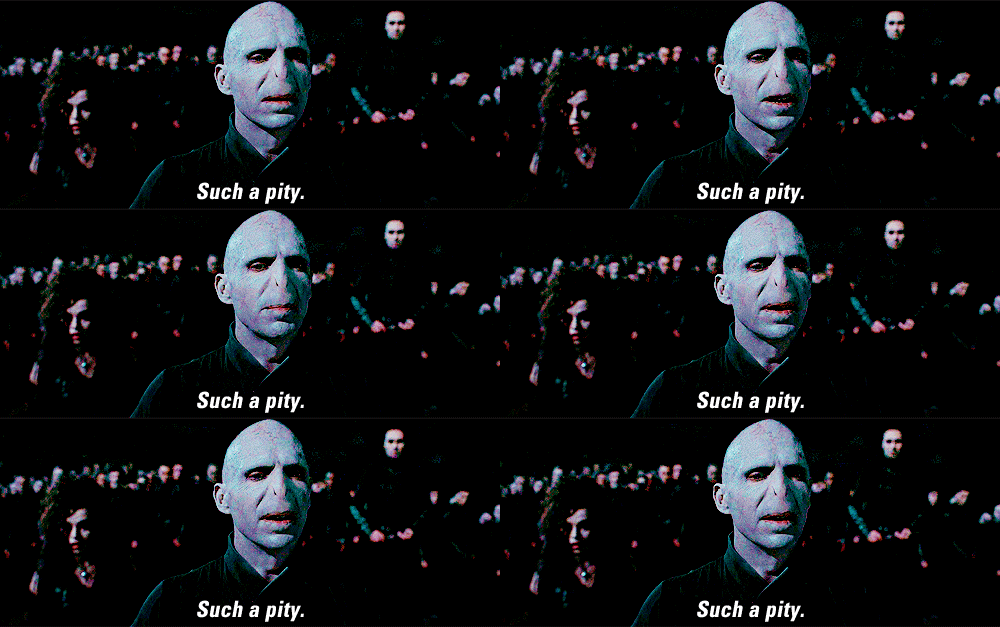
I’ve just read the letter and while it is verbose, riddled with spelling mistakes and sounds a little like an ill-informed political-manifesto, it is certainly not defamation.  It makes me furious to see the management at UKZN trying to intimidate these students into compliance and, presumably, discourage future dissent. This kind of knee-jerk response smacks of fragile egos and deep insecurities. Universities have always been a hot bed of critique and dissent being, as they are, a collection of intellectuals who usually understand the need for things like free-speech, critical thinking and dissent. Aside from the fact that UKZN’s approach here is morally repugnant and intellectually bankrupt, you also have to wonder, who on Earth is giving this University PR advice?! How did they think this was going to pan out? They presumably thought they were swatting a fly when in fact this strategy looks a lot more like the Dutch boy plugging holes in a breaking dyke, thinking somehow that this is a sustainable solution. Such a pity.

voldemort

As someone who did their undergrad at UKZN I am a more than a little ashamed that an institution of “higher learning” would take such a thuggish approach to something as harmless as a wordy letter from some politically-ambitious students. It’s called “engagement”/”discussion”/”dialogue”, you should try it sometime…

//

Also see the Right2Know write-up here.

Q&A with Eric Atmore

eric atmore

The aim of the Q&A series is to get an inside look into some of South Africa’s leading education academics, policy-makers and activists. This is the sixth interview in the series.  Eric Atmore is Adjunct Associate Professor of Social Development at the University of Cape Town and Director of the Centre for Early Childhood Development.

1)   Why did you decide to go into education and how did you get where you are?

 I grew up in an environment where education and learning was of prime importance.  My parents each had only modest schooling, Grades 8 and Grade 10 and they impressed upon their children to study, study and study.  This probably led to an interest in education.  My career path has been through social development initially, then leading a large early childhood development (ECD) organisation in Cape Town and then in 1994 founding the Centre for Early Childhood Development.  Throughout this period I lectured at the University of Cape Town where I have been Adjunct Associate Professor in Social Development since January 2009.

 2)   What does your average week look like?

 The beauty of working at the same time in social development, education and the academic environment is that there is no “average week”.  In any one week I can visit ECD centres, speak to parents and caregivers, assist with developing a management programme, teach 110 students in political economy, meet with donors, write an article for publication, consider how to structure our investments, supervise post-graduate students and then celebrate success with my colleagues.  Every week is busy but I try to make time each day to think about what we are doing, how we are do what we do, and how we are going to get to where we want to be.

 3)   While I’m sure you’ve read many books and articles in your career, if you had to pick two or three that have been especially influential for you which two or three would they be and why?

The most important book I have read has to be “Up the Organisation” by Robert Townsend (1970 and reworked in 2007). It is sub-titled “If you are not in business for fun or profit what the hell are you doing here?”  He was a business man who led Avis Rent-a-Car.  It has great advice such as “Don’t have assistants, give people real jobs”, “Lawyers are a liability”, “Don’t have reserved parking space for the boss” “Don’t have a mistress”, “Keep your promises”, “Small companies should be fun” and “Abolish your public relations department”. The other book is “What would Google do?” by Jeff Jarvis (2009).  It gives the reader an insight into how to run a company or organisation and it asks and answers the most urgent business questions of today.  The third book is “Outliers: The Story of Success” by Malcolm Gladwell (2008) which tells about extremely successful people and focuses on intelligence and ambition.

 4)   Who do you think are the current two or three most influential/eminent thinkers in your field and why?

 In the early childhood development field internationally it is Professor James Heckman, Nobel economic s laureate of 2000.  His work has influenced the field tremendously. In South Africa, Linda Biersteker has been very influential.  She is a close colleague. Sadly, there have been and still are a number of negative influences in the ECD sector, individuals who do not have the interests of children at heart.  Some have moved off the scene but some still remain.

   5)   What do you think is the most under-researched area in South African education?

 In the ECD sector we have research, some very good and some really bad.  What bothers me is that there is no link between research evidence, policy change and programme implementation.  So we know how many children there are, what they need and how the country can provide it.  But government does not use it, or avoids acting on the research which does exist. We do not need another study on the importance of ECD, this has been done. Probably the most needed research is on how do we turn what we know into action?

  6)   What is the best academic advice you’ve been given?

My third daughter Catherine, who is a final year BEd student at Stellenbosch University gave me the best advice ever.  She said: “Before you walk into the lecture theatre make sure that your fly is done up”.  I have followed this advice religiously.

 7)   If you ended up sitting next to the Minister of Education on a plane and she asked you what you think are the three biggest challenges facing South African education today, what would you say?

The biggest challenge is getting the political will of government to improve education.  I believe that the political will to improve education is not there.  The second challenge is to ensure that every school in the country has the basic infrastructure to function.  This means classrooms, qualified teachers, textbooks, desks amongst others.  This is linked to political will. The third challenge is to ensure that every child enters Grade 1 having had maximum opportunities to grow and thrive in a quality early learning environment.

 8)   If you weren’t in education what do you think you would be doing?

Probably a professional sportsman.  I played soccer representing South African Universities over a period of 7 years, I was South African Universities Heavyweight boxing champion, I have run marathons including TwoOceans and Comrades, I have completed the long-distance Ironman Triathlon so I guess a professional sportsman.

9)   Technology in education going forward – are you a fan or a sceptic?

 I am enthusiastic about technology, I encourage students to use technology in the lecture theatre during lectures.  For instance if we want to know the adult literacy rate in India I ask students to find this out whilst I talk.    However, the greatest technology lies between our ears but we do not seem to use it.

 10) If you were given a R5million research grant what would you use it for?

 I would assemble a dream team of education people (this is Dylan Wray’s idea) and give them two weeks to complete a plan for how to get quality education to every children in South Africa now.  The balance I would give to them to start to implement the plan.

 //

One or Eric’s recent (2012) articles discusses the “Challenges facing the early childhood development sector in South Africa” (co-authored with van Niekerk & Ashley-Cooper). For more research see here.

//

Some of the other academics/policy-makers on my “to-interview” list include Servaas van der Berg, Martin Gustafsson, Thabo Mabogoane, Veronica McKay, Hamsa Venkatakrishnan, Volker Wedekind, John Kruger, Linda Biersteker, Jonathan Jansen and Jon Clark. If you have any other suggestions drop me a mail and I’ll see what I can do.

0-3 years: *Must-read* Educational info for parents (from ZeroToThree)

zero to three

In doing some reading on Early Childhood Development I came across the Zero-to-Three website which is a treasure trove for those interested in scientifically-informed information on early childhood development for children aged 0-3 years (see links below). If you know of anyone with a baby (or expecting one soon) do send this on to them, I’m sure they will find it fascinating and immensely useful! As Nobel Laureate Professor James Heckman has said “Early learning begets later learning and early success breeds later success.” Also be sure to check out the Zero-to-Three website: http://www.zerotothree.org/

//

Everyday Ways to Support Your Baby or Toddler’s Early Learning

Download this handout (in both English and Spanish) to learn more about how you can support your child’s development from birth to three in the everyday moments you share. 

What We Know About Early Literacy and Language Development
This handout provides information on how early language and literacy skills unfold across the first three years of life.

Tips for Your Child’s Development Assessment
This handout provides tips on preparing for, and participating fully in, your child’s developmental assessment.

Healthy Eating Strategies for Young Children
This handout suggests 8 ways that parents can help their baby or toddler develop healthy eating habits in the first three years. [English ] [Espanol ]

Age-Based Handouts:

Birth to 12 Months 

Healthy Minds: Nurturing Your Child’s Healthy Development

Birth to 2 Months
English 
[286 KB]   Espanol  [387 KB]

2 to 6 Months
English 
[305 KB]   Espanol  [385 KB]

6 to 9 Months
English 
[286 KB]   Espanol  [379 KB]

9 to 12 Months
English 
[299 KB]   Espanol  [333 KB]

The Magic of Everyday Moments 

Birth to 4 Months
[
English ]  [Espanol ]

4 to 6 Months 
[
English ]  [Espanol ]

6 to 9 Months
[
English ]  [Espanol ]

9 to 12 Months 
[English ]  [Espanol ] 
Supporting Your Baby’s Language and Literacy Skills

Supporting Your Baby’s Thinking Skills

Supporting Your Baby’s Self-Confidence

Supporting Your Baby’s Self-Control


Your Baby’s Development

Birth to 3 Months

[232 KB  ] [Espanol  ]

 3 to 6 Months

[219 KB   [Espanol  ] 

6 to 9 Months

[239 KB  ] [Espanol  ]

9 to 12 Months

[243 KB  ] [Espanol  ]

12 to 24 Months

Healthy Minds: Nurturing Your Child’s Healthy Development

12 to 18 Months
English  [304 KB ]  Espanol  [324 KB ]

18 to 24 Months
English  [260 KB ]  Espanol  [331 KB ]

The Magic of Everyday Moments

12 to 15 Months
[English ] [Espanol ]

15 to 18 Months
[English ] [Espanol ]

18 to 24 Months
[English ] [Espanol ]

Supporting Your Baby’s Language and Literacy Skills

Supporting Your Baby’s Thinking Skills

Supporting Your Baby’s Self-Confidence

Supporting Your Baby’s Self-Control
Your Baby’s Development

12 to 15 Months

[232 KB  ] [Espanol  ]

15 to 18 Months

[224 KB   ]  [Espanol  ]

18 to 24 Months

[258 KB  ] [Espanol  ]

24 to 36 Months

Healthy Minds: Nurturing Your Child’s Healthy Development
English  [292 KB ]   Espanol  [336 KB ]

The Magic of Everyday Moments

24 to 36 Months
[English ] [Espanol ]

Supporting Your Baby’s Language and Literacy Skills

Supporting Your Baby’s Thinking Skills

Supporting Your Baby’s Self-Confidence

Supporting Your Baby’s Self-Control
Your Baby’s Development

24 to 30 Months

[228 KB  ] [Espanol  ]

30 to 36 Months

[239 KB  ] [Espanol  ]

Robocop, Ethics & Digital T-Rexs

robocop

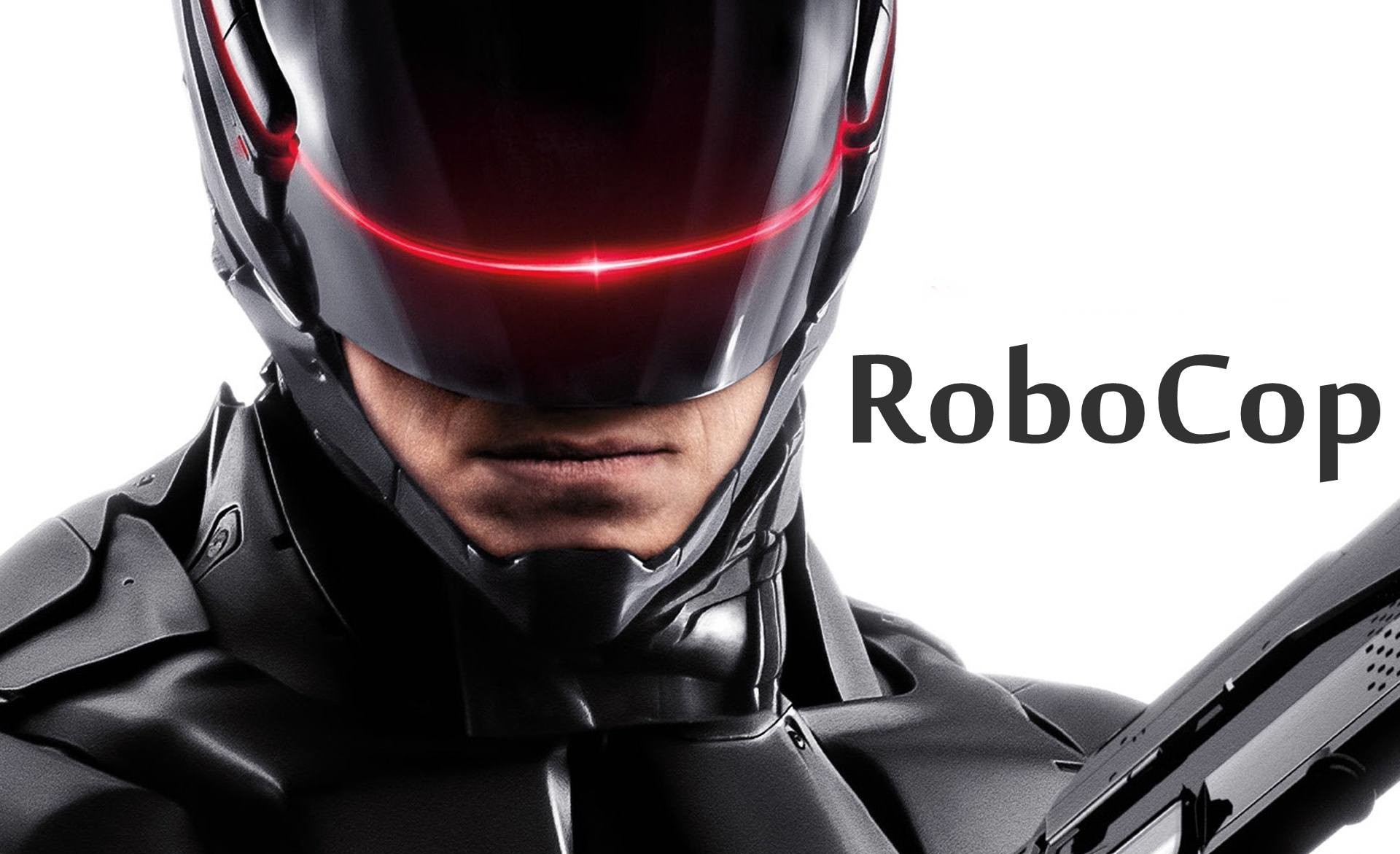
Yesterday I decided to go and watch the new Robocop movie at Montecasino. I’ve never been to Montecasino before and, for those who haven’t been before, it is quite a surreal place. They have tried to recreate an Italian piazza inside a gigantic building. There are cobblestone roads and Tuscan buildings, complete with window-sills and balconies. There are trees and fountains and all the other things you might expect in some rural Italian village (albeit a highly commercialized one). The main thing that was weird for me was that the “time” inside seemed to be permanently set at around 5:30/6pm. I’ve heard of this happening in casinos where they try and fool people into thinking it’s evening time when in fact it might be 10am. People are immediately lulled into an evening mind-set and the usual evening familiarities (especially drinking alcohol) kick in. This was the first thing that made me feel a little uneasy in this place, and the feeling didn’t go away until I left the “building”.

Then I watched Robocop. It’s a great movie and the gist of the story is as follows: 1) Awesome, honest, handsome likeable cop gets blown up in a car-bomb after investigating corruption, 2) tech firm approaches grieving wife and asks if they can try out a new technology which integrates man and machine and would save her husband’s life, and 3) the bad tech firm actually plans on using it as a big Trojan-Horse PR scheme to make the American people love robots and overturn a law prohibiting “autonomous” machines in the US. As I’m sure you can already see, it touches on a number of important ethical and philosophical questions. Where is the line between man and machine when we start integrating the two? When we have chips in our brains that control part of our functioning (identifying and eliminating baddies in Robocop’s case), are we responsible for those actions? What is the definition of agency? Consciousness? At what point does a human become a machine? Is a human brain planted on a mass of body-machinery still a human? What is the test for “being a human”? These may sound like ‘out-there’ questions, but they will soon be very much ‘in-here’ as these kinds of questions come before congresses and parliaments around the world. Lant Pritchett recently said something to the effect of: “Change takes longer than you think but happens quicker than you think” which I think I agree with. The time between the first airborne flight (1903) to the first man on the moon (1969) was only 66 years! Or look at how quickly we have evolved from Pagers to Google Glasses. It’s not simply that the rate of new technology is accelerating, but that the growth in the rate of acceleration is also growing. Scary stuff.

When I came out of the movie I saw an 82-inch ultra-HD television standing right there with such clarity and precision it looked completely surreal. I was mesmerized. By this stage I was laughing to myself. Then the final straw was when we sat down for dinner at a random restaurant and the waiter hands us iPad-menus! This is first time in my life that I have been given a digital menu, but it makes complete sense. When the net-cost-benefit of technology is lower than the net-cost-benefit of physical menus, digital menus will become ubiquitous. Obviously.

On a more philosophical note I think one of the reasons why the rate of growth in technology scares me is because the youth are far more likely to be the ones who invent, understand and appropriate new technology. Yet wisdom and experience are still concentrated largely among the aged (as they have always been). There is also a parallel in the technical and non-technical disciplines…

trex

The ones creating new technology are often not the ones who contemplate or understand the moral, ethical or philosophical implications of those inventions. New technologies are not always benign. It is highly possible that facial-recognition technology was in existence long before there were any laws governing its use (I wonder if there are laws governing its use now?!). Is it OK to walk around in public with a camera that can match people’s faces to their Facebook profiles? Have those people given their consent to be identified simply by being outside? Do they need to give their consent? What are the implications for opt-in and opt-out rules when it comes to facial recognition? What about satellite surveillance? It’s completely unsurprising when you hear that 50-year old lawmakers are decades behind 20-year old hackers. While facial recognition may not sound like a big thing to many of you, the stakes are likely to escalate rapidly. If we found a way to “augment” sight and digitally record our stream of sight, is that legal? Why or why not? Currently the US is deciding whether or not Amazon can use drones to deliver Amazon parcels. While that may sound pretty quaint and novel, these type of questions are linked to bigger ones, especially the role we are willing to assign to robots in society. If robots can deliver parcels, can they also clear snow? drive buses? prescribe medicine? make citizens arrests? shoot criminals? Where and how does one draw the line between what robots can and can’t do?

Technology is advancing at a rapid pace and it won’t be long before these kinds of questions and terms become part of our everyday lives, words like “intelligent technology”, “thinking robots”, “artificial intelligence”, “smart phones”, oh wait…

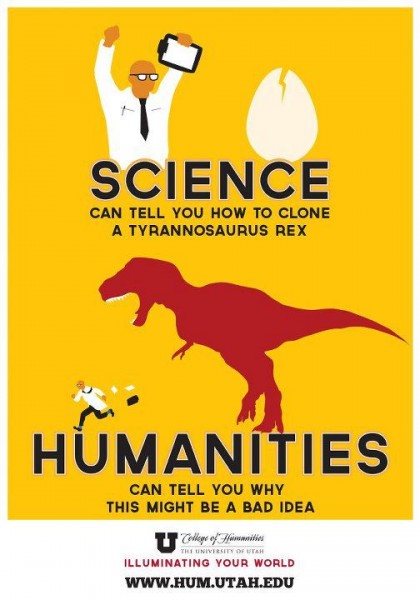
Don’t get me wrong, I love tech and I’m a big fan of innovation and progress, but let’s not be caught  with our pants down surrounded by a small army of digital T-Rexes!

//

PS If you haven’t seen the Google Glasses intro check it out here (scary and cool) and also check out one of Google’s new robots, Big Dog, from the Boston Dynamics stable.

Q&A with Johan Muller

jpm2

The aim of the Q&A series is to get an inside look into some of South Africa’s leading education academics, policy-makers and activists. This is the fifth interview in the series. Johan Muller is an Emeritus Professor in the School of Education at UCT


1)   Why did you decide to go into education and how did you get where you are?

 Short answer – by accident. I did my Masters in Organisational Psychology, discovered pretty quickly I didn’t want to work for Anglo, studied in Leiden where I drifted into sociology. First academic job back was in psychology at Turfloop (now Limpopo), when fate lent a hand: A mate of mine asked me whether I didn’t fancy coming to Wits to lecture in Education, about which I knew virtually nothing. To my amazement I was offered a job, teaching social/ educational theory. (He then went farming). This was the middle of the dismal 1980s and politics intervened, I became involved with the NECC, headed the first Education Policy Unit at Wits and never looked back. When UCT offered me a chair in education, I still had only my Masters in psychology. Does that say something about UCT or about education? (Don’t worry, I did the PhD since).

 2)   What does your average week look like?

 Ah well now, I’m retired, so I spend a lot of time reading, writing, and talking to the passing graduate student. I do odd jobs for Higher Education South Africa and UCT’s Research Office, and various universities around the country. Can’t complain.

3)   While I’m sure you’ve read many books and articles in your career, if you had to pick two or three that have been especially influential for you which two or three would they be and why?

Althusser’s ISA article lifted the lid on the deviousness of culture and its connivance with education; Gramsci’s Prison Notebooks told me you could get into trouble if you took policy too seriously; Durkheim’s work on religion showed me that science was religion (the ‘sacred’) by other, vastly more sophisticated, means; and Bernstein’s work tied a knot in it all that I haven’t been inclined to undo, and that proves vastly generative for me, day by day.

Not many educators in that list, you might say, but not many educators write very well, or with the combination of wit and passion that the above do. Reminds me why education was not my first choice. But I’ve learnt not to hold that against the learners bent on epistemic ascent.

  4)   Who do you think are the current two or three most influential/eminent thinkers in your field and why?

I consider my field to be sociology of education (that’s the discipline) and curriculum and educational policy as the applied domains. So the most important sociologists have to be Bernstein (experiencing a resurgence of interest), Bourdieu, currently Andrew Abbott and Randall Collins. These are important because all of them have written synoptically about how education ‘works’ in the social body of the nation state. Then more directly education, Stephen BallSteve RaudenbuschDavid Cohen, all of whom are smarter and more interesting than many others. Then there’s Martin Carnoy … and a longer list. My own focus is on knowledge, which shears me off a little from the mainstream.

 5)   What do you think is the most under-researched area in South African education?

 We have no idea what it will take to make knowledgeable teachers out of clueless ones, at least not while they are actually on-the-job. And I think the neurosciences will pretty soon say some surprising things to the educational enterprise, but I know of no-one in this country working there.

  6)   What is the best academic advice you’ve been given?

 Write that book!

  7)   If you ended up sitting next to the Minister of Education on a plane and she asked you what you think are the three biggest challenges facing South African education today, what would you say?

  Teachers, teachers and teachers. And, unlike most of my colleagues, I don’t think it’s what the teachers can’t do that matters; it’s what they don’t know that makes the critical difference. (Of course those are connected).

8)   If you weren’t in education what do you think you would be doing?

 Law, probably, that’s what my mother wanted me to do. Or writing novels.

9)   Technology in education going forward – are you a fan or a sceptic?

 Look, if 5% of educators said they were fans I’d be surprised. We’re natural Luddites, you see. But technology is going to advance very quickly, and prostheses that are some sort of extension of our brains is just around the corner.

 10) If you were given a R5million research grant what would you use it for?

 Doing neuro-social investigations of kids that succeed against the odds.

//

I have included a few of Joe’s articles below and a full list of his research can be found here,

//

Some of the other academics/policy-makers on my “to-interview” list include Servaas van der Berg, Martin Gustafsson, Thabo Mabogoane, Veronica McKay, Hamsa Venkatakrishnan, Volker Wedekind, John Kruger, Eric Atmore, Linda Biersteker, Jonathan Jansen and Jon Clark. If you have any other suggestions drop me a mail and I’ll see what I can do.

Q&A with Ursula Hoadley

ursula2

The aim of the Q&A series is to get an inside look into some of South Africa’s leading education academics, policy-makers and activists. This is the fourth interview in the series. Ursula Hoadley is an Associate Professor at UCT’s School of Education

1)   Why did you decide to go into education and how did you get where you are?

 I did a teacher training diploma after my degree, unsure of where I was headed, but wanting a qualification that would guarantee me a job. In the course of the Diploma I did a module on the sociology of education. I was absolutely transfixed. The lecturer (Dave Gilmour, who is now a colleague in the School of Ed at UCT) showed us the British documentary 7-Up, and thus began my interest in the relation between education and class, it’s reproductive processes and later, how to think about interruption. After the diploma I went straight on to do a Masters. I taught for a short period and then was offered a position on a research project based at UCT, part of the President’s Education Initiative study which was the first attempt at a systematic investigation of classrooms in South Africa.

 2)   What does your average week look like?

Spread between teaching, working with post grad students, research, admin and work with people and agencies outside my institution, like Equal Education Law Centre, UMALUSI, the fabulous Stellenbosch economics crew…! I try to run three times a week, and my university job is sandwiched by my other (wonderful) job – my 3 and 5 year olds.

 3)   While I’m sure you’ve read many books and articles in your career, if you had to pick two or three that have been especially influential for you which two or three would they be and why?

Very hard to answer this question. There have been many. The foundational sociology texts were fundamental to my thinking about education – especially Durkheim and Marx. Durkheim’s “Division of Labour in Society” and “Elementary Forms of Religious Life” especially provided a particular way of thinking about education as the specialisation of consciousness, a social process whereby the “outside” (society) becomes “inside” (to the individual consciousness). Basil Bernstein’s work opened up for me the abiding question in my own research  – why does schooling fail the working class? His work has been the most influential on my own work, because of the concerns but also because the theory is so generative in relation to empirical elaboration. There have also been a number of particularly influential texts in education: Dan Lortie’s ‘School Teacher’. This book completely fascinated me in its account of a systematic sociological analysis of teachers in the US. Who they are, why they are there, where do they come from etc. I’ve always wanted to do a replication of this type of study in South Africa. David Labarree: How to Succeed in School Without Really Learning. His historical/sociology analyses of education systems and their evolution is great.

 4)   Who do you think are the current two or three most influential/eminent thinkers in your field and why?

I like the bloggers and tweeters, like Diane Ravich and Doron Isaacs. You’re good like this too. Up to the minute responses to things that are going on, that are critical and thoughtful.

  5)   What do you think is the most under-researched area in South African education?

I think one is our teachers. I have wanted for a long time to do a study along the lines of Lortie (see above) – which uncovers who our teachers are, why they are there, how long they stay, what they read… I don’t think we clearly understand why teachers do the things they do in the classroom (and these are quite enduring things, that have some uniformity across similar contexts). Part of understanding that is understanding why and how teachers come to be in the classroom in the first place.

  6)   What is the best academic advice you’ve been given?

Read thinkers in the original. Don’t rely on secondary texts. I remember reading a lot about Durkheim, the division of labour etc. and then finally reading Durkheim in his own words. The ideas are very different in the original, generally more interesting and engaging and I find they stay in the mind. He writes beautifully. Like a very sophisticated old gentleman.

  7)   If you ended up sitting next to the Minister of Education on a plane and she asked you what you think are the three biggest challenges facing South African education today, what would you say?

Overshoot, overambitious plans. Why is a pre Grade R even being proposed at the point at which we can barely afford Grade R and have so little capacity in the system to deliver quality there? Why are we proposing a third compulsory language when we don’t have sufficient skilled language teachers, nor enough good texts, to teach a first and second? We need to be more modest in our goals.

The second is a lack of differentiation within the system. We can’t have the same plan for every school and every university. This is hard, but trying to hit all nails with the same hammer is buggering up the coffin… or something like that…

 8)   If you weren’t in education what do you think you would be doing?

  A documentary film maker. I have no idea whether I would be any good at it, but I have a fascination for the way an unusual or specific issue phenomenon is considered visually, and an argument constructed through film. I would love translating the research involved into an angle with an aesthetic.

9)   Technology in education going forward – are you a fan or a sceptic?

  Total skeptic, as you well know!

 10) If you were given a R5million research grant what would you use it for?

 A Lortie-style Sociology of teachers in South Africa study…

//

Some of Ursula’s recent research can be found below:

  • Muller, J. & Hoadley, U. (2012, forthcoming). Knowledge mobilisation in South Africa. In B. Levin (Ed.), Knowledge Mobilisation in Education. Policy Press.
  • Gamble, J. & Hoadley, U. (2011). Positioning the regulative. In: G. Ivinson & B. Davies. Bernstein’s sociology of knowledge: New developments, new possibilities, thinking outside the frame. London: Routledge.

Some of the other academics/policy-makers on my “to-interview” list include Servaas van der Berg, Martin Gustafsson, Veronica McKay, Hamsa Venkatakrishnan, Volker Wedekind, John Kruger, Eric Atmore, Linda Biersteker, Jonathan Jansen and Jon Clark. If you have any other suggestions drop me a mail and I’ll see what I can do.

Q&A with Stephen Taylor

Stephen-Taylor-160x200

The aim of the Q&A series is to get an inside look into some of South Africa’s leading education academics, policy-makers and activists. This is the third interview in the series.

Dr Stephen Taylor is currently an advisor and researcher in the Director General’s office of the national Department of Basic Education in South Africa.

1)   Why did you decide to go into education and how did you get where you are?

 After finishing school my interests lay mainly in the social sciences, so I decided to major in Political Science, Philosophy and Economics. I also did History and English at university. Upon finishing undergraduate studies it seemed to me that economics offered the widest range of applied career alternatives, so I felt that a BComm Honours degree in Economics was sensible.  One year goes by fast and so it seemed easy to continue with a one-year coursework Masters  in Economics.  Here I first was exposed to education through Professor Servaas van der Berg’s Economics of Education course.  At the end of a Masters Degree in Economics I felt that I had the perspective acquired through studies in Politics, Philosophy and Economics, but I felt that I still lacked a marketable skill.  So I thought hard about doing a postgrad LLB and even teaching, but in the end I decided to start out on a PhD focussing on the role of education in South Africa’s economic development.  The advantage of this topic was the quality of supervision available and that it was an applied issue – something very relevant in South Africa and in which a lot of work is already being done.  It was only really during my PhD that I learnt applied research skills, especially how to do survey data analysis.  In the context of increasing availability of nationally and internationally representative education data, these skills were enormously empowering and opened up powerful ways to contribute to education research.  After finishing my PhD in 2010 I continued to work in the RESEP group at Stellenbosch until in September 2011 I got an invitation to work in the national Department of Basic Education as an advisor and researcher in the office of the Director General.  I have been there since then, and have really enjoyed the policy environment, being able to assist in building internal technical capacity and I seem to have managed to continue with interesting academic work as well.

2)   What does your average week look like?

 I probably spend about 2 hours a week training others with the DBE (especially on data analysis and evaluation methods); about 8 hours a week in meetings where my role is mainly to give technical advice on projects such as running surveys and working with external service providers on research projects; about 8 hours working with raw data to respond to specific information queries or to form the basis of more academic research; about 6 hours writing academic papers or policy-oriented reports/briefs; about 6 hours on more administrative things such as responding to emails; about 5 hours reading; about 3 hours disseminating research and recommendations through presentations; and also some time these days on research project design (writing proposals, applications for funding, etc).  I think that gets me close to 40 hours.

3)   While I’m sure you’ve read many books and articles in your career, if you had to pick two or three that have been especially influential for you which two or three would they be and why?

 I’ll say the combined work of Esther Duflo, Abijhit Banerjee and Michael Kremer (and their collaborators), who through many experimental research projects in developing countries have shed considerable light on what works and what doesn’t work in schools that are attended by the poor.  Their book “Poor Economics” is an accessible read and has an exciting chapter on education, drawing on many of their experiences and specific research projects.  For a very short but comprehensive account of the sort of lessons this strand of work is producing, see this paper in Science, here.

4)   Who do you think are the current two or three most influential/eminent thinkers in your field and why?

Same as above: Esther Duflo, Abijhit Banerjee and Michael Kremer

5)   What do you think is the most under-researched area in South African education?

 We know incredibly little about what works to improve learning in the schools we have.  But let me pick one specific area:  What teacher support strategies actually work so that they change practice and consequently learning outcomes?

6)   What is the best academic advice you’ve been given?

 “A PhD is just an academic exercise.”  There is a temptation, especially with a PhD, to want to change the world through your research, but that can leave one feeling insignificant and actually keep you from making progress.  The important thing is to keep learning through doing research, and hopefully over time you will make a contribution.

7)   If you ended up sitting next to the Minister of Education on a plane and she asked you what you think are the three biggest challenges facing South African education today, what would you say?

 Diagnosis:  The fundamental problem in the school system is that as children progress through the school system not enough learning is happening in each year.  Put differently, learning trajectories are too flat. The problem is especially acute in the early grades where basic literacy and numeracy skills are not being acquired in time.  This leads to massive learning deficits which is the main cause of dropping out of school in grades 10 and 11.

Solution: Part 1: Address the root of the problem by coming up with a well-researched intervention in the Foundation Phase, which addresses both teacher capability and motivation. The challenge will be to design an intervention that avoids the typical implementation trappings of working within the large and decentralised system, by for example involving support from non-departmental actors, but that can also realistically be implemented at scale.

Solution Part 2: The reality is that we will not solve the root problem overnight and we have many children in the Intermediate Phase and early secondary school who have accumulated learning deficits.  We need to address these deficits through effective remedial interventions in order to help them cope with the grade-specific curriculum, which assumes earlier foundations are in place.  Here one should design, evaluate and implement an intervention such as afternoon classes focussed on foundational skills like reading, holiday learning camps or waiving the curriculum for a term to administer an intensive catch-up programme.  I would also take the opportunity while sitting next to the Minister to express support for the three major interventions under her leadership – CAPS, Annual National Assessments and the DBE Workbooks – which were the kinds of recommendations many of us were making 4 years ago.  These interventions need to be built on.  There is much room for improvement in their implementation and in the ways in which they can be used further.

8)   If you weren’t in education what do you think you would be doing?

 Okay, here comes a change in tone.  I have often considered law as well as teaching in high schools.  But right now, I think I’d consider devoting more time to be involved in Christian church work, specifically in planting new churches.  Why?! I really do believe in God, as revealed in the Bible and in the person of Jesus.  I am convinced that the message about Jesus, which is essentially an invitation to know him, is just as important and relevant as ever. And I believe local churches are a primary way in which God has chosen to reach out to people with this message.

9)   Technology in education going forward – are you a fan or a sceptic?

I’m a sceptic until I see a well developed concept that is feasible in terms of cost and the South African context, integrated into an instructional regime, and rigorously shown to positively impact on learning outcomes.

10) If you were given a R5million research grant what would you use it for?

I am currently trying to raise roughly this amount for a research project about how to improve early grade reading acquisition.  So to be consistent, I’ll say that I would use the money to implement this research project.  It uses a Randomised Evaluation methodology to rigorously measure the impact of 3 alternative reading interventions in combination with some qualitative research methods (mainly classroom observation) to answer the “why” questions.  You can read a short summary of this research proposal, which is already partly funded, here.

//

Links to some of Stephen’s recent Working Papers are included below:

Some of the other academics/policy-makers on my “to-interview” list include Servaas van der Berg, Martin Gustafsson, Veronica McKay, Hamsa Venkatakrishnan, Ursula Hoadley, Volker Wedekind, John Kruger, Eric Atmore, Linda Biersteker, Jonathan Jansen and Jon Clark. If you have any other suggestions drop me a mail and I’ll see what I can do.

Links I liked…

ele

  • The Annual National Assessments for literacy and numeracy (Grades 1-6 and 9) for 2011, 2012 and 2013 are now available for download on the Department of Basic Education’s website. I’m really impressed with the transparency of the DBE and this a great sign going forward. Now I just wish that subject-experts would download the tests and compare the difficulty levels and questions across the years. Is there anyone out there?!
  • The Illustrated guide to a PhD – classic illustration (thanks Hendrik van Broekhuizen)
  • Great 1min video “MOVE” which reminded me that I really need to go and travel again sometime soon! 
  • Where is it illegal to be gay? – great resource from the BBC (thanks @James Dray)
  • Great review of Nina Munk’s damning book (“The Idealist”) about Jeff Sachs and the Millenium Villages project. To his credit, Sachs answered my tweet and we eneded up having a great conversation about development and the meaning of “aid” – see my TL.
  • Random tid-bit of info – for those interested in SA-SAMS, the manuals can be found online here (Thanks Gabi).
  • Wielding Whip and a Hard New Law, Nigeria Tries to ‘Sanitize’ Itself of Gays” – Tragic article from the NYT. Unbelievable what gets done in the name of religion while those who support the religion say nothing. I’m reminded of Burke’s quote: “The only thing necessary for the triumph of evil is for good men to do nothing.”
  • Quote of the week (and very relevant for the discussion on ANAs in South Africa) – Campbell’s Law – “The more any quantitative social indicator (or even some qualitative indicator) is used for social decision-making, the more subject it will be to corruption pressures and the more apt it will be to distort and corrupt the social processes it is intended to monitor.” (thanks Jon Hodgeson)

Q&A with Brahm Fleisch

brahm

The aim of the Q&A series is to get an inside look into some of South Africa’s leading education academics, policy-makers and activists. This is the second interview in the series. 

Brahm Fleisch is currently a professor at the  Wits School of Education and head of the Educational Leadership and Policy Studies center

1)   Why did you decide to go into education and how did you get where you are?

In my first year of university (in the USA), I studied mathematics.  It became clear midway through the year that although I had been a good mathematics student in high school, university was a different story.  At the same time I began to get involved in anti-apartheid politics and slowly gravitated away from the sciences, ending up doing more politics and philosophy courses, eventually majoring in history and philosophy.  During my final year I was a little anxious that I would graduate without a marketable ‘skill’.  I saw on one of the notice boards a flyer offering students an opportunity to earn a temporary teacher ‘license’ simply by successfully completing ten weeks of teaching practice.

I spent the first year teaching in an excellent high school in Ithaca, NY.  I found the town a bit small, and was keen to spend some time in the big city.  It seemed like a good idea at the time to enrol in a Masters programme, not really thinking about the longer term implications.  After getting a part-time  job in New York City in a policy unit dealing with education, I got really hooked into the field.

2)   What does your average week look like?

 A real mix.  I spend considerable time with administrative issues as the head of a division.  Mostly an hour sorting out emails in the morning and at least one meeting per day.  During the term, I spend up to three days a week teaching, preparing to teach, or consulting with students.  One full day is spent with my graduate students, and then I squeeze in research and reading and writing.  My best time of the year is January and early Feb, most productive research time.   One small note about the research time, a substantial number of hours goes into administrative aspects of research, eg. Fundraising, managing contracts, networking with stakeholders etc.

3)   While I’m sure you’ve read many books and articles in your career, if you had to pick two or three that have been especially influential for you which two or three would they be and why?

Impossible to answer.  Over the past few years I have been influenced by the work of David Cohen, Deborah Ball, Stephen Raudenbush, Richard Elmore.  They have fundamentally reoriented my thinking to pay attention to ‘instruction’.

4)   Who do you think are the current two or three most influential/eminent thinkers in your field and why?

The problem with the question is that while I read debates in the US, the issues and challenges in middle income/developing country contexts are substantially different.

5)   What do you think is the most under-researched area in South African education?

Overambitious curriculum, and the issues that Pritchett & Co have written about.  There continues to be a tendency to blame teachers, a lack of resources and learners background for educational failure, but my sense is that there are a host of issues related to ‘instruction’ that need careful and original study.

6)   What is the best academic advice you’ve been given?

While I was working in a soft-funded research unit in New York City, one of the senior researchers told me that I needed to think of academic life as thirds, one third fund-raising, one third doing the research and writing it up, and one third doing dissemination.  She didn’t do any teaching, but put research ‘work’ into perspective.

7)   If you ended up sitting next to the Minister of Education on a plane and she asked you what you think are the three biggest challenges facing South African education today, what would you say?

 She sits in First Class, and even if I did get an upgrade . . . . .

  1. Getting the instructional programme right (instructional infrastructure, pitched at the right level with the right alignment and coherence)
  2. Corruption (at school level, the buying of promotion posts, the requirement to pay cooldrink money to teachers, etc.)
  3. Finding ways to create elite education within the public sector.

8)   If you weren’t in education what do you think you would be doing?

Farming

9)   Technology in education going forward – are you a fan or a sceptic?

 Sceptic.  Big sceptic.

10) If you were given a R5-million research grant what would you use it for?

I’d try to set up a small-scale Randomised Control Trial or counter-factual studies that provide robust evidence of initiatives or approaches that work.  R5m  would not go very far.

//

Some of the other academics on my “to-interview” list include Servaas van der Berg, Martin Gustafsson, Veronica McKay, Hamsa Venkatakrishnan, Ursula Hoadley and Stephen Taylor. If you have any other suggestions drop me a mail and I’ll see what I can do.

Q&A with Mary Metcalfe

Mary2

The aim of the Q&A series is to get an inside look into some of South Africa’s leading education academics, policy-makers and activists. We start the series with Professor Mary Metcalfe…  

1)   Why did you decide to go into education?

“Originally it was the only way that I could get funding to study – a teaching bursary.  Although the broad field of education was not inconsistent with my fundamental interest in social service, I have stayed in education for 40 years  – I started teaching unqualified.

2)   What does your average week look like during the semester?

 I am a visiting adjunct professor at Wits PDM, but I only go there when I see postgraduate students for supervision.  I currently spend all of my time on PILO (the Programme to Improve Learning Outcomes), and on my work as Chair of the Education Advisory Board of the Open Society Foundations.  The latter keeps me traveling often during the year.  PILO keeps me busy in the Northern Cape and in KZN.   This means many early morning flights and late evening returns.  I tend to have very long working days and working weekends.  I usually work in the evening listening to music, and try to stop working an hour or so before I sleep – or my mind is still racing and I can’t sleep!

3)   While I’m sure you’ve read many books and articles in your career, if you had to pick one or two that have been especially influential for you which one or two would they be and why?

Most recently, the person who changed my thinking a great deal has been Richard Elmore.  I couldn’t accept his notions of opening the teaching space at first glance – my professional education was deeply rooted in the independent professional judgement of the educator.  It took some thinking to realize that this is actually a deeper professionalism.

4)   Who do you think are the current two or three most influential/eminent thinkers in your field?

Linda Darling-Hammond, Ben Levin, and Helen Timperley 

5)   What do you think is the most under-researched area in South African education?

The social context of secondary schooling and how this impacts on learning and retention – dropout, self-esteem, and the consequences of this for families.

6) If you could highlight one of the pieces of advice you regularly give your students, what would it be?  

I’m not sure that I have said anything stupendous.  I am very keen for students to construct arguments well and to be able to use the literature to do so without losing their own voice.

7)   If you ended up sitting next to the Minister of Education on a plane and she asked you what you think are the three biggest challenges facing South African education today, what would you say?

  1. To understand the constitutional framework for the roles and responsibilities of the national and provincial departments of education.  Norms and Standards are a critical instrument and have not been adequately used as an instrument for accountability, planning, and to create justifications for the financing to achieve the careful plans developed at provincial level. It is the provincial plans that matter, and it would be great if the national department used the norms and standards component of the South African Schools Act to assess these plans. Norms and Standards can be set for a variety of key elements of quality – and the provinces should report as envisaged in the Act.  Where there are careful plans with capacity, the funds might follow.
  2. I’d also highlight the internal efficiency of the system.   We are running short of funding – the personnel share is growing which has dire consequences for quality – and there is too much wastage in the system. Poor quality results in repetition, failure and drop out.  We need to move on the Grade 10 exam so that young people who leave before NSC have a credential, and to take the pressure off of the NSC which must assess so much.  
  3. A sense of hope amongst teachers that they will be supported – that they will be helped with the problems that they face. 

8)   If you weren’t in education what do you think you would be doing?

I have stayed in education because I believe that it is the key mechanism to change lives, and build development. Nothing can do this better.

9)   Technology in education going forward – are you a fan or a sceptic?

A great fan.  I think about this a lot and try to keep up to date.  In PILO we are using technology in some interesting ways – but it is “over-sold and underused” as Cuban has said.  Capacity must be there for the entire value chain, and there must be thorough M and E. We must insist on open education resources wherever possible, and work towards technology being an instrument of achieving equality.”

//

Some of the other academics on my “to-interview” list include Brahm Fleisch, Servaas van der Berg, Martin Gustafsson, Veronica McKay, Hamsa Venkatakrishnan, Ursula Hoadley and Stephen Taylor. If you have any other suggestions drop me a mail and I’ll see what I can do.

SACMEQ data archive available for download

sacmeq

The SACMEQ data for 14 sub-Saharan African countries is now available for download for anyone who registers on the SACMEQ website (it only takes 5 minutes). This is a tremendously rich dataset and I’d encourage anyone who is interested in the quality of education in Africa to download it and explore. For some background reading I’d recommend the following:

Links I liked…

venn matters

  • As far as intellectual crushes go, I am a huge fan of Bill Easterly – listen to his EconTalk podcast on benevolent autocrats
  • The richest 300 people in the world have the same wealth as the poorest 3000,000,000 (3 billion) – absolutely illuminating and truly scary 3 minute infographic video
  • Sad day for LGBT rights in Nigeria as President Goodluck Jonathan bans same-sex marriage in the country.
  • Political prophet Alistair Sparks writes an insightful piece on what another 5 years of Zuma means for the ANC and South Africa.
  • Chart showing Africa from an LGBT rights perspective. Just another way that South African is different to the rest of Africa – it respects the rights of minorities irrespective of the size of the majority.
  • US parents are 2.5 times more likely to ask Google “Is my son gifted?” than “Is my daughter gifted” – NYT article showing the ongoing legacy of gender inequality and patriarchy.
  • Causal evidence that secular education reduces religiosity among girls in Turkey – no surprises there folks (see NBER paper here).
  • SAFM Forum at 8 – the podcast from my radio discussion on “Back to School
  • Given the jamboree around the matric 2013 results I found myself on TV a few times this month 1) School dropout in South Africa: 550,000 – eNCA, 2) Teacher content knowledge in South Africa – News24, 3) Mathematics literacy in South Africa – News24. Fun times!
  • Mweli Mathanzima (acting DDG for curriculum) wrote a response to my article (ANA results are not comparable), his article titled “No ANA mess, they’re a success.” I’m still contemplating if I want to right a reply to his reply but I think I will wait for the inspiration to hit. The main criticism I have (encapsulated in the title of my article) is that the Minister should not be claiming “improvements” using ANA changes year on year – something that Mweli does not address. The question is pretty straight-forward, does he agree or disagree with the Minister that the ANA results prove that things are improving? The short answer is that they CANNOT be used to show improvements or deterioration because they aren’t psychometrically calibrated to be compared year on year…anyways I’ll probably write a short reply sometime.
  • The DBE has called for comment on its new policy “Incremental introduction of African Languages Policy” and asked for comment. If you feel strongly about the potential upsides/downsides then the call for public comment closes on the 12th of Feb.

Education in SA – Still separate and unequal (Extended version of CityPress article)

Mud schools, no lights or electricity, overcrowded. Madelene Cronjé

[The article below is an extended version of my article published in CityPress on the 12th of January 2014]

When the matric results were released on Monday this week, the Deputy Minister of Education Enver Surty chastised us in academia for “denigrating” the schooling system, claiming that now is not the time for pessimistic criticism but rather for celebration and “inspiring hope”. The Deputy Minister will have to forgive me because I find it incredibly difficut to celebrate when no one is really acknowledging the 550,000 students who started school 12 years ago but have been silently excluded from the schooling system, dropping out before matric. To be specific, of 100 students that started school 12 years ago, only 51 made it to matric in 2013, 40 passed and 16 qualified to go to university. These youth that drop out before matric are completely marginalized and pushed to the fringe of society, forgotten amidst the hype of those who passed. Minister Motshekga is no exception. In her 5000 word speech, she devoted all of 10 words to discussing the issue: “The sector needs to urgently reduce repetition and dropout  drastically.” That’s it. Two strong adjectives and a hat tip?

I’ve been told  by some that now is not the right time to talk about this. But when is the right time to talk about it? June? September? It’s never comfortable or convenient to talk about half a million children dropping out of school and facing unemployment or menial work – something that happens year in and year out.

By not addressing drop out and repetition Minister Motshekga did a disservice to the country, but perhaps even more disturbing were the sweeping statements that fly in the face of hundreds of research reports on South African education. In discussing the results the Minister claimed that: “Contrary to what some would like the nation and the public to believe – that our results hide inequalities, the facts and evidence show that the two top provinces (Free State and North West) are rural and poor…The truth is in terms of learning outcomes in the sector, education remains an equalizer between poor and rich.”

To address the second part of this statement first, if South Africa’s education is an “equalizer” between poor and rich, why is it that South Africa’s income inequality has increased since the transition? While it is certainly true that if quality education is offered to rich and poor alike it will lead to a situation of increased social mobility, this is not the case in South Africa. In South Africa we have two public schooling systems: one which is functional, wealthy, and able to educate students (about 25% of public schools); with the other being poor, dysfunctional, and unable to equip students with the necessary knowledge and skills they should be acquiring in their schooling career (roughly 75% of public schools).

Apart from a small minority, most black children continue to receive an education which condemns them to the underclass of South African society, where poverty and unemployment are the norm, not the exception. This substandard education does not develop their talents and abilities or expand their economic opportunities, but instead denies them dignified employment and undermines their own sense of self-worth. In short, poor school performance in South Africa reinforces social inequality and leads to a situation where children inherit the social station of their parents, irrespective of their motivation or ability. That is how income inequality increases.

The second part of her statement – that matric results do not hide inequalities – is also patently untrue. The matric results, like every other educational data set in South Africa, hide enormous inequalities that sometimes aren’t immediately apparent. Before getting to the matric 2013 results, let me summarize some of the findings from the numerous studies highlighting South Africa’s ongoing educational inequalities: 1) The SACMEQ study of 2007 showed that there are huge geographic inequalities in the country with 41% of rural Grade 6 children being functionally illiterate compared to only 13% of urban grade 6 children. The prePIRLS study of 2011 showed the large linguistic inequalities exist: Of those children whose home language was Xitsonga, Tshivenda or Sepedi, one in two (50%) could not read by the end of Grade 4 compared to one in ten (11%) for English and Afrikaans children, and 3) The General Household Survey of 2011 showed that there are large racial inequalities in matric attainment: only 44% of Black and Coloured youth aged 23-24 had attained matric compared to 83% of Indian youth and 88% of White youth. We could also look at the TIMSS study of 2011 or the NSES study of 2009 or any of the Annual National Assessments or a host of others – they all show the same thing – systemic inequalities and underperformance.

But if we take a closer look at the matric results for 2013 we will see that they too hide severe inequalities. When allocating funding to schools, the Department classifies them into one of five categories called quintiles. Each quintile is meant to have 20% of schools ranging from Quintile 1 (the poorest 20% of schools) all the way up to Quintile 5 (the richest 20% of schools). The funding allocations are pro-poor with Quintile 1 schools receiving R905 per learner and higher quintiles receiving progressively less funding all the way up to Quintile 5 schools which receive R156 per learner. On the surface the differences between the matric pass rate by quintile are not too large with 70% of matrics from Quintile 1 passing and 92% of matrics from Quintile 5 passing. But this hides the fact that pre-matric dropout is twice as high in Quintile 1 compared to Quintile 5. If we looked at the number of enrolments in Grade 8 in 2009 (i.e. when the matric 2013 class was in Grade 8) there were 206,031 students in Quintile 1 schools and 141,905 students in Quintile 5 schools (the numbers are not equal between quintiles because schools prefer to be classified in lower quintiles to receive higher subsidies). But by the time they got to matric there were only 105,954 Quintile 1 matrics and 104,344 Quintile 5 matrics. That is to say that 49% of Quintile 1 students dropped out between Grade 8 and Grade 12 but only 26% of Quintile 5 students dropped out between Grade 8 and Grade 12. So if we rather calculate the matric pass rate as a percentage of those enrolled in Grade 8 four years earlier the figures change drastically being 36% in Quintile 1 and 68% in Quintile 5, i.e. of 100 Grade 8 Quintile 1 students, only 36 made it to matric and passed. Of 100 Grade 8 Quintile 5 students, 68 made it to matric and passed. Similarly, the proportion receiving bachelor passes by quintile is only 36% for Quintile 1 matrics and 68% for Quintile 5 matrics But if we calculate it as a percentage of Grade 8 enrolments four years earlier the figures drop to an abysmal 10% for Quintile 1 and 39% for Quintile 5. As a proportion, the number of Quintile 5 students in Grade 8 that will go on to pass matric with a bachelor’s pass is four times higher than that for Quintile 1 students. These shocking results are not limited only to Quintile 1 – the graph shows that the results are very similar in Quintiles 2, 3 and 4.

quintile

In highlighting these results it is not my intention to be the prophet of doom of South African education. I actually do think things are improving and we should give praise where it is due. Minister Motshekga has presided over a number of very important reforms including the introduction of the Annual National Assessments (ANAs), the implementation of Curriculum Assessment Policy Statement (CAPS), the roll out of the workbooks and the establishment of NEEDU. By focussing on the basics the Minister has laid the foundation for improvement and I agree that we are beginning to see the fruits of these efforts. Because of this I also happen to think she is the best  Minister of Education we have had to date. But to claim that the results do not hide inequalities is absolutely unforgiveable. If there is one thing that is clear from the local and international research on South African education it is that our schooling system is egregiously unequal. That finding is simply not up for debate.

While the low-level equilibrium that South Africa finds itself in has its roots in the apartheid regime of institutionalised inequality, this fact does not absolve the current administration from its responsibility to provide a quality education to every South African child, not only the rich. Until such a time as the Department of Basic Education and the ruling administration are willing to seriously address the underlying issues in South African education, at whatever political or economic cost, the existing patterns of underperformance and inequality will remain unabated.

Nic Spaull is an education researcher in the Economics Department at Stellenbosch University. He blogs about education research at www.nicspaull.com and he can be followed on Twitter @NicSpaull

Additional reading: