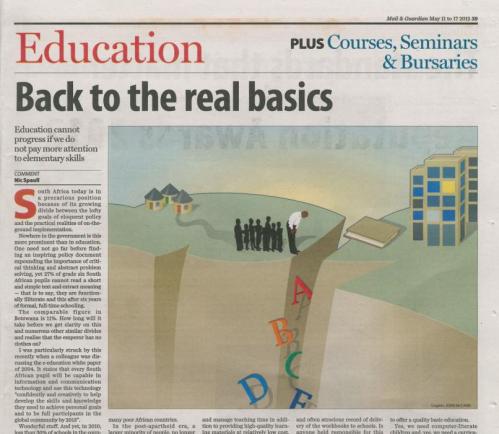
M&G article – intervene as early as possible

I have an article in this week’s M&G discussing when and how we should intervene to right the wrongs of apartheid. You can read it here. In short, fighting inequality in the labour market will only have limited success because the patterns of who has which skills have already been cemented for many years. Rather we should be intervening as early as possible (preschool) and fighting the generative mechanisms of inequality rather than simply dealing with the effects of those generative mechanisms. Interested to hear people’s thoughts on this…

NAPTOSA Keynote presentation – Education in SA

Image

On Friday the 27th of August I gave the keynote address at the NAPTOSA annual conference in Durban. The presentation is downloadable here: “Education Report Card 1996-2011: An Ailing System”. I also wrote up most of the speech as an article which is now available online on the Politicsweb website: Education in SA: a tale of two systems. All in all it was a great time in Durban. 

Read on…

Links I liked

Haha - Sneaky sea monster #elephante

The Godfather speaks…Schleicher on PISA 2009

If you have any interest in education and international educational research, watch this video. Andreas Schleicher (director of PISA) presents the PISA 2009 results at a conference. You can download the powerpoint here.

Links I liked…

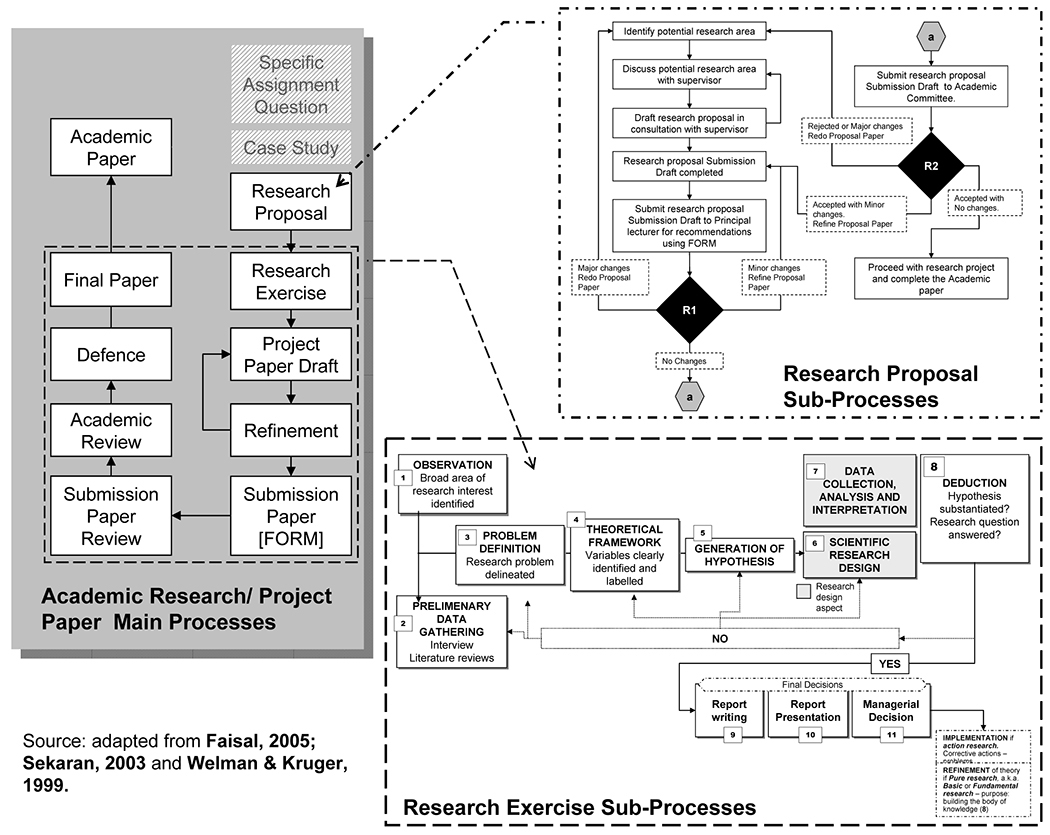
The research process – a flow chart

Great flow chart on the research process – see high-res version here

Existential literacy

“The illiterate of the 21st century,”Alvin Toffler famously said“will not be those who cannot read and write, but those who cannot learn, unlearn, and relearn.” Our outlook on the world and our daily choices of disposition and behavior are in many ways learned patterns to which Toffler’s insight applies with all the greater urgency – the capacity to “learn, unlearn, and relearn” emotional behaviors and psychological patterns is, indeed, a form of existential literacy.”

Such wisdom from the BrainPickings Sunday newsletter. My recent trip home was basically all about existential literacy (both mine and others) – this will be on my to-do list for the foreseeable future! 

Invest in yourself

For a long time now I have been convinced that financial investments are inferior to investments in one’s skills, knowledge and capabilities. Initially it was just a hunch, a by-product of my worldview. But the more I thought about it, the more it became clear that investing in myself made more sense than investing in financial assets. The aim of an investment is to achieve some return, benefit or gain in the future. In essence it involves limiting one’s current consumption possibility frontier in order to increase one’s future consumption possibility frontier. This is all very general, abstract, and theoretical, i.e. wonderful. 

As the times have changed, our notions of what is valuable have also changed. Where previously physical assets were the be-all and end-all of wealth and power, our current system runs along the contours of knowledge and information. Whenever I doubt this truth I remind myself that one little piece of technology the size of a coin (USB stick), with one little virus coded in ones and zeros has the potential to send the entire world into chaos. This has never happened, thankfully, but you don’t have to be a futurist to know the devastation that could be caused by a virus that randomly reallocated wealth, and since the majority of the world’s wealth is measured with digital placeholders – not land or gold or something tangible – this is entirely possible.

This is true of the world, but it is also true of the individual. Your most valuable asset is your brain, the repository of your skills, knowledge and capability. You can invest in bonds and stocks and try and secure your financial future in that way, but a more reliable and rewarding way is to invest in yourself. If you lose all your financial wealth and your possessions vaporize into the ether, you will still have your brain and the skills you have acquired, unless you are dead in which case it doesn’t matter. I’m still working on the mental-disability critique (perhaps take out insurance?!). If you accept that you are your most important asset, then you should spend your money in such a way as to grow your range of skills, knowledge and capabilities. That includes most books, meaningful travel, new courses, and self-study – these are INVESTMENT expenditures, not CONSUMPTION expenditures. Mistaking these two leads to sub-optimal allocations of income. Next time you invest in a financial asset, do so with the explicit reminder that you are implicitly saying that the return on that financial investment is more than the return on investments in your own skills. 


Race Attitudes and Education – EG Malherbe speech 1946

PDF of the book “Race Attitudes & Education” by EG Malherbe (1946) which is his speech from the Hoernle Memorial Lecture for the SA Institute of Race Relations – 17 pages and well worth the read.

Some notable excerpts:

“Troops fight well in proportion as they understand the things they are fighting for as well as the things they are fighting against” – Malherbe 1946

 
“Mr Hofmeyr devoted his first Memorial Lecture last year to a discussion of the bearing of the Christian principles on race problems. He showed how the central truth of the Fatherhood of God carried with it “the implication of the brotherhood of man, irresepctive of race or creed or colour and the concept of a world-wife family, all the members of which stand in the same relationship to its Head.” He also showed how “this family association is independent of the physical origin and the racial characteristics of those who make it up” p3
 
“So what do we have here: a country where there is on the one hand a tendency to oppress the Jews because they are so few and so clever, and on the other hand a tendency, equally strong, to deny democratic privileges to the natives because they are so many and so ignorant” p7
 
“Racial prejudices operate on the emotional plane and often spring from fear and a curious set of inferiority complexes.” p7
 
“English-Afrikaans relationships have improved considerably amongst the men in the army. We have strong proof that as a result of playing, working, fighting, suffering and dying together, a mutual appreciation and in many cases genuine affection has sprung up” – Malherbe 
 
“Education for mere literacy is not enough. In fact, that stage of education is in many respects a dangerous one, because it is too inadequate. It makes him an easy prey of propaganda through press headlines which is all he usually reads in a newspaper. he has not had enough education to make him propaganda-proof. One of the functions of education is to develop in men defence mechanisms against having their critical sense blurred or their consciences violated. A man should at least know when he is being propagandized. If a person’s schooling is insufficient to provide this armour, he should be taken care of by means of a system of adult education. in fact I am convinced that in matters of social and political education the late adolescent and adult period is far more important than the ordinary school age period.”
 
Professor Edgar Brookes realized this when he so succinctly summed up the South African’s attitude to Native education as “too humane to prohibit it, but too human to encourage it” p22
 
“Even the fine idea of trusteeship is not without its shortcomings in practice. According to this the natives stand in relation to Europeans as wards to a guardian who accepts as “a sacred trust of civilization” the task of helping his immature wards on to those advantages of civilization which they are unable to attain for themselves. I sometimes wonder whether those who carried out this concept have considered, at least in the Union, the possibility that the wards should or will ever grow up. There is no Master of a Supreme Court to ensure that this trusteeship does not become stepmothering!” p22
 
“Plato said that the man who wrote the nation’s songs wielded greater influence than the man who made the nation’s laws. I would say that the men who write the headlines of our newspapers wield far greater influence than our legislators”
 
“These were men trained and experienced in the techniques of adult education and it will not be easy to recruit that type of objective minded and well-informed officer again. I very much fear that if an attempt is now made to start, the whole movement might be becalmed in the haven of mediocrity. The idealism, the enthusiasm as well as the intellectual capacity will not be there to buy” p24
 
“Education for leaders should be our first objective amoungst the Non-European. To spread mere literacy thinly amongst the masses is dangerous, unless it is accompanied by the training of truly educated leaders who can guide the masses and who will see to it that their little education is not exploited and cultivating more bitterness” p26
 
The mark of a good education is to see such things in their right perspective and not to mistake the exceptional (however serious and annoying) for the significant. p27
 
“The chief reason why one war has always followed another throughout history seems to me to be in large measure due to the fact that the self-sacrificing idealism, without which battles cannot even be fought, much less won, and with which youth is so generously endowed, is featured in times of war and discounted in times of peace. When youth are faced with the necessity to undergo hardships, sufferings, and death in order to save their countries from disaster, they are implored to become idealists. Even the most crass-minded realist knows that no other philosophy can sustain men’s minds in moments of crisis. Once the crisis is over, the order of the day to youth is that they all put away their idealism as they do their outmoded weapons of combat. He who sacrifices his personal interest in the cause of the common good in war is called a hero. He who imagines that such principles of behavior should be put into practice in times of peace is apt to be thought of as an unrealistic, starry-eyed idealist. The one has a crown as the reward of his labours, and the other a cross.”
John M Fletcher in The Virginia Quarterly Review (quoted in Race Attitudes and Education by E G Malherb 1946)

Critical Christianity

Recently I have been struck by the number of non-thinking Christians. Christianity is not simply a cultural affiliation for those raised in the Western Tradition. It is a distinctive Weltanschaaung with non-trivial implications. The problem with compartmentalized Christians is that their faith and their thinking are seen as two separate affairs which negatively affects both their faith and their thinking. Their faith is naive, and their thinking is deficient. While I agree that the foundational truths of Christianity (i.e. those necessary for salvation) are understandable to 13 year olds, I also believe that faith and reason are not incompatible, and furthermore that worshiping God with our minds is actually a command, and thus not an optional extra.

This is expressed so wonderfully in Bethlehem Seminary’s Core Values:

“If God has inspired a Book as the foundation of the Christian faith, there is a massive impulse unleashed in the world to teach people how to read. And if God ordained for some of that precious, God-breathed Book to be hard to understand, then God also unleashed an impulse to teach people how to think about what they read—how to read hard things and understand them, and how to use the mind in a rigorous way. Therefore, we endeavor in all of our intellectual inquiry to love God with our minds by thinking deeply and humbly about his word and his works.”

Tim Keller provides a great example of this in his discussion on ““Creation, Evolution, and Christian Laypeople” (PDF) where he asks “How do we correlate the data of science with the teaching of Scripture?”  Also watch the debate between Professor Richard Dawkins and the Archbishop Rowan Williams on “The nature of human beings and the question of their ultimate origin.” If Christianity is such a big part of your life, why haven’t you thought about it at least as much as all the other areas?

The Emperor has no clothes…

I wrote an article for this week’s Mail & Guardian with the original title “The Emperor has no clothes on” which subsequently got changed to “Back to the real basics” which is perhaps less obscure but far less sexy. Nevertheless I am quite attached to the analogy from Anderson’s fairy tale and I am committed to using it with reference to the SA education system at some point in the future. The article is available on the M&G website here, and in PDF version here. There is also a nice article from The MercuryLack of accountability hitting pupils hard” which quotes some of my research. All in all it was a good week…

Idealism

“The chief reason why one war has always followed another throughout history seems to me to be in large measure due to the fact that the self-sacrificing idealism, without which battles cannot even be fought, much less won, and with which youth is so generously endowed, is featured in times of war and discounted in times of peace. When youth are faced with the necessity to undergo hardships, sufferings, and death in order to save their countries from disaster, they are implored to become idealists. Even the most crass-minded realist knows that no other philosophy can sustain men’s minds in moments of crisis. Once the crisis is over, the order of the day to youth is that they all put away their idealism as they do their outmoded weapons of combat. He who sacrifices his personal interest in the cause of the common good in war is called a hero. He who imagines that such principles of behavior should be put into practice in times of peace is apt to be thought of as an unrealistic, starry-eyed idealist. The one has a crown as the reward of his labours, and the other a cross.”
 
John M Fletcher in The Virginia Quarterly Review (quoted in Race Attitudes and Education by E G Malherb 1946)

Reading roundup.

  • “This is not just a problem of the need for more money or doing what we are doing better,” says Berdegué. “The challenge that we all have today is to decide what kind of development we should aim for and what we need to make that happen.”

Abolition of Slavery: morality > economy ?

“A deep stain on Christian history is the African slave trade. Since Christianity was dominant in the nations that bought and sold slaves during that time, the churches must bear responsibility along with their societies for what happened. Even though slavery in some form was virtually universal in every human culture over the centuries, it was Christians who first came to the conclusion that it was wrong. The social historian Rodney Stark writes:

“Although it has been fashionable to deny it, anti-slavery doctrines began to appear in Christian theology soon after the decline of Rome and were accompanied by the eventual disappearance of slavery in all but the fringes of Christian Europe. When Europeans subsequently instituted slavery in the New World, they did so over strenuous papal opposition, a fact that was conveniently ‘lost’ from history until recently. Finally, the abolition of New World slavery was initiated and achieved by Christian activists.”

Christians began to work for abolition not because of some general understanding of human rights, but because they saw it as violating the will of God. Older forms of indentured servanthood and the bond-service of biblical times had often been harsh, but Christian abolitionists concluded that race-based, life-long chattel slavery, established through kidnapping, could not be squared with biblical teaching in either the Old Testament or the New. Christian activists such as William Wilberforce in Great Britain, John Woolman in America, and many, many others devoted their entire lives, in the name of Christ, to ending slavery. The slave trade was so tremendously lucrative that there was enormous incentive within the church to justify it. Many church leaders defended the institution. The battle for self-correction was titanic.

When the abolitionists finally had British society poised to abolish slavery in their empire, planters in the colonies foretold that emancipation would cost investors enormous sums and the prices of commodities would skyrocket catastrophically. This did not deter the abolitionists in the House of Commons. They agreed to compensate the planters for all freed slaves, an astounding sum up to half the British government’s annual budget. The Act of Emancipation was pased in 1833, and the costs were so high to the British people that one historian called the British abolition of slavery ‘voluntary econocide.’

Rodney Stark notes how historians have been desperately trying to figure out why the abolitionists were willing to sacrifice so much to end slavery. He quote the historian Howard Temperley, who says that the history of abolition is puzzling because most historians believe all political behaviour is self-interested. Yet despite the fact that hundreds of scholars over the last fifty years have looked for ways to explain it, Temperley says, ‘no one has succeeded in showing who campaigned for the end of the slave trade…stood to gain in any tangible way…or that these measures were other than economically costly to the country‘. Slavery was abolished because it was wrong, and the Christians were the leaders in saying so. Christianity’s self-correcting apparatus, its critique of religiously supported acts of injustice, had asserted itself.”

From Tim Keller’s “The Reason for God

26 April, 2012 05:58

Aside

Roundup of the week…

  • Economist article [April 14th 2012] on academic publishing – “Government bodies that fund academic research should require that the results be made available free to the public”
  • Interesting article on the politics of succession in the ANC, an excerpt:  “ANC branch activists can make their way through this mishmash of the New Testament, Lenin, and Walt Disney without having to engage with uncomfortable realities of corruption, unethical campaigning and state incapacity.”
  • Andreas Schleicher on Preparing teachers and school leaders for the 21st century: “Everyone realises that the skills that are easiest to teach and easiest to test are now also the skills that are easiest to automate, digitize and outsource. Of ever-growing importance, but so much harder to develop, are ways of thinking, creativity, critical thinking, problem-solving, decision-making and learning; ways of working – including communication and collaboration; and tools for working – including information and communication technologies. The Nordic countries, in particular, also highlighted the importance of skills around citizenship, life and career and personal and social responsibility for success in modern democracies”
  • An interview with Andreas Schleicher “The principle lesson I’ve learned is that focusing on teaching is going to be key. The second lesson is that there’s been an increase in educational spending (especially in industrial countries), but if we look at the way we spend the resources, they’re often focused on lowering class size rather than creating more engaging learning environments and raising the quality of teaching”
  • C.S. Lewis on writing “Good English” is whatever educated people talk; so what is good in one place or time would not be so in another”…always prefer the plain direct word to the long, vague one. Don’t implement promises, but keep them…Never use abstract nouns when concrete ones will do. If you mean “More people died” don’t say “Mortality rose”  via Chris Blattman
  • Interview with Esther Duflo: “Can better data end global poverty?” I particularly liked Duflo’s answer to the question “Do you have a final goal in mind that you work towards?” and in true economist fashion she answers:

ED: I am not sure I have really an opinion on this, or that I should. I think the goals should be set by the political process, by what a society at some point wish is important. I may have my own view on what is important in life, but I am not a philosopher, and I don’t feel it is my job to tell people what they should think is important. I think the job of an economist should be to help individuals or societies (via their policy makers) reach these goals, once they have been set. 

 Photo from Nic Atmore 

Educational intentions of all OECD countries…

Belgium intends to conclude a pact with the providers of education and the trade unions on the teacher career. China seeks to vigorously improve the pre-service education for teachers and expand early childhood education for all children. Denmark wants to make elevating the status of the teaching profession a top national priority and underlines that educational pathways from age 0 to 18 need to strike a careful balance between social and subject-matter skills. Estonia aspires to a comprehensive reform of pre-service, in-service and co-operative professional development, following the model of the most advanced education systems. Finland seeks to develop new collaborative models for school development and teacher education development, a better alignment between curricula goals and educational assessment, and improved pedagogical use of social medial. Germany will bring the German Ministers and union leaders together to move the dialogue among the social partners beyond rhetoric. Hungary seeks to better align and reinforce the context, process, feedback and relationships among key players, aiming for genuine collaboration among stakeholders. Japan will further advance its holistic reform of preparation, recruitment and professional development. Korea wants to strengthen collaboration between school leadership and local communities. The Netherlands will introduce peer reviews for school leaders and teachers as the primary instrument for quality assurance. New Zealand will further develop a systemic approach to making successful practice common practice. Norway intends to work on career paths for teachers that can be combined with distributed and collaborative leadership and focus on how to implement national reforms all the way into the classroom. Poland will place the premium on preparing teachers for 21st century skills. Singapore seeks to further advance its whole system approach to education reform to achieve impact and sustainability. Sweden wants to do more to attract top students into the teaching profession and to create incentives to reward high performing teachers throughout their careers. Switzerland will seek new ways to create careers for teachers and to integrate other professionals into teaching. The United Kingdom seeks to promote an atmosphere and the conditions for teachers to be actively trusted and respected. The United States seeks to build a coherent and systemic process for engaging all actors in comprehensive large scale change, challenging every assumption, big or small. Of course, none of these pronouncements imply a formal commitment on the part of governments or unions, but they underline the intention of Ministers and Union leaders to move the education agenda forward. The 2013 Summit will tell how fast these visions turn into reality.”

-Andreas Schleicher (AKA the grand master of international education) here

Low cost private schools – an alternative view

See excerpt below from Lewin and Little below (NOT Romney)

“Some have argued that low price private schools make a significant contribution to increased access to education by the poor but the evidence for this is often partial and incomplete and fails to demonstrate that such schools generate additional school places rather than provide a choice for those who would otherwise go to government school. It is also clear that those households with little or no cash income are unlikely to be able to afford the costs of the fees necessary to support unsubsidized private schooling…However the analysis shows that it is only households in the top two quintiles of income where the probability of attending private schools begins to increase. Private schools do indeed offer a choice for the relatively wealthy but have little or no impact on the access to education of the poor. The development of private schools has resulted in richer households opting out of the government schools removing the possibility of influential community voices being heard who have a stake in government schooling. It appears that these developments are neither pro-poor nor equitable and that it is clear that the state remains the provider of last resort” (Lewin & Little, 2011: 335).

 This is a very interesting point and one which is not made in the South African press when the topic is discussed (see these articles from EconomistEconomistWorld Bank, and FT). While there have been a number of authors calling for the increase in low cost private schools, less emphasis is made about the research behind these claims. After reading Lewin & Little’s (2011) editorial I am less optimistic about the role of ‘low’ cost private schools in South Africa or, for that matter, most other sub-Saharan African countries. Their argument about the ‘influential community voices’ leaving the public system has many parallels with the fear of ‘white-flight’ during the transition after apartheid. In order to prevent white students (and teachers) fleeing to the private sector when school fees were abolished/equalized, the SA Schools Act made provision for the charging of school fees to supplement government funds. This prescient policy kept many white students and teachers in the public system, which helped to set a bar for appropriate standards of teaching, learning and assessment. It is widely acknowledged that it would have been detrimental if the majority of South Africa’s human capital (teachers) fled to the private sector. We need to think about the unintended consequences of these policies (like low-fee private schools) before jumping on the band-wagon. I’m still undecided about the place of low-fee private schools, but am slightly more skeptical than I was before I read this.
Lewin, K & Little A. 2011. Access to education revisited: Equity, drop out and transitions to secondary school in South Asia and Sub-Saharan Africa. International Journal of Educational Development 31(2011) 333-337