Category Archives: Uncategorized

Links I liked…

c836f1a0dad0899f388d2d84e5fc2258

These are some things I’ve been reading and listening to over the last while. Sharing is caring 🙂 Post yours in the comments below…

  • “Bread and roses” – political slogan and poem – sung by The Radcliffe Pitches  (thanks Brett!). The phrase “Give us bread but give us roses too” resonated with me as the most succinct way of expressing that the fight for dignity is about more than meeting basic needs.
  • Linked to the above poem, I really enjoyed Joel Modiri’s article “The Law’s Poverty” and the clash between an a-historical human-rights approach to the law and a historically-situated “justice” approach to the law.
  • To be or not to be” – Masha Gessen on choice, Jewishness, identity, emigration and America (thanks again Brett!)
  • STARI – Excellent resources on reading in Middle School (Grade 6-8). The STARI project run by Catherine Snow –
  • WordGen – More resources on developing vocabulary through a 72-week discussion program (Catherine Snow’s baby)
  • Huapango – a Mexican folklore ballet showcasing the incredible cultural variety and richness of the Mexican peoples. Each part of the song was created with a one group in mind and the ballet showcases their traditional dances and outfits. I’ve been listening to this on repeat for about a month (Thanks Victor!)
  • Jonathan Jansen’s address to the Stanford Senate: “The case for the Academic Senate” – I include an excerpt from that address below:

“What does this say about the role of the Senate? Quite simply, the question of knowledge is at its root a question of agenda-setting in any Senate. This points to leadership, of the President and in particular of the Senate executive. A university Senate has a choice. It can be primarily a place of administrative regulations, rules and procedures but it can also be an arena in which the “big questions” of academy and society come to enjoy prominence on the Agenda.  I wish to suggest five such big questions (the first already referenced earlier) that should constitute a major part of the agenda of Academic Senates concerned with the purposes of a university in the 21st century:

(1) The representational contents of the curriculum (what we teach)

It matters enormously that Senates step back on a regular basis and ask questions about knowledge, identity and curriculum. What knowledge matters in the 21st century? Whose knowledge “makes it” into the curriculum? And is the Stanford graduate in any field of study equipped to encounter and act on a complex (integrated and divided) world?

(2) The complexion of the professoriate (who teaches)

It does matter that a Senate asks questions of who teaches. The strength of the best universities in the world depends crucially on the recruitment of the best talent across contexts, cultures and countries. It also conveys to students (and faculty) a crucial point that advanced knowledge is not locked up in one race, gender or culture.

(3) The diversity of the undergraduate (and also graduate) enrolments (whom we teach)

It matters that a Senate keeps returning to the question of who the student is we are privileged to teach. All students benefit from the knowledge that comes with learning from and alongside students from different class, race and ethnic backgrounds but also from other countries. (It always puzzles me that a university can boast, for the purposes of improved rankings, about the exclusivity of its entering first year class). It is also true that the strength of Stanford’s academic programs has always depended on the recruitment of the most talented graduate students on the planet.

(4) The methods of teaching (how we teach)

It is difficult to imagine a Senate in the heart of the Silicon Valley not returning to the agenda the question of the best technologies (in the broadest sense of the word) for teaching in this century. I know Stanford does this well. And yet efficacious teaching is about much more than technology-led instruction or teaching innovations in the classroom; it is about powerful teaching that engages student minds, develops criticality, stirs social and intellectual discomfort, and prepares those who seek learning to become comfortable with uncertainty. In short, how does the Stanford Senate account for teaching in this large and complex institution?

(5) The impacts on learning (whether teaching matters)

An academic Senate agenda should be concerned with the question whether what we teach matters in the lives of students. Powerful teaching is only evident in powerful learning. But this has to be assessed beyond the limiting confines of passing or failing in modules, courses or even degrees. Such assessment asks questions about the enduring effects of the educational experience beyond marketing anecdotes or even “feedback loops” from the corporate environment. Do graduates from this great university do much more than earn a living on a well-paid job? That surely must be among the broader purposes of a Stanford education and, therefore, a concern of the Senate.”
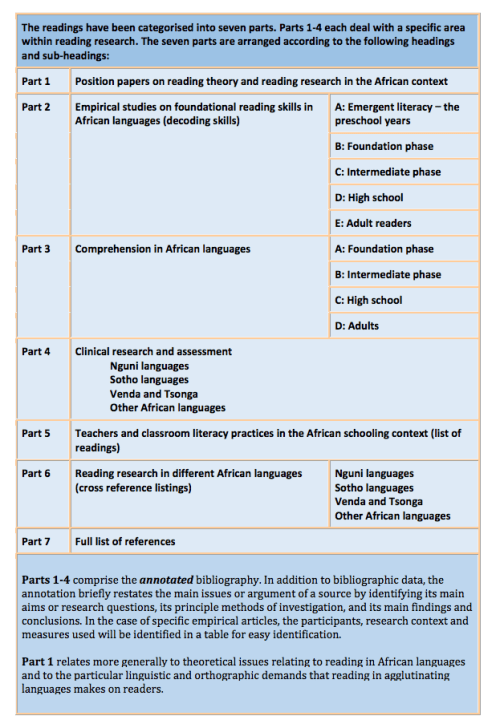
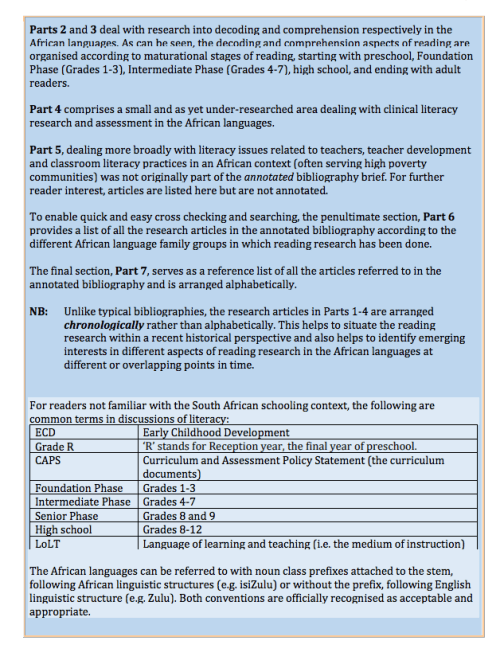
Reading in African Languages: An Annotated Bibliography 2004-2017 (Pretorius, 2018)

reading

I think there is now broad-based agreement that most South African children do not acquire the skills and dispositions they need to read for meaning and enjoyment. The PIRLS Literacy 2016 results show that 78% of Grade 4 students couldn’t read in any language. The way forward is therefore to ‘get reading right.’ Given that more than 70% of South African children learn to read in an African language in Grades R-3, we need to understand more about how children learn to read in these languages, and that inevitably involves research. Do children from different language groups learn to read in different ways? The language structures (orthographies) of South African languages are quite different to each other. As we’ve pointed out in some of our earlier work, the same sentence in different languages looks very different:

reading2

Should we be teaching Nguni languages (isiZulu, isiXhosa, SiSwati etc.) and Sotho languages (SeSotho, Setswana, Sepedi) in different ways? Or are these just peripheral differences that don’t change the overall approach. At the moment there is not a large body of research on this. However, Prof Lilli Pretorius has recently published an annotated bibliography of 40 studies (2004-2017) titled Reading in African Languages an Annotated Bibliography 2004-2017 under the PRIMTED banner. I include their blurb below:

“This annotated bibliography was compiled by Professor Lilli Pretorius of UNISA as part of the Primary Teacher Education Project (PrimTEd). It gives a summary account of research that has been done on reading in African languages from 2004 to 2017, more specifically on languages belonging mainly to the family of Southern African Bantu languages. It comprises over 40 annotated entries, mainly research articles from accredited journals, chapters from books and postgraduate dissertations or theses, and also lists several other sources closely related to reading in the African languages. Although it was originally compiled in 2017, it is designed in such a way that new entries can be added to it as new research emerges, and it will be regularly updated.”

Screen Shot 2018-05-22 at 11.20.43

Screen Shot 2018-05-22 at 11.20.59

This is a great resource both for those just starting out in the field, but also for established researchers looking for an overview of what’s out there.

Many thanks to the Lilli and the PRIMTED team for doing and initiating this important work. I believe the English-as-First-Additional-Language (EFAL) annotated bibliography is soon to be released.

For those interested here is my Q&A with Lilli from 2014.

The stories we tell ourselves

rainbow

There are not many things that are perennially interesting to me, but one of them is the stories that we tell ourselves. We sometimes think that what we do, or think, or feel is  just a reaction. ‘Such-and-such happened which is why I acted or thought or felt the way I did’. Yet so much of how we experience the world is determined by the stories that we tell ourselves. The charming, gay neurologist Oliver Sachs puts it well:

“We have, each of us, a life-story, an inner narrative – whose continuity, whose sense, is our lives. It might be said that each of us constructs and lives, a “narrative”, and that this narrative is us, our identities. If we wish to know about a man, we ask “What is his story – his real, inmost story?” for each of us is a biography, a story.”

I’m currently thinking about this in relation to inequality and education in a chapter I am working on, but that’s more about a collective story that we tell ourselves as a country. Thomas Piketty tells us that “Inequality in every country needs to be justified. You need to tell a story about why this level of inequality is acceptable or unacceptable.” That one quote has been really generative for me lately but right now I’m thinking about  stories on a personal level.

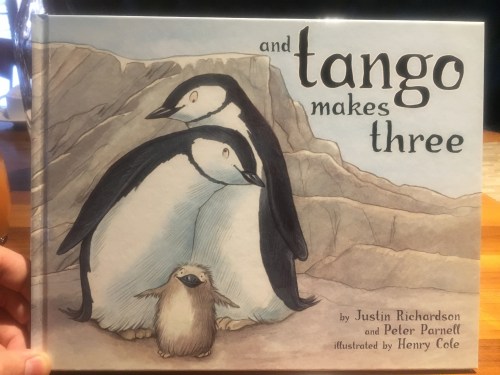
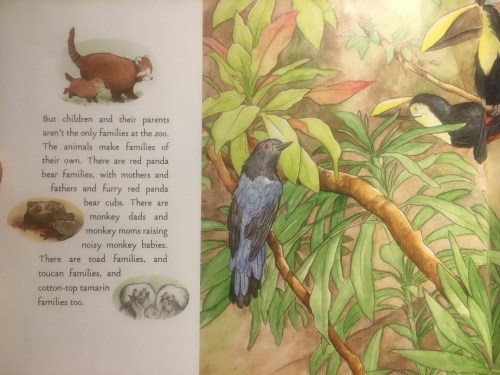
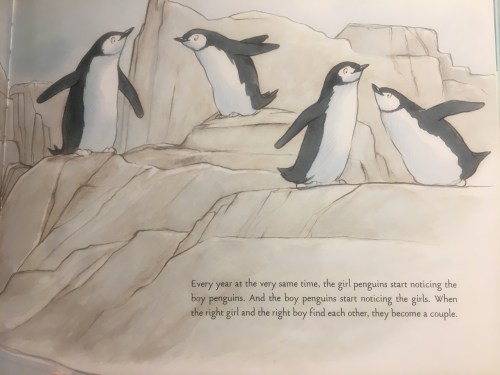
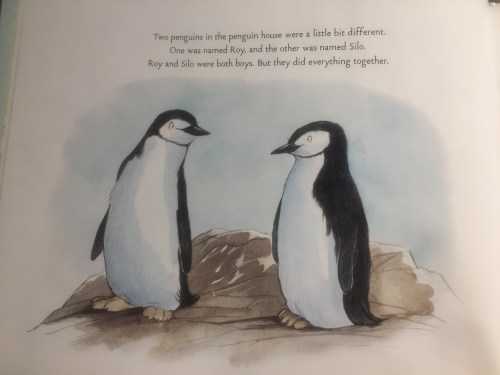
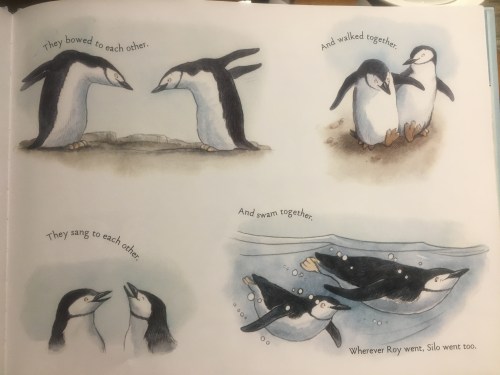
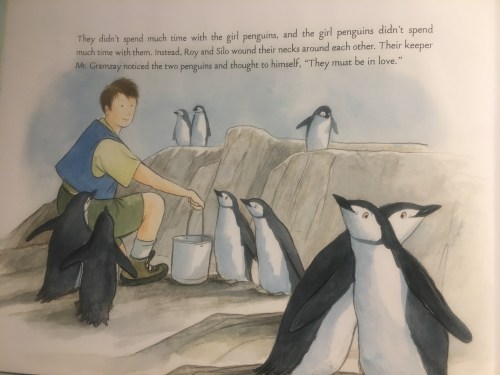
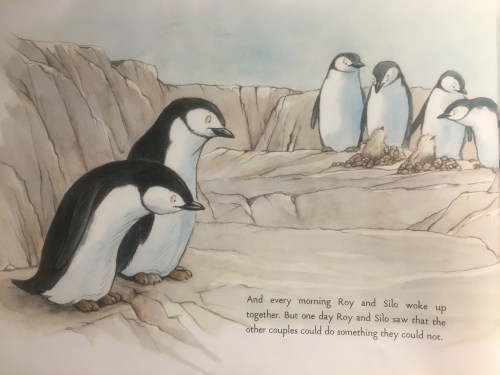
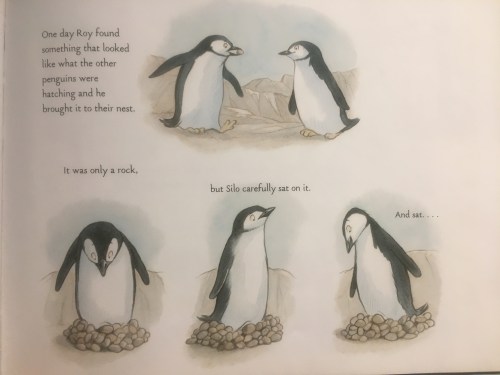
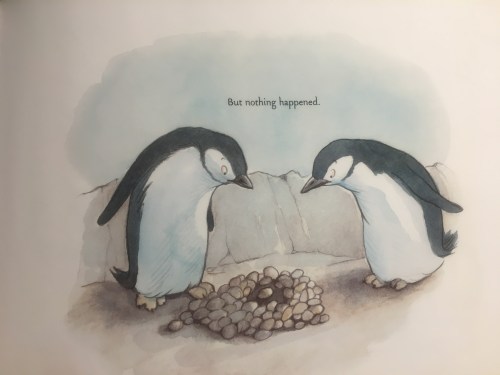
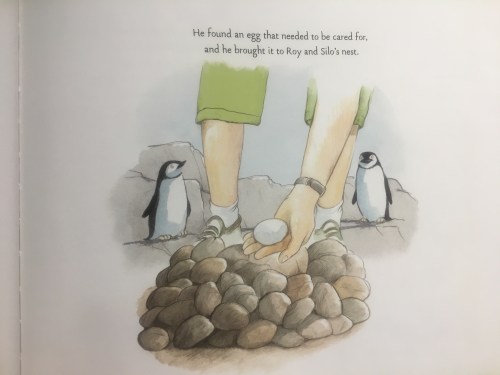
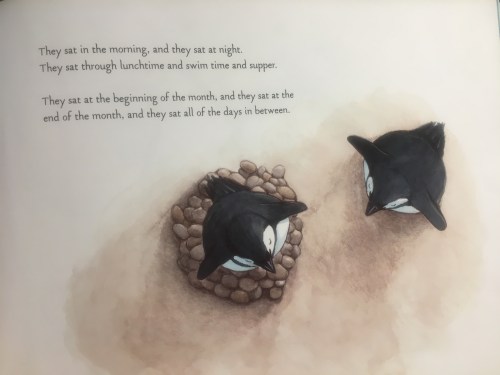
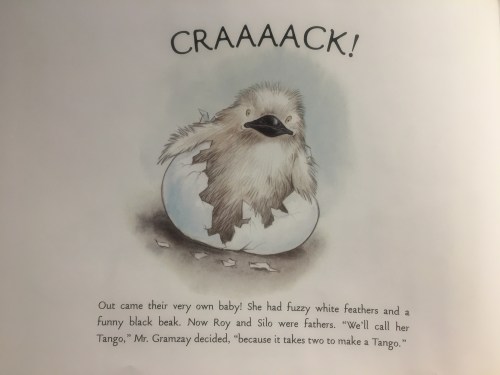
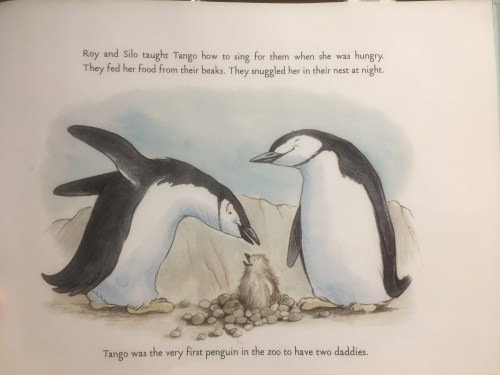
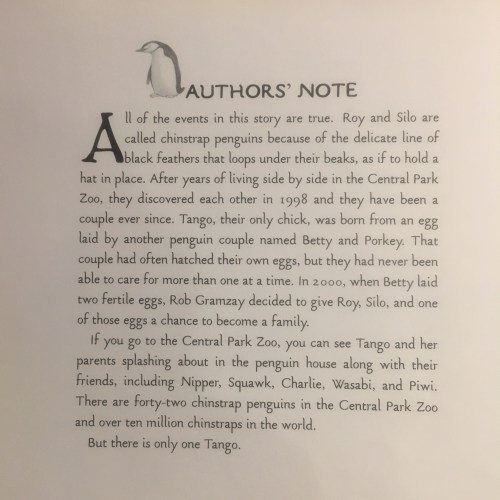
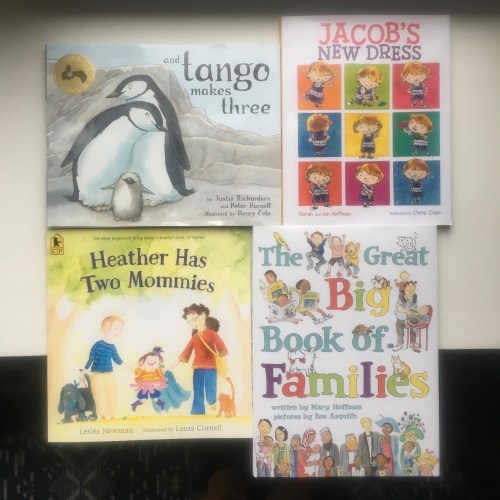
While I was overseas for a conference last week I came across a children’s book called “and tango makes three” by Justin Richardson and Peter Parnell. I love buying my niece and nephew books to read because they can never have too many books. But this book hit home for me and actually made me teary in the book store. I thought I’d share it here in the hope that others will come to the same realisation I did…


IMG_4617IMG_4606IMG_4607IMG_4608IMG_4609IMG_4610IMG_4611IMG_4620IMG_4619IMG_4612IMG_4613IMG_4614IMG_4616

IMG_4604

This last page was especially moving for me. As someone who grew up gay in a straight world, all the stories I was read as a child (and in fact all the books that existed in our bookstore and our library) had only straight characters. Princes marrying princesses, boys building, girls cooking, and any number of iterations on traditional gender roles and ‘normal’ sexual identities. Now that we do have stories stories with gay protagonists or children that don’t fit the norm I think some parents are reluctant to buy them. Their logic (I think) is that they don’t want to influence their child’s sexuality – or, more accurately, – to influence them in a non-heterosexual way. I find this incredibly ignorant. Nine times out of ten when you probe modern educated parents (and scientists and geneticists) they will agree that sexuality and gender identity are more likely to be about genetics (or epigenetics) than anything else. Yet this persists.

What they seem to miss is the quiet violence done to their children by presenting only one version of the world, one story, and possibly one that they do not see themselves in. Children map the world by the stories they are told and the stories they learn to tell themselves. Brene Brown has this great quote where she says that if you go around looking for a reason why you don’t belong, you will always find one. And I think this is one of the costs of growing up and not seeing yourself represented in the stories you’re told. You feel you don’t belong.

I want my niece and nephew to grow up in a world where they know that whoever they  are, they belong. Different ≠ wrong. The stories we tell ourselves, and the ones we tell our children, matter. My niece and nephew have hundreds of books with stories about everything under the sun. I want to make sure that I’m in one of those stories, and that if they are too, that’s also totally OK. Whoever they are and turn out to be, they belong.

fullsizeoutput_376

Throwing basic education under the bus (My Business Day article)

The article below first appeared in the Business Day on the 16th of April 2018. Their link here.

Basic Education Funding

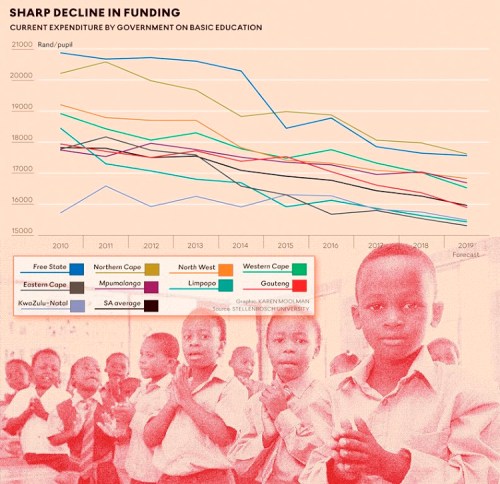
It’s not every day that Treasury reports can make you want to drink in the middle of the day. Then again, it’s not every day you realise a country-wide crisis has been brewing under your nose for a decade and no one noticed it. Over the last seven years there has been a consistent decline in the purchasing power of per-learner expenditure on basic education and no one has said a thing. To put it bluntly, funding per learner has declined by 8% in seven years. In so many ways this undoes any of the advances we think we might have made in education over the last seven years.

For a while now we’ve known that something funny happened in South Africa between 2003 and 2005 when births spiked by 13% and continued to stay high for a few years before coming down slightly in 2008. The leading explanation at the moment is the roll out of antiretrovirals (ARVs) over the same period. True to form, Grade 1 enrolments spiked by 13% five years later in 2008 with subsequent enrolment data showing this cohort slowly working its way through the education system with similarly large cohorts following in their footsteps each year. This group, which we’ve dubbed the ‘silent ship’ in our research group, is now in grade 8 in 2018. This weird demographic phenomenon has been confirmed by Martin Gustafsson’s comprehensive analysis of three different datasets; the Home Affairs birth registration data as well as age-specific data in the Department of Basic Education’s Annual Survey of Schools (ASS) data and the Learner Unit Record Information Tracking System (LURITS).

The aggregate effect of these increased births (and higher retention in the schooling system more generally) has meant that there were about 670,000 more learners in 2016 than there were in 2010. That means larger classes together with fewer books and fewer teachers per learner. But this is only half the story behind this unknown crisis. The other half is that there have been above-inflation increases in teacher salaries for over a decade. A decade of government gazettes together with Treasury’s Estimates of Provincial Revenue and Expenditure (EPRE) documents shows that between 2010 and 2016 teacher salaries increased by 57% compared to a 38% increase in the CPI (regular inflation). The problem with this is that total expenditure on education has only been increasing by inflation, or about 7% a year and therefore hasn’t kept up with these two factors (increased enrolment and above-inflation salary increases). Seen together this has translated into a significant decline in the purchasing power of expenditure on basic education between 2010 and 2017. Looking at the Medium Term Expenditure Framework the decline is set to continue. In 2010 we spent R17,822 on average per child dropping to R16,435 in 2017 and projected to decrease further to R15,963 by 2019 (all in 2017 Rands).  This is a 10% decline in per learner funding in ten years (2010 to 2019).

This decline in state funding is already starting to show up in international assessments. According to the Progress in International Reading and Literacy Study (PIRLS) the average class size of Grade 4 classes in South Africa was 40 in 2011 which has now increased to 45 learners per class in 2016. Yet this masks that the largest increases were found in the poorest schools. Among the poorest 60% of learners, class sizes increased from 41 to 48 learners per class between 2011 and 2016. For the richest 10% of learners, class sizes only increased from 33 to 35 learners per class. Over the same period there was no improvement in reading outcomes across the country. It’s highly unlikely that this systematic decline in per learning spending over the last seven years is unrelated to the stagnant learning outcomes reported in PIRLS over the same period.

Given the centrality of correct discounting to the overall findings here it is worth briefly explaining why using a traditional inflation rate is inappropriate for education. This is also likely the reason that this fact has gone largely unnoticed in South Africa. Essentially, because total expenditure on basic education has increased by 7,1% per year between 2010 and 2017 – keeping up with the Consumer Price Index (CPI) inflation over the period – most analysts have thought that the education budget has been keeping pace with the overall rise in costs. But CPI is the wrong index to deflate education expenditures because more than 80% of expenditures are on teacher salaries rather than a typical basket of goods. The salient question when discounting expenditures on education is thus, “How much money is required in 2017 to buy the same level of inputs used in 2010?” To do this requires the construction of an education-specific discounting index that is weighted at 80% of the cost of teachers (calculated using wage-bargaining agreements in the Education Labour Relations Council) and 20% weighted at regular CPI (for non-personnel expenditures like textbooks). Using this composite index allows us to ask how much it would cost to buy the basket of education ‘goods’ that we bought in 2010 (80% teachers and 20% non-teachers). The results are alarming. Figure 1 above shows the overall trend in per learner purchasing power in each province between 2010 and 2019 (all figures in 2017 Rands and 2017 to 2019 figures are based on MTEF projections).

All of the above is even more concerning in the context of ongoing fiscal austerity and significant increases in budget allocations to higher education. As a result of the #FeesMustFall movement, former President Zuma announced a new government policy of free higher education for poor and working-class families (reiterated by President Ramaphosa in 2018). This is now reflected in the 2018/19 budget where Higher Education received an additional R57 billion over the next three years to fund the new mandate. Basic education is being thrown under the bus as higher education becomes the new shining star.

Without detracting from the importance of decreasing financial exclusion to higher education for poor and working-class students, it must also be stressed that at most 15% of a cohort go to higher education in South Africa. Among the poorest 70% of the population it is less than 5% of a cohort who actually enter university. The battle is won or lost in primary school. Given the hierarchical nature of schooling and that university access and success are predicated in the foundations built in primary school and high school, it is an extremely short-sighted policy to continue on the current trajectory of declining per-pupil public expenditure on basic education and rising per-pupil public spending on higher education.

To all who have the inclination to look it is clear that the low quality of primary schooling in South Africa is the binding constraint – both to further educational success, but also to dignified employment, meaningful civic engagement and economic growth. Our most recent assessments show 78% of Grade 4’s can’t read for meaning and 66% of Grade 5’s can’t do basic maths. There is no conceivable route for South Africa to move from the status quo to any desirable future that does not first chart the route of significant improvements in primary education. And to put it bluntly, that is simply not possible when the overall pie is shrinking, a shrinking that is felt most severely by the poorest learners in the most challenging contexts. Treasury needs to re-assess how it is funding basic education and explain why there has been a significant decline in the actual resources available on the ground to educate South African learners.

The Comprehension Iceberg: Developing reading benchmarks in African languages

The-Iceberg-Illusion-SOURCE-openlab.ncl_.ac_.uk_

For the last few years we have been working on a project exploring reading in three African languages; isiZulu, Xitsonga and Northern Sotho (Sepedi). This was part of an ESRC-funded study looking at “Leadership for Literacy” and schools in challenging contexts. This week we published the first of a series of working papers on some of our results. The paper is titled “Investigating the comprehension iceberg: Developing empirical benchmarks for early grade reading in agglutinating African languages  (2018) and is co-authored with colleagues and friends Prof Elizabeth Pretorius (UNISA) and Mpumi Mohohlwane (DBE), who is now also doing her PhD at RESEP.

In the paper we argue here that we need to move beyond a repetitive focus on low comprehension outcomes; this is simply the tip of the iceberg. Below the surface there is widespread evidence that most children have not acquired the basic ‘tools’ for reading success – the ability to accurately and fluently decode letters and words and move from an effortful activity to an automated skill. Knowing that 78% of Grade 4’s cannot read for meaning in any language is important and sobering information, but probably not as helpful as knowing which components of reading children are struggling with and why teachers are struggling to teach them.  If children and teachers are ‘falling at the first hurdle’ (Taylor, 1989) does it make sense to focus on the seventh or eighth hurdle and ask why learners and teachers are not making it over?

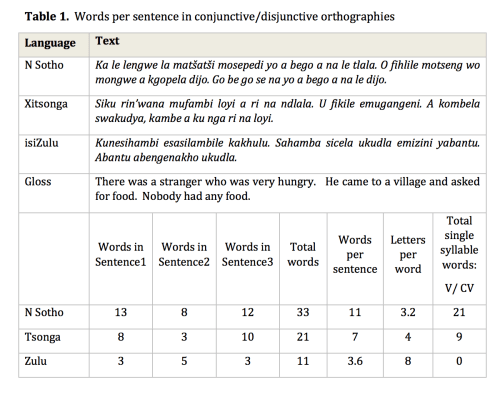
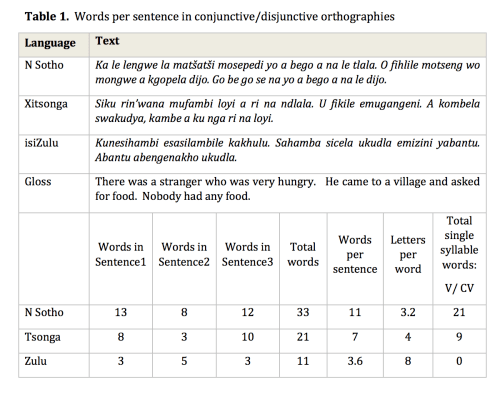
One of the important contributions of the paper is that we try to estimate benchmarks for these three African languages. While many benchmarks exist in English there are currently no benchmarks in African languages and unfortunately you cannot just version the English benchmarks for the African languages because the language structures (orthographies) are so different. This is easiest to explain using an example:

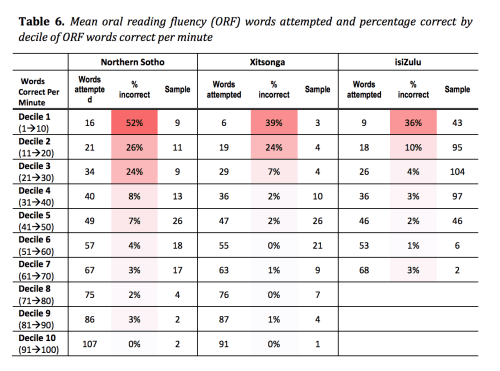
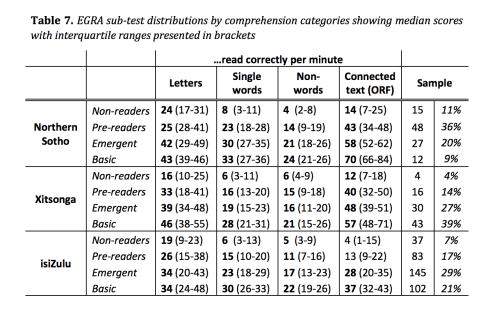
Screen Shot 2018-03-13 at 11.08.10 AMSo in isiZulu the first sentence is only 3 words while in Northern Sotho (Sepedi) it’s 13 words. We go on to show that there are also large differences in ‘required fluency’ across these languages and that accuracy rates and speed differ between conjunctive and disjunctive languages – see below.
Screen Shot 2018-03-13 at 10.54.39 AM

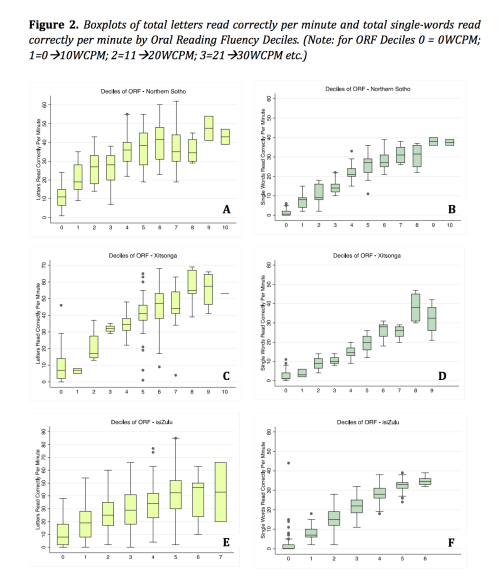
“Comparison across the languages shows that accuracy seems to be more important for fluent reading in isiZulu than in Northern Sotho or Xitsonga. The isiZulu learners reading at 21 wcpm or faster are reading with 95% accuracy or higher. In contrast, 95% accuracy is only associated with reading at 51 wcpm or faster in Northern Sotho and 31 wcpm or faster in Xitsonga. One of the reasons why Decile-1 learners are reading so slowly is that they are making mistakes on every second or third word. The fastest Northern Sotho readers (wcpm=107) and Xitsonga readers (wcpm=91) in the sample made no mistakes whatsoever.” (p12)

This can also be seen visually:

Screen Shot 2018-03-13 at 10.55.10 AM

We then use this information and some rudimentary comprehension outcomes to benchmark the different languages:

Screen Shot 2018-03-13 at 10.54.55 AM

We’d encourage those interested in this type of work to read the full paper – if you have any comments or suggestions we’d love to hear from you! Please include them in the comments below.
 Abstract

The importance of learning to read in mother-tongue is widely acknowledged in the linguistics literature yet reading acquisition in African languages remains under-researched and under-theorized. While numerous studies have highlighted the low levels of comprehension among learners reading in African languages in South Africa, little has been done to understand what lies beneath this ‘comprehension iceberg.’ In this paper we present new empirical evidence on reading outcomes and the subcomponents of reading for 785 Grade 3 learners across three languages (Northern Sotho, Xitsonga and isiZulu), drawn from 61 primary schools in South Africa. This is the largest sample of such learners to date. Using an adapted EGRA-type assessment we assessed letter-sounds, single-word reading, non-word reading, oral reading fluency and oral comprehension. From this data we present results on fluency, accuracy and comprehension and how these might relate to each other in these morphologically rich agglutinating languages. We also show that there are large differences in reading subcomponents between languages with conjunctive and disjunctive orthographies. Our results suggest that there are minimum thresholds of accuracy and oral reading fluency in each language, below which it is virtually impossible to read for meaning. These are 52-66 wcpm in Northern Sotho, 39-48 wcpm in Xitsonga and 20-32 wcpm in isiZulu. We argue that there is a strong need for empirical language-specific norms and benchmarks for indigenous African languages and present our benchmarks for these three languages as a move in that direction.

“A city drowning in incompetence” – my Daily Maverick rant about the water situation in CT

water

(This article was first published in the Daily Maverick on the 22nd of January 2018.)

A city drowning in incompetence

This week the City of Cape Town announced that at the current rate the taps will run dry in Cape Town on the 21st of April and will soon announce the City’s 200 water collection points. These are central locations that can be secured with riot-police and include places like sports fields and schools. The Mayor has explained that after the 21st of April “citizens would line up to receive up to 25 liters of water per person, with a separate queue for the differently abled. Prior to filling their vessels, each person would be given a dose of hand sanitizer.”

I’m sorry but, what the fuck?!

How the hell did we get this close to what will be the biggest natural disaster of the post-apartheid period and the majority of Cape Townians are carrying on business-as-usual? Only 39% of residents are using less than 87l of water – the previous, and now surpassed, restriction (the current restriction is 50l person). In history, it has never happened that a city the size of Cape Town has run dry. As a Canadian headline announced this week: “Cape Town at risk of becoming the first major city in the world to run out of water” (Globe & Mail).

It is clear that there has been an outright failure of leadership in the City of Cape Town. How is it that we have been having a drought for more than 1000 days, with water management experts advising the City on a constant basis and yet only now, with 90 days to go they are escalating things? Patricia De Lille has been the mayor of Cape Town for more than 6 years and the DA has run the Western Cape for more than 7 years. It’s been years in the making. It is beyond clear that the blame for this crisis lies ultimately with the City of Cape Town and their too-little-too-late responses to an imminent catastrophe.

How has the City not already exacted drastic action to ensure that we never reach Day Zero? Why has it taken so long to radically and drastically escalate the issue in the public’s mind? The province’s ‘Resilience Officer’ dealing with the drought is currently on gardening leave because of an internal spat about the MyCiti Bus procurement processes. The media strategy of the City of Cape Town is an absolute disaster. Why has the Province not passed emergency measures in the legislature to require all Western Cape targeted media outlets to devote at least 10% of their prime-time coverage to either public service announcements on the drought or how to reduce water consumption? Why is there no blimp above the CBD announcing “Day Zero: 21 April! REDUCE WATER or taps run dry”? Instead the City pushes its pathetic #ThinkWater message. Who is advising the City on their public relations campaign?! This is about an imminent natural disaster, not a preschool slogan for Water Day. If I can get daily SMSes for insurance I don’t want, or from political parties I won’t vote for, why can’t I get SMSes about what DayZero looks like, where my local water collection point is or some equally-scary information to make me change my behavior?

Tom Eaton points out that in 2018 Mmusi Maimane has tweeted as many times about his child’s first day of school as he has about the largest natural disaster in the post-apartheid period, that is to say, once. Of the 76 tweets in 2018 by @CityofCT (their official Twitter account) less than a quarter have been about water. More than half are inane messages like “Top of the morning to you, Cape Town. With a high of 22, you can expect clouds and sunshine with a windy afternoon.” I don’t want the City to wish me a joyous morning and a jolly good night. I want them to make sure that I have water in my taps.

Why has Helen Zille not called for a localized State of Emergency, which Section 37, 1(a) of the Constitution makes express provision for. That is, that Parliament can declare a State of Emergency in the event of a “natural disaster or other public emergency.” A city of 4-million people running out of water sounds like the definition of a natural disaster to me.

Of the City of Cape Town’s 7 big initiatives to get more water online (V&A, Strandfontein, Monwabisi, Harbour, Cape Flats, Atlantis and Zandvliet), 6 are delayed and behind schedule. The City’s threats of fining excessive users or throttling their water have not materialized. Together with these empty threats and in-fighting within the DA, the City has not managed to get water pricing right or publicly shame non-compliers? Why is there no publicly available list of the top 200 addresses that are openly flouting the City’s restrictions?

It’s also not as if this is the first time this has happened in the world. From 1997 to 2009 Australia faced the Millennium Drought. Melbourne, also a city of four-million people, managed to drastically reduce water consumption by 50% and pre-emptively implement a slew of policies and programs to avoid a humiliating and dystopian scenario of a city running dry. This included setting up an emergency body mandated with decision-making during the drought. It had an expert advisory group with independent experts and full transparency (Google “Low and Grant 2015 Fighting drought with innovation” for an academic overview).

The fact that we are approaching a natural disaster and the majority of Cape Townians are still living their best lives and ignoring the extremely mild reproaches of government means that someone needs to take drastic action. Whether that is the Premier, the Mayor or the President remains to be seen. Whoever takes up that mantle needs to step into the vacuum that has been left by a wave of incompetence and denialism. Call an emergency lekgotla with all the MECs, the top 50 CEOs, the vice-chancellors of universities, editors of newspapers, the heads of civil society etc.  Pass legislation that needs to be passed, take out full-page ads in every newspaper every day. How is this not the single most important thing happening in our province at the moment?!

This is not about the ineptitude of some dingy Department of Water official failing to plan properly but about politicians and bureaucrats doing too little too late. The scale of this crisis is such that, if unresolved, it could cripple the City. A fall in tourism, a loss of jobs, declines in property prices, widespread sanitary diseases. That sounds quite dystopian, but that’s what happens when the taps run dry. The DA and the City of Cape Town need to accept that they should have escalated this issue far sooner, and then begin a massive escalation initiative to hit the complacent middle-class with real consequences. The time for kumbaya messages is over.

*Note, DM made a few edits and I chose to keep my original wording 🙂 

My Sunday Times article on Matric 2017

space

(This article first appeared in the Sunday Times on the 14th of January 2018).

The real matric pass rate and the real site of failure in education

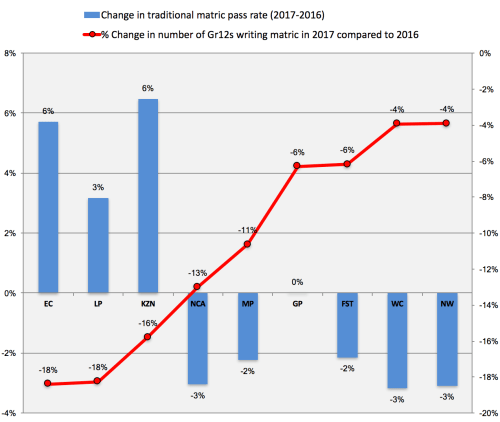
Every year the matric results come out and the whole country goes ballistic. Matric is on the front page of every newspaper and swamping the radio waves and TV stations of our country. And suddenly everyone has an opinion about what’s going on in education. “The Free State is the best province”, “We should ban the IEB and have one exam”, “The rising pass rate shows our interventions are working”. No. No. No. None of this is true. Firstly, the rising pass rate – from 73% in 2016 to 75% in 2017 is purely a function of more students being held back and dropping out. In 2017 there were only 401,435 passes compared to 442,672 in 2016 – that’s a 9% decline in one year. So why were there 40,000 fewer matric passes? It’s not because the population dropped by 9% in one year (it did go down but only by about 4%). It’s not because more candidates moved to writing their matric part-time (and therefore aren’t included in the ‘official’ pass rate); there were only 11,462 additional part-timers in 2017 compared to 2016. And it’s definitely not because there are fewer progressed learners (there were 108,742 in 2016 and 107,430 in 2017, basically the same). So we know it’s not the cohort, it’s not part-timers, and it’s not progressed learners, so what is it? Basically more kids are dropping out or being held back than in 2016. It’s also no surprise that the only provinces with increasing matric pass rates (Eastern Cape +6%, Limpopo +3% and KwaZulu-Natal +6%) were also the provinces with the largest declines in the numbers writing matric (-18%, -18% and -16% respectively). So the high-level take-home is that the more you ‘cull’ and ‘gate-keep’ the more your matric pass rate increases. It also means we have 5% fewer Mathematics and 10% fewer Physical Science passes in 2017 compared to 2016.

So what is the ‘real’ matric pass-rate. A lot of people have been asking this question, including myself, and it turns out it’s a little more complicated than one thinks. Occasionally we calculate ‘throughput pass rates’ (matric passes divided by grade 10 enrolments 2 years earlier or Grade 2 enrolments 10 years earlier), yielding figures around 39% for the 2017 Grade 10 throughput pass rate. This is the incorrect figure. The problem is that at least 20% of Grade 10 enrolments are actually ‘repeaters’ and not part of the original cohort. There are also the complications of those writing supplementary exams, getting part-time passes, or Independent schools writing the NSC exams. The most authoritative research done on this is by one of my colleagues at Stellenbosch University, Dr Martin Gustafsson, and according to his calculations the ‘true’ matric pass rate is about 55% and the province with the highest achievement is Gauteng. I believe that. While this is not as bad as the crude and incorrect figure of 39%, it is also not as high as the crude and incorrect figure of 75%. If one adds in youth who get some kind of non-matric qualification (i.e. through a technical or vocational college) the figure rises marginally to about 57%. So, 43% of youth in South Africa still get no qualification whatsoever. Not matric, not TVET, not university. Nothing. They enter the labour-market ill-prepared and inherit lives of chronic poverty and sustained unemployment. Is it any wonder that since 2002 more than 40% of 18-24 year olds in South Africa are ‘NEET’; Not-Employed-or-in-Education-or-Training?

So where do the wheels come off in the education system? The answer is long before matric. When children don’t learn to read for meaning in Grades 1-3 they fall further and further behind the curriculum even as they are promoted into higher grades.  Last month the 2016 Progress in International Reading and Literacy (PIRLS) results were announced and they showed that 78% of South African Grade 4 children could not read for meaning in any language (all 11 languages were tested). And if children don’t grasp the number concept, place-value or the four operations by the time they hit Grade 4 they are on a one-way ticket to failure. The 2015 Trends in International Mathematics and Science Study (TIMSS) showed that 61% of Grade 5 students could not do basic mathematics.

I know that for those writing and passing matric it is a momentous and important occasion. It’s the culmination of our schooling cycle and (unfortunately) a rite of passage into middle class life (note: necessary but not sufficient for said passage). But as a country I feel like we need to take active steps to de-emphasize the matric results and instead focus on the ailing primary school system, the ugly step-child in our national saga. We don’t even have national assessments in primary school anymore. If the wheels come off by Grade 4 then that’s where we need to be intervening. Prevention is better than cure. A stitch in time saves nine. A matric obsessed country misprioritizes its political and economic resources.

//

The DBE’s 2017 NSC Exam Report can be found here.


Explaining the matric results in 7 GIFs

*11pm 5/01/18: New addendum added. Note that the throughput pass rates or comparison rates discussed here are not the ‘real’ pass rate. It is not 37% but about 55% (the former is a crude approximation and underestimates the true pass rate by about 15-18 percentage points primarily because the denominator has repeaters) See Martin Gustafsson’s comment at the end of the post. 

worked up

Every year the matric results come out and the whole country goes ballistic. Front pages of the newspapers, every radio, every TV station. And suddenly everyone has an opinion about what’s going on. All the people. so. many. opinions. “The Free State is the best province”, “We should ban the IEB and have one exam”, “The rising pass rate shows our interventions are working”. No. No. No.

dulp2


  I was determined that this year I was going to stay out of the #MatricResults2017 morass and instead focus on our program to teach Foundation Phase teachers how to teach reading, because 78% of kids in SA can’t read. But no one seems to be reading the 97-page 2017 NSC Examination Report which has loads of information. Spend an hour or two analysing the data and it’s pretty easy to see what the trends are and what’s going on. So here are some of my take home points:

(1) The matric pass rate is one (very incomplete) measure of the education system and it’s a bad idea to focus on it in isolation.

got any other bad ideas (stark)

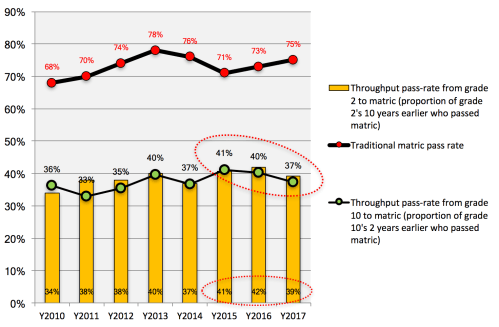
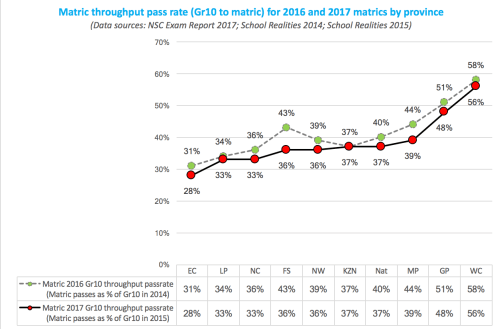
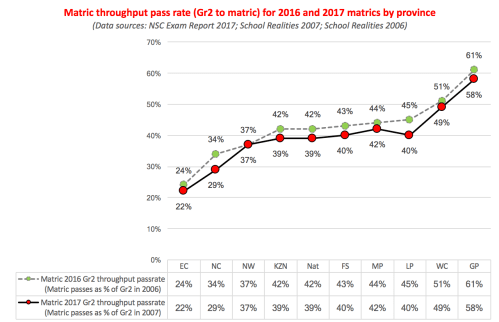
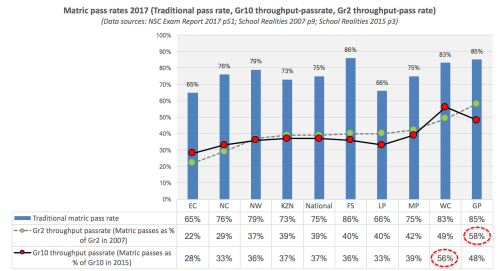
The matric pass rate is calculated as the numbers passing divided by the numbers writing. It can go up if either the numerator goes up or the denominator goes down (or both).  Nick Taylor argued this in 2011 and I’ve discussed this in 2015 and 2016. The gist of it is that it’s possible to artificially raise the matric pass rate by letting fewer weaker students write the exam (in SA this is referred to as culling or gate-keeping). So to get around this we calculate a ‘throughput pass rate’ where we divide the total number of passes by the Gr10 enrolment two years earlier or by the Grade 2 enrolment 10 years earlier. This is a VERY crude measure and does not take into account grade repetition in Gr2 and Gr10, migration, mortality etc (see Martin Gustafsson’s comment at the end of this post for a fuller discussion). So what do the trends look like in the “Traditional” matric pass rate and the “Throughput comparison rate? Basically, while the traditional pass rate has been rising the Gr10 throughput comparison rate has been declining for three years now and the Gr2 throughput comparison rate has been declining for two years. Note the ‘real’ matric pass rate is closer to 55% not 75%, but also not as low as 37%. Basically the ‘real’ pass rate is 15-18 percentage points higher than these crude estimates once you take into account repeaters and some other factors (again, see Martin’s comment at the end).

Screen Shot 2018-01-05 at 6.22.49 PM

(2) The provinces with the largest increases in matric pass rate have the largest declines in numbers writing matric

ram and cow

Basically what happens is that provinces (via principals and teachers) let fewer students reach and write matric (usually the weaker ones) which artificially lowers their denominator and raises their traditional pass rate. So the three provinces that have higher pass rates in 2017 compared to 2016 (EC, LP and KZN) also had the largest declines in the number of Gr12s writing matric between 2016 and 2017.

Screen Shot 2018-01-05 at 7.59.39 PM

(3) The Free State is NOT the best performing province in the country. Some people think that. They are wrong. 

entitled to your wrong opinion

As mentioned in point (1) above, the traditional pass rate can be very misleading. This is especially the case with the Free State. While it has the highest traditional pass rate (86%), it also has the largest decline in Gr10 throughput comparison rate between 2016 and 2017 (from 43% to 36%). What does that mean? Basically that the change between 2016 and 2017 for the Free State seems to be driven by the fact that they are letting fewer of their (weaker) Gr10’s reach matric in the first place.

Screen Shot 2018-01-05 at 6.19.30 PM

If one looks at the Grade 2 throughput comparison rate then Limpopo and the Northern Cape seem to doing quite a bit worse than they were in 2016.

Screen Shot 2018-01-05 at 6.15.27 PM

(4) So if we use the throughput pass rate who does better, the Western Cape or Gauteng?

excited

For those who follow education statistics it’s pretty clear that the WC and GP are always the top two provinces in the country. Sometimes it’s WC (PIRLS Literacy 2016, TIMSS-N 2015), sometimes it’s GP (TIMSS-Gr9 2015). So if the Free State suddenly pops up as number 1 you’ve got to look into the data a little. And what do we find? Surprise, surprise, if you use either the Gr2 throughput comparison rate or the Gr10 throughput comparison rate then the FS is fifth. And who’s first? Gauteng and the Western Cape, kind of both. You see if you take the Gr2 throughput comparison rate then it’s GP but if you take the Gr10 throughput comparison rate then it’s WC. You usually see GP ahead if you use Gr8 throughput as well. The reason is usually because the dropout that does occur in the WC usually happens before Gr10 so their Gr10 numbers are artificially low.

Screen Shot 2018-01-05 at 5.46.42 PM

But you might then ask: why not just use the Grade 2 throughput rate instead because it’s more reflective of the whole education system? Well, it’s mainly because there is likely some inter-provincial migration between Grade 2 and Grade 12 and this is most likely from poorer provinces towards WC and GP. So the WC and GP throughput comparison rates are always slightly inflated, and the Gr2 throughput rate is the most inflated.

(5) There are other things to focus on instead of the matric pass rate

I know that for those writing and passing matric it’s a momentous and important occasion. It’s the culmination of our schooling cycle and (unfortunately for some) a rite of passage into middle class life (note: necessary but not sufficient for said passage). But as a country I feel like we need to take active steps to de-emphasise the matric results and instead focus on the ailing primary school system that seems to drop off the radar after a week of new results being released. 78% of our Grade 4 kids cannot read for meaning in any language. 66% of our Grade 9’s can’t do basic maths or basic science. Perhaps because 79% of our Grade 6 maths teachers can’t pass Grade 6 maths tests? We need to get back to basics and ensure that every child learns to read for meaning and understand the concepts of number and numeracy. If the wheels come off by Grade 4 then that’s where we need to be intervening. Prevention is better than cure. A stitch in time saves nine. A matric obsessed country misprioritizes its resources.

Transmission ends.

convo over

Addendum: Important comment from the ever-wise Martin Gustafsson (I agree with all of his points here, including that the ‘real’ matric pass rate is best estimated as 55%.

“Nic, whilst I absolutely agree with the thrust of this, I don’t agree with the 37 to 39% figure. The problem with dividing Grade 12 passes with Grade 2 enrolment 10 years ago is that there are many repeaters in Grade 2. We have relatively good data for recent years pointing to around 10% of Grade 2 learners being repeaters. We don’t know with certainty what the situation was in 2007, but the figure then was probably higher. Counting NON-repeaters only in your denominator would give you a better idea of who should proceed to Grade 12. But there are other issues: mortality, migration (e.g. across provinces if you want to look at provincial ratios), enrolment in TVET colleges, supplementary examination results, part-time Matriculants, IEB. Once you take all of this into account you get around 55%, not the 37 to 39% you refer to. The DBE has published the calculations (done by me) behind the 55%. It’s at http://www.education.gov.za/Portals/0/Documents/Reports/Education%20Sector%20review%202015%20-%202016.pdf.

PS: for those who want to review the numbers and do their own calculations the Excel file and references for all the stats are available here

Open Letter to the next president of South Africa: We need a Marshall Plan for Reading

849x493q70nic-carel-openletter
 This article was first published online on the Daily Maverick on the 6th of December 2017. It is available here
Open Letter to the next South African president: We need a Marshall Plan for Reading . – Nic Spaull & David Carel
Cyril, Nkosazana – are you sitting down?

By now we trust that your advisers have informed you about the latest reading results released yesterday: 78% of our Grade 4 students can’t read. That’s eight out of every ten children in the country. Not in English, not in their home language, not in any language. Among Setswana and Sepedi home language learners the figure is over 90%.

We came last. Of the 50 countries that participated in the test, we came dead last.

But what does that mean? After four years of full-time schooling the vast majority of our kids cannot understand what they read, if they can decode the words at all. Simple questions, workbook exercises, even the most basic story book. These are meaningless to them. And if we don’t teach our kids how to read we’ve failed them before they’ve even started.

So what does this mean to you? In all likelihood one of you is going to be our next president. Sadly, we have a fatal history of presidents denying epidemics. This is not to say that your comrades haven’t made strong statements about education – they have. They have gazetted a host of well-intentioned policies, appointed task teams, procured service providers, promulgated Norms & Standards. There has been a lot of activity.

And yet, how then do we explain that there has been no improvement in reading outcomes since 2011?

We’re not saying that your predecessors weren’t trying. Naledi Pandor implemented the National Reading Strategy in 2006 and later the Foundations for Learning campaign in 2008. Minister Angie Motshekga helped stabilise the education system with a new curriculum and is currently backing the single bright, shining star among reading interventions – the Early Grade Reading Study.

But we’re fighting forest fires with buckets. Moving the needle in education will require a radical rethinking of both what’s needed and what’s possible.

Dr Dlamini Zuma and Mr Ramaphosa, respectfully, what we do not need is another steering committee, another convening of experts, another 12-point plan. We do not need another lengthy speech or moving statement telling us how committed you are to solving the reading crisis, and to “our children’s futures”.

What South Africa needs is to decide what Japan decided in 1872, that “there must be no community with an illiterate family, nor a family with an illiterate person”. This became Japan’s ‘Fundamental Code of Education’, the core of their development strategy, and they actually did it. Within decades they had successfully eradicated illiteracy.

What South Africa needs is to decide what Cuba decided in 1961 when it implemented the Cuban Literacy Campaign. They galvanised a million Cubans to systemically eliminate illiteracy across the country. It worked.

What South Africa needs is a Marshall Plan for Reading. We need you to use yourpresidency to mobilise our country behind one goal:

That all children can read for meaning by the end of Grade 3.

When eight out of 10 of our children can’t read for meaning, overcoming this challenge might seem impossible. But insurmountable problems are not new to our country. In 2000, at the peak of the AIDS crisis, who would have thought that four million South Africans would now be on antiretrovirals? Or that the ANC government would ultimately mobilise the country to build the largest AIDS treatment programme in the world?

Will you do the same for reading?

The unfolding reading crisis: The new PIRLS 2016 results…

pirls 2

Today the PIRLS 2016 results were released by the Minister of Basic Education Ms Angie Motshekga. To say that they are anything but devastating would be a lie.  8 in 10 children cannot read for meaning. This new report provides the latest evidence helping us to understand the unfolding reading crisis. I received an embargoed copy of the final report from the IEA last week late in the evening and battled to fall asleep after reading it. 78% of South African Grade 4 children cannot read for meaning in any language. I think this was the most striking thing for me -that we had previously underestimated the number of South African children that couldn’t read for meaning. Previously we thought the number was 58% (using prePIRLS 2011 Intermediate Benchmark) but it turns out that it is 78% (PIRLS Literacy Low International Benchmark). Basically we were using the wrong benchmark in the past. This is the first time that the easier PIRLS test (which used to be called prePIRLS and is now called PIRLS Literacy) was put on the PIRLS scale.

Apart from the horrifically low levels of reading achievement, South Africa also has the highest incidence of bullying among all 50 countries that participated in the study. 42% of Gr4 students indicated that they were bullied weekly (p226 in the report). Compared to 15% in the US and England.

I’ve summarized what I think are the main findings from the PIRLS 2016 report below. You can download the full report HERE and it is also available on the PIRLS website. The SA Summary reports are now also available (SA PIRLS Literacy, ePIRLS, SA PIRLS) The DBE’s official response is here.
Main findings:
  1. 8 of 10 SA children cannot read: 78% of SA Grade 4 students cannot read for meaning. That is to say that they could not reach the Low International PIRLS Benchmark in reading. They could not locate and retrieve explicitly stated information or make straightforward inferences about events and reasons for actions (PIRLS report page 55)
  2. SA scores last in reading of 50 countries: South African Grade 4 children have scored the lowest mark in the latest 2016 round of the Progress in International Reading and Literacy Study released today. The study included mostly High Income Countries but there were a number of middle-income countries such as Iran, Chile, Morocco, and Oman.
  3. SA lags far behind other countries: While 78% of SA Grade 4 kids cannot read, in America this is only 4% and in England just 3% cannot read. However the study also included middle-income countries. In Iran only 35% of Grade 4 students could not read for meaning and in Chile it was only 13% (PIRLS report page 55).
  4. Reading crisis deeper than previously thought: When South Africa participated in prePIRLS 2011 (an easier version of PIRLS) we thought that 58% of SA Gr4 children could not read for meaning. However this was on a separate test and not on the PIRLS scale score (i.e. not the same metric). 2016 was the first time that prePIRLS (now called PIRLS Literacy) was put on the same scale score as PIRLS. The true figure for children that cannot read for meaning is 78% – revealed today. Note this does NOT mean that reading outcomes have gotten worse between 2011 and 2015. In 2011 77% could not read for meaning and in 2016 78% cannot read for meaning (this difference is not statistically significant, i.e. the difference is negligible).
  5. Some evidence of improvement in reading 2006 to 2011 but stagnant since 2011: The only good news coming out of PIRLS 2016 is that there may have been significant improvements in reading between 2006 and 2011. Because the scale scores are now comparable we can compare the performance of Gr4’s in 2006 and Gr4’s in 2011 and 2016. This comparison seems to suggest quite a significant increase in reading scores between 2006 and 2011. Notably the Gr4 students in 2011 achieved higher scores than Gr5 students in 2006. Further analysis is needed but there does seem to be legitimate evidence of improvement between 2006 and 2011. Unfortunately no evidence of improvement between 2011 and 2016.
  6. SA reading scores stagnant since 2011: There has been no improvement in reading scores over the last five years (i.e. 2011 to 2016). Note that although the average scored declined from 323 to 320 this can NOT be interpreted as a decline. The standard errors overlap here so there is no certainty that there was any decline whatsoever (this is like taking your sitting heart rate 10 times and getting very tiny differences each time – they are not statistically significantly different) (PIRLS report page 29)
  7. SA gender gap in reading 2nd highest in the world: Girls score much higher than boys in reading across the board. In Grade 4 girls are a full year of learning ahead of boys. This gender gap is the second largest among all 50 countries that participated. Only Saudi Arabia’s is higher. (PIRLS report page 36). The gap between boys and girls is also growing over time. The gap between boys and girls was larger in 2016 than in 2011 (PIRLS report page 43).
  8. SA boys scores seem to have declined between 2011 and 2016: The average Grade 4 girl in SA scored 341 in 2011 and 347 in 2016 (unlikely to be statistically significant). The average Grade 4 boy in SA scored 307 points in 2011 and 295 points in 2016 (this is likely to be statistically significant but we cannot tell until the SA report is released  (PIRLS report page 43).
  9. Declining number of SA students reaching high levels of reading achievement: In 2011 3% of SA Gr4 students reached the High International Benchmark. In 2016 only 2% reached this same benchmark  (PIRLS report page 58).

Results within South Africa:

  1. Massive provincial differences in percentage of Gr4s who can read. 91% of Grade 4 children in Limpopo cannot read for meaning with equally high percentages in the Eastern Cape (85%), Mpumalanga (83%), Gauteng (69%), Western Cape (55%). Pg 5 of this report.
  2. Very large differences by test language. 93% of Grade 4 students tested in Sepedi could not read for meaning with similarly large percentages amount Setswana (90%), Tshivenda (89%), isiXhosa (88%), Xitsonga (88%), isiZulu (87%) and isiNdebele (87%) Grade 4 learners. Pg 5 of this report.
Background: PIRLS is implemented by the Centre for Evaluation and Assessment (CEA) at Pretoria University headed by Prof Sarah Howie. CEA press release here. In 2016 it tested 12,810 Gr4 students from 293 schools across the country (PIRLS report page 309). The sample is nationally representative and can be generalized to the entire country. Students were tested in whatever language was used in that school in Grades 1-3, i.e. all 11 official languages were tested and children were generally tested in the language with which they were most familiar. The results were released by Minister Motshekga today (5 Dec) in Pretoria.
The full report is available here and also on the PIRLS website from 11am today: – http://pirls2016.org/pirls/summary/
I have provided some boilerplate comment for journalists HERE. If you would like additional comment you can email me. (Comment ONLY via email. Please do not phone).

Do girls do better than boys at school & university? (my Sunday Times article)

The article below was published in the Sunday Times. The article is based on a Working Paper that my co-author (Hendrik van Broekhuizen) and I published this week. The full PDF of that article is available here.  I’ve extended that article slightly by including a few more graphs from the paper. 

darling

Do girls do better than boys at school and at university? That’s a question that occupies the minds of many parents and teachers. The short answer is yes, they do. Many people think girls are disadvantaged in education in South Africa, and while that might be somewhat true among the very poorest girls, on average girls actually do better than boys. They learn to read much quicker than boys do (which is true of pretty much all middle- and high-income countries). In South Africa girls also perform better in mathematics. Looking at large nationally-representative surveys from 2011 and 2015 we can see that by Grade 4 girls are a full year of learning ahead of their male peers in reading, despite being in the same grade. By Grade 5 girls are about 40% of a year of a learning ahead of boys in mathematics. 

But do these advantages continue into high school and university? That’s a question that my co-author (Dr Hendrik van Broekhuizen) and I tried to address in a paper we released this week. To do this we followed the entire matric class of 2008 into and through all public universities in the country. Using data from the Higher Education Management Information System (HEMIS) we followed all the students from the matric 2008 class that went on to university and followed them for a six-year period (2009-2013). There were 112,402 students in our dataset! Because the Department of Basic Education (DBE) and the Department of Higher Education and Training (DHET) collects detailed information on the results of all students we were able to see whether or not there was also a female advantage in matric and at university. 

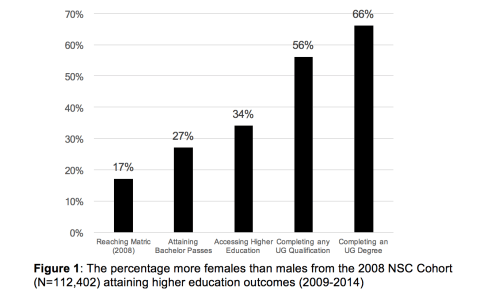
The results are truly remarkable. We find strong evidence of a large female advantage that continues to grow at each hurdle of the higher education process. To be specific, relative to their male counterparts we find that there were 27% more females who qualified for university, 34% more who enroll in university, 56% more who complete any undergraduate qualification and 66% more who attain a bachelor’s degree. This despite there being roughly equal numbers of boys and girls at the start of school. 

Screen Shot 2017-11-08 at 11.30.55 AM

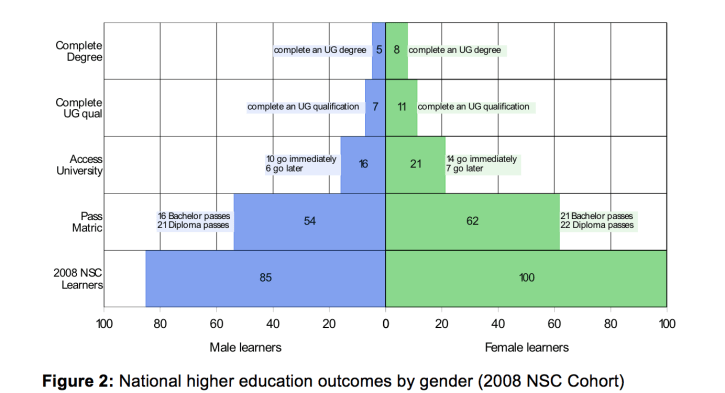
Another striking finding is the very large drop-off from Matric to degree attainment. The diagram below shows that for every 100 females in matric there are only 85 males in matric. And for every 100 females in matric only 8 females will complete an undergraduate degree within six years, with even lower numbers for males (only 5 males).

Screen Shot 2017-11-08 at 11.31.41 AM

Because of the richness of the data we can also see whether this advantage remains after controlling for various background factors like race, age, socioeconomic status etc. We can also control for school-level achievement. We find that this large female advantage remains after controlling for school-level performance, and exists for all subgroups of race, age, socioeconomic status, and province of origin.

But perhaps it is because females choose ‘easier’ fields of study than males – and that explains the ‘advantage’? The short answer is no. We examine 19 fields of study and find that females are significantly more likely to get a degree in 12 of the 19 fields (often by substantial margins), and are significantly less likely to get a degree in five of the 19 fields. However, this is almost entirely because they do not access these traditionally ‘male’ programs rather than due to lower completion rates once they are in. Only in Engineering and Computer Science do girls do worse than boys once they are accepted to the program. But while there are these  two fields where girls do worse, there are nine where boys do worse (including Health Sciences, Business Studies, Natural Sciences, Psychology etc.). One of the most interesting findings of the paper was that females are always and everywhere 20% less likely to dropout than their male counterparts (including in traditionally ‘male’ fields like Engineering and Computer Science), even after controlling for field of study, race, age, socioeconomic status, and location.

It is important to recognize that South Africa is not an outlier in this regard. The emergence of a female advantage in education (both at school and at university) is a global trend among middle and high-income countries. In the 33 countries that make up the Organization for Economic Cooperation and Development (OECD) – mainly a club of rich countries – 58% of bachelor’s degrees were awarded to women (in SA it is 61%). The question we usually get asked is why is this the case? We don’t really know yet, but the best international evidence points to the fact that girls have more and better “non-cognitive skills.” These are things such as self-control, self-motivation, dependability, sociability, perceptions of self-worth, locus of control, time-preference and delayed gratification. Other scholars argue that schooling is set up in such a way that it favors girls over boys, and favours the traits that society expects from girls or, alternatively those that girls just naturally have more of.

Another conundrum is how it’s possible for girls to do better at school and better at university but then worse in the labour-market? Women in South Africa get paid about 15-17% less than men do for the exact same work (again this is true around the world). The answers here are also complex and link to some easily observable features of society – like who is expected to care for children – and some less observable features like patriarchal norms and gender discrimination.

What our research shows is that girls in South Africa have a clear advantage at school and at university. Any conversation about ‘gender equality’ needs to take into account the disadvantage faced by boys at school and university, but also why this reverses when one moves into the labor-market.


DBE Research Protocols

DBE protocls

If you’ve ever wanted to conduct research on education in South Africa you may have been a little confused about the processes to follow when requesting data, getting approval to visit schools etc. The Department of Basic Education (DBE) has recently released research protocols for requesting data, getting research projects approved etc. There are two documents that you need to complete and email to them:

I think this is a great step towards standardising and formalising the processes for interacting with the DBE around research. I personally think that all of this could be done on a Google Form or a Surveymonkey questionnaire, eliminating all the paperwork, but baby steps 🙂

Creating your own excitement

actually

For a while now my blog has only been about ‘professional’ things in my life: links and presentations related to education, current research and that kind of stuff. But in the beginning I had always intended to combine my ‘personal’ and ‘professional’ in the same place. I like to read about other people’s lives, not just their ‘work’. What do they think about children? spirituality? where do they go when they are scared? That stuff interests me much more than the stuff they publish. And so I think that documenting my own thoughts, beliefs, doubts, realisations and anxieties – that stuff is probably as central to my work as any academic argument that resonates with me. And all these things affect what I spend my time on. And I suppose that’s what life is; what we spend our time on.

panda

So this is an attempt to try and bring back some of the personal into my largely ‘professionalised’ blog. I think one of the reasons why it morphed into a more work-life-only space was that I was thinking too much about who was reading my blog and whether deeply personal reflections were appropriate. So I’ve resolved that question by deciding that basically the only sustainable approach for me is to be able to bring all of who I am to whatever I’m doing. That means I can’t ring-fence my work and not talk about politics or social justice at the dinner table. It is a pet-peeve (read: serious fucking irritation) when people at dinner say things like “Can we move onto talking about something less intense?” FFS. This is when I take two deep breaths and usually make eye-contact with a close friend with a deadpan expression that broadly means “Why are we here?” or (more frequently) “Why did we invite this person to dinner?” Now, don’t get me wrong. I love banter and humor or lols as much as the next person, but when small-talk dominates the discussion I genuinely feel like I am wasting my whole life. I kid you not, some people can spend 45 minutes talking about whether one should put the fire-lighters on top of the charcoal or underneath the charcoal. I die.

dulp2

Anyways, that’s all just a sidebar to say that I can’t dichotomise work and play easily. And I am actively moving in the other direction. I’ve been mulling over some life things for a while and thought I’d create a listicle (who doesn’t love a good listicle!). Some realisations or thoughts or rants or text on the page:

(1) I want to live my life more deliberately. I agree that sounds super corny and cheap but it’s in relation to a quote from Paul Kalanithi’s book:

“If the unexamined life was not worth living, was the unlived life worth examining?”

I’ve explained the whole realisation in a lot more detail here. But the essence is that we typically regret the things we didn’t do rather than those we did (duh!) and that doubt and fear kill many more dreams than failure or rejection do.

doubt

(2) I want to work with people I enjoy spending time with. 

I’ve decided that I will make a conscious effort to find myself in situations where I get to work with people whose company I enjoy. I think I landed with my bum in the butter work-wise in that I get to do that pretty much every day. The people I work with at RESEP are such lovely mensches. And more recently I have started my own team of people at the Allan Gray Orbis Foundation Endowment with our Funda Wande project (website imminent!). Essentially a multi-media course to teach Foundation Phase teachers how to teach reading. I get so much energy and inspiration from the people I work with and I want to find ways of making sure that we find time to laugh and joke even when things are tight and deadlines are looming. More on this in the future…

(3) There are lots of people talking-about-the-work and very few people doing-the-work.  On the surface these two types of people look quite similar and play in similar spaces but in reality there is a huge chasm between the two. Cutting ribbons, giving talks, writing op-eds, making policies – essentially speaking about what needs to be done – are people I increasingly have less and less time for. This is not to say that just because people are ‘in the trenches’ that what they are doing is more important or more honorable or whatever. It’s more about whether or not people are actually tackling a particularly vexing issue or not. There is a big difference (which I am realising daily!) between saying “We need to develop benchmarks in African languages” and realising “This involves a lot of work, will cost a lot of money but it’s not something we can get around. For whatever reason no one is actually doing this. OK let’s get to work.” On this particular issue of benchmarks in African languages HERE is our first stab at this (paper to follow soon!).


ass kicked

(4) You have to create your own excitement. I think this is probably my biggest realisation and one that I keep coming back to. I have a tendency to fall into an external locus of control (“The belief that events in one’s life, whether good or bad, are caused by uncontrollable factors such as the environment, other people, or a higher power“). My knee-jerk reaction when things aren’t great in life is that this is because someone else has not done something they should have. lol. One of my favourite lines is “Just do your job.” Needless to say I loved the memes that were generated when Kim Davis (a county clerk in Kentucky) didn’t to do her job and defied the US Supreme Court in refusing to register gay marriages. It spawned a whole series of protests and memes with the hashtag #doyourjob and the like. Two of my favourites:

1

2

Anyways that’s a roundabout way of saying that I often find reasons outside of me, essentially, as to why things aren’t going well. And therefore the solution is that those things outside of me need to change before I can be happy again. This is obviously a really shitty life strategy. One of the perennial issues is excitement. Energy. Enthusiasm. Drive. Doing lots of work is easy when the fires are burning and the drive is there in full flow. The problem is when it goes, as it does. What do I do when I don’t actually want to jump out of bed and prepare for a presentation or write or read or talk or do anything that involves me getting out of bed? Sometimes I go to the beach for 2 days and do nothing but lie in the sun and listen to music. This is an extremely effective tonic. I usually get very bored of that and super excited about something I was working on and jump back into work. But what happens when that doesn’t work (or it’s winter!)? I’m still figuring this one out but I think the answer lies somewhere in the neighborhood of things like agency and being able to talk yourself out of moods or ruts, taking actions that you know will help (organise a dinner, see your therapist, encourage friends, do something you haven’t done before etc.), reflect. Be an adult. lol.
mediocreany idea

(5) The urgent and the important – make sure you find time for important stuff not just urgent stuff. This is a very new realisation. I think it dawned on me that I was mortgaging people for short-term deadlines. I know I am late to this party but I’m realising that deadlines never disappear they are only ever replaced by other deadlines. Maybe losing the joy of work is the canary in the cageThe first big warning sign that you need to take a step back and re-evaluate what’s happening in your life. And maybe that’s what this is; realising that I like the people in my life. I like the work I do. I like the country I live in. Life is good and I shouldn’t forget it. And no flurry of deadlines or seemingly urgent things should mess with that. That’s me for now.
x

Screen Shot 2017-09-25 at 12.38.09 PM


EGRS: Probably the most important education research/intervention post-apartheid

EGRS logo final Setswana

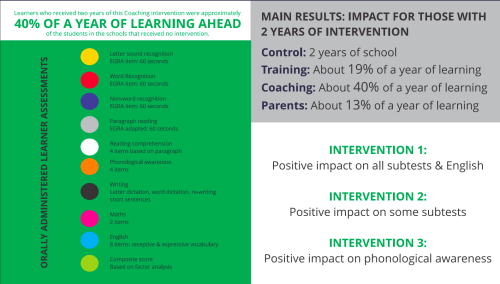
Breaking News: New ‘gold-standard’ study finds improvement of 40% of a year of learning in reading for disadvantaged children in South Africa. (At least that would be the title I’d pick if I was a sub-editor reporting on EGRS!)
In South Africa and around the world today there are many reasons to be despondent – whether about inequality, the environment or some of our political overlords. But every now and then we learn of truly amazing things that are happening despite all the shit in the world, and the Early Grade Reading Study (EGRS) is the best example of this in South Africa. The researchers leading the study were Stephen Taylor (DBE), Brahm Fleisch (Wits) and Mpumi Mohohlwane (DBE).

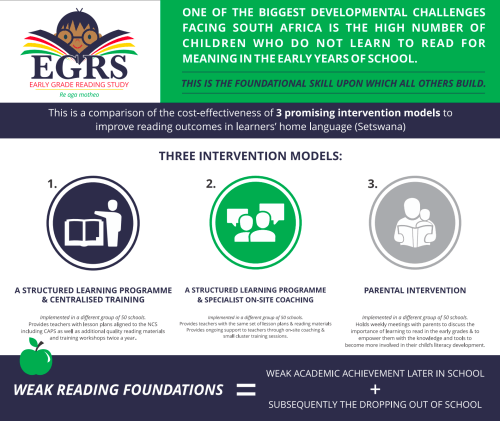
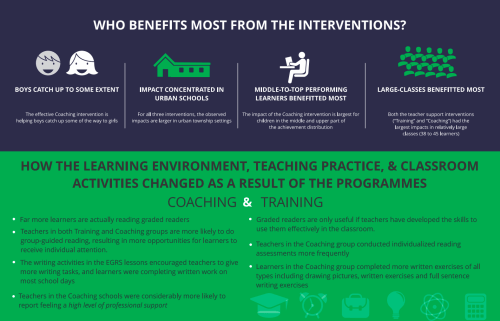
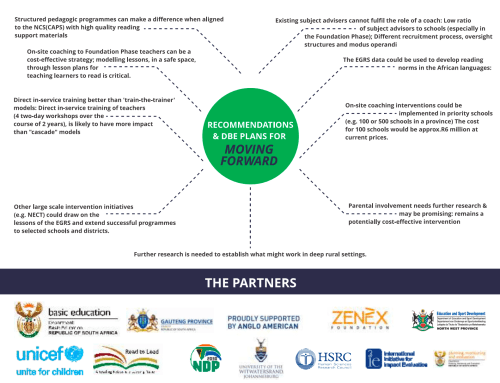
For those of you who don’t already know about it, have you been living under a rock? The EGRS study was a large randomised control trial that aimed to determine which (if any) interventions improve early grade reading outcomes in home language (Setswana) in 230 Quintile 1-3 schools in the North West province in South Africa. It was implemented in 2015 (Grade 1) and 2016 (Grade 2) and today the final results of the intervention were released and they are very encouraging! I would suggest everyone reads the EGRS Policy Summary Report and I include the great infographics below:

Screen Shot 2017-08-16 at 2.05.49 PM

Screen Shot 2017-08-16 at 2.06.09 PM

Screen Shot 2017-08-16 at 2.06.18 PM

Screen Shot 2017-08-16 at 2.06.33 PM

There are also three additional EGRS reports:

My Q&A with Nali Bali

Usually the sensational titles that sub-editors choose to use drives me crazy. This time I actually love that they focus on this quote about the lack of NRF Chairs in African Languages: 100% true!! 

Screen Shot 2017-08-07 at 3.18.15 PM

The edited Q&A is available on the TimesLive site here. But my unedited answers are here:

You’ve talked before about reading being South Africa’s biggest solvable problem. But the recent pre-Progress in International Reading Literacy Study (PIRLS) survey puts the number of Grade Four children who cannot read for meaning in any language at 58%. Where to begin turning this around?

I think there are a number of ‘basics’ that we need to get in place to rectify this problem. They can broadly be grouped under ‘Time’, ‘Text’ and ‘Teachers’.

Teachers: I think we need to ensure that all teachers actually know how to teach reading. Unfortunately most teachers have not been taught what the various components of reading are (phonics, vocabulary, comprehension, fluency and motivation) or how these fit together into a cohesive whole. Currently teachers focus on communalized activities like chorusing and offer very little differentiation or individualized instruction or assessment. There is little formal teaching of vocabulary, spelling, writing or phonics and almost no understanding of how to develop the most important skill in reading: comprehension. Countless research studies have shown that our teachers simply do not know how to teach reading and writing systematically. 

Text: Given that 70% of children in South Africa are learning to read in an African language in grades 1-3 before transitioning into English in Grade 4, we need to ensure that there are enough texts available to actually teach reading. I’ve recently looked at the number of graded readers that exist in the African languages and most series have 15 very short books per year from grades 1-3. This is simply unacceptable. If one looks at wealthy English schools children are reading up to 200 graded books per year. They usually take one home per day. We really need to increase the number and quality of resources available in African languages.

Time: A number of studies have shown that teachers are only using about 50% of the instructional time that is available during the year. As a result children do not have enough opportunity to learn to read.

At grade four level, children are expected to transition between the phases of ‘learn to read’ and ‘read to learn’ – essentially being able to read for meaning. Yet it’s also the age when schools tend to switch children from mother-tongue education to English-language instruction. That sounds like a recipe for disaster?

The transition to English in grade 4 is fraught with difficulties. For learners that have not become literate in their home language in grades 1-3 it is almost impossible to become literate in a second language (English). I think this points to two things: (1) deficiencies in how we are teaching home language in grades 1-3 and (2) deficiencies in how we are teaching English First Additional Language (EFAL) in grades 1-3. There is also a dearth of research on this transiton. The best research on this comes from the work of Carol MacDonald in the Threshold Project which was done in 1989! We need more research on the transition and how to ensure that learners are not only bilingual but also biliterate.

It’s worth noting that a number of other African countries also transition to English in Grade 4 and have much better reading outcomes than we do. The transition to English in Grade 4 is certainly not unique to South Africa.

Text-poor environments are definitely a contributor to our national literacy crisis. What are some of the most interesting projects you’ve come across to encourage production of books in indigenous languages?

 I think the move to develop graded readers in the African languages from scratch is a great example of progress. Up until recently most of the graded readers that had been developed in African languages were just translations from English, and often would lost all the ‘grading’ in the translations. This is because some words and themes that are ‘easy’ in English are actually very difficult in some African languages. The Vula Bula books by Molteno are a good example of de novo graded readers that were developed with the concept of grading in the specific language. I think the work of Nali Bali is also really important – developing stories written by home-language speakers and easily accessible to children.

It’s not just hard to find published literature in indigenous languages, there’s a dearth of linguistic research too – there are no oral reading fluency benchmarks for African languages, for example. Where would you particularly like to see significant change?

100%. This drives me absolutely crazy. Why on earth are there no National Research Foundation (NRF) Chairs in teaching reading in African languages?! Why is early grade reading research not a national research priority with priority funding? This is such a huge scandal in South Africa. The absolute failure of PanSALB to do what it was mandated to do by Parliament is a disgrace. While it’s great to see individual publishers and authors pushing forward and publishing books and stories in African languages, ultimately we need the funding and commitment from government that this is a national priority.

You’ve talked about making the achieving of mother tongue reading competency by grade three a prioritized national goal. What – and how long – might it take to achieve this?

To be 100% honest this will take time. It takes time to train teachers. Get high quality resources I nevery classroom and every home. We could create a great campaign and say that it needs to be done by 2020 and try and galvanize everyone, but that’s just not how long these things take. I think a ten-year time-horizon is probably more realistic. Even that is really ambitious. The Nobel prize winner Amartya Sen uses the Japanese experience in the mid-19th century as a classic example of the relentless focus on basic education. Soon after the Meiji restoration of 1868 The Fundamental Code of Education was issued (1872) which stated that there must be “no community with an illiterate family, nor a family with an illiterate person.” By 1913 the country was almost entirely literate, publishing more books than Britain and more than twice as many as the United States, even though it was much poorer than both of these countries. But none of this happens without a country-wide commitment to eradicating illiteracy and ensuring that every South African can read for meaning and pleasure.


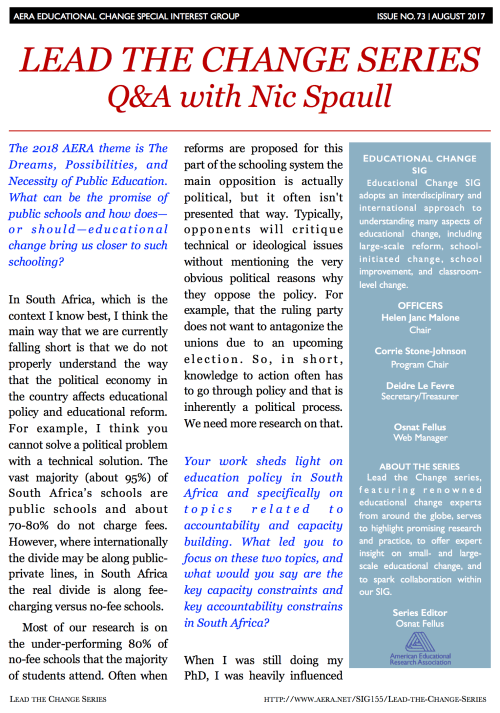
My ‘Lead the Change’ Q&A with AERA SIG

See below for a Q&A session I did for the Augest edition of “Lead the Change” run by the AERA SIG on Educational Change. PDF here.

Screen Shot 2017-08-02 at 8.55.00 AM

Screen Shot 2017-08-02 at 8.55.12 AM

Screen Shot 2017-08-02 at 8.55.22 AM

Screen Shot 2017-08-02 at 8.55.31 AM

DBE is hiring… (closing 14 Aug)

hiring-job-candidates-1940x900_34860

The Department of Basic Education (DBE) is advertising vacancies for a number of high-level posts. If you know of great candidates please forward this on to them. Our education system is only as good as the bureaucrats who help run it 🙂

PDF with full job descriptions and salaries HERE.

Some of them that might be interesting to some of you…

POST: Chief Director: (Ref no: 22435/02)

BRANCH: Curriculum Policy, Support and Monitoring
CHIEF DIRECTORATE: Curriculum and Quality Enhancement Programmes
SALARY: All-Inclusive remuneration package of R 1 068 564 per annum
CENTRE: Pretoria

POST: Chief Director: (Ref no: 22435/03)

BRANCH: Teacher and Professional Development
CHIEF DIRECTORATE: National Institute for Curriculum and Professional Development (NICPD)
SALARY: All-Inclusive remuneration package of R 1 068 564 per annum
CENTRE: Pretoria

POST: Director: (Ref no: 22435/05)

BRANCH: Planning, Information and Assessment
DIRECTORATE: National Assessments
SALARY: All-Inclusive remuneration package of R 898 743 per annum
CENTRE: Pretoria

POST: Director: (Ref no: 22435/06)

Branch: Planning, Information and Assessment
Directorate: Education Management Information Systems (EMIS)
SALARY: All-Inclusive remuneration package of R 898 743 per annum
CENTRE: Pretoria

POST: Assistant Director: Integrated Quality Management Systems (IQMS) (Ref no: DBE/40/2017)
Branch: Teacher and Professional Development
Directorate: Educator Performance Management and Development and Whole School Evaluation

SALARY: R 417 552 per annum
CENTRE: Pretoria

POST: Assistant Director (Reporting, Publication and Information Dissemination): (Ref no: DBE/42/2017)
Branch: Planning, Information and Assessment
Directorate: Education Management Information Systems (EMIS)

SALARY: R 417 552 per annum
CENTRE: Pretoria


Barbara Band’s links on diversity and inclusion

barbaraLast week I spoke at the South African Librarian’s Conference at Highbury in KZN (presentation one and presentation two) and heard Barbara Band speak about how the library can be a vital tool to make schools more inclusive and help all students thrive. It struck a cord for me because in high school I basically lived in the library during breaks for three years. My librarians weren’t especially empathetic or insightful but it was still a safe place in an unsafe school. As always we can’t forget that South Africa is a deeply unequal country and that only 37% of learners are in a school with a library (Page 20 from this DBE report).

In Barbara’s address she mentioned a bunch of different sites and resources and I asked her to email them to me so I could share the mall with you, so here they are:

Booklists and bookshops:

3

List of organisations that support diversity and inclusion:

  • Ditch The Label – anti-bullying charity supporting 12 – 25 year olds
    www.ditchthelabel.org
  • EACH – Educational Action Challenging Homophobia: provides training, support and resources.
    http://www.each.education/
  • Educate and Celebrate – Ofsted and DFE recognised programme to implement LGBTQ/inclusive curriculum
    www.educateandcelebrate.org
  • Gendered Intelligence – a not-for-profit company whose aim is to increase understandings of gender diversity.
    http://genderedintelligence.co.uk/
  • GIRES – Gender Identity Research and Education Society: aim is to improve lives of trans and gender non-conforming people. Lots of links to articles, research, legal advice, etc.
    http://www.gires.org.uk/
  • 6IGLYO – International Lesbian, Gay, Bisexual, Transgender and Queer Youth and Student Organisation: works with over 95 LGBTQ groups, run by and for young people.
    http://www.iglyo.com/
  • Inclusive Minds – a group of consultants and campaigners working to improve diversity in children’s literature.
    http://www.inclusiveminds.com/
  • Kidscape – deals with anti-bullying and child protection
    www.kidscape.org.uk
  • Mermaids – Family and individual support for children and teens with Gender Identity Issues.
    http://www.mermaidsuk.org.uk/
  • 4Metro – Equality and diversity charity, focusing mainly around London and South East.

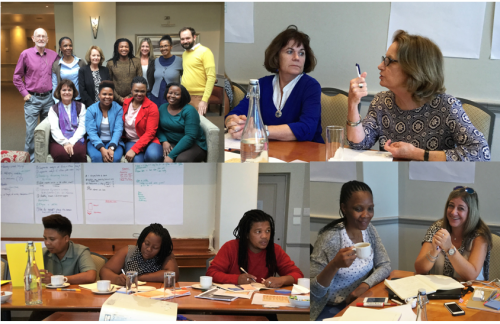
    www.metrocentreonline.org
  • Rewind – works in education to challenge racism and extremism
    http://rewind.org.uk
  • Schools Out UK – aim is to make schools safe and inclusive for everyone: lots of links to resources and other relevant websites.
    www.schools-out.org.uk
  • Stonewall – help and advice, carries out research, partners with schools and organisations, lots of resources.
    http://www.stonewall.org.uk/
  • Welcoming Schools – aimed at US elementary schools but has useful information, advice, etc.
    http://www.welcomingschools.org/

ALSO USEFUL:

7


Funda Wande: Teaching Reading for Meaning

[A little info on what I’ve been working on for the last while – more details to come in the coming months!]

Guest blog post I wrote for the Allan Gray Orbis Foundation from here

Overview: South Africa is virtually unique among upper-middle-income countries in that most of our children (58%) do not learn to read for meaning in the first three years of school[1]. Without this core skill, they fall further and further behind as they are promoted into higher grades. While there are many reasons for this reading crisis one of the most prominent is that Foundation Phase teachers do not know (and have never been taught) how to teach reading. The Funda Wande: Teaching Reading for Meaning” project aims to help address this course by developing a high-quality, free, open-access and SAQA-approved course: the ‘Certificate in Teaching Early Grade Reading.” All course materials will be available in isiXhosa (the pilot language) and subtitled in English. There will also be an English First Additional language sub-course. It is largely video-based with on-site coaches visiting teachers in their classrooms once every two weeks.

Capturefw

In the 21st Century we live in a world that is inundated with written language, or ‘print’. We see it in our newspapers, on our contracts, on the screens of our cell phones and the pages of our school books. From the policies of government to the signs on our roads, it is the essential ingredient in modern life. Print is everywhere. And this is why reading is so important. Learning to crack the code of how we represent spoken language using symbols is a big part of why we go to school. We learn the differences between b and d, or between p and q. Moving from letters and syllables to words and sentences we can read about pirates, pigs and pixies or earth-quakes and igloos. Once we have cracked the code the possibilities are endless. This is the joy of being initiated into the literate world.

Aside from the practical importance of reading to make our way through the world, reading (and writing) is essential for participation in formal education since the ability to decode text, read with comprehension and learn from reading is the bedrock of most activities in institutions of learning. If reading is not mastered early on, progress in schooling is restricted. Unfortunately nationally representative surveys (prePIRLS) show that more than half (56%)[2] of South African children do not learn to read fluently and with comprehension in any language by the end of Grade 4. But, as with most averages in South Africa, it hides huge inequalities. If we compare the wealthiest 10% of these learners with the poorest 50% the differences are astounding. Among the richest learners 86% learn to read for meaning compared to less than 30% among the poorest half of learners. Why is this?

One of the main reasons behind this reading crisis is that our teachers have never been given meaningful learning opportunities to acquire this specialized knowledge, neither in their initial teacher training nor in subsequent in-service training. They often do not know what the various components of reading are (phonics, vocabulary, comprehension, fluency and motivation) or how these fit together into a cohesive whole. Many teachers are also confused about how to implement different reading methodologies like group-guided reading or shared reading. Currently teachers focus on communalized activities like chorusing and offer very little differentiation or individualized instruction or assessment. There is also little formal teaching of vocabulary, spelling, writing or phonics and almost no understanding of how to develop the most important skill in reading: comprehension. Importantly, while the majority of our learners are learning to read in an African language (70%+), almost all universities only offer pre-service instruction on teaching reading in English.


To help fill this gap, we are designing a new course to help make sure that all Foundation Phase teachers in the country know how to teach reading in their home-language and in English as a First Additional Language. The “Funda Wande: Teaching Reading for Meaning” project was initiated at the start of 2017 at the request of the Allan Gray Orbis Foundation Endowment Trustees and is now funded by the Endowment together with two funding partners: The Volkswagen Community Trust and the Millennium Trust. The course is currently being developed for two languages: isiXhosa  and English First Additional Language. Using professionally filmed in-classroom videos, animations, info-graphics and other multi-media the course will teach the major components of reading and writing.

The 11 modules are: (1) How children learn to read, (2) Decoding in reading and writing, (3) Comprehension, (4) Vocabulary, (5) Children’s literature, (6) CAPS reading activities, (7) English as a First Additional Language, (8) Writing, (9) Reading assessment and remediation, (10) Inclusive education, and (11) Planning and progression. The course will be a credit-bearing Certificate accredited by the South African Qualifications Authority (SAQA). The course and all materials developed in the course will be openly licensed (Creative Commons) and freely available for anyone to use. It will be offered as a Certificate in Teaching Early Grade Reading by at least one public university in South Africa. The course will be evaluated in 2019-2021. If the evaluation of the course shows that it significantly raises teachers’ content knowledge and improves their teaching practice, and importantly raises the reading outcomes of the learners they teach – the mandate is to adapt the course and offer it in all of South Africa’s official languages. Ensuring that all teachers know how to teach reading and writing is the first step in ensuring that all South African children learn to read for meaning and pleasure.

If you are an expert in teaching early grade reading in isiXhosa and would like to be involved in the project or to find out more information please email me nicspaull[at]gmail.com

[1] This statistic is taken from one of the nationally-representative datasets of reading achievement in South Africa (prePIRLS, 2011). See Spaull (2016) for a fuller discussion of the results from the PIRLS and prePIRLS studies.

[2] Spaull, N (2016). Learning to read and reading to learn. Research on Socioeconomic Policy (RESEP) Policy Brief. Stellenbosch.

EGRS is recruiting as well :)

57c129023dd337b563123a2040341bb6.jpg

The Director of Research in the DBE – Dr Stephen Taylor – is looking for a Project Associate and a Project Intern for their Early Grade Reading Study (deadline for applications: 2 June 2017). The work they are doing on early grade reading is some of the most interesting and important work on the topic not only in South Africa but across the continent. Figuring out how you improve early grade reading outcomes at scale and using rigorous scientific evidence and evaluation. Having seen the early results of EGRS 1 I can say that there is a lot of promise in the coaching model for improving teacher’s content knowledge about reading and their pedagogical practice.

While the salaries may not be amazing 🙂 the team you will be working with really is and you may think of this as a launch pad into a rapidly growing and exciting field. Stephen Taylor, Mpumi Mohohlwane, Carol Nuga Deliwe, Janeli Kotze and Brahm Fleisch are all involved in the team. If you know of anyone please forward the TOR’s in the links above and below to them – deadline 2 June 2017.

EGRS 1


egrs2

I’m also working in this early grade reading space but on developing a (video and coaching based) certificate to teach early grade reading for the Allan Gray Orbis Foundation Endowment. I think we will also be recruiting soon. Stay tuned 🙂