“SADTU selling principals’ posts in exchange for cows, sheep and goats” (CityPress article)

I don’t usually repost articles on education but if these allegations are true – and Prof John Volmink’s report should identify if they are – then we really need decisive action from Motshekga or Zuma or someone who actually has power. This is a deal-breaker. You cannot have SADTU running provinces and calling the shots while children suffer as a result.

Corruption-Arrow-Sign1-630x286

“Pretoria – Rogue members of teachers’ union Sadtu have “captured” a key provincial education department, which officials in Basic Education Minister Angie Motshekga’s office say is now on the “verge of collapse”.

Investigators appointed by Motshekga to probe the jobs-for-cash racket run by union officials, which City Press exposed last year, have found that Sadtu members have “infiltrated that department and run a complex patronage system” in KwaZulu-Natal.

An investigation commissioned by Motshekga’s office and headed by Professor John Volmink has found that not only is education in KwaZulu-Natal being run by rogue union members, but Sadtu members have been found to have violated the system in the provincial education departments of Gauteng, North West, the Eastern Cape, Mpumalanga and Limpopo.

On Monday, Motshekga met KwaZulu-Natal education MEC Peggy Nkonyeni and senior officials in her department at OR Tambo International Airport to discuss the crisis.

A senior department official said the provincial department had “collapsed; there is no leadership”.

What investigators found

Other allegations Volmink’s team of 10 investigators uncovered around the country include:

. Evidence that a number of senior Sadtu members in the Eastern Cape have received cows, sheep and goats as payment for several principals’ positions throughout the province;

. That an applicant for a principal post at a Gauteng school approached his district director and showed him an SMS which proved Sadtu officials tried to extort R25 000 out of him in return for the job; and

. A Sadtu official in Limpopo’s Mopani district committed suicide after failing to secure two principal posts for teachers who had paid him R25 000 each. He killed himself after they demanded their money back.

In KwaZulu-Natal they found:

. Sadtu officials demanding that union members be appointed to 37 chief education specialist posts. Union officials insisted the department reduce the educational requirements for the posts from degrees to teaching diplomas;

. Sadtu officials have earmarked candidates to fill 15 senior managerial positions in the Ugu district in Port Shepstone;

. A Sadtu leader who is a junior teacher in the Ethekwini North region became the principal of a large school with two deputy principals in the Ilembe district after falsifying a letter of appointment;

. A senior Sadtu official in Ethekwini North illegally swapped positions with a principal of a large school in Ilembe. The “gentlemen’s deal” was struck because principals of large schools earn much more than those who run smaller schools; and

. Evidence that a school governing body member of a Pinetown school acted with Sadtu members to extort R30 000 from a teacher who had applied for the job of principal.

KZN on the verge of collapse

On Thursday, officials from the basic education department’s legal department were sent to Durban to meet senior provincial officials. Senior department sources with knowledge of the meeting said the lawyers “read the riot act to their provincial counterparts asking them to rein in Sadtu”.

Another official said: “They were very harsh on them, asking why they had not acted on Sadtu’s anarchy over the past two weeks.”

Over the past two weeks, pupils at 440 schools in the Ilembe region on the north coast and 485 schools in Ugu region on the south coast have received little teaching after regional union leaders ordered teachers to protest at district offices.

The teachers, who play loud music and disrupt work at the offices, aim to get rid of the directors.

The protest is set to intensify this week in the Ilembe region, where an unsigned notice from the office of the secretary of Sadtu’s Ethekwini North region – which was sent to members on Friday – states that all members should conduct sit-ins at district offices on Monday and shut down schools completely on Tuesday.

Three sources in the department told City Press that Ilembe district director Thembinkosi Vilakazi was visited by three Sadtu leaders from the Ethekwini North region in August last year. They demanded that she appoint them as chief education specialists in her three circuit offices in Stanger, Ndwedwe and KwaMaphumulo.

“They asked to talk to her and told her she was a comrade and should co-operate with them. They said they were prepared to support her and defend her from her enemies, but only if she gave them the positions. She told them things didn’t work like that and she couldn’t fix positions. She told them the fixing of positions was illegal and was corruption.”

He said the three told Vilakazi that if she did not agree to the deal, they would make her stay at the district miserable.

Vilakazi refused to comment.

Another senior KwaZulu-Natal official said that, while Sadtu had claimed Ugu district director Mfundo Sibiya was unfit to lead, what was at issue were the 15 senior positions advertised in the district.

“The department has endorsed interviewing panels given by Sadtu. Where have you ever seen that? Sadtu asked him to change certain people in the interviewing panels, but he refused,” said the official.

“One of the people they want, a Sadtu leader, is not even shortlisted.” Sibiya refused to comment.

Sadtu denies claims

Sadtu’s provincial secretary, Dolly Caluza, said the protests at Ilembe and Ugu had nothing to do with positions.

“There are issues our leaders are raising with the department and some of them date back to 2011. We are protesting about norms and standards and the allocation of teachers. Teachers are overworked and there is animosity because teachers are overworked,” she said.

Caluza accused Vilakazi of failing to attend meetings to resolve labour issues. She denied the protests were about positions.

Sadtu’s national secretary, Mugwena Maluleke, said anyone with evidence of corruption should approach Volmink’s team with evidence.

“One district director in KwaZulu-Natal made allegations – we asked him to submit evidence and he still hasn’t. If they don’t, it will appear that they want to run away from their responsibilities, and use Sadtu’s name to do that. People should be exposed if they are corrupt,” said Maluleke.

Directors fight back

Eight of KwaZulu-Natal’s 12 district directors met in Pietermaritzburg last week and agreed to approach Nkonyeni and Premier Senzo Mchunu to protect them from being intimidated by Sadtu members and the union’s grip on the department.

Sources close to the meeting told City Press that if Nkonyeni and Mchunu did not respond, the directors would appeal to Motshekga and President Jacob Zuma.

One director, who spoke on condition of anonymity, said: “Sadtu is running the department. We have resolved to take the fight to Sadtu. We want support from the premier and the MEC. We need support from the department of education; they must use their power to support us.

“Sadtu doesn’t give a f*** about our children’s education. Education is under siege; it is in the hands of syndicates. The ANC has to pronounce on this; we have reached the crossroads.”

Trouble brews over big jobs

Motshekga’s team’s visit comes as trouble brews over 37 chief education specialist posts.

Three senior officials close to the matter told City Press several provincial Sadtu leaders had publicly stated in meetings they had already allocated the positions to some of their members.

A senior official, who did not want to be named, said: “Sadtu wants the positions, saying they met with head of department Nkosinathi Sishi and persuaded him to advertise the positions.

“They said they would decide who was appointed. They have a list across the province.”

Three senior officials told City Press that when the positions were advertised in August last year, the prerequisite for candidates was a university degree.

But because most of Sadtu’s favoured candidates did not have degrees, the advertisement was withdrawn and the requirements were amended to a diploma.

The posts were re-advertised in March. Caluza denied the union had objected to district directors chairing interviewing panels of the 37 chief education specialist positions.

“We have not objected to directors chairing interviewing panels. We don’t decide who chairs panels, we only observe. Our role is to observe.”

KwaZulu-Natal education department spokesperson Muzi Mahlambi said the department was concerned about the disruption of classes at Ilembe and Ugu.

“We are engaging the leadership of Sadtu. We have already held three meetings with them. The engagements are so that the right of the child to learn can be protected. We have issued a circular that empowers principals to deal with teachers who are not at school.”

He said the province was confident that things would improve this week.”

//

From here.

Reading to some purpose

nasa 2

Open Stellenbosch: “Tackling language and exclusion at Stellenbosch University”

(The article below was written by the Open Stellenbosch collective and published in the City Press this Sunday the 26th of April 2015, and is also available on Daily Maverick). I’ve written about this topic myself and feel quite strongly that not enough is being done to diversify the staff and student bodies at Stellenbosch and particularly in changing the culture at the University, hence posting the article here.

“Tackling language and exclusion at Stellenbosch University”

– Open Stellenbosch

STELLENBOSCH-UNIVERSITY1-300x300-66aipc3bdj8dgyqq57lp7vrj5eq7lrofhxun14n3i42

“Many in South Africa are aware of the RhodesMustFall movement at UCT, and the problems of institutional racism it has highlighted. These problems are deeply entrenched at Stellenbosch University, where Open Stellenbosch was created to challenge the hegemony of white Afrikaans culture and the exclusion of black students and staff. Open Stellenbosch is a movement of predominantly black students and staff at the University who refuse to accept the current pace of transformation.

In 2013, only 3.5% of all professors at the University were black, while 86% were white. In fact, there are more professors named ‘Johan’ than there are black professors at our institution. Is this really what transformation looks like 20 years after Apartheid?

The fact that we as black students on campus have to take matters into our own hands to change the oppressive institutional culture at Stellenbosch is an indictment of the University management. We do not believe that those in the SRC, the Senate or the Council understand the weight of normalised oppression that we experience at this overtly white University.

Although our institution claims that “continuous transformation is part of the core being of the University”, this could not be further from our everyday reality at Stellenbosch. We are tired of empty promises and goals that are perpetually postponed. We have been having these conversations for over a decade now, and it is clear that the management at Stellenbosch has been operating in bad faith. Many promises, little action. There was the “Strategic Framework” of 1999, the “Vision 2012” document of 2000, the “Transformation Strategy” of 2008, the “Overarching Strategic Plan” of 2009, the “Quality Development Plan”, the “Employment Equity Plan”, the “Diversity Framework”, and so it goes on. These have all failed because of a wholesale lack of political will to implement them – both then and now.

Although there are many things that need to change at Stellenbosch University, as a matter of urgency we are calling for the following:

  1. No student should be forced to learn or communicate in Afrikaans and all classes must be available in English.
  2. The institutional culture at Stellenbosch University needs to change radically and rapidly to reflect diverse cultures and not only White Afrikaans culture.
  3. The University publically needs to acknowledge and actively remember the central role that Stellenbosch and its faculty played in the conceptualisation, implementation and maintenance of Apartheid.

Every day students and staff who do not understand Afrikaans are excluded from learning and participating at Stellenbosch University. As black students we are frequently asked, “Why do you come here if you can’t speak Afrikaans?” This question highlights the pervasive and problematic sense of ownership that some have over this University. Stellenbosch – like all universities – is a public institution. This is not an Afrikaans university. It is a South African university which offers instruction in Afrikaans and (to a lesser extent) English.

We have personally experienced countless instances of this institutional racism, including being forced to ask our Afrikaans-speaking peers to interpret what “Huiskomitee” members are saying in residence meetings. When we are allocated rooms, we are intentionally paired with other black students. Initiation at our residences involves explicit racism, homophobia and intimidation. It’s telling that we actively discourage our black school-leaving friends from considering Stellenbosch as a place to study. This is in an attempt to spare them the pain and humiliation of being silently subjugated by a passively hostile culture of white Afrikanerdom.

These exclusionary practices are not limited to students only. Some academics are forced to sit through meetings conducted in Afrikaans where they do not understand anything and yet are required to be there. These norms help explain why black faculty find Stellenbosch to be a hostile environment that privileges white Afrikaans culture. This privileging is most obviously reflected in the racial composition of teaching staff at the University (see graphic).

Is this what transformation looks like (3) (April 2015)

The University and its management will no doubt issue new statements, new speeches, new plans. This week we will read the latest reincarnation of a “Transformation Plan” with the Rector promising that this time it will be different. We are not interested in superficial gestures of goodwill. We want to see an end to Afrikaans-only classes. We want our University to represent our cultures as well. We want to be taught by more black faculty. After years of empty promises and hollow commitments, we no longer trust what you say. Speak to us with your actions because your words will fall on deaf ears, as ours have for over a decade.”

\\

Open Stellenbosch can be found on Twitter @OpenStellies and on Facebook at “Open Stellenbosch”

Q&A with Maurita Glynn-Weissenberg

MauritaThe aim of the Q&A series is to get an inside look into some of South Africa’s leading education academics, policy-makers and activists. This is the twenty-fifth interview in the series. Maurita Glynn-Weissenberg is the founder and director of the Shine Centre.

1) How did you get into education, can you summarise your journey to get to where you are?

I started off teaching my toys as a little girl as I only ever wanted to teach. I taught in the UK and SA in both private and state schooling of which the latter were in pretty edgy neighbourhoods in both countries. Struggling to read seemed to be something that followed children irrespective of where they grew up which led me to study remedial education at UCT in 1995.

In 1998 I started volunteering two mornings a week at Observatory Junior School. A school where most of the children travel long distances at their families expense to learn in English. However, more than half the class were not nearly reading at Grade 1 (?) level by Grade 4. What struck me was the commitment from families to educate their children and how keen the children were to do well. After two years of tutoring Grade 5 and 6 children I started looking for an early intervention which took me to visit a project in Tower Hamlets, East of London, UK. Here I saw corporates giving up a lunch hour once a week to read with children and the idea of Shine was born.

2)   What does your average week look like.

In the last year I have finally moved into a position of moving out of the day-to-day operations of the Shine Programmes and concentrating on developing the right systems and policies to reach our long term vision.

Last week I spent two mornings reviewing policies and researching a few more.

I had a meeting with one of our funders to look at making some changes to our peer-learning project, met with the Chairman of another literacy organisation to discuss collaboration and spent a morning reviewing our Social Franchise.

I also attended the Year Beyond Dinner at Chrysalis Academy where we welcomed 33 amazing youth who will be Shine Learning Partners in 8 schools who benefit from the Western Cape’s MOD programme. I ended the week attending a committee meeting of RASA (Reading Association of South Africa) as we are hosting this year’s RASA Conference along with the Pan African Reading Association.

However, after having quite a serious accident in 2009 I strongly believe in balance and I do manage to pick up my children from school and walk the dog along the green belt most days.

 3)   While I’m sure you’ve read many books and articles in your career, if you had to pick one or two that have been especially influential for you which one or two would they be and why?

Systemic change begins with people changing the way they think and do things. So that is what I am most interested in. Especially as Shine’s workforce is currently 700 volunteers, 23 Centre Managers, 23 school heads, 33 youth and a head office team of 13. Our focus group is thousands of young children and their caregivers.

The book and teachings that made the greatest impact on our work and my thinking is Nancy Cline’s Time to Think. Nancy Kline has identified 10 behaviours that form a system called a Thinking Environment, a model of human interaction that dramatically improves the way people think, and thus the way they work and live. We work this model into our programme and all our meetings. Meetings are useless if people don’t listen to one another, interrupt one another, talk too much or say nothing at all.

The second book that I learnt so much from was Playful Approaches to Serious Problems by David Epston, Jennifer Freeman and Dean Lobovits.

Our volunteers are offered training by Linda van Duuren who’s incredible work is based on David Epston’s Narrative Therapy. Our children come with huge challenges in their lives and it is important that as adults we are able to listen to and respect their unique language, problem-solving and resources. David Epston’s work gives us a framework to work from.

4)   Who do you think are the current two or three most influential/eminent thinkers in your field and why?

I have recently been lucky enough to be part of some incredible thinking.

In 2011 Shine was a finalist for the Wise Awards and ever since I have been sponsored to attend the Word Innovation Summit for Education. What I love about this Summit is that they want to hear from everybody in the field and actively sponsor thousands of people from all areas of education. There is as great a respect for the voice of a field worker in a refugee camp school as the chairman of Unesco for instance. There is so much to learn from the many people around me but I do have some favourites:

Firstly, Charles Leadbeater, who is a leading authority on innovation and creativity and co-wrote Learning from the Extremes. Published early in 2010 by Cisco, Learning from the Extremes examines how social entrepreneurs around the world are devising new approaches to learning in extreme social circumstances – favelas, slums, informal settlements – when there are few teachers, schools, text books. The radically innovative approaches they develop challenge conventional wisdom about schooling and provide new insights into how the developed world should reform its education systems.

My second favourite is Professor Anil Gupta who created the Honey Bee Network to ensure recognition, respect and reward for grassroots inventors and innovators at local, national and global levels. Searching the country with colleagues, he has found countless inventions developed out of necessity, which he has documented and often shared with the global community.

My wish for this year is for a larger group of South African educationalists and policy makers to attend the Wise Summit.

5)   What do you think is the most under-researched area in education in South Africa?

 Can’t say for sure but possibly Early Childhood Development.

6)   What is the best advice you’ve been given?

I think I have learnt the most from Kathryn Torres, our current chairperson, who has partnered me on the Shine journey since 2006. I always tended to allow my visions to paralyse me whereas she is someone that thrives on getting the job done. How lucky is this relationship?

Whenever I have an idea she gets me to haul out my diary and put the next step into action. So usually by the end of that conversation I have identified who I need to speak to, have made contact and the appointment is in the diary. That is simply how new centres were established in 2009, how our Social Franchise model came about and hopefully how our new project involving peer learning will evolve .

Kathryn’s advice: ‘One step at a time.’ It’s as simple as that!

7) You founded the Shine Centre in 2000 – can you give us some information about what Shine is all about, its aims and approach and maybe some of your plans for the future?

The Shine Model

We currently have 8 Shine Centres supporting 10 primary schools and 13 Shine Chapters (our Social Franchise Model) which supports 13 primary schools in 3 provinces.

The Shine Programme runs from a centre in schools each morning. It is managed by a Shine Centre Manager and between 40 to 80 trained volunteers run the programme (depending on the need). Grade Two or Three children are partnered with a volunteer for a year and together they work through a one hour structured literacy programme, twice a week.

Children who attend the Shine Centre have been assessed by Shine to be ‘at risk’ in terms of their literacy scores. This is determined at the end of their Grade One year when Shine assesses all Grade One children. Their progress is monitored twice a year which is shared with the class teacher together with any anecdotal information that the volunteer picks up.

The Literacy Programme consists of: Paired Reading, Shared Reading, Have a Go Writing and Word Games, using 36 five-minute games specially designed by Shine. Our programme complements the school curriculum and provides individual support to children who are struggling. All volunteers receive initial training on the methodology surrounding each of these areas, as well as continuous in-depth training on key and additional skills and learning areas.

On top of that we offer eye testing and glasses to the schools, parent workshops and soon we hope to introduce a peer-learning programme to the teachers.

Importantly, everything is tied together using our Shine Ethos which is based on the principles by Nancy Cline’s Time to Think, and we believe that this is what makes our programme both unique and successful. Children are encouraged to work at their own pace in a fun, warm and nurturing environment, where appreciation and praise are used to positively reinforce progress and good behaviour.

8) I’m sure you are in a different space now than you were in 2000 when you founded Shine, what advice would you give to yourself 14 years ago?

There are things I wish I had done differently but I do believe that it’s part of what I needed to experience and learn. In 1999 I lacked confidence to even think of knocking on doors to get funding. Thus I ended up designing a project that used volunteers and the infrastructure of the school that hosted it. The first Shine Centre established in 2000 ran on the smell of an oil rag but it was quickly noted that the literacy at this school rose steadily from 50% in 2002 to 82.7%% in 2008 (Western Cape Grade 3 testing).

But if I had to choose anything it is to have the courage of my convictions. I used to second-guess myself too much. And I wish I had been a little wilder in my youth. By 21 I was already married, had built a house and had two dogs that were serious hand-breaks! (I may have made up for that in my forties.)

9) What is the most rewarding and most frustrating thing about your job?

Walking into a Shine Chapter that has had our basic support and training and seeing the powerful interaction between the Learning Partners taking place. We won the Truth and Reconciliation Prize in 2008 based on the relationships that develop during a Shine session. It is nation building – without a doubt.

The most frustrating is seeing the huge potential of the children in our schools and the seemingly insurmountable challenges that confront them in our schooling system.

10) If you ended up sitting next to the Minister of Basic Education on a plane and she asked you what you think are the three biggest challenges facing the South African ECD sector, what would you say?

  1. The difficulty of finding and tracking every informal and formal crèche and nursery school in the country let alone the cost and challenges of training, resourcing and monitoring each facility.
  2. The challenge of training in a sector where caregivers have varying background in education.
  3. The fact that parents can often only pay a minimal cost which results in children spending their day in impoverished and over-crowded facilities with little or no individual care.

 11)   If you weren’t in education what do you think you would be doing?

I’d be in HR or maybe a feng-shui consultant. My team tease me because I love nothing more than rearranging the furniture in our offices and centres. I love making a space conducive to allowing people to really feel good.

12)   Technology in education going forward – are you a fan or a sceptic?

I love the idea of children being given the power to create their own learning using technology and Dr. Sugata Mitra who started the first Hole-in-the-Wall in a slum in New Delhi proposed the following hypothesis when he delivered an inspiring presentation at WISE in 2011: The acquisition of basic computing skills by any set of children can be achieved through incidental learning provided the learners are given access to a suitable computing facility, with entertaining and motivating content and some minimal (human) guidance.

However, being the mother of two boys who attend Waldorf Schools, I still believe that the most cost–effective and meaningful medium of teaching can be and should be dynamic, warm, positive human beings who are passionate about their subject and have mastery of it.

12) If you were given a R10 million research grant what would you use it for?

As we know children across the board in South Africa have poor literacy skills, which impacts on their opportunity or ability to learn and has devastating consequences for their chance to succeed in life. I would like to research innovative ways to improve literacy in South African schools through a national peer reading programme in which children read together for set times during the day. Paired and shared peer reading programmes have been introduced in both the UK and Canada and there is sufficient positive research emerging from these countries to support introducing a Book Buddies programme in schools throughout South Africa. I would love to be able to visit and observe the most successful peer reading programmes in the world and then research ways in which these could be modified to fit into the South African context. I would like to implement a Book Buddy programme nationally and complete a longitudinal study on the effects of the programme on the children. It is my dream to see children pairing up with their Book Buddy spontaneously and reading for pleasure at any time of the school day. If children learn to read for pleasure at school this translates into a life-long love of reading, which, in turn, impacts positively on generations to come as the children become parents and read to their children.

//

*Full disclosure: my mom (Sally Spaull) is a Shine volunteer in Durban and regularly tells me how wonderful the program is 🙂

Some of the others on my “to-interview” list include Veronica McKay, Thabo Mabogoane, Yael Shalem, Linda Richter and Volker Wedekind. If you have any other suggestions drop me a mail and I’ll see what I can do.

Previous participants (with links to their Q&A’s) include, Johan Muller, Ursula Hoadley, Stephen Taylor, Servaas van der Berg, Elizabeth Henning, Brahm Fleisch, Mary Metcalfe, Martin Gustafsson, Eric Atmore, Doron Isaacs, Joy Oliver, Hamsa Venkat, Linda Biersteker, Jonathan Clarke, Michael Myburgh, Percy Moleke , Wayne Hugo, Lilli Pretorius, Paula Ensor, Carol Macdonald, Jill Adler and Andrew Einhorn, Carole Bloch and Shelley O’Carroll.

[Guest blog-post] Takalani Sesame

[Below is a guest blog-post written by Lerato Nomvuyo Mzamane of Takalani Sesame. I usually don’t allow unsolicited guest blog posts but I really liked Takalani’s innovative way of engaging with children on serious issues in playful ways. I also watched Takalani as a kid 🙂 I especially like their development of an HIV-positive muppet (Kami) to help inform children about HIV and destigmatise children and adults who are HIV-positive, and the translation of some of their programs into African languages. I’ll let Lerato tell you a little more about their current innovations… ]

image_1

Research-Informed & Data-Driven Children’s Television Goes Online: The Takalani Sesame Approach

– Lerato Nomvuyo Mzamane

Inform, improve, measure … repeat. This research philosophy operates across all Sesame Workshop productions, including Takalani Sesame. Sesame productions reach 156 million children daily in more than 150 countries making it the world’s single largest informal educator. Since 2000, the Takalani Sesame education team has contributed to the pool of more than 1 000 studies worldwide that Sesame Workshop has conducted over its 40-year existence.

Takalani Sesame regularly undergoes formative assessments, finding out what young children are learning and what they like. We incorporate their feedback. Some changes defy adult preferences and challenge professional experiences, but that’s alright because we have a focus: the most important voice is the child’s.

Being a data-driven show, Takalani Sesame gathers significant amounts of information from its target markets. In addition to our core audience (3 to 7 year olds), groups that matter are their grown-ups (parents and teachers) and their older siblings (highly influential others).

Where is Takalani Sesame active?

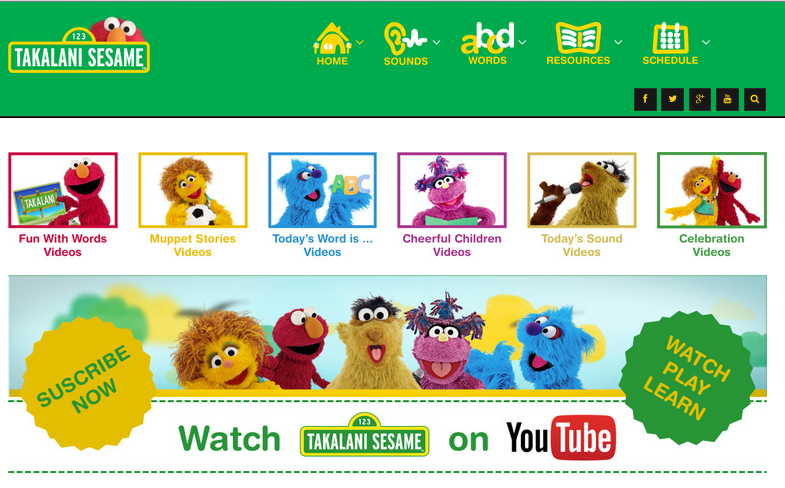
While best known for being a television programme, Takalani Sesame is also broadcast on radio, and there are regular outreach events in the communities we serve. We aim to reach children in every way possible, including through the most up-to-date technological ways. Most recently, we expanded our digital footprint by launching a dedicated YouTube channel alongside our two websites, social media identities and instant-messaging efforts.

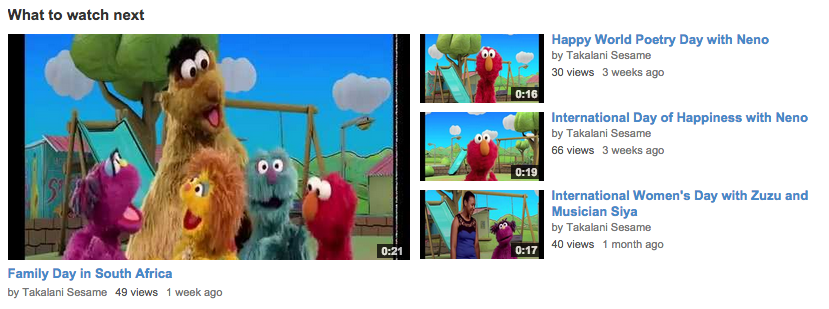
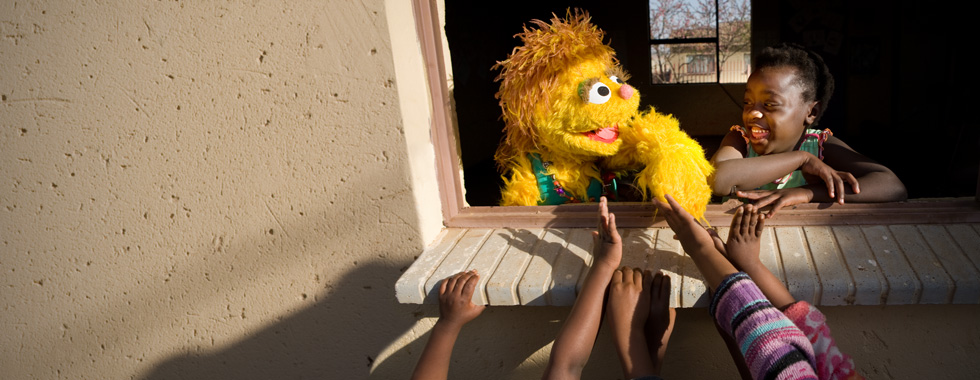
The Takalani Sesame YouTube channel (www.youtube.com/channel/UCSOzE3-7BQn7GtiftoiIRsg) is updated regularly and features episode segments in five languages – Sepedi, Afrikaans, isiZulu, Tshivenda and English. These are bite-size “edutainment” offerings that not only embrace multilingualism, but also help to further the educational mandates as outlined by our stakeholders and partners – the Department of Basic Education (DBE), Sanlam, the South African Broadcasting Corporation (SABC) and Sesame Workshop.

image_2

How is our target market using digital?

To understand our digital visitors better, we spent time in rural and urban crèches and primary schools. There were expected confirmations: more capable cellphones are getting more affordable and our lowly paid teachers are buying them; as the line between feature phones and smart phones narrows, mobile capabilities are advancing faster than some users can keep up with; data remains too pricey for many, even the employed, so free instant-messaging services and lower-cost internet usage dominate; and, the digital divide is also about age and younger educators are more aware of what is possible than older educators.

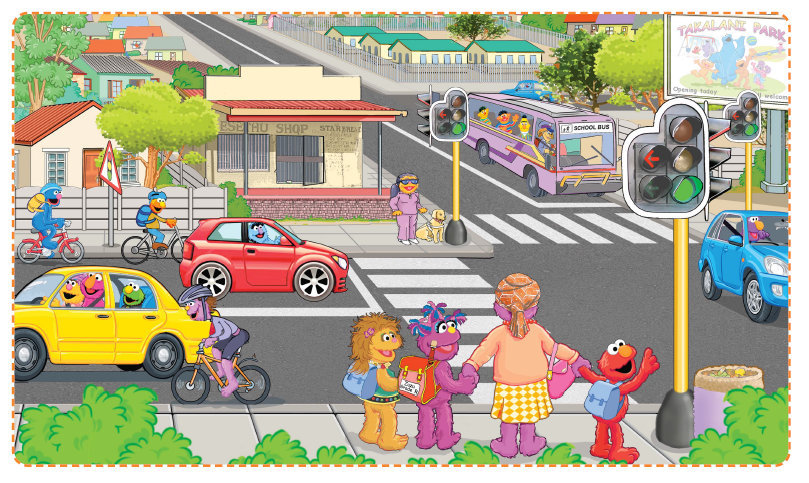
Case Study: Road Safety in South Africa

When Takalani Sesame piloted a road-safety initiative, the project team undertook research at several levels:

  • A literature review of road safety locally and abroad;
  • Focus groups with parents, teachers and community members before material development;
  • Preliminary testing of drafts at a volunteer school using retired teachers as data collectors;
  • Assessments after teacher training to see what could happen when development is rolled out at scale; and,
  • A monitoring and evaluation component by an independent entity.

All that before we could introduce the initiative to South Africa.

image_3

The transfer of knowledge applies across all our platforms. We’ve produced supplementary textbooks, educational materials, outreach programmes, literacy projects and many other initiatives tailored to the needs of the communities we serve.

Case Study: HIV/Aids Awareness Among Children

As part of our launch of the HIV-positive muppet Kamogelo (AKA Kami) in 2004, independent researchers confirmed that a child who has watched Takalani Sesame is four times more likely to have some knowledge of HIV/Aids than a child who hasn’t. Parents and educators who watched our television special “Talk to Me”, were twice as likely to talk to their children about HIV/Aids than those who had not watched it.

A national survey commissioned by the Nelson Mandela Foundation further showed that our young viewers demonstrate measurable gains in HIV/Aids knowledge and attitudes, including basic knowledge of the disease, blood safety, de-stigmatisation, and coping with illness.

image_4

[Image credit: Sesame Workshop]

Supporting the DBE’s White Paper on e-Education

In addition to wide research and market studies, Takalani Sesame leans on its partners for a universe of data and policies. This is especially true of the partnership with the Department of Basic Education (DBE).

A case in point is our embrace of the DBE’s White Paper on e-Education. We have taken up the mandate for Takalani Sesame to live in digital spaces. In 2013 we introduced a fun website [www.takalanisesame.co.za], a Facebook page and a Twitter handle @LoveTakalani. In 2014, we unveiled a special parenting, teacher resource and information-based website for educators and parents [www.earlychildhood-takalanisesame.co.za] and this year we’ve added the YouTube channel to further extended our digital footprint.

image_5

The big reveal during our most recent site-based digital-behaviour information gathering exercises was that a popular service was the e-publication of research and policy papers. We intentionally select practice-focused scholarship and this seems to be paying off.

Interestingly though, we found we spent most of our grassroots excursion time teaching teachers how to use their feature and smart phones. And once they figure out how to go online, wow…

//

Lerato Nomvuyo Mzamane is the Senior Multimedia Executive at Ochre Media, co-producers of Takalani Sesame and producers of many other groundbreaking programmes. She is a mother, teacher and activist with 30 years of experience in over 20 countries.

Links I liked…

dead fish

Q&A with Shelley O’Carroll

shelThe aim of the Q&A series is to get an inside look into some of South Africa’s leading education academics, policy-makers and activists. This is the twenty-fourth interview in the series. Shelley O’Carroll is the Director of Wordworks.

1)   How did you get into education, can you summarise your journey to get to where you are?

I’ve always been a bit of an idealist and can remember having a very keen sense of injustice during my school years in the late 1980’s. I was a bit late to be an activist, but left school as Mandela was released and for me there was a strong sense that I had a responsibility to contribute to a process of redress and do what I could to improve the lives of people who had been deprived of opportunities. I chose to become a teacher and majored in psychology. While I was busy with my undergrad studies I was involved in an adult literacy project in Khayamandi, and looking back, I think that was probably when I realised what a gift you give when you help people to learn to read. When I finished my HDE, I applied for a Commonwealth Scholarship and went to the Institute of Education in London where I did my masters in Psychology of Education. I came back to South Africa after my masters, taught at a bridging school in Joburg and then went to WITS to do a BEd (Remedial) as I needed an honours in order to register for an educational psychology internship. This gave me great clinical experience working with children who struggled with reading. I was a part time research assistant while I did my BEd and really enjoyed writing and being part of a research team. After I completed my BEd, I came back to the Cape to do an internship and registered as an Educational Psychologist. I worked for a few years as a school counsellor and then in private practice doing psychoeducational assessments, and specialised in working with children with reading difficulties. I also did some community work with Grade One children at a very disadvantaged school. For a while, I felt like I was living in two different countries – doing assessments with children from ex-model C and private schools – and then spending the rest of my time working with children who had so few opportunities and were so far behind even in their first year of school. I applied for an NRF scholarship and went back to London to do a doctorate – I really wanted to better understand how to help children as they started learning to read in Grade One. After I completed my PhD, I stopped working as an Educational Psychologist and set up a non-profit organisation with two colleagues.

 2)   What does your average week look like?

I juggle quite a bit – and rush around a lot! I am a mother of two young children and so I tend to start work at 7am, do school lifts and spend time with my children in the afternoon and then get back into work again most evenings. I spend some of my working day running Wordworks, managing projects, funders and budgets – and increasingly working with partner organisations who use our resources in their work. I invest quite a bit of time working with our programme teams on materials development and guidelines for training. Whenever possible, I try to find time to read and share new things I learn. I’d like to be spending more time writing and documenting our work.

3)   While I’m sure you’ve read many books and articles in your career, if you had to pick one or two that have been especially influential for you which one or two would they be and why?

An old favourite is ‘Literacy before schooling’ (Ferreiro and Teberosky, 1982) – this really helped shape my thinking about how, given opportunities, children try to make sense of printed words and written language long before teachers in formal school settings begin ‘teaching them to read’. ‘Apprenticeship in thinking’ (Rogoff, 1990) made me realise how children (mine included) were being apprenticed into literacy through daily experiences with print and oral language.  Other articles and books by Connie Juel, Morag Stuart, Brian Byrne, and Linnea Ehri helped me to understand what skills and knowledge children must have in order to learn to read – and how much children’s thinking has to shift in order to understand how written language works.

When I look at my bookshelf, I realise that the other books that have been influential have been a set of ‘Handbooks of Early Literacy and Language’ (Vol 1-3). These consist of articles written by a number of leading researchers and when I first read them I just remember being struck by how much research there was on how important young children’s language and emergent literacy was for later literacy development at school level. This was not part of mainstream thinking about literacy in South Africa at the time, and even now, evaluations of literacy performance and interventions to improve literacy tend to focus on teaching and learning in classroom contexts, largely ignoring what happens before children begin school in homes and preschool settings.

4)   Who do you think are the current two or three most influential/eminent thinkers in your field and why?

I think this would be easier to answer if I a.) had more time to read and b.) had a clearly defined field of research. Although I position myself in the field of early language and literacy development, our work spans home, community and school contexts and children from birth to seven years. There are so many areas of work within this broad field, and I probably know a bit about some of the leading thinkers, but not enough to really comment with any authority. Having said that, I think Lynn Murray, Peter Cooper, Zahir Vally and Mark Tomlinson’s research on booksharing with toddlers in Khayelitsha is groundbreaking and really shows the potential impact and value of sharing books with young children.

5)   What do you think is the most under-researched area in education in South Africa?

It will come as no surprise that I think the field of early language and literacy learning is significantly under-researched. We need more evidence about what children begin school knowing, not only what happens at school. We need more evidence about what kinds of interventions work to improve children’s early learning, and models of how to take good programmes to scale. We need to understand better how families can play a role in children’s education at school and at home.

7) You are currently the director of WordWorks – can you give us some information about what WordWorks is all about, its aims and approach and maybe some of your plans for the future?

Wordworks is a non-profit organisation that has been working in the field of early language and literacy development for the past ten years. We’ve developed programmes and resources for parents, volunteers, home-visitors and teachers of young children, with the aim of supporting them to build young children’s language and early literacy. Over the past few years we’ve also contributed to sharing knowledge about early language and literacy through policy briefs and reports.

Our team offers direct training and mentoring to schools in Cape Town, and we also work with partner organisations who we train and resource to deliver our programmes as part of their work in schools and communities.

We wish to remain a small organisation and our aim is to grow our reach through sharing knowledge, skills and resources, and building the capacity of schools, communities and organisations.

7b) As I understand it WordWorks has been asked to do the training of all registered Grade R practitioners in the Western Cape? Can you give us an overview of the training and what the desired outcomes of the training are?

Thanks to donor funding from USAID, ELMA and JP Morgan, we are going to be working in partnership with the WCED to provide training for all Grade R teachers across the province in a balanced language approach, and to provide teaching resources we have developed over the past three years. Together with partners SDU, PSP and ELRU, we will reach 3000 teachers through training and supporting ECD Curriculum Advisors and Lead Teachers in all 8 Districts in the Province. The teachers will attend a 5 day block training and then be supported through monthly collaborative enquiry workshops over a period of 8 months. The training will be grounded in a balanced language approach to literacy, and aligned with provincial training of Grade 1-6 teachers as part of the provincial LITNUM strategy.

Our aim is that teachers will have more knowledge about how children learn to read and write and the important role that Grade R teachers can play in building language and early literacy. We also want to share practical resources and ideas about how to support young children’s learning in an age appropriate way. Without making Grade R a watered down Grade 1 year, very important language and early literacy skills can be developed if teachers have the skills, knowledge and resources.

8) I’m sure you are in a different space now than you were in a decade ago. What advice would you give to yourself 10 years ago?

Be realistic about what can be achieved in a day.

9) What is the most rewarding and most frustrating thing about your job?

The most frustrating thing is that I never have enough time! I seldom end a day feeling like I finished what I wanted to do, and am constantly trying to fit in too much.

Apart from having too much work and too little time, there is very little I don’t like about my job. I work with a fabulous team of very dedicated people, and we have the privilege of contributing to change and making a difference to young children’s lives. It’s great to be reminded of how much good there is in the world, and most of our work is with volunteers and parents who inspire us with their commitment to children in their communities. We get to develop and share great resources and ideas – and are constantly humbled by what this means to people. We started off with the aim of supporting young children’s language and literacy development, but realise more and more how our work is impacting on women in communities.

10) If you ended up sitting next to the Minister of Basic Education on a plane and she asked you what you think are the three biggest challenges facing the South African ECD sector, what would you say?

  1. Improving the quality of teaching and learning through high quality, relevant and practical teacher training (both preservice training and ongoing professional development)
  1. Improving the status and working conditions of ECD professionals so that teaching young children becomes a more attractive career path and teachers are recognised for the important role they are playing.
  1. Increasing the provision of and access to non-centre based support for young children through supporting parents and caregivers (e.g. home-visiting programmes, workshops for parents).

 11)   If you weren’t in education what do you think you would be doing?

Research/advocacy.

 12)   Technology in education going forward – are you a fan or a sceptic?

 I think it can be useful, but doesn’t take the place of good old fashioned conversation and dedicated time given to children by an interested caregiver.

13) If you were given a R10 million research grant what would you use it for?

  1. To develop and/or validate tools that we could use to assess the impact of early intervention programmes for young children.
  2. To set up a team to research two related questions: a.) whether low cost interventions can lead to changes in parents’ and teachers’ knowledge about young children’s learning, and b.) to what extent/under what conditions changes in knowledge lead to changes in everyday parenting and teaching practice.
  3. Although I’d have run out of money by now…. a longitudinal study that followed a cohort of children and evaluated the impact of early interventions to improve language/literacy on children’s reading and writing development once they started school.

//

Some of the others on my “to-interview” list include Veronica McKay, Thabo Mabogoane, Maurita-Glynn Weissenberg, Yael Shalem, Linda Richter and Volker Wedekind. If you have any other suggestions drop me a mail and I’ll see what I can do.

Previous participants (with links to their Q&A’s) include, Johan Muller, Ursula Hoadley, Stephen Taylor, Servaas van der Berg, Elizabeth Henning, Brahm Fleisch, Mary Metcalfe, Martin Gustafsson, Eric Atmore, Doron Isaacs, Joy Oliver, Hamsa Venkat, Linda Biersteker, Jonathan Clarke, Michael Myburgh, Percy Moleke , Wayne Hugo, Lilli Pretorius, Paula Ensor, Carol Macdonald, Jill Adler and Andrew Einhorn and Carole Bloch.

An Introduction to Quantitative Data Analysis for Researchers in Education (8-12 June)

numbers

An Introduction to Quantitative Data Analysis for Researchers in Education

Stellenbosch University  |  8 – 12 June 2015

Overview

The aim of the “Introduction to Quantitative Data Analysis for Researchers in Education” course is to provide educational researchers with basic quantitative skills needed to interact with large-scale datasets in education. Although South Africa participates in a number of cross-national studies of educational achievement, few South African researchers possess the requisite quantitative skills needed to use these datasets (or others) in meaningful ways. This is problematic given that it is now widely acknowledged, both locally and internationally, that there is a serious need for education research that combines both qualitative and quantitative insights. It is for this reason that the course is primarily aimed at faculty and graduate students in education departments at South African universities. Other education researchers (from NGOs, think-tanks, policy forums) are also welcome to apply[1].

The course is intended to provide participants with a conceptual understanding of basic statistical procedures for quantitatively exploring and understanding data using a range of real-world data sets. The course introduces participants to measures of central tendency (mean, median, mode), non-central tendency (percentiles, quartiles, deciles etc.), and distribution (variance, standard deviation, inter-quartile range). Participants will learn how to calculate these statistics in STATA and also how to create graphs and tables that describe education data. The aim is always to equip participants with the skills needed to create their own graphs, tables and statistics in STATA and to interpret them accurately for their own purposes. All lectures and practicals will use South African education data, including SACMEQ, PIRLS, TIMSS, ANA and matric, as well as some administrative data (EMIS).

The course will be from 9am to 4:30pm each day from 8-12 June 2015 and will be held at Stellenbosch University. Each day there will be two interactive lectures and one extended practical session in STATA. No prior knowledge of STATA is necessary and participants need not have their own STATA license. The course will be held at a computer lab at Stellenbosch University and all computers will have STATA installed on them. The lecturers for the course will be Nic Spaull and Servaas van der Berg assisted by other ReSEP researchers.

Aims

The aim of the course is to take participants that have a basic understanding about statistics (means, frequencies, percentages etc.) and to help them to answer the following questions:

  • What is a standard deviation and how does one use and interpret it?
  • What is a standard error and how does it relate to a confidence interval?
  • What is a median? a mode? a percentile?
  • How does one decide how large a sample needs to be?
  • What is the difference between correlation and causation?
  • When can we say that one thing causes something else?
  • How do you create and interpret graphs in STATA? Including histograms, line charts, stacked bar charts, scatterplots, boxplots and kernel densities?

By the end of the course participants should be familiar enough with STATA and the basic concepts of descriptive statistics that they can generate and interpret graphs and tables in STATA by themselves. They should also have a basic understanding of the major educational datasets in South Africa (PIRLS, TIMSS, SACMEQ) and be able to answer their own questions using these datasets.

Costs

All costs for the course (including the course-fee, course-materials, transport to Stellenbosch and accommodation in Stellenbosch) will be covered by the PSPPD programme.

Applications

To apply to attend the course, please send an email to carinebrunsdon@sun.ac.za with your CV and a brief motivation as to why you think the course will be beneficial to you and your research (maximum 1-page). Please make the subject line of your email “PSPPD Data Analysis course” and indicate if you will be requiring transport to, and accommodation in, Stellenbosch and which city you will be coming from. There are limited spaces available (approximately 30) and preference will be given to senior faculty and PhD students, although masters students are also encouraged to apply.

Accessibility

If there are any applicants with special learning needs please indicate this on your application and we will do our best to accommodate your needs. We encourage you to liaise with us and the Office for Students with Special Learning Needs (OSSN) at Stellenbosch University.

Deadline for applications: 30th April 2015.

[1] We will be running a separate, but similar, course for education policy makers later in the year. Any interested individuals should please contact us at carinebrunsdon@sun.ac.za.

//

The PDF version of this call for applications can be downloaded here.

Links I liked :)

devote yourself

puppy1

Carli Davidson Pet Photography

Carli Davidson Pet Photography

Q&A with Carole Bloch

carole bloch

The aim of the Q&A series is to get an inside look into some of South Africa’s leading education academics, policy-makers and activists. This is the twenty-third interview in the series. Carole Bloch is Director of PRAESA.

(1) Why did you decide to go into education?

As a student, I taught guitar to children, then music appreciation to preschool children. I loved this experience and found that I connected really well with little children and was fascinated by their imaginations and the way they played and thought. After my BA at UCT, it was really luck that I got to do a PGCE in the UK… a long story, but I never looked back. I loved teaching, first teens with literacy learning problems, later preschoolers who played voraciously, with everything they could get their hands on. I experienced first-hand how to facilitate reading and writing as a personally meaningful, emergent process… I’ve been a teacher, and a learner in literacy education ever since.

(2) What does your average week look like?

I am a bit of an octopus these days – I have tentacles waving about in all directions with Nal’ibali. Keeping a national campaign moving along means having an overall vision at the same time as you are involved in details. There is ongoing networking and fund raising, overseeing and informing the literacy and literary information we put out across platforms, training and mentoring programmes and of course troubleshooting technical challenges, like newspaper supplements not arriving where they should on time and supporting colleagues, dealing with payments and staffing issues. Then there is always the daily email deluge! We communicate with great rapidity which means things can happen quickly, but I sometimes feel quite alarmed by the sheer volume of messages that come my way! The evenings and early mornings are often times to catch up with reading and trying clear my head to write.

(3) While I’m sure you’ve read many books and articles in your career, if you had to pick one or two that have been especially influential for you which one or two would they be and why?

It’s hard to choose just one or two: Illich Chukovsky’s 1960 classic From 2 to 5 on the extraordinary linguistic genius of young children and all of Vivian Paley’s books, especially The Boy who would be a Helicopter on the enormous literacy learning and general educative power of imaginative play and stories and Stephen Krashen’s Power of Reading from the 1990s which summarises the research on free voluntary reading (see http://www.sdkrashen.com/).

(4) Who do you think are the current two or three most influential/eminent thinkers in your field and why?

There are so many. Quite a few I don’t agree with, so I won’t mention them! For me, social anthropologist, Barbara Rogoff ‘s work on children participating as cultural apprentices in communities of (reading and writing) practice is really useful when thinking about what we need to understand about how reading culture development takes place. It fit’s amazingly well with the New Literacy Studies – Brian Street and David Barton et al’s conceptions of literacy as social practice – what I like especially about her is that she makes clear that people both join communities of practice and change them by their participation, such a critical insight for South African environments (eg Rogoff 1991, 2005).

Kenneth Goodman, though sadly much vilified I think is one of the greatest thinkers about the reading  process – it is in many ways really anticipating some of the recent insights from brain research – about how the senses work in general such as Chris Frith’s fascinating 2007 book Making up the Mind, on how the brain predicts (Goodman said that “reading is a psycholinguistic guessing game” (see eg Goodman, 1967). His work also helps us to understand that the process underlying reading is the same in any language (research with languages very different from English, like Chinese shows this), and so we don’t have to get bogged down worrying about that in literacy teaching with little children. There’s a really interesting article by him and others too which contests some of the neuroscientifc claims about how children read put forward by phonics proponents like Sally Shaywitz (see http://ericpaulson.wp.txstate.edu/files/2014/05/strauss_goodman_paulson_2009.pdf). I think there is so much differing ‘evidence’ that refers to teaching reading by experts in diverse fields, like linguistics, (who often tend to like to dissect languages and think when you learn to read you have to do this too) and also neuroscientists who do not necessarily understand how little children learn to read (eg Stanislas De Haene 2009). These can influence policy and have negative effects on the lives of young children – I mention some of this later.

5) What do you think is the most under-researched area in South African education?

Understanding the way babies and young children learn to speak, read and write in multilingual settings.

6)  What is the best academic advice you’ve been given?

I think two pieces of advice have stood out for me over the years – the one was from Neville Alexander who I worked closely with for two decades. In the days when very few people were working on ‘alternative’ approaches to young children’s literacy teaching, I sometimes would feel despondent when my ideas and approach seemed to fall on unresponsive ears. Neville used say “Don’t worry about what other people say or think – you know what you are doing, just get on with it”. I realised how significant a) support and b) conviction are to push on and keep going. Another person who helped me with a wise comment which I’ve never forgotten was Elsa Auerbach, an adult literacy specialist from Boston, who’s classic article also influenced me many years ago: http://linksprogram.gmu.edu/tutorcorner/NCLC495Readings/Auerbach-Sociocontemp_familyLit.pdf). When I asked Elsa how she would help teachers and teacher educators to deepen their literacy knowledge and understandings, given the huge disparities in education we were trying to address, she said to me very simply, that we all need the same kind of opportunities– in a nutshell to read, reflect and experience many demonstrations of good practice. This simple insight has guided me for many years as I’ve mentored others.

7) You are currently the director of PRAESA and involved with Nali’bali, for those that are unfamiliar with these organizations can you give an overview of their aims and approach and maybe some of your/their plans for the future?

PRAESA from its beginnings in 1992 was an NGO based at UCT involved in multilingual education, research, training and materials development – essentially to help transform children’s educational opportunities using the foundation of mother tongue based bilingualism. Our research and all development work has been embedded in the view that a home language or languages should be the bedrock for learning, used to deepen thinking and conceptual understanding (see www.praesa.org.za). Other languages can be learned and added to a child’s linguistic repertoire, rather than being replacements. The longer the home language is used, the more support the child is actually getting. As many of us are aware, this mother tongue based education has not been implemented, except for in experimental ways, I believe to the extreme detriment of the educational opportunities for the majority of children.

In 2012, we initiated the Nal’ibali reading-for-enjoyment-campaign. This grew out of the previous twenty years of literacy research and practical work in multilingual settings which used stories and home languages for language and literacy teaching and learning. Because the story form is universal to all of us and integral to the way our minds work, the obvious route to literacy learning is to inspire a love of reading among all children. So Nal’ibali aims to nurture storytelling and reading for personal satisfaction, particularly in children, but also in the adults who are their role models and nurturers. Nal’ibali involves an ongoing collaborative effort with many partners to help put into place the conditions that support the initial and ongoing literacy development of all children irrespective of class, linguistic or cultural backgrounds. We’re doing this through mentoring, workshops and collaboration with communities, supporting reading clubs, literacy organisations and trying to elicit the support of volunteers of all ages, integrated with a media campaign and the development of multilingual literacy resources and stories. Our vision is a literate society that uses writing and reading in meaningful ways and where children and adults enjoy stories and books (and of course non-fiction too) together as part of daily life. The mission – and clearly we all need to be involved for this to happen – individuals, NGO’s, universities, government and business – is to create the conditions across South Africa that inspires and sustains reading-for-enjoyment practices (www.nalibali.org and facebook nalibaliSA).

8) You have been heavily involved in research on early literacy in African settings, can you give us an overview of what we know about early literacy in African settings and also what we don’t know?

I can only talk about my views as to what I think we know and don’t know or somehow don’t acknowledge or value …

In a nutshell, we know that most children, irrespective of class, socio-cultural and linguistic background are capable of becoming competent, avid and creative readers and writers but that huge numbers of mainly African language speaking children don’t – and that the conditions that need to be in place for successful learning to take place are mainly in place for children of the elite only. We know that a combination of factors is involved and that these cut across home, community and school. But we don’t seem to widely appreciate the incredible importance of the ‘invisible’ literacy learning that takes place in the daily, informal community and home language ‘goings on’ of literate homes, and what it means when such learning, for whatever reasons, cannot take place.

We know that teachers ‘bring with them’ like children do, their literacy theories and practices into the classroom, and that a real stumbling block in the early years is how we still tend to train teachers to view their task as teaching skills as a priority over demonstrating and making possible the use of written language for personally meaningful reasons (This contributes to the learn to read/read to learn myth). We should know that this blocks many children off from highly effective learning strategies that could reveal them as exuberant emergent readers and writers that we expect from most young English speaking children. We don’t widely acknowledge, and maybe we don’t know, that the consequence is a cyclical one of adults tending to underestimate poor children’s capabilities in formal education situations, believing the children are struggling with ‘the basics’, when actually the struggle is that the basics of written language are being denied them!

We know that the push down from higher education is exacerbating this through the justification of curricula that package skills and knowledge in ways that override considerations about how to motivate young children ‘s enormous learning capacity. Global forces push down too – a current example is an assessment packages like EGRA, which grew from the USA ‘s DIBELS, that has caused so much heartache and stress for so many families (see The Truth About Dibels, Goodman 2006).

We know that low status and use of African languages for print functions (including the dearth of fiction and non fiction) means fewer adults are leisure readers. But we don’t widely value or address the fact that it seems extremely difficult to teach others to read when you don’t have your own repository of knowledge and stories arising from the texts you’ve read over time, to draw from – with the overwhelming effect of poor reading habits being that you tend not to have what it takes to reap the benefits from and pass on a passion for knowledge and story to others.

Given what we do know, we don’t know why government (with support from business) seems unable to invest with unflinching determination in the translation of desirable world texts, including ones from Africa, to support African publishers to produce a steady flow of the books we need and order these to stock community and school libraries …. to inspire reading and creative writing among adults and children in African languages and English and also to use in the training and mentoring of adults to grow to know and manage these collections. We also don’t know why there is an insistence on making teaching so very hard for teachers and learning difficult for the majority of children living in South Africa after grade 3 by forcing teaching in a language often not known well enough to use with dignity and depth.

9)   If you ended up sitting next to the Minister of Education on a plane and she asked you what you think are the three biggest challenges facing South African education today, what would you say?

The first is the fact that it is a tragedy that we haven’t implemented our Language in Education Policy of 1997, but that it is not too late and that this needs leadership from government and lots of information – in fact a campaign – to allow parents the opportunity to appreciate the issues involved in educating their children from a language perspective – how they would come to realise that they do not need to choose between English or African languages but that both are possible, and desirable.

The second is related and I’ve raised already – that government needs to act on the fact that until publishing in African languages is supported in a serious way, so that these languages are used in print for high status functions, including literature – and more of our adult population starts reading regularly for personal satisfaction and for pleasure, many children won’t become readers and writers in the fullest sense.

The third, if she was still listening, would be to discuss how to use literature to find practical ways to create a different ethos among us – one that promotes and encourages empathy and respect for each adult and child living in South Africa irrespective of background. We’d gather people together to generate a curriculum of shared stories for children of all ages, from South Africa, Africa and the rest of the world, which reflect the highs and lows of humanity – to support the growth of a new generation of people who reject stereotyping and prejudice, and value what we share in common, as well as our differences.

10)   If you weren’t in education what do you think you would be doing?

I’d be a professional gardener as I love growing things, or I’d be a cellist.

11) What is the most rewarding and most frustrating thing about your job?

The most rewarding thing is seeing partnerships grow that are allowing so many people across South Africa to get involved in quite relaxed ways to enjoy the substance of reading: Seeing how my colleagues inspire others is humbling. Watching how interest in books grow in people of all ages when they are motivated. Seeing sceptical and weary-looking adults put on their playful hats to communicate with children and share stories in animated ways  – this is stunning for me.

Frustrations are around how hard it can be to convince others that sometimes the most simple seeming solutions are the most profound sometimes… and of course the time it takes to get things done, mainly because we just don’t have the capacity, either human or financial – and knowing how much more SA industry and government could do to help us change the desperate situation we face in literacy education.

12)   Technology in education going forward – are you a fan or a sceptic and why?

Total fan and total sceptic! I’m a fan of making the most use of technology. In Nal’ibali, for example, we offer a growing repository of free multilingual stories and guidance etc. on web, mobi and cellphone for adults to use with children of all ages. I think that the freedom it allows to create multilingually is extraordinarily powerful and I love the potential and sometimes actual freedom to share material without the rigid constraints of traditional publishing. But I’m a sceptic about the wisdom of proclaiming paperless learning. I don’t believe we should attempt to create an either-or situation. Particularly, but by no means only – for babies and young children we still want print on paper and books. I think we need to support and nurture our publishing industry more now than ever before.

13) If you were given a R15million research grant (and complete discretion on how to spend it) what would you use it for?

I’d facilitate a major qualitative research process on various aspects of Nal’ibali: I’d like to track groups of children living in different settings from home to reading club to school over a period; document the indicators of the effects of reading for enjoyment on motivation, engagement and achievement, literacy and school learning, family dynamics etc. I know that our only glimmer of hope to persuade policy makers, linguists and many involved in education that what we are doing is essential is ‘scientific’ evidence!

 //

Some of the others on my “to-interview” list include Veronica McKay, Thabo Mabogoane, Maurita-Glynn Weissenberg, Shelley O’Carroll, Yael Shalem, Linda Richter and Volker Wedekind. If you have any other suggestions drop me a mail and I’ll see what I can do.

Previous participants (with links to their Q&A’s) include, Johan Muller, Ursula Hoadley, Stephen Taylor, Servaas van der Berg, Elizabeth Henning, Brahm Fleisch, Mary Metcalfe, Martin Gustafsson, Eric Atmore, Doron Isaacs, Joy Oliver, Hamsa Venkat, Linda Biersteker, Jonathan Clarke, Michael Myburgh, Percy Moleke , Wayne Hugo, Lilli Pretorius, Paula Ensor, Carol Macdonald, Jill Adler and Andrew Einhorn.

Developing an “access-to-learning” statistic: Combining access & quality in Sub-Saharan Africa

kenya

I’m currently in Washington D.C. for the Comparative and International Education Society (CIES) conference of 2015. Although it was -17′ C when I landed the weather has actually been lovely and DC seems like a lovely city to live in.

On Monday I presented two papers that I co-authored with Stephen Taylor on creating a composite measure of access and quality for 11 countries in sub-Saharan Africa. The presentation was very well received by the other delegates and a number of them have since commented on the importance of this research given where we are at cusp of the next set of post-MDG goal-setting, the “Sustainable Development Goals.” Personally I believe this is the most important research I’ve done to date, and it’s also the research of which I am most proud.

For those who would like to read the two papers I have included links below, and the PowerPoint slides can be found here. Both Stephen and I are trying to disseminate this research so if you know of anyone who might be interested in it please do forward it along to them. As always, comments and questions welcome.

Spaull, N., & Taylor, S., (2015). Access to what? Creating a composite measure of educational quantity and educational quality for 11 African countries. Comparative Education Review. Vol. 58, No. 1. (WP here).

ABSTRACT

The aim of the current study is to create a composite statistic of educational quantity and educational quality by combining household data (Demographic and Health Survey) on grade completion and survey data (Southern and Eastern African Consortium for Monitoring Educational Quality) on cognitive outcomes for 11 African countries: Kenya, Lesotho, Malawi, Mozambique, Namibia, South Africa, Swaziland, Tanzania, Uganda, Zambia, and Zimbabwe. Doing so overcomes the limitations of earlier studies that fo- cused solely on either quantity or quality. We term the new statistic “access to literacy” and “access to numeracy” and report it by gender and wealth. This new measure combines both quantity and quality and consequently places educational outcomes at the center of the discourse.

Taylor, S., & Spaull, N., (2015) Measuring access to learning over a period of increased access to schooling: The case of Southern and Eastern Africa since 2000. International Journal of Educational Development . Vol. 41 (March) pp47-59 (WP here).

ABSTRACT

This paper examines the extent to which increased access to primary schooling in ten Southern and East African countries between 2000 and 2007 was also accompanied by increased access to actual learning. We develop a measure of access to learning that combines data on education access and learning achievement to measure the proportions of children in the population (including those enrolled and not enrolled) that reach particular thresholds of literacy and numeracy. In all countries there was greater access to learning in 2007 than in 2000. These improvements in access to learning especially benefited girls and children from poor households.

Prize-giving speech at Durban Girls High School

On Friday the 27th of March I gave the prize-giving speech at Durban Girls High School. A few people have asked me for the text so I’ve included the transcript below…

dghs

“UNFINISHED BUSINESS”

Good morning prize-winners and parents, teachers and other guests. Firstly, congratulations on being the top-achievers at one of South Africa’s best schools. This is no small feat. While this is of course in part due to your own hard work and determination, I’m sure you will agree that part of your success is due to your parents and teachers. Girls, please join me and give them both a big round of applause.

Today I want to speak to you about the Future and about “Unfinished Business”; the unfinished business of gender equality around the world, and the unfinished business of South Africa.

 Let me start with talking briefly about the ongoing struggle for gender equality around the world. When we look across the countries of the world we see that there are more girls in school than ever before in human history. Women are paid more than at any time in the past and there are also more women in leadership positions. Thankfully the voices and stories of women are starting to receive equal treatment to those of men, and most importantly, these stories are being told by women themselves and not by men on their behalf. Yet it is difficult to celebrate these achievements when women still make up the majority of the world’s unfed, unhealthy, unschooled and unpaid. In every country around the world women carry the lion’s share of the child-caring responsibility. While this is of course an immense privilege, it is one that should be chosen and not assumed. I trust that if and when you have children you will talk about this frankly with your partners – as a conversation among equals, not a forgone conclusion.

 Throughout the world women’s interests are underrepresented in society. As in all things it helps to look at those who are in the corridors of power around the world.

  • Of the 195 independent countries in the world, less than 10% are led by women.
  • Women hold just 20 percent of the seats in parliaments globally. So for every female parliamentarian there are 4 male parliamentarians.
  • Less than 5% of the FORTUNE 500 companies have female CEOs.

 When we hear stats like this we need to ask how it is that women’s interests can be properly represented when there are so few women in positions of power? We still have ridiculous situations where national panels are deciding on women’s reproductive rights and access to contraception and the entire panel is made up of men?! To decide on issues relating to women’s bodies and women’s rights?! This is insane.

It is for this reason that I agree with Hillary Clinton when she says that achieving equality for women and girls is “the great unfinished business of the 21st century.”

The benefits of including women and embracing gender equality around the world are indisputable. Research is now beginning to confirm what we have known all along – that women are more altruistic than men in their allocation of resources.  I am particularly fond of one recent study in India that showed conclusively that when women are put in charge of a village council they allocate more money to drinking water, roads and welfare programs than men in similar positions. As the researchers from Yale and MIT note “Overall, these results indicate that a politician’s gender…does influence policy decisions.”

 Equalising opportunity between men and women is not only good for women, it is also good for men. We all benefit when our relative strengths are allowed to flourish unhindered. So this is the first point of my speech – gender equality is the great unfinished business of the 21st century and it turns to you and your futures to help finish it.

The second thing I want to talk to you about is the future, but before I do I want to tell you a little bit about your school. As I am sure you already know Durban Girls High School is one of the best performing schools in this province – you regularly achieve a 100% matric pass rate and a 97% bachelor pass rate. But I thought I would go and look at the data and see just how well you do in comparison to all the other public schools in the entire country. If we look at bachelor pass rates Girls High is not only in the top 1% of schools in South Africa, it is in the top 0.5% of schools. And if we only look at the 420 “large” schools – where there are more than 200 matriculants – Girls High comes second in the entire country. Congratulations!

This is an important point to which I will return later – that you are immensely privileged to be attending this school. Your years at Girls High are putting you on firm ground as you turn to face the future. And this is a good thing because if we are honest, we have no idea what the future holds for you. Karl Fisch summarizes this wonderfully when he says that

 “We are currently preparing students for jobs that don’t yet exist, using technologies that haven’t been invented, in order to solve problems we don’t even know are problems yet.”

 When this is the case you to learn to become comfortable with uncertainty and constant change. Make peace with the fact that your career is likely to change 4 or 5 times in the future and that you will need to relearn and reskill a number of times in your life. As Tofler says:

illit

 I would now like to move a little closer to home and focus on the role of women in South Africa and talk about unfinished business here in our own beautiful country.

We have all heard about the amazing men that ushered in our South African miracle – a peaceful transition to democracy. Men like Oliver Tambo, Nelson Mandela and Ahmed Kathrada. But we have heard much less about people like Rahima Moosa, Lillian Ngoyi, and Helen Suzman.

 The women of South Africa played an incredible and often unacknowledged role in resisting and overturning apartheid. As early as 1912 Indian women in South Africa encouraged Black and Indian miners in Newcastle to strike against starvation wages, organising the first mass passive resistance campaign in the country.

 These impressive feats are often glossed over as we focus on male protagonists like Sisulu or Biko. Looking more broadly, it is important to remember that practically all of recorded human history was written by chauvinist men, side-lining the central role that women have played in nurturing and shaping the history of humanity. To give a gendered spin on Churchill’s famous quote “History is written by the victors” – or in this case, by men.

womens-day-march

 One of the best examples of women’s involvement in resisting apartheid is the famous Women’s March which happened on the 9th of August in 1956 – the day we now commemorate with “Women’s Day”. 20,000 women marched to the seat of apartheid power – the Union Buildings in Pretoria – and presented a petition to Prime Minister Stijdom against the carrying of passes by women. This was one of the most impressive protests against the dreaded pass laws that were so characteristic of the apartheid state.

 To commemorate the occasion activists composed the now historic slogan “Now you have touched the women, You have struck a rock.” Or in it’s more recent version “You strike a woman, you strike a rock.”

 Let me quote one historian and paint a picture of this momentous day:

 “Many of the African women wore traditional dress. Others wore the Congress colours of green, black and gold. Indian women were clothed in white saris. Many women had babies on their backs and some domestic workers brought their white employers’ children along with them. Throughout the demonstration the huge crowds displayed a discipline and dignity that was deeply impressive.”

 Later, at Lillian Ngoyi’s suggestion, the huge crowds stood in absolute silence for a full hour.   Before leaving the women sang ‘Nkosi sikeleli Afrika” and left with the dignity and defiance with which they came.

 Indeed, you strike a woman, you strike a rock!

 But now you might be asking “What does this have to do with me?” That was 1956, this is 2015! True. All of you were born in the democratic era of South Africa – the so-called “Born Frees.” (Personally I think this is quite a cheesy name with overtones of Bruce Springsteen, but whatever we’ll go with it). For those sitting in this hall, you live in a very different South Africa to that of the women in that Momen’s March in 1956. Whether black or white, male or female, gay or straight you have the exact same rights and privileges enshrined in our constitution.

 As I mentioned earlier almost all of you will go to university and be fortunate enough to pursue your passions and interests wherever they may lead you. But you are the exception. You are the 1%. For most South Africans that is not the case and you can choose to do something about it.

 After 20 years of democratic rule most black children continue to receive an education that condemns them to the underclass of South African society, where poverty and unemployment are the norm, not the exception. This substandard education does not develop their capabilities or expand their economic opportunities, but instead denies them dignified employment and undermines their own sense of self- worth.

While I was writing this speech I spent a long time thinking about how to convey the South African reality and eventually settled on two numbers from the research: R25 and R10.

Today, on the 27th of February 2015 half the country lives on less than R25 per day. They are in abject poverty. With less than R25 per day they need to buy food, clothing, shelter, transport and all the other basic necessities needed to live free from deprivation.

Half of South Africa lives on less than R25 a day per person.

The second number is R10. 10million South Africans live on less than R10 per day. While I was writing this speech and thinking about this I just started crying. This level of poverty is what we call “extreme poverty” or “starvation poverty” or “malnourishment poverty”. The reason why this is called “malnourishment poverty” is because with less than R10 per day, you cannot buy the amount of calories needed not to be under-nourished, even if you spent your entire income on food. You would still be undernourished.

10 million South Africans live on less than R10/day. Whenever you see a R10 note remember – 10 million South Africans live on less than R10 a day.

I don’t tell you about these stats to bring a downer to your prize giving. I tell you about them to implore you to do something about it. Whatever your background – rich or poor – you have been given one of the greatest opportunities in life – an excellent education. You will qualify to go to university and allow for the free unfolding of your personality, gifts and talents. As you make your way in the world you will have many choices before you. What do I want to do with my life? Who do I want to be? What should I study?

And I want to suggest to you today that you will only find true meaning in your life when you live it for the benefit of others.

You were not born in a random country at a random time. You were born in South Africa only a few years into democracy. Born into a beautiful country of hope and potential but one that is also still riven with racial tensions and inequality. A country still trying to make peace with itself and with the wrongs of the past. This is the unfinished business of South Africa and it falls to us, the youth of the country to keep fighting. To fight for the rights of those who cannot fight for themselves. For the millions of poor and marginalized South Africans who live on the outskirts of society – unseen and neglected.

I will tell you how we fix this country. It is not by relying on corrupt politicians whose greed and envy cloud their judgment and choices. It is not by bitching and complaining or packing for Perth. It is not by building higher walls or buying bigger cars. The way we will fix this country is when competent, ethical and ambitious young women and men decide to be part of the solution at whatever personal or professional cost. When passionate people like you and me decide that we want to work in government schools and public hospitals not because it is our last resort but because it is our first responsibility – to use the opportunities we have received for the benefit of others.

So, in closing, it is my hope today, that sitting in this hall, there are those who will use their talents, energies and ambitions to finish the unfinished business of South Africa. That here amongst us are some Rahima Moosa’s or Helen Suzman’s or Lillian Ngoyi’s, who can speak truth to power. Who can fight for the marginalised and oppressed. And who can show to all the world that when you strike a woman you strike a rock.

 Thank you.

//

In writing this speech I have taken statistics and phrases from a variety of different places including Sheryl Sandberg’s “Lean In”, Angus Deaton’s “The Great Escape”, a number of articles on SA History online, and various speeches of Hillary Clinton.

“Some Children Are More Equal Than Others” [moving documentary on SA Educ]

Screen Shot 2015-02-18 at 11.07.21 AM

Today Stefan Gottfried released his short documentary on education in South Africa, aptly named “Some Children Are More Equal Than Others.” I came into contact with Stefan last year when he was working with the Legal Resources Centre. It happened to be at the same time I was visiting mud-schools in the Eastern Cape late last year (blog post here). The documentary was produced on a shoestring budget but clearly conveys the tragedy and anguish of hundreds of thousands of parents in South Africa. The motif that runs through much of the documentary is that the low quality of education offered to the majority of South Africa’s children becomes a poverty trap and prevents any form of social mobility. It reminded me of something I wrote 2 years ago:

“While the low-level equilibrium that South Africa finds itself in has its roots in the apartheid regime of institutionalised inequality, this fact does not absolve the current administration from its responsibility to provide a quality education to every South African child. After 19 years of democratic rule most black children continue to receive an education which condemns them to the underclass of South African society, where poverty and unemployment are the norm, not the exception. This substandard education does not develop their capabilities or expand their economic opportunities, but instead denies them dignified employment and undermines their own sense of self- worth. In short, poor school performance in South Africa reinforces social inequality and leads to a situation where children inherit the social station of their parents, irrespective of their motivation or ability. Until such a time as the Department of Basic Education and the ruling administration are willing to seriously address the underlying issues in South African education, at whatever political or economic cost, the existing patterns of underperformance and inequality will remain unabated” (from here).

Although I see the tragic education stats on a daily basis, it really hits home when you see the pain and anguish of black parents who see and understand that education is the route out of poverty for their kids and are trying their hardest to get their children into “good” schools but failing at every turn. Watch the documentary and ask yourself “What can I do to change this tragic, dangerous and deeply unfair situation?”

Links I liked…

 bright

  • A book on education in Gauteng 1994-2014 has now been published. I wrote a chapter on standardised assessments. Spaull, N. (2014) Educational outcomes in Gauteng 1995-2011: An overview of provincial performance in standardised assessments, in F Maringe & M Prew (eds), Twenty Years of Education Transformation in Gauteng 1994 to 2014: An Independent Review, African Minds, Somerset West., pp 289-312
  • Free PDF books on race, sexuality, gender and class (really useful resource!)
  • “Lifelines for poor children” – Nobel Laureate James Heckman writes an accessible (2013) NYT article on early childhood development. “What’s missing in the current debate over economic inequality is enough serious discussion about investing in effective early childhood development from birth to age 5.”
  • In light of the recent moves by Gauteng Department of Basic Education to introduce “paperless classrooms” we would all do well to read this chapter “Computers in schools: Why governments should do their homework.” But we will go around the mountain one more time and check for ourselves. Because how do you know if it’s a dead-end until you’ve tried it? Well, maybe because everyone else tried to do exactly what we are proposing to do and it didn’t work? If you’re not teaching teachers how to use the tech, budgeting for maintenance and most importantly evaluating the project (to figure out if it’s actually working) then it’s pretty much doomed to fail. As they say in the chapter above “The evidence so far is quite persuasive that programs that overlook teacher training and the development of software may yield low returns” (p169).  I’m all for using tech in meaningful ways but this isn’t that, this is basically “Let them eat iPads.” (also see this NYT article, “Can you have too much tech?“)
  • “How Pakistan fails its children” – scathing NYT article (2014) on the state of education in Pakistan and the lack of political will for true reform.
  • “The Pursuit of Beauty” – A lovely New Yorker article about a little known Chinese mathematician in the US who solved a pure-math mystery and is now famous. (Thanks Lilli for the link). It’s uplifting to hear that we humans are still making progress and pushing the boundaries of knowledge further and further every year.
  • The HSRC are looking for a Doctoral Research Trainee in Education and Skills Development (deadline for applications 6 Feb 2015). For more details see the advert here.
  • A good friend of mine Shelanna Sturgess has recently started blogging. She’s an art teacher at Durban Girls High School and has a bunch of cool stuff on art and teaching with technology, check out her site here.
  • If you want to know what perverse incentives are then read this Cullen (2003) article “The impact of fiscal incentives on disability rates” – when you give schools extra money for children with disability suddenly the number of children classfied as disabled increases…”My central estimates imply that fiscal incentives can explain nearly 40% of the recent growth in student disability rates in Texas”

Q&A with Andrew Einhorn (Numeric)

andrew einhorn

The aim of the Q&A series is to get an inside look into some of South Africa’s leading education academics, policy-makers and activists. This is the twenty-second interview in the series. Andrew Einhorn is the founder of Numeric, a South African NGO using Khan Academy to teach mathematics. 

1) Why did you decide to go into education and how did you get where you are?

I’ve missed a few big opportunities in my life. I was at Harvard when Mark Zuckerberg started Facebook. I can remember one evening considering going round to his dorm to talk about getting involved. Facebook was tiny then; it only had a few thousand members. Still, I thought it was a nice idea and wondered if I could help out. But I was busy with classes and never got around to getting in touch with him. I guess that ship has sailed.

I came back to South Africa in 2007 and got a job with a financial firm. But I had seen the Netflix model in America and wondered if it could be established here. A friend and I looked into it – it just seemed like a no-brainer. But ultimately I was still a little risk averse and couldn’t summon the chutzpah to up and leave my investment analyst position. Another opportunity missed!

A few years later I received an email from a funder querying whether Khan Academy might be used in the South African context. I watched Sal’s TED Talk and saw in it another big opportunity. This time I wasn’t too keen to let it slide. So I started to look for ways to connect this powerful online learning tool with children in townships with a view to strengthening South African maths education. Four years later, my thinking around how to use Khan Academy has changed somewhat, but I’ve never looked back and feel as motivated today (if not more) as the day I started.

2) What does your average week look like?

The truth is my days are rather unglamorous. A lot of my time is spent attending to small details – logistics and people. I have less contact time with kids than I would like, but I am satisfied that my work allows a much larger number of pre-service teachers to get valuable class time with our students. They do a great job. Better than me. My job is to make sure that everything runs smoothly and that our team of programme managers and coaches are well supported. Numeric is fortunate to have a set of supportive and clued-up funders, which means I spend relatively less time canvassing funders and more time on operations, which is a big plus.

3) While I’m sure you’ve read many books and articles in your career, if you had to pick two or three that have been especially influential for you which two or three would they be and why?

In terms of maintaining balance and a sense of perspective, Bertrand Russell’s “The Conquest of Happiness” is undoubtedly amongst the most influential books I have read. Sam Walton’s “Made in America” is an excellent read, especially if you have an entrepreneurial leaning and are considering doing something that involves scaling. 

4) Who do you think are the current two or three most influential/eminent thinkers in your field and why?

I’m not too well placed to answer this one, I’m afraid, I am woefully under-read!

5) What do you think is the most under-researched area in South African education?

I’m also not an expert here, but it does surprise me that there isn’t a bigger lobby to up the ante in the teacher-training space.

6) What is the best advice you’ve been given?

One of the most valuable insights I have come across in recent years is a quote from Howard Thurman: “Don’t ask what the world needs. Ask what makes you come alive, and go do it. Because what the world needs is people who have come alive.”

And in a recent tweet from Ricky Gervais: “It’s better to create something that others criticise than to create nothing and criticise others. Go create! Have fun :)”

7) If you ended up sitting next to the Minister of Education on a plane and she asked you what you think are the three biggest challenges facing South African education today, what would you say?

Teacher training

Teacher training

Teacher training

8) If you weren’t in education what do you think you would be doing?

Setting up bubble tea stalls at farmers’ markets, or otherwise looking for ways to bring Italian cheese-making expertise to South Africa.

9) You founded the organization Numeric in 2011 – can you give us some background information on the organization and discuss its aims, plans and approach?

With the average score on the Grade 9 Annual National Assessment sitting at 10.8% (2014), it has become clear that South African maths education is broken well before children reach Grade 9. This has informed Numeric’s decision to focus on Grades 6 – 8. We currently run after-school maths programmes in 35 partner schools in the Western Cape and Gauteng. We recruit pre-service teachers (mostly bachelor of education students), train them intensively, and then pair them with groups of 22 learners at our partner schools. They then meet with their kids twice a week throughout the school year, and take the children through an intensive maths programme that starts with times tables and builds up through fractions, negative numbers and order of operations.

Numeric is highly quantitative in its approach. All Grade 7s and 8s at our partner schools write a baseline test in January and an endline test in November. We use these tests to measure the improvement in the scores of learners on the Numeric programme over the course of one year, net of the improvement of learners who are not on the programme. We call this measure the “delta”. The tests are created, administered and graded by an independent assessment committee, and to keep things honest, no Numeric staff member or coach has access to the tests before or after the testing. The two key metrics that drive Numeric are the delta and the cost per learner per month (CLM). Our goal is to maximize the delta and to minimse the CLM.

While the main focus of our programmes is to improve the learners’ maths, we are aware that, in the process. our coaches – future maths teachers – improve enormously both in terms of content and confidence. With the average public school teacher teaching over 5,000 kids during their career, any improvement we can bring about pre-service has positive and far-reaching consequences.

10) Three years after founding Numeric I imagine you are in a different space now than you were then, what are the lessons that you have learnt and what advice would you give to yourself 3 years ago?

When I started out, it was my naive hope that technology could be used to educate children in the absence of a (competent) teacher. I would set up computer labs, put in some bandwidth, show the kids Khan Academy, and voila, they would educate themselves!

I couldn’t have been more wrong.

While we continue to be big fans of technology (Khan Academy in particular), we are increasingly convinced that the key to generating results lies in the quality of our coaches/teachers. While at the tertiary level, platforms like Coursera, Udacity and edX have allowed people to learn things fairly independently, we believe that at the primary and secondary school level, particularly in the classroom environment, the human presence is indispensable. The role of our coaches is threefold: To motivate learners, to support them when they are struggling, and (perhaps most importantly) to praise them when they are doing well.

Due to infrastructure limitations in certain areas where we work, nearly half of our programmes run in the absence of Khan Academy. Our observation? The biggest delta is generated by the best coaches, technology or no technology.

11) What is the most frustrating and most rewarding thing about your job? 

One of the most rewarding parts of my job is working with the leadership and management of our partner schools. There is a lot of negative media around South Africa’s teachers and schools, but the picture I see is quite different. We work with some real superstars both in Johannesburg and Cape Town – principals, teachers, administrators etc. I’d like to take the media to meet them sometime!

I am occasionally frustrated by poor policy decisions, but tend not to lose too much sleep over them as they are outside of my control. And there are good people (like you guys) lobbying to get these issues rectified.

12) What would you say are the three major difficulties faced by civil-society organizations in South Africa?

It concerns me how much time and effort the founders and leaders of many civil-society organisations have to put into funding. Most organisations have fragmented funding bases with tens or even hundreds of contributors. This goes together with a donor mentality that wants to have fingers in as many pies as possible (I will give R10 000 to 10 organisations rather than R100 000 to one). The result is a large amount of administrative and communication work which usually falls to the organisation leadership. This comes at the expense of them innovating, improving and driving change. I understand that organisations mitigate risk by having a diversified funding base, but a lot of time and energy is spent dressing up social initiatives so that they can be sold to funders, rather than focusing on the problems themselves.

13) What would you most like to see change in the South African education system?

I’d like to see sensible legislation passed that makes space for charter schools. These are schools which receive public funding but operate independently of the established public school system. There are many people chomping at the bit to open and run good public schools with the government’s assistance. I think providing space for them to do so would bring a lot of talent into South African education and I suspect the government would ultimately get kudos for the improved educational outcomes.

I would also like to see sensible legislation passed that allows for independent teacher-training institutions to be opened. At present, the universities carry the entire burden of teacher training. I think there are lots of talented people outside of universities who would relish the opportunity to open and run small, high-impact teacher training institutes. The effect of such institutes, in my view, would be substantial.

Finally, I’d like to see a PR campaign that brings more talented matriculants into bachelor of education (or teacher training) programmes. As the famous American engineer Lee Iacocca once said: “In any rational society, the best of us would be teachers and the rest would make do with something else.” I have sat in too many interviews with prospective pre-service teachers where they explain to me that the bachelor of education was their second choice or their fall-back option. This mentality needs to change. There are few professions that compare in importance with that of teaching and it’s time we communicate this to young South Africans and bring our best into the teaching profession.

//

Some of the others on my “to-interview” list include Veronica McKay, Thabo Mabogoane, Maurita-Glynn Weissenberg, Shelley O’Carroll, Carole Bloch, Yael Shalem, Linda Richter and Volker Wedekind. If you have any other suggestions drop me a mail and I’ll see what I can do.

Previous participants (with links to their Q&A’s) include, Johan Muller, Ursula Hoadley, Stephen Taylor, Servaas van der Berg, Elizabeth Henning, Brahm Fleisch, Mary Metcalfe, Martin Gustafsson, Eric Atmore, Doron Isaacs, Joy Oliver, Hamsa Venkat, Linda Biersteker, Jonathan Clarke, Michael Myburgh, Percy Moleke , Wayne Hugo, Lilli Pretorius, Paula Ensor, Carol Macdonald and Jill Adler.

Curro private school assigns kids to classes based on race. WTF?!

race

It would seem that as far as education is concerned 2015 is not off to a good start. First we had the MEC for education in KZN explaining that her “visions of an ideal education system” include 18th century pseudo-science, namely streaming 6 year old children based on the size and shape of their skulls (phrenology) and the style of their handwriting (graphology). She has subsequently apologized to “everyone who felt offended” but did not retract the statement. Now this week Eyewitness News reports that a private school in Pretoria – Curro Roodeplaat – is assigning children to classes based on race?! They report that a group of 30 parents have signed a petition demanding an explanation from the school and the company. The explanation given by the company (Curro is one of the few for-profit private school chains in the country) was equally dumb-founding.  Curro Holdings’ regional manager Andre Pollard explained their rationale as follows:

“It’s not because we would like to segregate the whites, it’s just because of friends. Children are able to make friends with children of their culture.”

This sounds like a social/friendship-based version of ‘separate development.’ Fifty-two years ago the Bantu Education Act was made into law, segregating children based on the colour of their skin. Still today we are dealing with the aftermath of that one piece of legislation. By conflating education and subjugation it transformed our schools from sites of learning to sites of activism and resistance. It destroyed the culture of teaching and learning and created a lingering fear of education as an instrument of political subjugation.

With a history such as ours how can a school possibly argue that separating children based on race or ‘culture’ is necessary?! The sheer nerve that their regional manager can justify this racial segregation saying that children find it easier to make friends with children of their own culture is astounding and shameful. This is not the first time I have heard about racial discrimination in Pretoria’s Curro schools, but it is the first time I have seen it reported in the media. Currently there are 43 Curro schools across the country raising revenue of over R400 million in 2014. The company recently invested R1,5 billion in expanding their facilities with an aim of reaching 80 schools by 2020.  Only 4% of South African students attend Independent (i.e. non-public) schools but the vast majority of those are not-for-profit schools with about 0,4% attending for-profit schools like Curro.

While we might be tempted to brush this off as an isolated instance at a single Curro school, we need to ask why this behaviour is seen as acceptable by their regional manager? Curro needs to unequivocally condemn these practices and ensure that they are not practiced at any of their other schools. Looking at the speeches and policies at the time of our transition one can clearly see that education was (and is) seen as one of the most promising channels of integration, nation-building and transformation. The actions of this school show utter contempt for the democratic project in South Africa. There are many amazing Independent schools in this country who offer high quality education in a socially inclusive and culturally sensitive way. It would seem that Curro Roodeplaat is not one of them.

The ideal school system to get one’s head around [my Sunday Times article]

photo

[This article first appeared in the Sunday Times on the 25th of January 2015, it is also available online on Daily Maverick]
Earlier this month the MEC for Basic Education in KwaZulu-Natal, Ms Nelisiwe Peggy Nkonyeni, announced the provincial results of the 2014 matric class. Reading through her speech, it was difficult to know whether to laugh, cry or scream, and in the end one could but shake one’s head in disbelief.

After re-reading the speech, and checking online that this wasn’t in fact a hoax, one could only settle on anger and outrage. Reading through the concluding remarks of Nkonyeni’s speech, it is not hard to see why.

“As I conclude, I revisit the thoughts that guide my innermost conscience in the execution of my responsibilities. Visions of an ideal education system dominate my thinking. In the realm of my thought world, I wish […] That our system could have graphologists who would analyse the uniqueness of each child’s handwriting and channel them accordingly […] That philosophy could be a subject offered at a basic education level so that the system could produce critical thinkers; that chess lessons could be offered to all mathematics learners in order to improve their mathematical schools; and that our system could train and produce phrenologists who would study the shape of a child’s head at Grade R so that we channel the children accordingly”

(MEC Nkonyeni, 7 Jan 2015).

I’m sorry, but you really cannot make this kind of stuff up. Essentially, we can summarise the above and say that the four things that “dominate” the thinking of the KZN MEC for Basic Education are graphology, philosophy, phrenology and chess. Given that there is some international research showing that chess and philosophy can have a positive impact on educational achievement, I will put those two aside for now and discuss the other two issues. This is not to say that I see chess and philosophy as solutions to our education crisis (I don’t), but only that the other two – phrenology and graphology – are so outlandishly ridiculous and unscientific that I do not want to lend them credibility by association.

To be clear, phrenology aims to make judgements about a person’s character and mental capacity based on the structure of their skull, while graphology aims to make similar judgements by analysing the physical characteristics and patterns of their handwriting. Both of these fields are generally considered pseudo-science, since they have no scientific evidence base whatsoever, and have been debunked for over 100 years already.

The fact that MEC Nkonyeni uses these fringe theories to “guide her innermost conscience” and is on record stating that they dominate her “vision of an ideal education system” is deeply problematic. We are talking about the most basic possible level of scientific literacy. To quote one definition of scientific literacy, it refers to “distinguishing scientific facts and theories from pseudoscientific beliefs such as those found in astrology, alchemy, medical quackery and the occult”. If we are willing to stream our children in Grade R based on phrenology and graphology, why not horoscopes and palm readings?

One might be tempted to brush off these statements as harmless rhetoric from a left-field thinker and that these beliefs couldn’t possibly make their way into public policy. However, it would be wise to recall what happened in the province under her leadership as MEC for Health a decade ago. Based on her medical beliefs, she refused to give the go-ahead for the use of ARVs in the treatment of HIV-positive individuals, claiming that they were toxic and had bad side effects. Instead, she encouraged HIV-positive people to take uBhejane, an untested herbal concoction. As we all know, anti-retroviral therapy is now the standard of care for those who are HIV positive. The fact that this life-saving treatment was denied to hundreds of thousands of people for many years because of the MEC’s pseudo-scientific beliefs is one of the enduring scars on our country’s medical history. Seen in this light these statements about phrenology and graphology don’t seem so harmless anymore.

These are not just the careless statements of an unimportant politician. Ms Nkonyeni is the MEC for Basic Education in our most populous province. She is directly responsible for the education of every child in KwaZulu-Natal, i.e. 2,901,697 children in 6,151 schools (23% of all South African students, to be specific). She also oversees the largest single provincial budget in the country (R39,4 billion). And she wants to stream your children when they are six years old based on the size and shape of their skulls?! You cannot make this stuff up.

As an educational researcher in South Africa, I am deeply concerned that these are the principles that are guiding the educational leadership of KwaZulu-Natal. We have more than enough problems dealing with the education crisis in our country as it is. Careless statements about pseudo-scientific beliefs undermine the legitimacy of the education department in KZN and cast doubt on the strategic direction of education in the province. MEC Nkonyeni needs to clarify her views on graphology and phrenology and issue a public statement assuring parents that they will not influence education policy in the province in any way, shape or form. “Those who cannot learn from history are doomed to repeat it.”

Q&A with Jill Adler

jill

The aim of the Q&A series is to get an inside look into some of South Africa’s leading education academics, policy-makers and activists. This is the twenty first interview in the series. Jill Adler is a professor in the education faculty at Wits and Chair of Mathematics Education. 

1)   Why did you decide to go into education?

I always loved mathematics, and was inspired by particular teachers in both primary and secondary schools, and so I went to University to study mathematics. I gave “extra mathematics lessons” while I was doing my degree and enjoyed this (as well as earning quite well from it) and so went on from a B Sc to do my professional teaching diploma. Psychology was my second major – this also wasn’t in my original plan – I had thought I would do Applied Maths, but I enjoyed Psychology in first year and so continued, and then enjoyed work on child development, learning and so on. So I moved into teaching – rather than set out to teach, or work in education. When I began my working career as a secondary mathematics teacher, I had no intention of becoming an academic and researcher in education. My first post was in a so-called ‘coloured’ school in Cape Town, a school with a strong political identity tied to the Unity Movement. This strengthened my concerns with and interest in educational inequality. My work turned in that direction, and in 1977 I went to work at the SACHED trust. I wrote mathematics materials for Weekend World Newspaper (which was banned in 1977) and then Sunday Post, and found in the early 1980s that the materials were being used by adults working in various sectors including the mines. This stimulated research that led to my Masters degree which focused on “Adults learning mathematics through the newspaper”. I tracked down and interviewed a group of these aduts and learned a great deal about what it meant for many to return to study – and do this through a written mass medium; of course I also learned about how mathematics can be communicated in that medium. And as they say, the rest is history. After completing my Masters, and my children were a little older, I decided to re-enter formal teaching and the university sector, and was fortunate to get a lecturing position first in primary mathematics at what was then JCE and then in the Department of Education, at Wits.

2)   What does your average week look like?

It’s busy! I don’t have an ‘average’ week – my work spreads across all components of research, teaching both post graduate courses and professional development, lots of post graduate supervision, reviewing journal papers, writing references, assisting others with papers they are working on, and running a large project (managing staff, finances, reporting) and so on. This is my current work and a function of the position of Chair of Mathematics Education, and director of a large research and development project – my work spread is not the same as it was five years ago before I took on this chair. Broadly my time is shared between supporting the professional development work we do in schools, and doing and supporting the research that is linked to this work, with a large proportion of time supporting full time doctoral students in the project. I teach less than I did before. I travel internationally a fair amount, to conferences and for other international work I do. Also, until July 2014, I held a joint part time Professorship at Kings College London, and so spent time there each year … I am now a visiting professor, and only continue with some doctoral supervision. I will still spend some time there, but not as much and with less commitment and work demands.

3)   While I’m sure you’ve read many books and articles in your career, if you had to pick one or two that have been especially influential for you which one or two would they be and why?

Interesting as I think about this, Eva Hoffman’s Lost in Translation had an immense effect on me. I happened to read this while I was working on my PhD, and it provided a different gaze on what it meant to learn and live in a language that was not your mother tongue, or as she called it, the language of her heart and emotions. I have since read much of her work, the most powerful of which was After Such Knowledge: Meditations on the Holocaust. The latter, a philosophical and social commentary rather than an academic text, has contributed significantly to my understanding of the social world, as well as some of my own location in history.

Most influential at the start of my academic career was Lev Vygotsky’s work: Mind in Society and Thought and Language. As a mathematics education researcher I am always working between educational theory and literature in mathematics education. With my early work on teaching mathematics in multilingual classrooms, David Pimm’s book Speaking Mathematically was pivotal in turning my attention to mathematical language more generally. More recently, with my interest in mathematical knowledge in and for teaching and particularly what is produced as mathematics in teacher education practice, influential resources are Basil Bernstein’s Pedagogy, Symbolic Control and Identity, and Anna Sfard’s Thinking as Communicating and then the extensive work done by Deborah Ball in the past decade. I could go on, as I enjoy reading, and spend time relaxing with whodunnits …

4)   Who do you think are the current two or three most influential/eminent thinkers in your field and why?

Three people come to mind: Anna Sfard and Luis Radford are both influential and eminent thinkers in mathematics education today. Each has and continue to develop a theory of mathematics learning, Anna through a quite radical discursive turn, and Luis also with semiotics, with a stronger cultural activity orientation. Both have produced rigorous and conceptually complex frames with which to engage (describe and explain) mathematics teaching and learning. And then Steve Lerman, long time collaborator and friend, for his breadth of knowledge and wisdom in our field and his continuing work related to the social turn as he named it many years ago.

5)   What do you think is the most under-researched area in South African education?

I think our whole field of educational research in South Africa is relatively young. There is so much we need to know more about, and from the empirical base of our schools, classrooms and learners. I think the transition years from primary into secondary mathematics what teachers need to know and do to teach across subjects at that level are very poorly understood. This is critical in mathematics where the move to greater abstraction and working with symbolic forms emerges. It is also a critical point where we need to know more about what it means to learn and teach mathematics in a dominant minority but extremely powerful language (English).

6)   What is the best academic advice you’ve been given?

To be a learner … a good researcher has to be willing to be a learner … to be in a position of ‘not knowing’, and then learning through and from research.

 7) You have been involved in mathematics teacher education at WITS for a long time – in your experience what are the two or three areas that students struggle with most when they become teachers and start teaching in schools?

Just coping with the demands of a full time teaching job in the first year is difficult enough for anyone. Teaching is very hard work. Those entering first year on the job are lucky if they come into a school where there is a depth and range of experience and so can support you in the first year. Just keeping up with the work to be done is challenge enough. For mathematics teachers going into many of our secondary schools, a real struggle is dealing with the backlog in learner knowledge – this compounds the difficulties of teaching “all your learners” and moving on at a pace demanded by the curriculum.

8) There is widespread agreement in the mathematics education literature in South Africa that a large proportion of mathematics teachers do not have the content knowledge and pedagogical skill to teach mathematics effectively. What do you think are the most promising models or interventions that deserve further investigation or evaluation?

Given our history, and the way in which apartheid education ravaged both sense of self, and of knowledge and learning, I think the models that require support NOW, are those that provide practicing teachers sufficient TIME to (re)learn mathematics, more specifically what the field calls ‘mathematics for teaching’. The model we have developed in the Wits Maths Connect Project is promising – it is grounded in a conception of mathematics for teaching, and takes place over 16 – 20 days, spread over an academic year. We have shown that when teachers have opportunity AND TIME to strengthen their relationship with mathematics (and by this I mean relearn mathematics they teach in greater depth, and learn new mathematics, while becoming more mathematical in how they think when doing mathematics) this impacts on the learning gains of their students. The model includes a version of lesson study – and so work on teaching and thus pedagogical skill. But even in our lesson study model, the focus is on what we call the object of learning – what learners are to know and be able to do mathematically, and how this is or is not brought into focus with learners in a lesson.

9)   If you ended up sitting next to the Minister of Education on a plane and she asked you what you think are the three biggest challenges facing South African education today, what would you say?

Hmm, an interesting question. Building respect for the profession, and the work of teaching is a huge challenge, and it requires engaging the organisation of the profession where at a public level, employment conditions and mainly salary is the issue. Changing that conversation to be one that is equally concerned about learners and learning is first and foremost. Second, I would focus on the challenges of time and knowledge in our education. We have systemic problems, underpinned by weak orientations to knowledge (whatever the discipline. Becoming knowledgeable – and that is what is needed for teaching – takes time, no matter what your discipline is; and it requires deep respect for the learning/teaching process.

10)   If you weren’t in education what do you think you would be doing?

 I suppose I would be in social service of some kind, or perhaps child psychology?

11)   Technology in education going forward – are you a fan or a sceptic?

Neither – any tool only takes on power in use. We can make more productive use of a range of technologies … if and only if we understand their use is never separate from the user and their context and conditions.

12) If you were given a R5million research grant what would you use it for? 

This could sound like a lot of money – depending on what it has to pay for, it could also do very little. The short of it is that I am doing the research I want to do, and think is important – studying the inter-relation between mathematics teaching in secondary school, mathematics teacher education and professional development, and student learning.

//

A full list of Gill’s research can be found here and here.

Some of the others on my “to-interview” list include Veronica McKay, Thabo Mabogoane, Andrew Einhorn, Maurita-Glynn Weissenberg, Shelley O’Carroll, Carole Bloch, Yael Shalem, Linda Richter and Volker Wedekind. If you have any other suggestions drop me a mail and I’ll see what I can do.

Previous participants (with links to their Q&A’s) include, Johan Muller, Ursula Hoadley, Stephen Taylor, Servaas van der Berg, Elizabeth Henning, Brahm Fleisch, Mary Metcalfe, Martin Gustafsson, Eric Atmore, Doron Isaacs, Joy Oliver, Hamsa Venkat, Linda Biersteker, Jonathan Clarke, Michael Myburgh, Percy Moleke , Wayne Hugo, Lilli Pretorius, Paula Ensor and Carol Macdonald.

Links I liked :)

 dead fish

  • My presentation on the matric results 2014 (22 Jan 2015). Matric 2015: Understanding the results, interrogating the issues. Presentation at Eduvate’s Ed-Tech seminar (Stellenbosch)
  • “Judge orders government officials to personally pay up” – this is an interesting development in SA. Unbelievably shocking story.
  • Report on an early grade reading initiative that showed promise but wasn’t followed up on 😦 Impact Study of SMRS Using Early Grade Reading Assessment in Three Provinces in South Africa  – I was alerted to this by Nick Taylor’s excellent 2013 NEEDU Reading Report (draft version)
  • “Formative evaluation of workbooks and textbooks in South Africa” – Study by ACER.
  • Interesting article on “The superiority of economists“
  • Great 2012 podcast on “True Grit” by Angela Duckworth. Are there any good SA psychologists/educationists doing research on this topic of perseverance, self-control and grit? If so please include in the comments. If not, someone get on it!
  • Minimum wages: the choices are not simple – UCT’s Seekings and Nattrass weigh in on the debate.
  • Great example of the power of open-source / Creative Commons – someone has curated the awesome aerial photos NASA takes. Free wallpapers for your phone.
  • DG Murray Trust Hands-on Learning Brief: Scaling up ECD in SA
  • Full list of presentations (and slides) from UNICEF’s recent Knowledge Building Seminar on Early Childhood Development (ECD) – I would recommend looking over the presentations by Mark Tomlinson, Linda Biersteker, Marie-Louise Samuels, Linda Richter and Jean Elphick.
  • Useful organogram of the Western Cape Education Department (thanks Mike Wilter)
  • Isabel Allende “This I believe: In giving I connect with others” – extremely moving one page essay about finding meaning in giving. I’ve added this to my list of “higher truths”
  • “Private school effects in urban and rural India” – “The results have several implications of interest for policy-makers. Combined with previous work highlighting that the average cost per child in rural private schools is a fraction of the average cost in the state schools, and that private schools dedicate less instructional time to Telugu and Mathematics, they suggest strongly that private schools are considerably more productive than government schools. However, they also imply that the spread of private schools is unlikely to raise average achievement levels as measured by math skills or functional literacy significantly; with the exception of English, I do not find any large and consistently positive ‘private school effect’. To the extent that the first-order concern for education policy in India remains the abysmally low levels of achievement in general, rather than the inefficiencies in the delivery of education services, the spread of private schooling by itself is clearly not an adequate solution. The large and significant private school premium in English, provided without any trade-off in other subjects in the case of Telugu-medium private schools and only a modest trade-off in English-medium schools, could lead to a possibly large wage premium for private school students in the future. Combined with the selectivity on socio-economic background in the private sector, this premium provides possible grounds for concern that private schools hinder social mobility and facilitate the intergenerational persistence of socio-economic status.”
  • Quote of the week: “If there is no struggle, there is no progress. Those who profess to favor freedom, and yet depreciate agitation, are men who want crops without plowing up the ground. They want rain without thunder and lightning. They want the ocean without the awful roar of its many waters. […] Power concedes nothing without a demand. It never did and it never will.” — Frederick Douglass, leader and one-time slave, in “An address on West India Emancipation” (via Jon Hodgson)
  • “Without words, without writing and without books there would be no history, there would be no concept of humanity.” – Hermann Hesse (On Lilli Pretorius’ recommendation I’m now listening to “Proust and the Squid” by Maryanne Wolf (first Audible book free)

Q&A with Carol Macdonald

CarolThe aim of the Q&A series is to get an inside look into some of South Africa’s leading education academics, policy-makers and activists. This is the twentieth interview in the series. Carol Macdonald is a research fellow associated with the Department of Linguistics and Modern Languages at UNISA and also undertakes consulting work in the field of education and linguistics.

1)   Why did you decide to go into education?

I lived in the UK for five years doing a Masters and PhD. I would have loved to live over there, but it seemed best to come home. I decided that if I were to work in South Africa then I would necessarily have to work in black education. There wasn’t a choice. Otherwise I might just as well have stayed in Scotland.

2)   What does your average week look like?

 It depends if I am fatigued or not: I generally work about 40 hours, spread over seven days, I find the late morning and early evening are my most productive times. I do contract work and also academic work, and try not to go out in the week. It’s astonishing to me that people think I can take bites out of my working day simply because I work from home. Nobody would make that assumption if I worked in an office.

 3)   While I’m sure you’ve read many books and articles in your career, if you had to pick one or two that have been especially influential for you which one or two would they be and why?

I read Curriculum and Reality by Hugh Hawes in the mid-eighties, and it seemed to capture the contradictions of African education. The work of Clifford Geertz, an anthropologist taught me a great deal about ethnography. The work of Piaget (numberless articles and books) helped me to understand meta-theory, and then the Collected Works of Vygotsky have been seminal in my life, partly also about meta-theory. I have gone on to read extensively in Cultural Historical Activity Theory, including Mike Cole and Andy Blunden, and am on the XMCA list serv where we discuss issues on a daily basis. You can see then that theoretical psychology (and not linguistics) is my preferred mode. However, I do keep abreast of developments in second language learning in primary school: I have an enduring interest in the relationship between language and cognition.

4)   Who do you think are the current two or three most influential/eminent thinkers in your field and why?

Clifford Geertz, Piaget (and Neo-Piagetians), Vygotsky, Cole, Blunden, Whitehead, Polanyi. This covers the broad interests I described under 3) above.

5)   What do you think is the most under-researched area in South African education?

 The effects of rapid curriculum change on the confidence and practice of teachers. They are not treated with the respect they deserve. Educational change is stressful, and so too much change is even more stressful. I do understand that this kind of rapid change is a world-wide phenomenon, but we haven’t looked at the effects in our context.

I think we need to make a detailed study of the use of LTSM. In developed educational systems teachers only give a cursory look at textbooks, and tend to develop their own materials or use several sources. We need to know what happens when the challenges are much greater in context like our own.

We also need to have a long hard look at lack of prestige when young people go into education. Education is the easiest faculty to get into – the lowest number of matric points. There are so few really bright undergraduates in education, yet we entrust the future of the country to these young people. We need to look at countries like Finland where teaching is a highly respected profession.

6)   What is the best academic advice you’ve been given?

 Margaret Donaldson, my PhD supervisor (and a doyen of child development), told me that one doesn’t have to read everything, one can think for oneself. That has built my confidence about moving out of my academic comfort zone. Then Len Lanham wrote a reference for me which said that I would rise to a prominent position in research and teaching in South Africa. I was about 22 at the time, and overwhelmed by this prospect, but I learned to grow into it. When I gave Lanham the six reports of the Threshold Project – he said “This is just the beginning”. I had to grow into that view too. If people trust you, you learn to fulfil what they hope for you. I have tried to pass this type of confidence on to my students.

7) In the late 1980s you lead a team of researchers in the Threshold Project. This has been an especially influential study looking at the transition from an African language into English. Can you give us a brief overview of the study, its findings and why you think it has been so influential?

From pilot studies I worked out that African children were having difficulties in making the transition from the first language to English as the medium of instruction in Std 3 (grade 5). We looked at a number of aspects. We looked at language teaching and testing, cognitive development, materials development, and school-based learning experiences. We also had a detailed study of textbooks – and the gap between English as a subject and English as the medium of education. We tried to break new ground in understanding the nature of educational development in the local context. Much of the information we derived should up the difficulties the teachers and learners were having in general in their schools and school practices. We came up with a range of policy options which could be used, based on choice at the school level. We stressed the need for deep literacy practice in the home language. (This remains a key issue right here and now.)

8) Knowing what you know now, if you were to do an update study of the Threshold Project, can you give us a brief sketch of the kind of research that you would do and what you would look into and how?

I might ask some of the same questions, but with an updated spin on the research. Although there are more children in the schools and they are generally better resourced, I think there are still critical gaps. One example would be the rapid turnout of textbooks with not much informed thought going into them. I would go into a deeper analysis of pedagogy. I would look at what constitutes a robust school. I would look at the sustainability of change, and what deep change looks like. Having said that, there would never be such an opportunity to do basic and applied research on the same scale now. There is now a great deal of emphasis on implementation.

9) If you had to go back 20 years and give yourself advice, what would you say?

I would still have pursued the same course (as I really try to live mindfully), but I might have looked more at educational policy, change and systemic change. I would have tried to keep out of tertiary teaching of undergraduates. I would have tried to move into being a Reader rather than a Lecturer right at the beginning.

10) If you had to pick 2 or 3 ‘reasons’ why most African language learners battle to transition to English in grade 4 which ones would you pick and why?

The absence of deep literacy at home. The poor management of resources like libraries, and classroom libraries. The failure of the teachers to realise what it takes to inculcate the practices of literacy, particularly in the Foundation Phases. This is because they never experienced this for themselves as learners and students.

11)   If you ended up sitting next to the Minister of Education on a plane and she asked you what you think are the three biggest challenges facing South African education today, what would you say?

 I would first commiserate with her for having such a daunting job. Then I would share with her about what I said in 10) above. Finally I would talk to her above the professional burden on teachers in the context of excessive and continuous curriculum revisions. Finally I would talk to her about the range of learners we have locally, and why their needs would not be met by all having the same textbook – that is really a very silly suggestion.

12)   If you weren’t in education what do you think you would be doing?

I would be doing theoretical psychology. (Actually you can do that in education too, of course!)

13)   Technology in education going forward – are you a fan or a sceptic and why?

I am a great fan of technology. We have access to so much information on the web; we can search so easily for articles online. But it should remain a tool rather than something which controls us. It’s not a panacea.  Social media sometimes supplants real contact, so a balance should be struck.

14) If you were given a R15million research grant what would you use it for? 

I would first ask if it was for basic or applied research (although it is very likely to be the latter). That would determine the range of questions I would address. I would like to have a project to run for five years. The most interesting questions tend to pop up in the third year.

Probably the most important aspect would be to pull in promising young research and mentor them. At the ripe age of 61, that is the key contribution I can make.

 //

A list of Carol’s publications can be found here, and I would strongly recommend her short book Eager to talk and learn and think – Threshold Project (1991) which she co-wrote with Burroughs. 

Some of the others on my “to-interview” list include Veronica McKay, Thabo Mabogoane, Andrew Einhorn, Maurita-Glynn Weissenberg, Shelley O’Carroll, Carole Bloch, Yael Shalem, Jill Adler, Linda Richter and Volker Wedekind. If you have any other suggestions drop me a mail and I’ll see what I can do.

Previous participants (with links to their Q&A’s) include, Johan Muller, Ursula Hoadley, Stephen Taylor, Servaas van der Berg, Elizabeth Henning, Brahm Fleisch, Mary Metcalfe, Martin Gustafsson, Eric Atmore, Doron Isaacs, Joy Oliver, Hamsa Venkat, Linda Biersteker, Jonathan Clarke, Michael Myburgh, Percy Moleke , Wayne Hugo, Lilli Pretorius, and Paula Ensor.