Category Archives: Uncategorized

Links I liked

think


“Matric Cracks Starting to Show” – my ST article

crack

(The article below first appeared in the Sunday Times on the 10th of January 2016)

Like so many things in South Africa, this year’s matric results are a paradox of good policies badly implemented. This time it was the Minister’s bold ‘promotion policy’ that led to an extra 21% more learners writing matric (644,536 this year compared to 532,860 last year). The policy limits the number of times learners can repeat a grade to once every three years and means fewer students drop out, being ‘promoted’ instead. While her decisive action has led to increased efficiency and improved access, it has also inadvertently caused a huge crack in the matric standardisation process, one that is only now starting to become apparent. The fact that the Department did not properly identify all progressed learners, and that Umalusi did not (and perhaps could not) take account of all progressed learners in their standardisation process calls into question the massive upward adjustments in marks that took place behind the scenes.

As usual, some commentators have myopically focussed on the drop in the matric pass rate, from 76% (2014) to 71% (2015) as if this, in and of itself, were a meaningful indication of anything. It isn’t. Or that it signalled a decline in quality, or harder exams. It doesn’t. Yes, the matric pass rate went down but the number of learners passing it went up. And in fact the real question might not be why the matric pass rate dropped, but why it didn’t drop further. In comparing the media statement from Umalusi and the technical report from the Department, the answer is quite clear. The decision was made to raise the raw marks across the board, from Maths and Physical Science to Life Science, Maths Literacy, History, Accounting, Geography and 24 other subjects. Umalusi themselves make a point of emphasizing that this was an “unprecedented set of adjustments”. When the Maths Literacy pass rate is adjusted from 38% to the final (and publicly reported) 71%, this is most certainly unprecedented, and I would argue, unwarranted. Was the test really so much more difficult than previous years? (This is the only reason why one is allowed to adjust the marks at all). Why did the internal and external moderators not pick up the huge increase in difficulty? Is it not more plausible that the massive drop in pre-adjusted performance was actually due to the additional 112,000 weaker learners who would’ve otherwise dropped out? If so, Umalusi shouldn’t have adjusted.

This is not to say that the Minister was wrong in introducing the promotion policy. Quite the opposite; she was heeding local and international research which shows that excessive repetition is costly, inefficient and has no educational benefit to the learner. Yes, we do need to find ways of preventing and remediating the problem, but rooting out wasteful repetition in the mean time is prudent and wise. A positive effect of this policy and the extra-large class of 2015 meant many more learners taking and passing key subjects, with about 52,000 extra matric passes, 9000 extra maths passes and 15,500 extra bachelor passes.

Both Umalusi and the Department claim that there were only 65,671 progressed learners. Yet there were an extra 111,676 matrics this year. So where did the other 46,005 extra learners come from? The clear answer is that there was a big policy change preventing schools failing learners multiple times and encouraging them to promote weak learners and push them into matric. Secondly, the way provinces record and report who is a progressed learner is highly dubious and varies by province and district. So, although we have approximately 66,000 ‘officially’ progressed learners, we also have 46,000 ‘quasi-progressed’ learners (what Umalusi calls ‘borderline candidates’).

The reason why all of this matters is because it influences the decision of whether to adjust the matric results and by how much. Umalusi is only ever meant to adjust the marks up or down if they believe the exam was harder or easier than previous years. The core assumption in this standardisation process is that the different matric cohorts (2013, 2014 or 2015 matrics) are of equal ability. Thus, any differences between the years can only be because the paper was easier or harder. And this is where the crack emerges. There is simply no way that the 2015 distribution of 645,000 matrics (including progressed and quasi-progressed learners) are as strong as the distribution of 533,000 learners in 2014. Thus the reason the 2015 cohort did so much worse on the raw scores was because of the extra 112,000 weaker learners, not because the tests were harder. We know that Umalusi did not take this into account because there is no way of identifying the 46,000 quasi-progressed learners. In Umalusi’s defence they couldn’t have excluded them even if they had wanted to because provinces didn’t record them. But it doesn’t seem Umalusi excluded these 112,000 (or even the 66,000) learners when they standardised the 2014 and 2015 distributions. This is illogical.

In an unusual change from previous media statements, this year Umalusi included the raw failure rates of subjects (i.e. before any adjustments). This can be compared to the marks in the technical report issued by the Department. The only difference between the two figures are the Umalusi adjustment, a small change due to school based assessments and a small language compensation for second language learners (extra 4 percentage points). When I refer to ‘raw’ and ‘final-adjusted’ pass rates I mean before and after these are accounted for. The three subjects I will focus on here are Maths Literacy, Geography and Business Studies since they all have big increases in enrolments which suggests these were the subjects taken by the progressed and quasi-progressed learners. The differences between the raw pass rate and the final-adjusted pass rate are large for Geography (increased from 66% to 77%), for Business Studies (increased from 54% to 76%) and especially for Maths Literacy (from a shockingly low 38% to 71% after adjustments!). For a national assessment these are incredibly large adjustments.

This could only be justified if the 2015 exams were extraordinarily more difficult in 2015 than in 2014. I simply do not buy it. The internal and external moderators all agreed that these exams were set at the appropriate level. To warrant adjustments of this magnitude they would have had to have been way out in their judgements. Why are we looking for alternative explanations for the big drop in raw marks when this one is staring us in the face? The most logical and obvious reason for the drop is the inclusion of an extra 112,000 weaker learners in 2015. Paper difficulty is marginal by comparison. In maths literacy alone there were 76,791 extra candidates in 2015. Where did these learners come from? It is clear that these are the weaker progressed and borderline candidates and that they are the main reason why the raw marks dropped so much. If so then we cannot just adjust the raw marks upwards, as was done this year.

The Umalusi standardisation process is necessary and probably the best we can do when different papers are written year-on-year, but Umalusi needs to clarify what happened here and in future be more transparent in their standardisation process. Unfortunately, no amount of standardisation can solve the biggest problem in our education system which is the fact that most children attending the poorest 75% of schools do not learn to read for meaning by the end of grade three and are forever behind. Indeed, matric starts in grade 1.

Dr Nic Spaull is an education economist at Stellenbosch University. He can be found on Twitter @NicSpaull and his work can be found at nicspaull.com

Guest blog: Gabi Wills on “Teacher union membership in SA”

triangles

Below is an Extract from Gabi Wills forthcoming PhD thesis:

Chapter 4: Teachers’ unions and industrial action in South African schooling. Exploring their impacts on learning. In Wills (2015, forthcoming) An economic perspective on school leadership and teachers’ unions in South Africa”

Teacher union membership in South Africa

During apartheid, the provision of unequal education to race groups was an instituted policy mechanism to supress the majority of South Africa’s black population. Most notoriously, black people were intentionally provided inferior education through the then ruling party’s “Bantu education”[1] policies. Separate education departments, divided along racial lines, implemented not only distinctive curricula for students but distinctive forms of authority over teachers. As noted by Chisholm (1999), control over white teachers was largely professional in nature where they were consulted in the formation of curricula and given a degree of autonomy in work. By contrast, control over black teachers was intentionally bureaucratic and authoritarian in line with state intentions for social control. Black teachers were closely monitored by inspectors, subject advisors and other representations of white subjugation. In the late eighties, however, large political opposition arose to apartheid in general and particularly its unjust education policies (Govender, 2004). The linkage with the apartheid state of bureaucratic controls over teachers generated considerable teacher resistance which persists today.

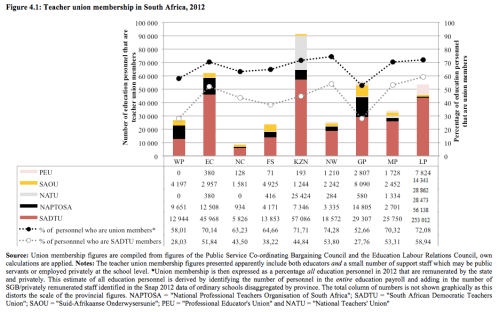
As a rough estimate, two thirds[2] of all persons in education (including administrators, management, support staff and privately employed personnel in schools) are formally identified as members of a teacher union in South Africa. In absolute terms, this represents 380 000 members using 2012 data where membership rates and choice of teacher union differ across provinces.

Screen Shot 2015-12-24 at 9.15.41 AM

Figure 4.1: Teacher union membership in South Africa, 2012

If one limits the national teacher union membership estimate to only teachers this estimate is likely to be higher. Armstrong (2014: 4) using the Labour Force Surveys between 2000 and 2007 identified that roughly 76 percent of teachers in South Africa are union members. What these national estimates do not recognise is the interesting provincial dimension to union membership in the education sector which is highest in provinces such as the North West, Limpopo, KwaZulu-Natal, Mpumulanga and the Eastern Cape but notably lower in Gauteng Province and the Western Cape.

There are various different teacher unions in South Africa, but by far the dominant union is the South African Democratic Teachers’ Union, most commonly referred to as SADTU. Audited 2012 figures indicate that their membership comprised roughly 253 000 personnel which represents two thirds of all registered teacher union members. SADTU membership has also grown substantially over the past twenty years, with membership figures in 2012 that were 2.5 times that in 1996 (Govender, 2004).[3] A clear provincial dimension exists to SADTU affiliation. Their proliferation is strongest in the Limpopo Province where figures from the Public Service Co-ordinating Bargaining Council suggest that 82 percent of all unionised education personnel in Limpopo are registered members of SADTU, compared with a figure of 48 percent in the Western Cape. The next largest teachers’ union is the National Professional Teachers’ Association of South Africa (NAPTOSA) with just over 50 000 members as at December 2012. Affiliation to this union is strongest in the Western Cape and the Gauteng Province when expressed as a proportion of unionised teachers in each province. These provincial differences in union membership are worth noting. They may have implications for differences in the balance of negotiating power across provincial chambers of the ELRC and in the functioning of provincial administration departments of education.

Considering the two largest teachers’ unions in South Africa, SADTU and NAPTOSA, both play a role in negotiating conditions of work for teachers in two sets of combined teachers unions[4] in the sector specific ELRC. Both unions fulfil a primary function as bargaining agents for their members, although on the basis of sheer vote size SADTU’s influence in negotiations is considerably more substantive. However, in balancing their secondary functions as political and professional organisations[5] they are divergent in their ideologies (Chisholm, 1999; de Clercq, 2013). Teacher unions represented in what is now NAPTOSA existed in the early days of apartheid with typically white leadership and an agenda largely concerned with the professionalism of teachers. By contrast SADTU, having emerged in direct opposition to apartheid, is understandably more militant, political and concerned with the rights of the ‘worker’ than promoting professionalism (Chisholm, 1999). Moreover, SADTU is an affiliate of COSATU – one of the three members in the tripartite ruling alliance – which prioritises their role as a political organisation over their function as a professional body. As a political organisation, their presence is extensive not only in terms of membership numbers. The organisational structure of the union facilitates an on-site presence across almost all school districts and in the majority of schools.

______________________________________________

[1] The Bantu Education Act of 1953 was the designed plan of former Prime Minister H.F. Verwoerd. In his own words he said, “There is no place for [the Bantu] in the European community above the level of certain forms of labour. It is of no avail for him to receive a training which has as its aim, absorption in the European community” (Senate, 1954). The Bantu Education system was established to educate black youth only to a level where they could operate as labourer, worker and servant.

[2] See the notes of Figure 4.1 for a description of how this figure was estimated relying on union membership figures from the Public Services Bargaining Council (PSBC). Calculating teacher unionisation rates with available data in South Africa is not straight forward, where it is not obvious what groups of education personnel are included in the PSBC figures. On the basis of a priori expectations this estimate of 66 percent seems too low but it must be noted that in both the numerator and denominator of the calculation are non-educator personnel such as provincial or district staff, school support staff and privately employed SGB or other staff members at the school level. If one were to limit the numerator and denominator to include only educators, this figure may be higher if more educators than administrators are unionised. It is also noted that some studies have erroneously attributed teacher union membership figures reported by the PSBC as referring to teachers only, when non-teachers in the education sector are also included in these figures. For example, both SADTU and NAPTOSA attract teachers in the public and private sector and other workers in the education sector to their membership base. If this is not recognised, this results in over inflated estimates of teacher unionisation as high as 90 percent in some studies.

[3] The majority of the growth in SADTU’s membership took place between 1996 and 1999 when their membership base grew from 106 000 to nearly 200 000 three years later (Govender, 2004).

[4] At the ELRC, negotiations and consultation takes place between the Employer (the DBE) and two sets of combined trade unions (CTU). The first is the CTU-SADTU where SADTU membership vote weights are combined with the Cape Teachers’ Professional Association (CTPA). NAPTOSA’s bargaining power is established through the combined ‘Autonomous Teachers Union’ (ATU) which includes a number of smaller unions including the Suid-Afrikaanse Onderwysersunie (SAOU), the National Teachers’ Union (NATU), the Professional Educators Union (PEU), the Public Servants Association (PSA) and the Health and Other Service Personnel Trade Unions of South Africa (HOSPERA).

[5] As noted by Cowen and Strunk (2014), there are three main functions of teachers’ unions. The first and most dominant role is that of a bargaining agent for member teachers and the second role is that of a political organisation advocating for teachers. As a political organisation, their function is to act as an interest group, “active not only in promoting or opposing particular pieces of legislation or administrative policy, but also as a force in national, state and local elections” (ibid, 2014: 4). The third role is that of a professional organisation, providing support to individual teachers. In particular, where teacher unions embrace their role as a catalyst for the professionalization of the teaching force, this can yield very positive impacts for educational systems. However, this role is not widely explored in relation to its influence on student achievement and altering district/national resources for education (Cowen and Strunk, 2014: 4).

Q&A with Jonathan Jansen (SAERA SIG)

jansen

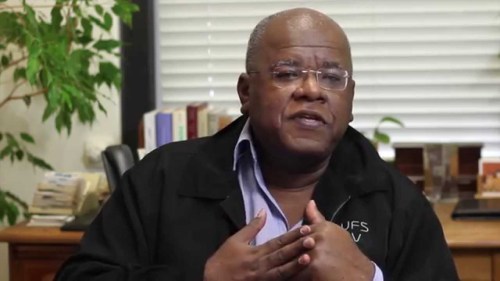
The Q&A with Professor Jonathan Jansen below first appeared in the SAERA “System-wide Educational Change” Newsletter.

Q&A with Jonathan Jansen

You have recently published two new books on educational change that have received critical attention from the public, How to Fix Schools (2014) and Leading for Change (2015). What is it about your thinking that has attracted so many readers?

First of all, everyone knows that there is something wrong in education, those that work in schools and those that send their children there and the general public. So I think that it helps attract a broad readership because of the focus on the issue in the media. Second, I think people don’t just read books they read authors and so the fact that I have been in the public space a lot more in recent years largely through my column in The Times for example. This gives the books the kind of attention that they would not have gotten otherwise. Third, in both of these publications, I try not to deal with these concerns in abstract academic language but to make them as practical as possible and to be as insightful as possible for people who are not specialists. It is for them to enjoy and to spur them to action. And fourth, I try to insert a sense of hopefulness at the end to each book.

Much of your work centres on educational leadership at various levels, particularly the role of leaders in transforming relationships. Can you talk a little about how you conceptualise the relationship between leaders and leadership at institutional level and system-wide policy or programme driven change?

I have more or less given up on the ability of system leaders to be able to make change from the top. I have been around too long to believe that this is even possible.
As you know in the early days of the transition, during and after the days of NEPI, I sat on committees of government when there was excitement about being able to say something worthwhile and there was a fair chance that you would be heard by the minister or the DG. I don’t have that sense anymore. My sense is that critics and public intellectuals are being shut out of these kinds of spaces. So I made a conscious decision to engage through visible practices of leadership. Sometimes these gain the attention of those in higher authority. Idon’tthinkwehavea government that is attentive enough or serious enough about educational change to allow practice and research to inform policy. For example, the most profound piece of practical research ever done in the history of this country is the National Development Plan. The diagnosis is profound. And yet, the government seems unable to absorb the good thinking and sound data into development actions. In saying this, I have not strayed too far from my work on the symbolic functions of policy. That is not to say that I am cynical or unpatriotic. Quite the opposite. There is limited space time and space to make a difference. For me, I am able to do this, for example, by working on projects like How to Fix Schools by providing books and videos to all high schools in the country with training support where required.

This doesn’t require working directly with government at national, provincial or local levels on policy.

What do you consider to be the key research areas to focus on for young and mid-career researchers interested in leadership and system- wide educational change?

The first thing to be said to young and mid-career scholars working on system-wide educational change is that it is time for bold new ideas and approaches to the subject. In other words, instead of replicating the kinds of things senior scholars like myself, Pam Christie and Jo Muller have done, a new generation needs to ask different kinds of questions and experiment with new methodologies. The upcoming generation of scholars need to provide new insights about the persistence of certain kinds of problems built into the system of education. Second, we need to move away from the fidelity perspective in policy studies. Too many policy studies still focus on how faithfully people implement this or that policy. When there is a big gap, they explain it as the consequence of ‘stubborn teachers’ or think that policies are ‘stupid’. We need to move beyond this fidelity approach to policy studies and introduce new questions about the relationship between policy and practice. This will take us away from stale formulations. Third, I also think we need to move away from a pre-occupation with analyses of exceptional cases. When we do use them, we need take a fresh look at how they are used. Finally, I think we need to shift our focus from the problem of change to the problem of continuity.

The System-wide Educational Change SIG has had its inaugural meeting this year in Bloemfontein at SAERA. What do we need to do as an emerging research community to build scholarship in our field?

We need to get more people with great potential into the field. That must be the number one priority. We need to connect them with scholars and scholarship around the world. It is not sufficient that they do their PhD studies at UCT, Wits or the Free State. New scholars with great potential need to spend time with people like Alma Harris in the UK or Andy Hargreaves at Boston College. The capacity to speak to local problems in intellectually powerful ways means knowing about and being fluent with educational change discourse and practices in other parts of the world. This would allow us to be theoretically courageous. As you know I have often say that you cannot get very far at UCT without referencing Bernstein or Bourdieu, at UWC without referencing Marx and Frere, and Stellenbosch without van der Walt or van der Stoep. Getting out will allow people emerge from the deeply entrenched tracks of theory and method. Broadening intellectual life requires being international and comparative in focus. Advanced scholars these days need more than a PhD and for a good post-doc experience, they need wider exposure.

We know that you tweet and have a strong presence on YouTube. How should our research community be engaging with the new media space?

This is an important issue less for myself than for a new generation of scholars. I really cannot see how a new PhD scholar in the post 2015 world can work unless they are connected to a whole lot of sites and platforms for their day to day research. Online professional networks provide a platform for your ideas, for your CVs, for the circulation of your research papers. These new media spaces allow for wider audiences to actively engage with your ideas and scholarship. The people I spoke about earlier, Alma and Andy use twitter to give

the latest updates on the papers they are presenting at conferences in Malaysia and Australia. I’m amazed at how a bunch of us get tagged and can engage with their ideas through the simple medium of twitter. I have just recorded a series of lectures on leadership and research that will go on YouTube. And we will see the responses from around the world. We are certainly not going to get far unless there is a consciousness about social media and the technical ability to navigate with these new spaces.

What would you want to see us doing with the SAERA SIG newsletter?

I’m excited about the potential of the newsletter. It can allow us to know more about what everyone is doing around the country. I often get surprised about research that is going on in some institution or another, and I think of myself as being in touch. The newsletter is a forum for sharing new ideas, new questions, and new methodologies. It can also showcase the experts in specific areas. For example, Brigette Smit knows a lot about computerised qualitative data analysis. It also provides a space to highlight what is happening around the world. The newsletter can also stimulate a dialogue between up- and -coming scholars and established academics. I’m amazed at how many emails I get from young scholars asking advice and requesting to be mentored. The newsletter would provide an organised platform for this.

Links I liked (and some personal reflections)

rise

  • Taylor, N. 1989. Falling at the First Hurdle: Initial encounters with the formal system of African education in South Africa. Research Report #1. EPU. (via JET Education). – an old but important report that is not in the public domain yet (as far as I’m aware) – thanks JET for scanning this.

  • Improving learning in primary schools of developing countries: A meta-analysis of randomized experiments” – Patrick McEwan (2015) (via Servaas van der Berg).
  • The independent Task Team led by Prof John Volmink, which was appointed to look into the ‘jobs-for-cash’ scandal exposed by CityPress last year, has found that SADTU has a ‘stranglehold‘ over the State in provinces such as the Eastern Cape, Limpopo, Mpumalanga and KwaZulu-Natal. These scandals sometimes turn deadly when the ‘right’ candidate is not appointed. On this topic I would highly recommend Gabi Wills’ new article “Informing principal policy reforms in South Africa through data-based evidence.” To give you the highlight: The cohort of principals that are currently in the system are, on average, much older than they were in the past meaning that there is soon to be a wave of principal retirements. Whereas in 2004 only 17% of principals were aged 55yrs+, in 2012 that figure was 33%! If these principals retire at 60 this means that between 2012 and 2017 there will be about 7000 principal replacements! (remember there are only about 24,000 public schools in SA).
  • This latest report shows that the South African Council of Educators (SACE) is a toothless dog, as I have argued before. Earlier this year SACE ran their own investigation into the exact same jobs-for-cash scam and could not find “a single bit of evidence” that there was corruption in the appointment of teachers and principals in SA. Subsequently CityPress has claimed SADTU ‘told SACE to end their investigation” after the names of top SADTU officials started cropping up in the investigation. So how is it that SACE ran an investigation on the same issue at the same time and found no evidence while Volmink’s team found multiple examples of corruption, and 13 of the cases were so strong that they could already be passed on to the police? Go figure. Minister Motshekga needs to put a target on SACE and reform the entire organization. It is rotten through and through.
  • Holstee have come up with a set of 10 questions to ask yourself about the year that was. Reflection. Contemplation. Good stuff.
  • I’m re-reading Henri Nouwen’s “Reaching Out” – the book where he outlines his understanding of spirituality from the Christian perspective. It’s lovely, not too preachy or crispy-clean / three-bags-full-sir Christianiaty which I have little tolerance for. One quote:

“When loneliness is haunting me with its possibility of being a threshold instead of a dead end, a new creation instead of a grave, a meeting place instead of an abyss, then time loses its desperate clutch on me. Then I no longer have to live in a frenzy of activity, overwhelmed and afraid of the missed opportunity” – Anonymous in Nouwen’s Reaching Out p35

All models are wrong but some are useful.

— George Box (via Farnam Street Brain Food)

I am really enjoying poetry for the first time in a long time…

“I said to my soul, be still and wait without hope, for hope would be hope for the wrong thing; wait without love, for love would be love of the wrong thing; there is yet faith, but the faith and the love are all in the waiting. Wait without thought, for you are not ready for thought: So the darkness shall be the light, and the stillness the dancing.” – T.S. Elliott

Also Pablo Neruda.

It was also my birthday last month which started in tears and ended in champagne with a view! Ad Astra Per Aspera!

IMG_7650

Photo credit: Michael Chandler (@MrChandlerHouse)

Important new SA education research (SAJCE Special Issue)

moon

As part of my postdoc at Stellenbosch University and Stanford University I have been managing a large research project commissioned by the SA Presidency and funded by the EU in the Programme to Support Pro-Poor Policy Development (PSPPD for short!). The aim is to identify the ‘binding constraints’ in the SA education sector – more on that in the coming months. As part of that project we asked Elbie Henning if we could dedicate a special issue of the South African Journal of Childhood Education (SAJCE) to the research emerging from the project. As the editor she agreed and we asked Nick Taylor (JET) and Thabo Mabogoane (Presidency) to be the guest editors for the special issue. That special issue was published online last week and there is no pay wall (viva open access!). I have included the abstract for each article as well as links to the full text for each one. I would strongly recommend reading Nick and Thabo’s editorial if you don’t have time to read through all the articles. They provide a good overview of the key findings. The research here covers a number of fields ranging from ECD, matric assessment, reading, teachers, principals, and education data.

Editorial: “Policy research comes of age in South Africa” (Nick Taylor and Thabo Mabogoane)

Investment in Early Childhood Development (ECD) has the prospect of cultivating potential within individuals and can assist in bridging the social equity gap from a very young age. Over the past decade Grade R has been the strongest policy lever used by the Department of Basic Education to improve early learning. The National Development Plan calls for universal access to two years of early childhood development prior to entering Grade 1. This paper explores the merits of this proposal, given the specific South African context. More specifically, this analysis intents to bring new information to bear on three matters. The first relates to the demand-side and aims to identify participation trends among four and five year olds. The second objective is to consider the supply-side and aims to understand the policy space in which pre-Grade R will function, the quality and quantity of infrastructure already in place, and the expertise of ECD practitioners. The final question considers the implementation of a universally accessible pre-Grade R within a constrained system and the requirements to ensure that it will have a significant impact on those children most in need.
Much hope is placed on education systems to reduce socioeconomic learning gaps. But in South Africa, uneven functioning of the school system widens learning gaps.This paper analyses education performance using ANA data. Weak calibration and inter-temporal or inter-grade comparability of ANA test scores limit their usefulness for measuring learning gains. However, relative performance provides meaningful information on learning gaps and deficits. A reference group that is roughly on track to achieve the TIMSS average is used to estimate the performance required in each grade to perform at TIMSS’ low international benchmark. By Grade 4, patterns across quintiles of on track performance approximate matric exemption patterns. Viewed differently, academic and labour market prospects may be bleak for children who are no longer on track. Improvement in outcomes requires greater emphasis on the Foundation Phase or earlier, before learning deficits have grown to extreme levels observed by the middle of primary school. This statement is true whether deficits arise from weak early instruction, or simply because a disadvantaged home environment requires early remedial action. The emphasis on the early grades that this analysis of the ANAS suggests is contrary to the conclusions drawn from the ANA results by policy makers, that weak test scores in Mathematics in Grade 9 require major interventions in that grade.
The ability to read for meaning and pleasure is arguably the most important skill children learn in primary school. One integral component of learning to read is Oral Reading Fluency (ORF), defined as the ability to read text quickly, accurately, and with meaningful expression. Although widely acknowledged in the literature as important, to date there have been no large-scale studies on ORF in English in South Africa, despite this being the language of learning and teaching for 80% of ESL students from Grade 4 onwards. We analyze data provided by the National Education and Evaluation Development Unit (NEEDU) of South Africa, which tested 4667 Grade 5 English Second Language (ESL) students from 214 schools across rural areas in South Africa in 2013. This included ORF and comprehension measures for a subset of 1772 students. We find that 41% of the sample were non-readers in English (<40 Words Correct Per Minute, WCPM) and only 6% achieved comprehension scores above 60%. By calibrating comprehension levels and WCPM rates we develop tentative benchmarks and argue that a range of 90-100 WCPM in English is acceptable for Grade 5 ESL students in South Africa. In addition we outline policy priorities for remedying the reading crisis in the country.
This study analyses information and feedback from matriculation level continuous assessment in the South African education system. Continuous assessment (CASS) at the time carried a 25% weight in the final matriculation (Grade 12) mark, and it provides feedback that affects examination preparation and effort. Weak assessment in schools sends wrong signals to students that may have important consequences for the way they approach the final examination. Moreover, similarly wrong signals earlier in their school careers may also have affected their subject choice and career planning. This study compares CASS data to the externally assessed matric exam marks for a number of subjects. There are two signalling dimensions to inaccurate assessments: (i) Inflated CASS marks can give students a false sense of security and lead to diminished exam effort. (ii) A weak correlation between CASS and the exam marks could mean poor signalling in another dimension: Relatively good students may get relatively low CASS marks. Such low correlations indicate poor assessment reliability, as the examination and continuous assessment should both be testing mastery of the same national curriculum. The paper analyses the extent of each of these dimensions of weak signalling in South African schools and draws disturbing conclusions for a large part of the school system.
In the past decade there has been a notable shift in South African education policy that raises the value of school leadership as a lever for learning improvements. Despite a growing discourse on school leadership, there has been a lack of empirical based evidence on principals to inform, validate or debate the efficacy of proposed policies in raising the calibre of school principals. Drawing on findings from a larger study to understand the labour market for school principals in South Africa, this paper highlights four overarching characteristics of this market with implications for informing principal policy reforms. The paper notes that improving the design and implementation of policies guiding the appointment process for principals is a matter of urgency. A substantial and increasing number of principal replacements are taking place across South African schools given a rising age profile of school principals. In a context of low levels of principal mobility and high tenure, the leadership trajectory of the average school is established for nearly a decade with each principal replacement. Evidence-based policy making has a strong role to play in getting this right.
This research makes use of hierarchical linear modelling to investigate which teacher characteristics are significantly associated with student performance. Using data from the SACMEQ III study of 2007, an interesting and potentially important finding is that younger teachers are better able to improve the mean mathematics performance of their students. Furthermore, younger teachers themselves perform better on subject tests than do their older counterparts. Identical models are run for Sub Saharan countries bordering on South Africa, as well for Kenya and the strong relationship between teacher age and student performance is not observed. Similarly, the model is run for South Africa using data from SACMEQ II (conducted in 2002) and the relationship between teacher age and student performance is also not observed. It must be noted that South African teachers were not tested in SACMEQ II so it was not possible to observe differences in subject knowledge amongst teachers in different cohorts and it was not possible to control for teachers’ level of subject knowledge when observing the relationship between teacher age and student performance. Changes in teacher education in the late 1990s and early 2000s may explain the differences in the performance of younger teachers relative to their older counterparts observed in the later dataset.
This paper provides an overview of the various datasets pertaining to education in South Africa that are informing or could inform policy making in education. The paper serves as an inventory for anyone interested in understanding what data is available, how it may be accessed, what the quality of the data is and in what formats it may be accessed. The paper is divided into three parts. The first part provides a description of existing education datasets and the basic data elements contained in each of these datasets. When discussing each of the existing education datasets, the paper addresses the quality of the education data available in South Africa. The first part also refers to the policy implications and the important role that data plays in policy-formulation. No information system on its own is comprehensive enough to provide all the information needed in strategic decision-making. Hence, part two of this paper discusses the need for data integration as an important data management strategy. The third part examines the effectiveness of implementing a learner unit record system nationally in comparison with the EMIS system that is currently in place and that is based on aggregate or summary institution–level data.

______________________________

The full Special Issue can be found here.

Links I liked

listen

  • It is worth reading and re-reading the DBE’s “Second detailed indicator report for the basic education sector” published last year. The infrastructural backlogs in the Eastern Cape particularly are truly unbelievable.
  • The MEC of Gauteng has proposed rotating principals every September in an effort to curb corruption. As a friend of mine said “It takes at least 3 years to find your feet in a new school – this is like school leadership musical chairs. It’s ludicrous.” I agree.
  • New IJER Special Issue on Teacher Rounds, like medical rounds but for teaching practice.
  • Instil Education – a private teacher development startup in SA – are looking for an “Instil Fellow” and a “Director of Teacher Development” – links here.
  • I’m currently reading through one of my masters students dissertations and came across this lovely quote by Martha Nussbaum:
  • “Nothing could be more crucial to democracy than the education of its citizens. Through primary and secondary education, young citizens form, at a crucial age, habits of mind that will be with them all through their lives. They learn to ask questions or not to ask them; to take what they hear at face value or to probe more deeply; to imagine the situation of a person different from themselves or to see a new person as a mere threat to the success of their own projects; to think of themselves as members of a homogeneous group or as members of a nation, and a world, made up of many people and groups, all of whom deserve respect and understanding” – Nussbaum (2006, p.387).
  • I am currently staying with a friend and his family and made a few meals from Nigel Slater’s “Tender: Volume 1” which is lovely. My kind of a cookbook.  Kathleen Alcott captures the appeal in her New Yorker article
  • Slater is the writer for those of us who have ended up in the kitchen because transforming chopped vegetables and seasoned meats into complex dishes makes us feel that we have acted capably for the sake of our own well-being, and for the well-being of those we love. The hours I spend bent over an evolving meal are, as I believe they are for Slater, a step in the direction of the person I want to be and the home I’d like to have, even if I am frequently not that person, even if I do not come from that type of home. We conceive who we are as we conceive the meal in front of us.”
  • Two documents that will be helpful for those in government and in the NGO world. They are “Database of potential funders for municipalities” and in a different version: Database of potential funders (both from the CSI Trialogue Newsletter)

NEEDU 2013: Moving from Form to Substance (Guest blog post: Gabrielle Wills)

lines

NEEDU 2013: Moving from Form to Substance

Guest blog post by Gabrielle Wills

The NEEDU 2013 report entitled “Teaching and Learning in Rural Primary schools” has finally entered the public domain. Subsequent to the release of the first NEEDU 2012 report, sensational headlines in the press presented certain findings that were isolated from the wider objective of the report. This potentially misrepresented both the objective of the report and the much needed role of NEEDU, which (as its name suggests) is the national evaluator of education. It is no surprise then that the 2013 report has been withheld from public view, delaying constructive dialogue and systems thinking that will emerge out of this insightful material. Compared with the press’ responses to the release of NEEDU 2012, media reporting has been somewhat less damaging in its representation of the findings this time round. However they have still not conveyed the most pertinent messages of the report. This article is intended to direct the reader to the report’s substance.

Before considering the details, a noted conceptual contribution of the report is this: it moves towards being systemic in its evaluative approach, even when considering individual elements that make up the whole. In Lant Pritchett’s book “Rebirth of Education” he draws on Howard Gardener’s (1991) evocative phrase, arguing that we live with an “unschooled mind” about systems. Many activities and research undertaken in the field of education and education economics are modular, focusing on aspects or isolated interventions without considering how these link together within the wider system. NEEDU 2013 moves beyond just a discussion of just individual symptoms of a broken system, of which we are becoming acutely aware (for example poor teaching content knowledge and absurdly low levels of learning in the classroom), getting closer to the institutional inefficiencies that must be addressed before we can move forward.

Much of the discussion of the report is framed under two headings: accountability and instructional leadership. The first is a term with which most economists are well-familiar (and our education system far less so). However the notion of ‘instructional leadership’ is used in the education administration literature, usually in reference to school leaders and the extent to which they organise the school environment to focus on the core business of the school, namely learning. The report extends this terminology to wider administration at the district, provincial and national level to consider that the management of curriculum, assessment and resources will have a strong bearing on learning improvements.

“Instructional leadership may be thought of as the ensemble of processes, operating at different levels of schools, and directed towards leading the system to improved quality (NEEDU 2013, pp 13)”.

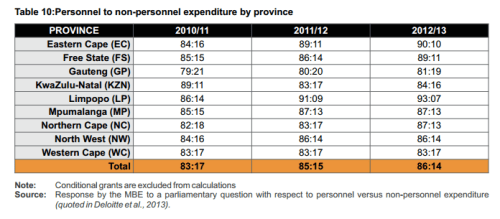
One of the most important processes within this ensemble is the management of human resources and particularly the post provisioning process, recruitment and promotion, and professional development. “HR management is the single most important tool available to PDEs (provincial directorates of education) in giving effect to curriculum policy. It provides the tools for the optimal deployment of the costliest and most important resource, educators.” The discussion draws our attention to how provinces have lost control of the post provisioning process, which has the largest budgetary implications for the department (and arguably national spending). The provincial personnel-non-personnel spending split should be 80:20 but has become increasingly skewed towards personnel, impeding on the system’s ability to deliver non-personnel resources to schools.

Screen Shot 2015-12-10 at 4.13.09 PM

Without discipline in spending, the stability of provincial departments to execute functions is severely threatened. This has far reaching consequences for system functionality. It follows that the first three recommendations of the report, and rightly so, are that post provisioning norms and standards need to be unambiguously communicated and applied where strengthening education management information systems aids this process. It also highlights how the process of post provisioning and the recruitment and promotion of personnel must be removed from the influence of the predatory behaviour of organised interest groups.

Strongly related to instructional leadership, the report raises the importance of monitoring and evaluation required within education. However, much of what is being done in this regard takes on a ‘form’ of these things yet lacks any substance. This quotation sums it up well:

“.. in large parts of the system and with respect to a number of instructional leadership processes, both systems management and teachers are going through the motions, with little impact on the objects of their attention… Activity does not necessarily signify progress: there is a great deal of instructional leadership activity throughout the system, but much of it is undertaken at too superficial a level to make any impact on the quality of teaching and learning If going through the motions is the first step towards effective instructional leadership, then engaging with the substance of the activities is the next (NEEDU 2013, pp 48).”

 This is an acutely important observation. In reading recent Annual Plans and Annual Reports prepared by the DBE there is great deal of activity and forms of monitoring taking place. In many ways, some activities have been admirable and NEEDU 2013 directly acknowledges such successes. Yet many activities are divorced from the objective of improving learning. Consider the following examples:

  • The quality of management in school is being monitored using perfunctory checklists of certain documents such as school improvement plans (SIP) and up-to-date records. But the majority of schools have a SIP and documents can readily be organised and kept up to date even in the presence of incompetent leaders. What is required is hiring the best leaders, on the basis of expertise not years of service or political affiliation. What is required is monitoring their performance using proven instruments of assessment rather than a checklist of activities accomplished.
  • There is no doubt that the introduction of ANA has signalled a major step forward in monitoring whether the system is working. However these are neither standardized tests in the sense that year-on-year comparisons are possible, nor are the majority of schools and districts using these effectively to identify learning gaps. ANA is a form of monitoring yet currently lacks substance in influencing learning or even simply monitoring systemic progress.

While focusing on institutional inefficiencies, NEEDU 2013 does not shy away from obvious problems of addressing teaching in the classroom. In recommendations five and six, the need for a roll-out of a proven reading and writing programme as well as primary numeracy and mathematics programme is expressed. Recommendation nine focusses on addressing teacher proficiencies through educational development, calling for considerable investigation into the teacher education sector and whether it is equipping graduates with necessary competencies. Despite great intentions to improve education and accompanying strategies, it is currently not possible given inherent capacity constraints of both teachers and administrators.

The time of window dressing activities that hide systemic weaknesses has continued for too long. We must move away from forms of activity that mimic best practice while neatly steering away from threatening fundamentals on the surface. Systemic weaknesses must be seen and acknowledged for what they are, and action taken to address them. In this regard, the recommendations of the report should be strongly considered.

________

Gabrielle Wills is a PhD candidate at Stellenbosch University and is part of the RESEP team. Her latest research is titled “A profile of the labour market for school principals in South Africa” which she presented at a conference earlier this year (PPT here).

Assessing oral reading fluency – some resources for teachers and researchers

reading ORF

Over the past year I have been doing some research on oral reading fluency (ORF) with Kim Draper (CDE) and Elizabeth Pretorius (UNISA). The journal article version of my paper with Kim should be available later this month in the SAJCE but you can read a Working Paper version here and the abstract at the end of this post. Lilli and I are in the process of submitting our article to journals so there is no version currently available, but there should be one early next year.

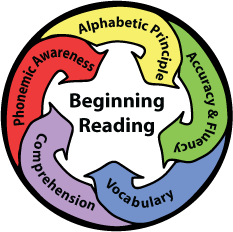
reading fluencyFor those who are unfamiliar with oral reading fluency, it is the speed at which written text is reproduced as spoken language, or put more simply, it is how quickly and accurately you can read aloud. It is one of the components of the “Big 5” which originated in the National Reading Panel in the US. Although this is a fundamental component of reading, it is rarely assessed in South African schools.

The way one usually goes about testing oral reading fluency is to sit down with a student 1-on-1 and ask the student to read a specific passage aloud. While the student is reading the passage the assessor times the reading and also follows the text on her own copy of the passage, marking any errors. At the end of the reading, or after one minute (depending on how one is administering the test), the assessor records the time, totals the number of errors and then can calculate a score called “Total Words Read Correctly Per Minute” or WCPM. This is calculated as the total of all the words in the passage up to where the student was at one minute, and then subtracting the total number of errors to give Words Correct Per Minute. Given that the same passage is used for all students this method creates a measure that is comparable across students or schools.

In 2013 the National Education and Evaluation Development Unit (NEEDU) conducted a study where they tested the oral reading fluency of 1772 Grade 5 students (all English Second Language students) from 213 schools in rural areas. The results of that study can be found here. Kim Draper and Nick Taylor were the lead researchers on this project.

A few days ago a principal from a primary school in South Africa emailed me to ask if there were any books that I would recommend that he reads over the holidays (for those interested I recommended this book and this one). But it reminded me that it would be helpful to post a link to the oral reading fluency assessments that NEEDU used to test the grade 5 students in their 2013 sample. That way other researchers can use the same tools and compare their results to those of NEEDU, and also so that primary school teachers can see how to assess oral reading fluency, with the aim of doing their own oral reading fluency assessments. So here they are 🙂 – all the materials used by NEEDU are available in THIS appendix. That includes the two reading comprehension passages, the questions associated with them and the instructions to the ORF assessors.

For those who want to assess first language English speakers or to assess other grades, I would also recommend looking at the “Florida Assessments for Instruction in Reading: Ongoing Progress Monitoring, Oral Reading Fluency Grades 1-5” which has a number of passages for each grade.

If you’re a teacher or a researcher and have conducted your own oral reading fluency assessments, I’d love to hear about how you did it, what lessons you learned, if the materials are available online etc. Please post any comments or links below.

//

Abstract:

The ability to read for meaning and pleasure is arguably the most important skill children learn in primary school. One integral component of learning to read is Oral Reading Fluency (ORF), defined as the ability to read text quickly, accurately, and with meaningful expression. Although widely acknowledged in the literature as important, to date there have been no large-scale studies on ORF in English in South Africa, despite this being the language of learning and teaching for 90% of students from Grade 4 onwards. As part of the National Education and Evaluation Development Unit (NEEDU) of South Africa, we collected and here analyze data on 4667 grade 5 English Second Language (ESL) students from 214 schools across rural areas in South Africa. This included ORF and comprehension measures for a subset of 1772 students. We find that 41% of the sample were non-readers in English (<40WCPM) and only 6% achieved comprehension scores above 60%. By calibrating comprehension levels and WCPM rates we develop tentative benchmarks and argue that a range of 90-100 WCPM in English is acceptable for grade 5 ESL students in South Africa. In addition we outline policy priorities for remedying the reading crisis in the country.

Martin Gustafsson on “Higher education policy challenges”

Higher_Ed_and_Sustainability_980x444

In the past three months South African higher education has come into full focus thanks to efforts of students in #FeesMustFall, #OpenStellies, #RhodesMustFall and others. The article below was written by one of RESEP’s researchers, Dr Martin Gustafsson, and first appeared in Business Leadership South Africa’s newsletter. I’ve highlighted the sections I think are most important to note…

Higher Education Policy Challenges – Dr Martin Gustafsson

“I recall a prominent person from organised business declaring some years back at a meeting that the business sector in South Africa had essentially withdrawn from the education policy discourse to avoid conflict with government. Instead, the sector had turned its attention to easier, less controversial areas of involvement, such as partnerships with individual education institutions and bursaries for promising students. This is not a good approach. Smaller projects can make a difference, but policy matters and it is something to which business should pay more attention. Business is well placed to provide policy advice in areas where it is strong: unit costs, cost-effectiveness, trade-offs between priorities and efficient management.

What are some of the difficult policy questions in what has recently become a volatile higher education sector?

Low public spending on higher education has been in the spotlight. This spending comes to 0.6% of GDP, compared to around 1.1% for comparable countries. The problem relates more to low student numbers than low spending per student. If we use countries at South Africa’s level of development as our benchmark, UNESCO education statistics suggest that our public spending per student should be 12% higher, while the number of students should increase by 30%. Current pressures to spend more per student are justified, but this should not be allowed to slow down the growth we have been seeing in enrolments.

Of course growing the sector is not just about enrolling more students, but also about a higher ratio of graduates to enrolments. What in South Africa is referred to as low ‘throughput rates’ – essentially high levels of dropping out and repetition – are commonly considered a core problem. We would be in a better position to respond to this problem if we understood it better.

Low throughput rates are not a peculiarly South African phenomenon. Similar patterns are found in many countries, which suggests that shifting the numbers is not easy. An Organisation for Economic Co-operation and Development (OECD) report on dropping out at tertiary level indicates that around 53% of students enrolling for a degree in the United States do not attain the degree. The Council for Higher Education has found the figure to be a rather similar 55% in South Africa. For the OECD as a whole, however, the figure is a better 31%. My own analysis of household data suggests that the ratio of degrees obtained per year to the number of full-time equivalent students, the graduation rate is around 1:7 for South Africa and Brazil.

So what are the circumstances of around half of our university students who do not complete a degree? It is difficult to obtain an overall picture. Sample-based household surveys, such as Stats SA’s Labour Force Survey are of limited use partly because the students in question are a small percentage of the population, and because there are no questions relating to tertiary-level dropping out. Longitudinal surveys conducted by universities or faculties can tell us a bit, though they do not provide a national picture. By far the most commonly cited reason for dropping out is financial constraints. However, students’ academic results and their ability to find funding are closely linked. If their results are poor, it is more difficult to renew funding. Yet the data we have indicates that the tragedy of academically well-performing students who drop out mainly due to funding reasons is substantial. It is a tragedy for the individual, but also for the country’s development, given the skills shortfall in the labour market, and it is bad for the attainment of workplace equity targets.

The OECD report warns against an all-or-nothing approach of classifying all drop-outs as failures and a manifestation of wasted effort. Even an incomplete university education is likely to improve an individual’s wage prospects and productivity in the workplace. It is in the interests of business to advocate for and fund more rigorous research on, for instance, the relationship between wages and the actual range of higher education outcomes which includes non-completed graduates.

The policy debates should be informed by accurate estimates, which exist, of the graduate unemployment rate. This rate is relatively low, and lower than what is suggested by some figures which have been quoted, including figures from an inaccurate January 2012 article in The Economist.

An unfortunate blind spot in our strategies for expanding the university sector is the lack of attention paid to the role of private universities. Countries such as China and Brazil, which have expanded their university enrolments even faster than South Africa, have succeeded in doing so partly through carefully thought out policies governing the emergence of more private universities. Such universities need not be elite relative to public universities, and there are ways of dealing with the risk of sub-standard educational quality offered by unscrupulous institutions.

Brazil’s strategy for combatting low-quality private universities and poor quality higher education at public institutions, is unusual and fascinating. Final year undergraduate students must write, apart from examinations set by the university, a short discipline-specific nationally standardised test which allows the national authorities to gauge which universities are clearly not teaching their students the basics. Moreover, aggregate test results are publicly available, putting students and their families in a more informed position when they select a university. Marcelo Rezende, in an article in Economics of Education Review, argued that the system has helped universities to focus on producing quality graduates.

Two institutions other than the universities are critical for building a better higher education system. Problems in the National Student Financial Aid Scheme are at the core of the 2015 unrest in the sector. The recommendations of the official 2010 review report remain relevant today. Secondly, without further educational quality improvements in the schooling system, the expansion of universities will be difficult. The National Development Plan’s key strategy for improving schools, paying attention to school principals – specifically their hiring, functions, remuneration and performance contracts – is a sensible one.

//

On the issue of school principals I would strongly recommend following the work of Gabrielle Wills, a PhD student at RESEP who has done some very innovative and useful research on principals and leadership in South Africa. For example see her 2015 Working Paper “A profile of the labour market for school principals in South Africa” which she presented at a conference earlier this year (PPT here).

Guest blog post: Erin Raab

erinFor a while now I’ve been meaning to ask a few people who I know if they’d like to do a guest blog post on something they’re interested in. While I was at Stanford earlier this year I met Erin Raab in David Labaree’s course “A History of School Reform in the US” (which is a great course). Erin is currently doing her PhD at Stanford in the Graduate School of Education where she’s trying to answer the following question: “How might we might re-envision, re-design, and transform our schooling system so that it empowers teachers and students as positive changemakers, in their own lives and in their communities?”
Prior to Stanford she worked in international educational development, including five years in Durban where she completed her Master’s in Development Studies (cum laude) as a Rotary Scholar. She also founded the KwaNdengezi Education Centre which serves 8000 learners in 9 schools, and worked with the Department of Basic Education as a Senior Researcher for MIET Africa on SADC’s program Care and Support for Teaching and Learning.
After realising that we both loved James Scott’s “Seeing Like a State” (which is an absolute must-read for everyone interested in anything ever) I asked her to make a list of other influential books/articles/videos. This is what she sent 🙂
**-  Allen Article by Danielle Allen (political philosophy) on disentangling the relationship between equality & education – she really helped clarify links I was struggling with.
**-  Aukerman, Lyle Articles on Dialogic Pedagogy  – I think this way of thinking about understanding learning (combined with socio-cultural ways of thinking about it) is key, really fundamental, somehow
–  Boyce & HertzmanArticle on how our environments affect us at the genetic level attached — This FASCINATES me…I think it’s important to think about how this is all really affecting us…not just psychologically but physiologically….it’s related to Nadine Burke Harris’ talk in a way.
–  GehlbachArticle on why social psychology might be important for educators to consider

Some books that have been influential:

seeing
**- Seeing Like a State – Scott – a lens for analyzing the failure of big social engineering schemes of the 20th century & a useful framework for exploring the design and impact of a more varied array of smaller social reforms (or attempts at social reform).  I attached the reaction paper I wrote on it.
thinking
**-  KahnemanThinking Fast & Slow – This book blows my mind.  Looks at how the brain works and “the psychological basis for reactions, judgments, recognition, choices, conclusions, and much more”.  I’m halfway through.
syst
**-  Capra & LuisiA Systems View of Life – Another one I’m working on in bits and pieces and am about halfway through because it’s mindblowing.  Starts with an overview of the history of scientific thought and how we’ve gone back and forth between believing we can boil things down to their smallest parts and then understand them, vs. the view that the whole is more than the sum of its parts.  I got into it as I started thinking that the answer had to lie in shifting the whole system — which meant considering how systems work and systems theory.
**-  Asch – Social Psychology – he’s one of the fathers of social psychology and, while dense, his book touches on so many core aspects of what humans need to flourish.
*-  Why We Do What We Do (by Deci) – precursor to Daniel Pink’s book Drive — about our three core human psychological needs – essential to considering intrinsic motivation.
* – Foucault – Discipline & Punish – A number of things stick with me, in particular about how we’ve made the punishment for “crime” to be separated from society and invisible.  I also think much of it relates to how we think about schooling & behavior.  Deleuze’s book “Foucault” is also a great accessible interpretation.
* – MarxDas Kapital – I haven’t read the whole thing, but the chapters I have read from the first volume blew my mind. If you haven’t read him at all, it seems important, especially for an economist 🙂
*-  LS Vygotsky & Education – Moll – — socio-cultural approaches to learning that I think are more representative of how we actually learn than traditional conceptualizations.  Relatively easy introduction to the ideas
*-  Scarcity – Mullanaithan — effects of scarcity mindset on people – — (I think this book and Daring Greatly & Deci & Soul of Money get at some of the core ways we are affected by our culture, but blame it on individuals).
*-  Pedagogy of the Oppressed – Freire – classic, amazing.
*-  Daring Greatly – Brown – I keep thinking about the role of shame in our organizations vs. wholeheartedness (also great for thinking about our own wholeheartedness 🙂 ).
*-  Soul of Money – Twist – Interesting look at interaction b/w cultural & individual relationships with money.
–  Flourish – Seligman – framework from positive psychology about what “flourishing” might mean.
–  Creative Confidence – Kelley – By the originators of design thinking.
–  The Price of Inequality – Stiglitz – looks at the political and social costs of inequality – rooted in the U.S. but perhaps even more applicable in SA.
–  The New Jim Crow – Alexander – unrelated to education, per se, but it really affected me and I’d like to write a similar kind of expose book looking at the system of education.
Interesting Videos
–  Ken Robinson’s Ted Talk – schools kill creativity

–  Nadine Burke Harris’ Ted Talk – effects of toxic stress

–  Story of Stuff Mini-movie – we should make one like this about ed!

–  Simon Sinek’s Ted Talk – the original why/how/what 🙂

–  Tony Robbins’ Ted Talk –  framework for thinking about motivation/psychological needs, I think he pulls from Deci a good deal

–  Shawn Achor’s Ted Talk – happiness advantage (basically, I just like this one ;o …and I think he has a good critique of methodologies that focus on the mean)


————————————————–

I’m always fascinated to know about the books/articles/movies/experiences that influence the way people see the world, themselves and each other. If you’d like to share yours please include links in the comments section below 🙂

My Child Gauge 2015 Chapter (PDF)

Screen Shot 2015-11-15 at 1.47.20 PM

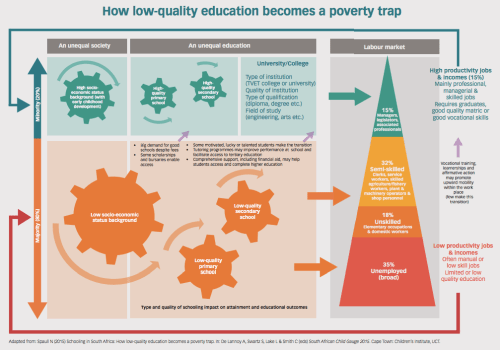
This week marks the launch of the 2015 Child Gauge with this year’s theme being “Youth and the intergenerational transmission of poverty.’ I wrote the education chapter titled Schooling in South Africa: How low-quality education becomes a poverty trap. The above flow-chart summarises the research in a single poster and shows how an unequal schooling system and an unequal labour-market perpetuate each other in South Africa such that low quality education becomes a poverty trap.

I would also recommend reading the Youth Matters bulletin. An excerpt:

Screen Shot 2015-11-15 at 1.50.56 PM

Reading to some purpose

face2

  • If I had to recommend one book that could change the way you view the world, “Seeing Like a State” would be it. Sociology, Political Science, History and Economics all wrapped into one compelling explanation of the world that we see. Taking a month off to digest this would be an excellent use of almost anyone’s time IMHO.
  • Fascinating LRB article reviewing “Empire of Tea: The Asian Leaf that Conquered the World.” Another amazing LRB article shows a breadth of knowledge that is absolutely astounding. From Weber and Durkheim to Israel, Gorbachev and Confucianism. A long but satisfying read!
  • Social Foundations of Education” 2011 University of Michigan course outline by Ball and Cohen. Looks like an incredible course.
  • Word of the week: ‘Nomenklatura‘ “a select list or class of people from which appointees for top-level government positions are drawn, especially from a Communist Party”
  • Important new (2015) research article “Teacher Supply in South Africa: A Focus on Initial Teacher Education Graduate Production” by RESEP’s Hendrik van Broekhuizen. Exhaustive. Meticulous. Important. My take home point is that we win or lose the initial teacher education battle with UNISA!
  • Dr Linda Zuze writes an interesting article “Desperate to be Digital” where she unpacks a demand from COSAS “We must get tablets just like the Chinese students.” Also  see the BBC article “Computers ‘do not improve’ pupil results, say OECD.” I am a little wary of these bivariate scatter-plot type comparisons of countries that do well and also a bunch of other things and then saying that those things cause the good performance, but nevertheless an interesting article.
  • There’s a new book by Hanushek and Woessman (2015) titled “The Knowledge Capital of Nations” – see Lant Pritchett’s review here (thanks Elbie!)
  • “Is our determination to achieve excellence in reading skills in our children killing their love and enjoyment of a good book?” This is the question asked by Ryan Spencer in his article “Reading teaching in schools can kill a love of books” (via Lilli Pretorius). Also see this article by Donalyn Miller titled “Cultivating Wild Readers” (via Sarah Murray)
  • An article from a month ago on DBE-SADTU relations by Leanne Jansen that some might of missed: “Motshekga said Sadtu was “more bullish” in the Eastern Cape because of the “culture of chaos” in that province, and within its education department. “Corruption plays a major role in destabilising the sector. Structures like Sadtu don’t create problems for the sake of creating problems. “It’s about patronage, access to government tenders … It’s deeper than being disruptive for the sake of being disruptive … It is leadership in provincial education departments to a large extent. There is Sadtu in the Western Cape, why is it not behaving the way it is behaving in the Eastern Cape?
  • Corrupting Learning: Evidence from Missing Federal Education Funds in Brazil” -via John Aitchison

Goodbye for now South Africa

Paris

I am currently sitting in JFK airport en-route to San Francisco and drinking 4 espressos to re-align my internal clock and stay awake until a reasonable hour. So I suppose this is a good time to fill everyone in on my plans for the next year and a half. From now until the end of 2015 I will be a Visiting Scholar at the Graduate School of Education at Stanford University in California. I’ll be taking some courses while I’m here and also finish up our (RESEP’s) ‘Binding Constraints in Education’ project which we’re currently doing for the SA Presidency and the E.U. Needless to say I’m really excited to be spending time at Stanford and I do intend to blog about my experience here.

The second piece of exciting news is that I’ve been awarded the OECD’s Thomas J Alexander Fellowship for 2016. That means I’ll be working on PISA data and focussing on developing countries. The broad aim is to find meaningful ways of integrating access (enrolment) and quality (learning) in education, along the lines of my earlier work on sub-Saharan Africa. I’ll be based at the OECD headquarters in Paris from January until July next year and then back at Stanford for the last 4 months of 2016.

As much as I have loved my time in South Africa to date I am also ready to get some international perspective and work on other developing countries for a while. There are 2 main reasons for this. In order of priority: (1) I think that many developing countries are experimenting with bold and innovative reforms with long-term strategic leadership, something that is sorely lacking in South Africa where it often feels like we are simply tweaking things at the margin. I want to understand what they are doing, what’s working and how they got it going. I am especially interested in the Brazilian case. (2) It’s not a wonderful feeling when some people you are trying to help – in this case the South African educational bureaucracy – portray you as part of the problem when in fact you are trying to help. I know that parts of the Department are open to research, and I have been encouraged by two recent speeches by the Minister of Basic Education, but there is a clear hostility towards those of us in the research community that highlight to the public just how bad the situation really is. I still do not believe that the powers that be understand the true severity of the crisis in education, because if they did we would not be continuing with things in a business-as-usual way. A massive crisis like the one we have requires pretty radical solutions. (As an aside, at the VW Foundation colloquium last week I was encouraged to hear the Minister using the word ‘crisis’ on more than one occasion in her speech – let’s hope that the reforms that are implemented are commensurate with this acknowledgement). The Minister has told us (researchers) that we are on the same page and that we all agree on the problems. Now that may or may not be true, but unless the conclusion is a radical overhaul of the most dysfunctional 30% (?) of our schools, I don’t know that we are on the same page. In these schools there is next to no learning taking place at all, as evidenced by abysmal educational outcomes. Such an overhaul would be costly – financially and politically – but it would send a strong signal that we simply cannot go on in a business as usual way.

Maybe all of the above is par for the course and reform always takes a long time. Perhaps it couldn’t be any other way, I don’t know. Either way I needed a change of perspective and time to think about bigger-picture solutions in S.A., sub-Saharan Africa and the developing world more generally. I also need time and space to figure out what I want to spend my life doing and the kind of person I want to become.

To get perspective you need a break, so I won’t be commenting on all the educational issues in South Africa while I’m away.

I think that my blog may also take on a more personal note as I explore some of the broader, non-immediate issues in education, and in my own life.

Onwards and upwards…

Nic

Some links and updates before leaving :)

dissolve

Before leaving I thought It would be a good idea to do a bit of a ‘brain-dump’ on my blog to update everyone on the things that I know about in the South African education space. Some of these might be very well known but I imagine some of them are less well known. In any event I think it’ll be helpful. If you know of any other ‘useful-to-know-about’ projects please include them in the comments to this post. And just for shits and giggles I’ve included some GIFs 🙂

  • The matric pass rate will drop this year. You just need to look at the gigantic matric cohort that we have this year – in fact, if my calculations are correct it is *the* biggest matric cohort we have ever had! One can only conclude that this is because of the automatic-progression law that’s now being applied to the FET phase. There are 687,230 students enrolled in matric this year, compared to 571,819 last year. Enough said.

ear dear

  • Speaking of matric, let’s briefly touch on the perennial no-brainer that is always politicized and therefore scrapped – testing prospective matric markers. Every year the Minister says prospective matric markers will need to write a competency test prior to being appointed and every year SADTU opposes it and it’s scrapped at the last minute. This article of mine from 2013 is just as true today as it was then, unfortunately. I think this is a good litmus-test of whether the Minister or the new DG mean business. If the research shows that many teachers lack basic content knowledge of the subjects they are teaching and marking – and it definitely does – then we need to be asking why prospective markers are not required to prove they can assess accurately? (except in the Western Cape where testing prospective matric markers has been in place for many years already).

excellent question

  • We now have a new Director General of Basic Education, Mr Mweli. This position has been essentially vacant (i.e. no permanent DG) for more than a few years now. It will be very interesting to see what he chooses to prioritise in his time as DG.

hmm very interesting

  • The results of the SACMEQ 2013 (Gr6) national testing and the TIMSS-Numeracy 2014 (Gr5) study should be released soon. As an aside South Africa is seriously thinking about taking part in PISA-for-Development in 2017 which will be great – more on that in the future (I’m working at PISA next year). The SACMEQ 2013 results are very important. I am really looking forward to seeing what they show.

kittens looking

  • The for-profit sector will continue to grow rapidly in South Africa in the coming decade, largely because the majority of public schools are dysfunctional. The ‘low-fee’ sector will grow the fastest as entrepreneurs and investors see the potential for huge growth and massive returns (with or without State subsidies).

a dollar makes me holler

  • See my presentation to the IEB on for-profit schooling in SA here. To give you an idea about the growth of Curro students/schools, for example, see the graph below:

Curro

that escalated quickly

  • Nick Taylor, one of the education champions in South Africa, is pushing ahead with his Initial Teacher Education Research Project (ITREP) – see here. It aims to identify to what extent we are producing teachers who are better able to address the challenges of schooling. The initial results have found especially damning results for university’s existing teacher training programs. Hopefully the positive energy and attention will lead to reform. Nick is also involved in a cool (and important) project aimed at creating communities of practice for Primary numeracy and literacy researchers in South Africa. Both of which show serious promise.

excited

  • The education technology space in South Africa (and in the world generally) is booming. Billions of Rands have been allocated to technology in both Gauteng and the Western Cape. I have been meaning to write an article about this for a long time but haven’t got around to it yet unfortunately. In light of this move we would all do well to read this chapter “Computers in schools: Why governments should do their homework.” But we will go around the mountain one more time and check for ourselves. Because how do you know if it’s a dead-end until you’ve tried it?

dulp2

  • Well, maybe because everyone else tried to do exactly what we are proposing to do and it didn’t work? If you’re not teaching teachers how to use the tech (and doing it properly in a hands-on, in-classroom way), budgeting for maintenance and most importantly evaluating the project (to figure out if it’s actually working) then it’s pretty much doomed to fail. As they say in the chapter above “The evidence so far is quite persuasive that programs that overlook teacher training and the development of software may yield low returns” (p169). Importantly we should be asking where these budgets are coming from. Is it wise to be spending billions in untested, unevaluated technology when we still have 500,000 disabled students out of school? (see my presentation to SANASE AGM here).  I’m all for using tech in meaningful ways but this isn’t that, this is basically “Let them eat iPads.” (also see this NYT article, “Can you have too much tech?“).

got any other bad ideas (stark)

  • On a positive note there is a really important Randomised Controlled Trial (RCT) currently underway in the North West, Kudos to the DBEStephen Taylor, Brahm Fleisch, Nompumelelo Moholwane and their team for initiating this one. See here for a write-up about it. It’s basically trying to find the best way of teaching reading in the early grades, testing alternatives against each other to find the one with the biggest impact and the most-effective alternative. For those not familiar with the RCT methodology, read this document written for the UK Parliament. I am really looking forward to the results from this study. They have important ramifications for how we ‘teach’ early grade reading in South Africa.

prism

And then some of my ‘usual’ links:

  • Presentations from our Quantitative Research in Education conference. Many of these papers have been developed into full articles and will be available in a special issue of the SAJCE –Priorities and Policy-making in South African Education – which should be out later this year. In the mean time I would strongly recommend going through Gabrielle Wills’ presentation on the principal labour-market in South Africa. She estimates that due to the ageing profile of principals that there will be 7000 principal replacements between 2012 and 2017 in South Africa. That’s enormous.

idea explosion

hell to the no

  • The Auditor General of South Africa has released their special report on the Education Sector in South Africa – see here.
  • One school in California has decided to ban grade-based promotion and has moved to a performance/competence criteria for promotion. Interesting, innovative, forward-thinking. More of this please…
  • The New York Public Library has put 20,000 high-res images of maps online and makes them free to download (via Kelsey).
  • Before deciding on your opinion about racism (or the lack thereof) at Stellenbosch University (or the Open Stellenbosch movement) watch this 30-minute documentary about the experiences of 32 black students at the University. My thoughts on this: (1) The current pace of transformation is too slow, (2) the current culture at the University is experienced as exclusionary by Black students, (3) While not its explicit aim, the current language policy at SU has the effect of excluding many Black students from quality higher education (in a country where such quality higher education is rare), (4) these issues will not go away until deep, meaningful and sustained reforms (which will be difficult) are implemented at the University, (5) disciplinary hearings and expulsions for protesting students is *totally* the wrong approach to deal with this (one wonders who is advising those in management?!). Watch the documentary for yourself and let me know what you think…

stellenbosch graduation photo

Some presentations I’ve given in the last 2 months:

That’s all for now.


Im outta here

Start where you are, with what you have…

goal

This is perhaps the most important document to come out of the Department of Basic Education in a long time; Action Plan to 2019: Towards the Realisation of Schooling 2030. Although we are regularly faced with much depressing information on the state of education in South Africa, reports like this give me hope that there are some excellent people working in the department, thinking strategically and working within the existing constraints. It is not delusional, the goals are (mostly) realistic, and it charts a clear path to get to where we want to go from where we are.

Education people far and wide – read this, quote it, refer to it and hold the Department to these plans!

“SADTU selling principals’ posts in exchange for cows, sheep and goats” (CityPress article)

I don’t usually repost articles on education but if these allegations are true – and Prof John Volmink’s report should identify if they are – then we really need decisive action from Motshekga or Zuma or someone who actually has power. This is a deal-breaker. You cannot have SADTU running provinces and calling the shots while children suffer as a result.

Corruption-Arrow-Sign1-630x286

“Pretoria – Rogue members of teachers’ union Sadtu have “captured” a key provincial education department, which officials in Basic Education Minister Angie Motshekga’s office say is now on the “verge of collapse”.

Investigators appointed by Motshekga to probe the jobs-for-cash racket run by union officials, which City Press exposed last year, have found that Sadtu members have “infiltrated that department and run a complex patronage system” in KwaZulu-Natal.

An investigation commissioned by Motshekga’s office and headed by Professor John Volmink has found that not only is education in KwaZulu-Natal being run by rogue union members, but Sadtu members have been found to have violated the system in the provincial education departments of Gauteng, North West, the Eastern Cape, Mpumalanga and Limpopo.

On Monday, Motshekga met KwaZulu-Natal education MEC Peggy Nkonyeni and senior officials in her department at OR Tambo International Airport to discuss the crisis.

A senior department official said the provincial department had “collapsed; there is no leadership”.

What investigators found

Other allegations Volmink’s team of 10 investigators uncovered around the country include:

. Evidence that a number of senior Sadtu members in the Eastern Cape have received cows, sheep and goats as payment for several principals’ positions throughout the province;

. That an applicant for a principal post at a Gauteng school approached his district director and showed him an SMS which proved Sadtu officials tried to extort R25 000 out of him in return for the job; and

. A Sadtu official in Limpopo’s Mopani district committed suicide after failing to secure two principal posts for teachers who had paid him R25 000 each. He killed himself after they demanded their money back.

In KwaZulu-Natal they found:

. Sadtu officials demanding that union members be appointed to 37 chief education specialist posts. Union officials insisted the department reduce the educational requirements for the posts from degrees to teaching diplomas;

. Sadtu officials have earmarked candidates to fill 15 senior managerial positions in the Ugu district in Port Shepstone;

. A Sadtu leader who is a junior teacher in the Ethekwini North region became the principal of a large school with two deputy principals in the Ilembe district after falsifying a letter of appointment;

. A senior Sadtu official in Ethekwini North illegally swapped positions with a principal of a large school in Ilembe. The “gentlemen’s deal” was struck because principals of large schools earn much more than those who run smaller schools; and

. Evidence that a school governing body member of a Pinetown school acted with Sadtu members to extort R30 000 from a teacher who had applied for the job of principal.

KZN on the verge of collapse

On Thursday, officials from the basic education department’s legal department were sent to Durban to meet senior provincial officials. Senior department sources with knowledge of the meeting said the lawyers “read the riot act to their provincial counterparts asking them to rein in Sadtu”.

Another official said: “They were very harsh on them, asking why they had not acted on Sadtu’s anarchy over the past two weeks.”

Over the past two weeks, pupils at 440 schools in the Ilembe region on the north coast and 485 schools in Ugu region on the south coast have received little teaching after regional union leaders ordered teachers to protest at district offices.

The teachers, who play loud music and disrupt work at the offices, aim to get rid of the directors.

The protest is set to intensify this week in the Ilembe region, where an unsigned notice from the office of the secretary of Sadtu’s Ethekwini North region – which was sent to members on Friday – states that all members should conduct sit-ins at district offices on Monday and shut down schools completely on Tuesday.

Three sources in the department told City Press that Ilembe district director Thembinkosi Vilakazi was visited by three Sadtu leaders from the Ethekwini North region in August last year. They demanded that she appoint them as chief education specialists in her three circuit offices in Stanger, Ndwedwe and KwaMaphumulo.

“They asked to talk to her and told her she was a comrade and should co-operate with them. They said they were prepared to support her and defend her from her enemies, but only if she gave them the positions. She told them things didn’t work like that and she couldn’t fix positions. She told them the fixing of positions was illegal and was corruption.”

He said the three told Vilakazi that if she did not agree to the deal, they would make her stay at the district miserable.

Vilakazi refused to comment.

Another senior KwaZulu-Natal official said that, while Sadtu had claimed Ugu district director Mfundo Sibiya was unfit to lead, what was at issue were the 15 senior positions advertised in the district.

“The department has endorsed interviewing panels given by Sadtu. Where have you ever seen that? Sadtu asked him to change certain people in the interviewing panels, but he refused,” said the official.

“One of the people they want, a Sadtu leader, is not even shortlisted.” Sibiya refused to comment.

Sadtu denies claims

Sadtu’s provincial secretary, Dolly Caluza, said the protests at Ilembe and Ugu had nothing to do with positions.

“There are issues our leaders are raising with the department and some of them date back to 2011. We are protesting about norms and standards and the allocation of teachers. Teachers are overworked and there is animosity because teachers are overworked,” she said.

Caluza accused Vilakazi of failing to attend meetings to resolve labour issues. She denied the protests were about positions.

Sadtu’s national secretary, Mugwena Maluleke, said anyone with evidence of corruption should approach Volmink’s team with evidence.

“One district director in KwaZulu-Natal made allegations – we asked him to submit evidence and he still hasn’t. If they don’t, it will appear that they want to run away from their responsibilities, and use Sadtu’s name to do that. People should be exposed if they are corrupt,” said Maluleke.

Directors fight back

Eight of KwaZulu-Natal’s 12 district directors met in Pietermaritzburg last week and agreed to approach Nkonyeni and Premier Senzo Mchunu to protect them from being intimidated by Sadtu members and the union’s grip on the department.

Sources close to the meeting told City Press that if Nkonyeni and Mchunu did not respond, the directors would appeal to Motshekga and President Jacob Zuma.

One director, who spoke on condition of anonymity, said: “Sadtu is running the department. We have resolved to take the fight to Sadtu. We want support from the premier and the MEC. We need support from the department of education; they must use their power to support us.

“Sadtu doesn’t give a f*** about our children’s education. Education is under siege; it is in the hands of syndicates. The ANC has to pronounce on this; we have reached the crossroads.”

Trouble brews over big jobs

Motshekga’s team’s visit comes as trouble brews over 37 chief education specialist posts.

Three senior officials close to the matter told City Press several provincial Sadtu leaders had publicly stated in meetings they had already allocated the positions to some of their members.

A senior official, who did not want to be named, said: “Sadtu wants the positions, saying they met with head of department Nkosinathi Sishi and persuaded him to advertise the positions.

“They said they would decide who was appointed. They have a list across the province.”

Three senior officials told City Press that when the positions were advertised in August last year, the prerequisite for candidates was a university degree.

But because most of Sadtu’s favoured candidates did not have degrees, the advertisement was withdrawn and the requirements were amended to a diploma.

The posts were re-advertised in March. Caluza denied the union had objected to district directors chairing interviewing panels of the 37 chief education specialist positions.

“We have not objected to directors chairing interviewing panels. We don’t decide who chairs panels, we only observe. Our role is to observe.”

KwaZulu-Natal education department spokesperson Muzi Mahlambi said the department was concerned about the disruption of classes at Ilembe and Ugu.

“We are engaging the leadership of Sadtu. We have already held three meetings with them. The engagements are so that the right of the child to learn can be protected. We have issued a circular that empowers principals to deal with teachers who are not at school.”

He said the province was confident that things would improve this week.”

//

From here.

Open Stellenbosch: “Tackling language and exclusion at Stellenbosch University”

(The article below was written by the Open Stellenbosch collective and published in the City Press this Sunday the 26th of April 2015, and is also available on Daily Maverick). I’ve written about this topic myself and feel quite strongly that not enough is being done to diversify the staff and student bodies at Stellenbosch and particularly in changing the culture at the University, hence posting the article here.

“Tackling language and exclusion at Stellenbosch University”

– Open Stellenbosch

STELLENBOSCH-UNIVERSITY1-300x300-66aipc3bdj8dgyqq57lp7vrj5eq7lrofhxun14n3i42

“Many in South Africa are aware of the RhodesMustFall movement at UCT, and the problems of institutional racism it has highlighted. These problems are deeply entrenched at Stellenbosch University, where Open Stellenbosch was created to challenge the hegemony of white Afrikaans culture and the exclusion of black students and staff. Open Stellenbosch is a movement of predominantly black students and staff at the University who refuse to accept the current pace of transformation.

In 2013, only 3.5% of all professors at the University were black, while 86% were white. In fact, there are more professors named ‘Johan’ than there are black professors at our institution. Is this really what transformation looks like 20 years after Apartheid?

The fact that we as black students on campus have to take matters into our own hands to change the oppressive institutional culture at Stellenbosch is an indictment of the University management. We do not believe that those in the SRC, the Senate or the Council understand the weight of normalised oppression that we experience at this overtly white University.

Although our institution claims that “continuous transformation is part of the core being of the University”, this could not be further from our everyday reality at Stellenbosch. We are tired of empty promises and goals that are perpetually postponed. We have been having these conversations for over a decade now, and it is clear that the management at Stellenbosch has been operating in bad faith. Many promises, little action. There was the “Strategic Framework” of 1999, the “Vision 2012” document of 2000, the “Transformation Strategy” of 2008, the “Overarching Strategic Plan” of 2009, the “Quality Development Plan”, the “Employment Equity Plan”, the “Diversity Framework”, and so it goes on. These have all failed because of a wholesale lack of political will to implement them – both then and now.

Although there are many things that need to change at Stellenbosch University, as a matter of urgency we are calling for the following:

  1. No student should be forced to learn or communicate in Afrikaans and all classes must be available in English.
  2. The institutional culture at Stellenbosch University needs to change radically and rapidly to reflect diverse cultures and not only White Afrikaans culture.
  3. The University publically needs to acknowledge and actively remember the central role that Stellenbosch and its faculty played in the conceptualisation, implementation and maintenance of Apartheid.

Every day students and staff who do not understand Afrikaans are excluded from learning and participating at Stellenbosch University. As black students we are frequently asked, “Why do you come here if you can’t speak Afrikaans?” This question highlights the pervasive and problematic sense of ownership that some have over this University. Stellenbosch – like all universities – is a public institution. This is not an Afrikaans university. It is a South African university which offers instruction in Afrikaans and (to a lesser extent) English.

We have personally experienced countless instances of this institutional racism, including being forced to ask our Afrikaans-speaking peers to interpret what “Huiskomitee” members are saying in residence meetings. When we are allocated rooms, we are intentionally paired with other black students. Initiation at our residences involves explicit racism, homophobia and intimidation. It’s telling that we actively discourage our black school-leaving friends from considering Stellenbosch as a place to study. This is in an attempt to spare them the pain and humiliation of being silently subjugated by a passively hostile culture of white Afrikanerdom.

These exclusionary practices are not limited to students only. Some academics are forced to sit through meetings conducted in Afrikaans where they do not understand anything and yet are required to be there. These norms help explain why black faculty find Stellenbosch to be a hostile environment that privileges white Afrikaans culture. This privileging is most obviously reflected in the racial composition of teaching staff at the University (see graphic).

Is this what transformation looks like (3) (April 2015)

The University and its management will no doubt issue new statements, new speeches, new plans. This week we will read the latest reincarnation of a “Transformation Plan” with the Rector promising that this time it will be different. We are not interested in superficial gestures of goodwill. We want to see an end to Afrikaans-only classes. We want our University to represent our cultures as well. We want to be taught by more black faculty. After years of empty promises and hollow commitments, we no longer trust what you say. Speak to us with your actions because your words will fall on deaf ears, as ours have for over a decade.”

\\

Open Stellenbosch can be found on Twitter @OpenStellies and on Facebook at “Open Stellenbosch

An Introduction to Quantitative Data Analysis for Researchers in Education (8-12 June)

numbers

An Introduction to Quantitative Data Analysis for Researchers in Education

Stellenbosch University  |  8 – 12 June 2015

Overview

The aim of the “Introduction to Quantitative Data Analysis for Researchers in Education” course is to provide educational researchers with basic quantitative skills needed to interact with large-scale datasets in education. Although South Africa participates in a number of cross-national studies of educational achievement, few South African researchers possess the requisite quantitative skills needed to use these datasets (or others) in meaningful ways. This is problematic given that it is now widely acknowledged, both locally and internationally, that there is a serious need for education research that combines both qualitative and quantitative insights. It is for this reason that the course is primarily aimed at faculty and graduate students in education departments at South African universities. Other education researchers (from NGOs, think-tanks, policy forums) are also welcome to apply[1].

The course is intended to provide participants with a conceptual understanding of basic statistical procedures for quantitatively exploring and understanding data using a range of real-world data sets. The course introduces participants to measures of central tendency (mean, median, mode), non-central tendency (percentiles, quartiles, deciles etc.), and distribution (variance, standard deviation, inter-quartile range). Participants will learn how to calculate these statistics in STATA and also how to create graphs and tables that describe education data. The aim is always to equip participants with the skills needed to create their own graphs, tables and statistics in STATA and to interpret them accurately for their own purposes. All lectures and practicals will use South African education data, including SACMEQ, PIRLS, TIMSS, ANA and matric, as well as some administrative data (EMIS).

The course will be from 9am to 4:30pm each day from 8-12 June 2015 and will be held at Stellenbosch University. Each day there will be two interactive lectures and one extended practical session in STATA. No prior knowledge of STATA is necessary and participants need not have their own STATA license. The course will be held at a computer lab at Stellenbosch University and all computers will have STATA installed on them. The lecturers for the course will be Nic Spaull and Servaas van der Berg assisted by other ReSEP researchers.

Aims

The aim of the course is to take participants that have a basic understanding about statistics (means, frequencies, percentages etc.) and to help them to answer the following questions:

  • What is a standard deviation and how does one use and interpret it?
  • What is a standard error and how does it relate to a confidence interval?
  • What is a median? a mode? a percentile?
  • How does one decide how large a sample needs to be?
  • What is the difference between correlation and causation?
  • When can we say that one thing causes something else?
  • How do you create and interpret graphs in STATA? Including histograms, line charts, stacked bar charts, scatterplots, boxplots and kernel densities?

By the end of the course participants should be familiar enough with STATA and the basic concepts of descriptive statistics that they can generate and interpret graphs and tables in STATA by themselves. They should also have a basic understanding of the major educational datasets in South Africa (PIRLS, TIMSS, SACMEQ) and be able to answer their own questions using these datasets.

Costs

All costs for the course (including the course-fee, course-materials, transport to Stellenbosch and accommodation in Stellenbosch) will be covered by the PSPPD programme.

Applications

To apply to attend the course, please send an email to carinebrunsdon@sun.ac.za with your CV and a brief motivation as to why you think the course will be beneficial to you and your research (maximum 1-page). Please make the subject line of your email “PSPPD Data Analysis course” and indicate if you will be requiring transport to, and accommodation in, Stellenbosch and which city you will be coming from. There are limited spaces available (approximately 30) and preference will be given to senior faculty and PhD students, although masters students are also encouraged to apply.

Accessibility

If there are any applicants with special learning needs please indicate this on your application and we will do our best to accommodate your needs. We encourage you to liaise with us and the Office for Students with Special Learning Needs (OSSN) at Stellenbosch University.

Deadline for applications: 30th April 2015.

[1] We will be running a separate, but similar, course for education policy makers later in the year. Any interested individuals should please contact us at carinebrunsdon@sun.ac.za.

//

The PDF version of this call for applications can be downloaded here.

Developing an “access-to-learning” statistic: Combining access & quality in Sub-Saharan Africa

kenya

I’m currently in Washington D.C. for the Comparative and International Education Society (CIES) conference of 2015. Although it was -17′ C when I landed the weather has actually been lovely and DC seems like a lovely city to live in.

On Monday I presented two papers that I co-authored with Stephen Taylor on creating a composite measure of access and quality for 11 countries in sub-Saharan Africa. The presentation was very well received by the other delegates and a number of them have since commented on the importance of this research given where we are at cusp of the next set of post-MDG goal-setting, the “Sustainable Development Goals.” Personally I believe this is the most important research I’ve done to date, and it’s also the research of which I am most proud.

For those who would like to read the two papers I have included links below, and the PowerPoint slides can be found here. Both Stephen and I are trying to disseminate this research so if you know of anyone who might be interested in it please do forward it along to them. As always, comments and questions welcome.

Spaull, N., & Taylor, S., (2015). Access to what? Creating a composite measure of educational quantity and educational quality for 11 African countries. Comparative Education Review. Vol. 58, No. 1. (WP here).

ABSTRACT

The aim of the current study is to create a composite statistic of educational quantity and educational quality by combining household data (Demographic and Health Survey) on grade completion and survey data (Southern and Eastern African Consortium for Monitoring Educational Quality) on cognitive outcomes for 11 African countries: Kenya, Lesotho, Malawi, Mozambique, Namibia, South Africa, Swaziland, Tanzania, Uganda, Zambia, and Zimbabwe. Doing so overcomes the limitations of earlier studies that fo- cused solely on either quantity or quality. We term the new statistic “access to literacy” and “access to numeracy” and report it by gender and wealth. This new measure combines both quantity and quality and consequently places educational outcomes at the center of the discourse.

Taylor, S., & Spaull, N., (2015) Measuring access to learning over a period of increased access to schooling: The case of Southern and Eastern Africa since 2000. International Journal of Educational Development . Vol. 41 (March) pp47-59 (WP here).

ABSTRACT

This paper examines the extent to which increased access to primary schooling in ten Southern and East African countries between 2000 and 2007 was also accompanied by increased access to actual learning. We develop a measure of access to learning that combines data on education access and learning achievement to measure the proportions of children in the population (including those enrolled and not enrolled) that reach particular thresholds of literacy and numeracy. In all countries there was greater access to learning in 2007 than in 2000. These improvements in access to learning especially benefited girls and children from poor households.