How #FeesMustFall relates to SA schooling – my Sunday Times article

money ed

[Below is the full and slightly extended text of my Sunday Times article awkwardly titled “While the rich get education, SA’s poor get just ‘schooling’” [8/11/2015]

Looking back on the last 30 days in South Africa you cannot help but conclude that the issue of university exclusion on financial grounds has struck a nerve in the national psyche. There are not many issues in our country where there is universal consensus across issues of race or class, and yet this is one of them.

Deserving students should not be excluded from university because their parents cannot afford the fees. This is unjust, unsustainable and unacceptable as almost everyone now agrees. How we will pay for this is another story – and one that deserves attention – but we all agree that rationing access to limited university positions cannot be based primarily on parental income. Yet, this is exactly what happens in South African schools.

If you can afford to send your child to a former Model-C school or a private school, there is no question about it, you do! I am willing to bet (and AfricaCheck please follow up on this) that there is not a single member of Parliament who sends their child to a no-fee school in our country. Not one. It is an unspoken truth that no-fee schools are for the poor and ‘good’ schools are for the rich. To put this in context, no-fee schools make up the vast majority ranging from 66% to 88%* of schools (depending on if you ask students or principals respectively), and almost all of them are dysfunctional in that they do not impart to students the necessary knowledge, skills and values needed to succeed in life. There are at least 10 different independently conducted nationally-representative surveys attesting to this.

The problem here is two-fold: (1) Most parents cannot afford the fees at these schools since they are frequently as high as university fees (R31,500 per year), and (2) there are very limited places in these schools. Of the 25,741 schools in South Africa only 1,135 are former Model-C schools and 1,681 are independent (private) schools. Put together that accounts for only 11% of total schools. Even if we abolished fees in all these schools – and I’m not sure that is the way to go – you cannot fit 12 million children into 2,816 schools!

I completely agree that a system where access to quality schooling is almost exclusively a function of parental wealth (i.e. our current system) is unjust and must change. But purely from a numbers perspective we simply have to find ways of improving the quality of the 88% of schools that are already no-fee. Thinking about South African schooling as a zero-sum game where there is fixed number of ‘good’ schools will not get us very far.

Why do we have fees?

The reason why we have public schools that charge fees is that policy-makers at the time of the transition were afraid (probably correctly) that if they abolished fees in public schools, all white teachers and white students would go to private schools and we would be stuck with mostly white private schools and exclusively black public schools. Allowing these former white-only schools to charge fees was the trade-off for preventing that outcome. To try and prevent a system that was split entirely on ability to pay, the Constitution declares that no child can be denied admission to a school because his/her parents cannot pay fees.

Yet this is exactly what happens in the majority of cases. How is it that the majority of fee-charging schools manage to maintain a student body drawn primarily from that small subset of the population that can pay fees? Presumably by excluding the ones that can’t pay fees, in formal and informal ways. After speaking to some of the principals of these schools – many of whom are incredibly dedicated and committed to social transformation, I am not under any illusion that there is a simple answer to this or that these are not well-meaning individuals who are trying to maintain a high-quality of education on a very tight budget. Yet the reality remains – . The rich get access to universities and well-paying jobs while the poor get menial jobs, intermittent work or long-term unemployment.

According to the Quarterly Labour-Force Survey of 2014 the South African labour market can be split into four groups with the proportion of the working age population in each group included in brackets:

  • Unemployed (broad definition, 35%),
  • Unskilled (domestic workers and elementary occupations; 18%)
  • Semi-skilled (Clerks, service-workers, shop personnel etc.; 32%)
  • Highly-skilled (Legislators, managers, associated professionals; 15%)

The tragic reality in South Africa is that if your parents are in the ‘top’ part of the labour market (the 15%) then you send your children to the ‘top’ part of the schooling system (which charges fees). That gives your children access to university and to that same ‘top’ part of the labour market that you are currently in. If you are in the ‘bottom’ part of the labour-market (the 85%) then the only schools that you can afford and that are available are the second-tier no-fee schools. However, these schools are of an extremely low quality and the only way to get access to university is in spite of them (with a dedicated teacher or an extremely hard-working student) not because of them. In fact grade 8 students attending fee-charging schools (quintile 5) are two to four times more likely to qualify for university than those attending no-fee schools (quintiles 1-4).

Yes there are exceptions to all of the above. Fee-charging schools do admit some students (perhaps 10-15%) that cannot pay fees, and some that pay partial fees. They also offer scholarships and bursaries. Similarly there are some extremely poor no-fee schools that succeed in spite of the odds – often because of a resilient principal. Yet these are exceptions to the rule or apply only to a small minority.

While the education crisis that South Africa finds itself in has its roots in the apartheid regime of institutionalized inequality, this fact does not absolve the current administration from its responsibility to provide a quality education to every child in South Africa not only the rich. After 21 years of democratic rule most Black children continue to receive an education which condemns them to the underclass of South African society, where poverty and unemployment are the norm, not the exception. This substandard education does not develop their capabilities or expand their economic opportunities, but instead denies them dignified employment and undermines their own sense of self-worth.

In short, poor school performance in South Africa reinforces social inequality and leads to a situation where children inherit the social station of their parents, irrespective of their own motivation or ability. Until such a time as the Department of Basic Education and the ruling administration are willing to seriously address the underlying issues in education, at whatever political or economic cost, the existing patterns of underperformance and inequality will remain unabated.

*The 88% figure is calculated using the 2015 Q1 DBE Masterlist and only counting as ‘fee-paying’ those schools that were categorised as “No” for ‘NoFeeSchool’. It is not clear what the fee status is of the schools that are currently listed as “To Be Updated” and “Not Applicable”. For conservative estimates I would go with 66% from the Action Plan (see pg50 here). The figures for the number of ex-Model C schools were also taken from the 2015 Masterlist – see “ExDept”. 

 //

Dr Nic Spaull, from the Research on Socio-Economic Policy group at Stellenbosch University, is a contributor to the South African Child Gauge 2015, which focuses on youth and the intergenerational transmission of poverty. The publication was/will be released this week by the Children’s Institute, University of Cape Town and is available on www.ci.org.za.

  • My @Powerfm987 interview on the Child Gauge 2015 where we spoke about education, reading by age 10, school fees and inequality, teacher training, priorities and whether or not government is working with researchers in education (short answer: yes, but probably not enough)

Links I liked :)

beauty

  • Nice interview with Nobel prize-winning economist Angus Deaton on Randomized Control Trials and the future of development economics (via Gareth Roberts). Deaton’s book is in my top three list of next books to read. An excerpt from the interview:

TO: Do you think there are promising leads in abolishing world poverty
AD: From RCTs?
TO: From anywhere.
AD: I know what I think which is that we should be thinking much more about politics than about micro-detailed studies. So I’m basically in the same boat as Daron Acemoglu and Jim Robinson.

  • Great source of “For” and “Against” arguments for the “Top 100 Debates
  • Two new (2015) books published by UNESCO: “Investing against evidence: the global state of early childhood care and education” and “Mobile phones & literacy: empowerment in women’s hands; a cross-case analysis of nine experiences
  • EdNext interview with U-Mich’s David Cohen on “Teaching and its Predicaments” – I was interested to hear that he thinks that charter networks could have a large positive impact, and also discusses the possibility of technology, reaffirming the usual refrain: “Technology is no better than the people that use it
  • Nice list of course outlines/readings for those interested in political communication, propaganda, media etc. See Stanford’s “Political Communication Lab
  • Stanford’s Design-School has quite a cool handout “Interview for Empathy” and “Empathy Map
  • One of the people I’ve met here works at the AltSchool in Palo Alto or san Francisco (I can’t remember). This sounds like a pretty fascinating school that’s rethinking how to ‘do’ school. Check out the videos here. It is also $20,000/year and part of a for-profit company.
  • What looks like a cool Stanford course: “Building Innovative Brands
  • Stanford anthropologist James Ferguson discusses “The Politics of a Post-Jobs Economy” and highlights the case of cash transfers in South Africa. Here’s the bio: “Most of the left’s politics for most of the last century and a half have been framed around the idea that the principle way we get money is that we work: we trade our labor to businesses that need it. But what happens if we re-think the way we distribute money, and it isn’t about work anymore . . . it’s about your rights as a citizen to a share of the value that the economy’s producing? We’ll discuss the places where this is actually happening, and what it means for our economics and our politics”
  • My kind of fashion blog – http://advancedstyle.blogspot.com/

Courses and readings at Stanford

stanford-university

While I’m at Stanford I’ve decided to audit a bunch of courses, some related to education and some not at all. There are two main reasons for doing so: (1) I’ve always been fascinated in the topics that they cover (propaganda, school reform, history, experimental evaluation), and (2) I’m interested to see how Stanford professors ‘run’ their courses (What level do they teach at? What methods do they use? How involved are students? What are the expectations of students and faculty?).

When I get a gap and feel inspired to do so I want to blog about some of these experiences. So far my initial impressions are that they prescribe and expect a lot more readings per week than a typical South African course (typically 4-6 readings per course per week). The fact that they have four quarters (instead of two semesters) means that students generally do more courses per year and that they try and cover quite a lot of content in a short space of time.

One of the courses I’m taking is the “History of School Reform in the United States” by Prof David Labaree. So far this has been a fascinating course and I would encourage anyone interested in education to read through the outline here. I want to briefly discuss three of the readings from this course that I’ve read so far.

(1) Elmore, Richard F., & McLaughlin, Milbrey W. (1988).  Steady work.  Santa Monica, CA: Rand.

This is a long but interesting article on school reform in the US. They make the useful distinction between Policy, Administration and Practice and talk about the interplay between these different players. They argue that there are only three ways you can reform education: (1) change professionals’ views of effective practice; (2) change administrators’ perceptions of how to manage competing demands; (3) change elected officials’ views of what citizens demand (p10). They also have a fascinating insight that trying to change the social practice of teaching is like trying to change language use:

“In reality, reform is more like the process of introducing changes into a language. Language is independent of our attempts to change it. Some attempts to change usage ‘take’, others don’t. Official language (read policy) is often quite different from actual usage (read administration and practice). Actual usage varies considerably from one area to another, often to the point where people from different regions have difficulties in understanding one another. Over time, though, languages change dramatically, as we see, for example, when we contrast Elizabethan English with modern American English. These changes result not just from explicit reforms (the King James Bible, the Oxford English Dictionary, Fowler’s Modern English Usage), but also from individual, local, regional, and national changes in patterns of speech. We don’t simply wake up one morning and begin speaking a different version of the language because the government of New York Times says we should. We change the way we speak by adapting everyday usage to signals from various sources about what good language is. Similarly, education practice goes on daily in thousands of classrooms and schools without the guidance of policymakers or reformers. Patterns of practice vary among individuals, localities, regions, and whole nations. Occasionally we try to introduce changes in this practice by changing policy and administration. Often, we cause dramatic changes to take place over long periods of time. But at any given time, the effects of specific changes are much like the effects of specific attempts to reform language – diffuse, uncertain, and variable” (p13).

And in a similar vein, quoting March:

“Diffuse systems change generally as a consequence of the spread or contagion of knowledge and beliefs, or of broad systems of incentives, much the way fashions in clothing spread through a population of loosely connected customers” (March) (p7).

(2) Cohen, David K. (1988). Teaching practice: Plus que ça change.  In Phillip W. Jackson (ed.), Contributing to Educational change (pp. 27-84).  Berkeley: McCutchan

I found this paper absolutely enthralling and felt like a totally new approach to doing educational research. Cohen bridges psychology, sociology and education to try and explain teaching practice in America. He provides the psycho-analytic micro-foundations for what we see in American teaching. He makes the argument that how teachers define knowledge (narrowly) and how they choose to teach (conservatively) are rational risk-reduction strategies in the face of uncertainty and dependence. Cohen further argues that these behaviours are compounded by the fact that the ‘usual’ protections found in similar professions are absent in teaching.

Like every other practice of human improvement, school teaching is an impossible profession. But unlike all the others, the social circumstances of school teaching tend to strip practitioners of the protections that help make practice manageable for most therapists, university professors, organizational consultants, and others” (p72).

David Cohen is currently at the University of Michigan, which looks like it has a great school of education. Here is a course that he co-taught with Deborah-ball (of maths research fame): “Social Foundations of Education

(3) Metz, Mary H. (1990). Real school: A universal drama amid disparate experience. In Douglas E. Mitchell & Margaret E. Goertz (Eds.), Education Politics for the New Century (pp. 75-91). New York: Falmer.

This is an insightful, if tragic, article about how many schools perform ritualistic functions to ensure that they (and others) see their school as a ‘Real School,’ even if this means that actions, programmes, structures etc. are totally inappropriate. I have often wondered how it is that school kids in South Africa can go to school for 5 years and learn next to nothing in mathematics or language (as measured by tests). But if you think of the other functions that schools serve – as socially-mandated places where children go during the day, as socialisation structures, as ‘normal’, etc. it becomes more understandable why there is no mass revolt. Read the paragraph below, and ideally the whole article – it is especially relevant to South Africa!

“As we watched the schools in daily action, and talked with the actors who gave them life, it seemed that the schools were following a common script. The stages were roughly similar, though the scenery varied significantly. The roles were similarly defined and the outline of the plot was supposed to be the same. But the actors took great liberties with the play. They interpreted the motivations and purposes of the characters whose roles they took with striking variation. They changed the entrances and exits. Sometimes, they left before the last act. The outlines of the plot took on changing significance with the actors’ varied interpretation of their roles. Directors had limited control over their actors; only a few were able to get the actors to perform as an ensemble that would enact the director’s conception of the play. Directors often had to make the best of the qualities the actors brought to their roles and to interpret the play consistently with the players’ abilities and intentions.

“Just the same the script was there, and the play was in some sense recognisable as the same play in all the schools. More important, the script was extremely important to some of the actors and some of the audiences. In fact, it was where the production was hardest to coordinate and perhaps least easily recognizable as the same play that was being produced at schools where action meshed more smoothly, that the school’s staffs were the most insistent and that their production followed the script for “The American High School”, varying from others only in details” (p76).

Reading to some purpose

face2

  • If I had to recommend one book that could change the way you view the world, “Seeing Like a State” would be it. Sociology, Political Science, History and Economics all wrapped into one compelling explanation of the world that we see. Taking a month off to digest this would be an excellent use of almost anyone’s time IMHO.
  • Fascinating LRB article reviewing “Empire of Tea: The Asian Leaf that Conquered the World.” Another amazing LRB article shows a breadth of knowledge that is absolutely astounding. From Weber and Durkheim to Israel, Gorbachev and Confucianism. A long but satisfying read!
  • Social Foundations of Education” 2011 University of Michigan course outline by Ball and Cohen. Looks like an incredible course.
  • Word of the week: ‘Nomenklatura‘ “a select list or class of people from which appointees for top-level government positions are drawn, especially from a Communist Party”
  • Important new (2015) research article “Teacher Supply in South Africa: A Focus on Initial Teacher Education Graduate Production” by RESEP’s Hendrik van Broekhuizen. Exhaustive. Meticulous. Important. My take home point is that we win or lose the initial teacher education battle with UNISA!
  • Dr Linda Zuze writes an interesting article “Desperate to be Digital” where she unpacks a demand from COSAS “We must get tablets just like the Chinese students.” Also  see the BBC article “Computers ‘do not improve’ pupil results, say OECD.” I am a little wary of these bivariate scatter-plot type comparisons of countries that do well and also a bunch of other things and then saying that those things cause the good performance, but nevertheless an interesting article.
  • There’s a new book by Hanushek and Woessman (2015) titled “The Knowledge Capital of Nations” – see Lant Pritchett’s review here (thanks Elbie!)
  • “Is our determination to achieve excellence in reading skills in our children killing their love and enjoyment of a good book?” This is the question asked by Ryan Spencer in his article “Reading teaching in schools can kill a love of books” (via Lilli Pretorius). Also see this article by Donalyn Miller titled “Cultivating Wild Readers” (via Sarah Murray)
  • An article from a month ago on DBE-SADTU relations by Leanne Jansen that some might of missed: “Motshekga said Sadtu was “more bullish” in the Eastern Cape because of the “culture of chaos” in that province, and within its education department. “Corruption plays a major role in destabilising the sector. Structures like Sadtu don’t create problems for the sake of creating problems. “It’s about patronage, access to government tenders … It’s deeper than being disruptive for the sake of being disruptive … It is leadership in provincial education departments to a large extent. There is Sadtu in the Western Cape, why is it not behaving the way it is behaving in the Eastern Cape?
  • Corrupting Learning: Evidence from Missing Federal Education Funds in Brazil” -via John Aitchison

Goodbye for now South Africa

Paris

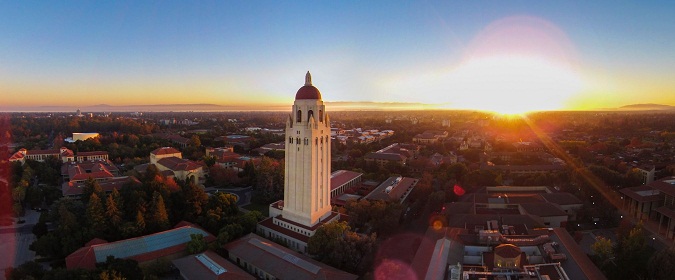
I am currently sitting in JFK airport en-route to San Francisco and drinking 4 espressos to re-align my internal clock and stay awake until a reasonable hour. So I suppose this is a good time to fill everyone in on my plans for the next year and a half. From now until the end of 2015 I will be a Visiting Scholar at the Graduate School of Education at Stanford University in California. I’ll be taking some courses while I’m here and also finish up our (RESEP’s) ‘Binding Constraints in Education’ project which we’re currently doing for the SA Presidency and the E.U. Needless to say I’m really excited to be spending time at Stanford and I do intend to blog about my experience here.

The second piece of exciting news is that I’ve been awarded the OECD’s Thomas J Alexander Fellowship for 2016. That means I’ll be working on PISA data and focussing on developing countries. The broad aim is to find meaningful ways of integrating access (enrolment) and quality (learning) in education, along the lines of my earlier work on sub-Saharan Africa. I’ll be based at the OECD headquarters in Paris from January until July next year and then back at Stanford for the last 4 months of 2016.

As much as I have loved my time in South Africa to date I am also ready to get some international perspective and work on other developing countries for a while. There are 2 main reasons for this. In order of priority: (1) I think that many developing countries are experimenting with bold and innovative reforms with long-term strategic leadership, something that is sorely lacking in South Africa where it often feels like we are simply tweaking things at the margin. I want to understand what they are doing, what’s working and how they got it going. I am especially interested in the Brazilian case. (2) It’s not a wonderful feeling when some people you are trying to help – in this case the South African educational bureaucracy – portray you as part of the problem when in fact you are trying to help. I know that parts of the Department are open to research, and I have been encouraged by two recent speeches by the Minister of Basic Education, but there is a clear hostility towards those of us in the research community that highlight to the public just how bad the situation really is. I still do not believe that the powers that be understand the true severity of the crisis in education, because if they did we would not be continuing with things in a business-as-usual way. A massive crisis like the one we have requires pretty radical solutions. (As an aside, at the VW Foundation colloquium last week I was encouraged to hear the Minister using the word ‘crisis’ on more than one occasion in her speech – let’s hope that the reforms that are implemented are commensurate with this acknowledgement). The Minister has told us (researchers) that we are on the same page and that we all agree on the problems. Now that may or may not be true, but unless the conclusion is a radical overhaul of the most dysfunctional 30% (?) of our schools, I don’t know that we are on the same page. In these schools there is next to no learning taking place at all, as evidenced by abysmal educational outcomes. Such an overhaul would be costly – financially and politically – but it would send a strong signal that we simply cannot go on in a business as usual way.

Maybe all of the above is par for the course and reform always takes a long time. Perhaps it couldn’t be any other way, I don’t know. Either way I needed a change of perspective and time to think about bigger-picture solutions in S.A., sub-Saharan Africa and the developing world more generally. I also need time and space to figure out what I want to spend my life doing and the kind of person I want to become.

To get perspective you need a break, so I won’t be commenting on all the educational issues in South Africa while I’m away.

I think that my blog may also take on a more personal note as I explore some of the broader, non-immediate issues in education, and in my own life.

Onwards and upwards…

Nic

Some links and updates before leaving :)

dissolve

Before leaving I thought It would be a good idea to do a bit of a ‘brain-dump’ on my blog to update everyone on the things that I know about in the South African education space. Some of these might be very well known but I imagine some of them are less well known. In any event I think it’ll be helpful. If you know of any other ‘useful-to-know-about’ projects please include them in the comments to this post. And just for shits and giggles I’ve included some GIFs 🙂

  • The matric pass rate will drop this year. You just need to look at the gigantic matric cohort that we have this year – in fact, if my calculations are correct it is *the* biggest matric cohort we have ever had! One can only conclude that this is because of the automatic-progression law that’s now being applied to the FET phase. There are 687,230 students enrolled in matric this year, compared to 571,819 last year. Enough said.

ear dear

  • Speaking of matric, let’s briefly touch on the perennial no-brainer that is always politicized and therefore scrapped – testing prospective matric markers. Every year the Minister says prospective matric markers will need to write a competency test prior to being appointed and every year SADTU opposes it and it’s scrapped at the last minute. This article of mine from 2013 is just as true today as it was then, unfortunately. I think this is a good litmus-test of whether the Minister or the new DG mean business. If the research shows that many teachers lack basic content knowledge of the subjects they are teaching and marking – and it definitely does – then we need to be asking why prospective markers are not required to prove they can assess accurately? (except in the Western Cape where testing prospective matric markers has been in place for many years already).

excellent question

  • We now have a new Director General of Basic Education, Mr Mweli. This position has been essentially vacant (i.e. no permanent DG) for more than a few years now. It will be very interesting to see what he chooses to prioritise in his time as DG.

hmm very interesting

  • The results of the SACMEQ 2013 (Gr6) national testing and the TIMSS-Numeracy 2014 (Gr5) study should be released soon. As an aside South Africa is seriously thinking about taking part in PISA-for-Development in 2017 which will be great – more on that in the future (I’m working at PISA next year). The SACMEQ 2013 results are very important. I am really looking forward to seeing what they show.

kittens looking

  • The for-profit sector will continue to grow rapidly in South Africa in the coming decade, largely because the majority of public schools are dysfunctional. The ‘low-fee’ sector will grow the fastest as entrepreneurs and investors see the potential for huge growth and massive returns (with or without State subsidies).

a dollar makes me holler

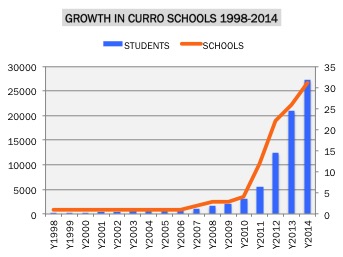
  • See my presentation to the IEB on for-profit schooling in SA here. To give you an idea about the growth of Curro students/schools, for example, see the graph below:

Curro

that escalated quickly

  • Nick Taylor, one of the education champions in South Africa, is pushing ahead with his Initial Teacher Education Research Project (ITREP) – see here. It aims to identify to what extent we are producing teachers who are better able to address the challenges of schooling. The initial results have found especially damning results for university’s existing teacher training programs. Hopefully the positive energy and attention will lead to reform. Nick is also involved in a cool (and important) project aimed at creating communities of practice for Primary numeracy and literacy researchers in South Africa. Both of which show serious promise.

excited

  • The education technology space in South Africa (and in the world generally) is booming. Billions of Rands have been allocated to technology in both Gauteng and the Western Cape. I have been meaning to write an article about this for a long time but haven’t got around to it yet unfortunately. In light of this move we would all do well to read this chapter “Computers in schools: Why governments should do their homework.” But we will go around the mountain one more time and check for ourselves. Because how do you know if it’s a dead-end until you’ve tried it?

dulp2

  • Well, maybe because everyone else tried to do exactly what we are proposing to do and it didn’t work? If you’re not teaching teachers how to use the tech (and doing it properly in a hands-on, in-classroom way), budgeting for maintenance and most importantly evaluating the project (to figure out if it’s actually working) then it’s pretty much doomed to fail. As they say in the chapter above “The evidence so far is quite persuasive that programs that overlook teacher training and the development of software may yield low returns” (p169). Importantly we should be asking where these budgets are coming from. Is it wise to be spending billions in untested, unevaluated technology when we still have 500,000 disabled students out of school? (see my presentation to SANASE AGM here).  I’m all for using tech in meaningful ways but this isn’t that, this is basically “Let them eat iPads.” (also see this NYT article, “Can you have too much tech?“).

got any other bad ideas (stark)

  • On a positive note there is a really important Randomised Controlled Trial (RCT) currently underway in the North West, Kudos to the DBEStephen Taylor, Brahm Fleisch, Nompumelelo Moholwane and their team for initiating this one. See here for a write-up about it. It’s basically trying to find the best way of teaching reading in the early grades, testing alternatives against each other to find the one with the biggest impact and the most-effective alternative. For those not familiar with the RCT methodology, read this document written for the UK Parliament. I am really looking forward to the results from this study. They have important ramifications for how we ‘teach’ early grade reading in South Africa.

prism

And then some of my ‘usual’ links:

  • Presentations from our Quantitative Research in Education conference. Many of these papers have been developed into full articles and will be available in a special issue of the SAJCE –Priorities and Policy-making in South African Education – which should be out later this year. In the mean time I would strongly recommend going through Gabrielle Wills’ presentation on the principal labour-market in South Africa. She estimates that due to the ageing profile of principals that there will be 7000 principal replacements between 2012 and 2017 in South Africa. That’s enormous.

idea explosion

hell to the no

  • The Auditor General of South Africa has released their special report on the Education Sector in South Africa – see here.
  • One school in California has decided to ban grade-based promotion and has moved to a performance/competence criteria for promotion. Interesting, innovative, forward-thinking. More of this please…
  • The New York Public Library has put 20,000 high-res images of maps online and makes them free to download (via Kelsey).
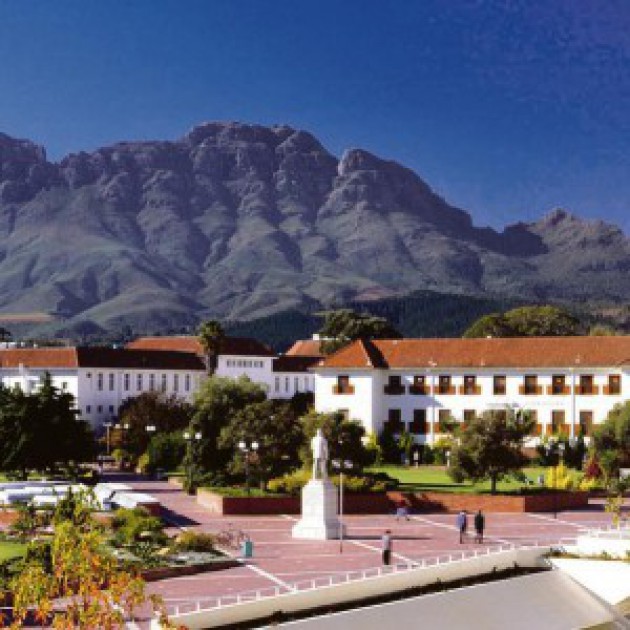
  • Before deciding on your opinion about racism (or the lack thereof) at Stellenbosch University (or the Open Stellenbosch movement) watch this 30-minute documentary about the experiences of 32 black students at the University. My thoughts on this: (1) The current pace of transformation is too slow, (2) the current culture at the University is experienced as exclusionary by Black students, (3) While not its explicit aim, the current language policy at SU has the effect of excluding many Black students from quality higher education (in a country where such quality higher education is rare), (4) these issues will not go away until deep, meaningful and sustained reforms (which will be difficult) are implemented at the University, (5) disciplinary hearings and expulsions for protesting students is *totally* the wrong approach to deal with this (one wonders who is advising those in management?!). Watch the documentary for yourself and let me know what you think…

stellenbosch graduation photo

Some presentations I’ve given in the last 2 months:

That’s all for now.


Im outta here

Start where you are, with what you have…

goal

This is perhaps the most important document to come out of the Department of Basic Education in a long time; Action Plan to 2019: Towards the Realisation of Schooling 2030. Although we are regularly faced with much depressing information on the state of education in South Africa, reports like this give me hope that there are some excellent people working in the department, thinking strategically and working within the existing constraints. It is not delusional, the goals are (mostly) realistic, and it charts a clear path to get to where we want to go from where we are.

Education people far and wide – read this, quote it, refer to it and hold the Department to these plans!

Reading to some purpose

baloon rock

  • Important This American Life podcast on accidental school desegregation in Missouri in 2013 (via Doron Isaacs). Such a relevant conversation for South Africa where the distinction between functional and dysfunctional schools is so stark. We really need to be doing more research on understanding the formal (and informal) ways that fee-charging schools manage to exclude students that cannot pay. While I am sympathetic to passionate principals who are concerned about funds needed to run the school, I am even more sympathetic to parents of poor children who want a good education for their children but simply have no options.
  • The School of Life asks “What’s Education For?” and provides quite a compelling answer which highlights the current deficiencies in our education system (globally).
  • Inside The Secret World of Russia’s Cold War Mapmakers – very cool WIRED article.
  • 2014 USAID “Mobiles For Reading:A Landscape Research Review” via Garth Spencer Smith
  • In 1989 Susan Sontag gave a guest lecture at Michigan State University about ‘illness as metaphor’ where she discusses cancer and AIDS with insight and eloquence. Worth listening to.
  • Brilliant Comedy Central skit showing what it would be like if we treated our best teachers like our best football players
  • Informative New Yorker article on Jeb Bush’s influence on education – specifically testing and the proliferation of charter schools (including for-profit charter schools) during his time as Governor of Florida. Remember that he is probably going to be the Republican presidential candidate for the upcoming U.S. elections.

My opening remarks at the OR Tambo Debate and an afterword…

comb

On the 7th of July the Wits School of Governance together with the OR Tambo Foundation and the UNDP hosted the 4th debate in their series. The title was “Implementing the NDP: Achieving Basic Education Goals”, focussing specifically on accountability. I was on the panel, together with Sizwe Nxasana, the Minister of Basic Education Angie Motshekga and Siphiwe Mthiyane. Melissa King and Barbara Dale-Jones wrote an overview of the event for the M&G and you can read that here. I include my opening remarks and one or two comments below.

“Let me start by saying that I have immense admiration and respect for Minister Motshekga. I don’t think there is a single person in this room that is so naïve as to think that your job is easy or uncomplicated. Or that the solutions are straight-forward. In the face of an ongoing crisis in education you have worked systematically and consistently to improve the system by getting the basics in place. And indeed there have been some improvements and signs of success that we should acknowledge and to some extent also celebrate.

Let me highlight the 4 most impressive achievements as I see them.

  • Firstly, we now have a solid well thought-out curriculum that has widespread buy-in from all stakeholders- CAPS. We should not change the curriculum.
  • Secondly, everyday 9 million children receive at least one free school meal and this is paid for the by the State.
  • Thirdly, each child from grades 1 to 9 receives 4 high-quality workbooks per year – 2 for maths and 2 for language. These structure the curriculum by week and provide lessons for teachers to teach.
  • Lastly, we now have national tests – the ANAs – that test children in grades 1-9 in mathematics and languages. With the exception of the census this is the largest single data collection exercise undertaken by government of South Africa. It is colossal

In light of these achievements it is prudent to ask why it is that myself and others continually use the word “crisis” or more accurately an “an on-going crisis” when we refer to our education system. It is not because we are ignorant of these achievements or that we do not appreciate their scale and scope, we do. Rather we use this term because it is the only one that reflects the gravity and severity of the picture we find when we look at the nationally representative datasets in education. Let me give you some examples:

  • At the end of Grade 4 more than half of our students cannot read for meaning and interpretation and a third are completely illiterate in any language.
  • 61% of our grade 9 students did not know that three fifths was equal to 0.6.
  • 76% were not minimally competent in maths or science in grade 9 – that do not know about whole numbers or basic graphs. They are 3-4 years behind the curriculum.
  • Or if we look at the matric pass rate – that much touted, publically celebrated statistic that is also deeply flawed as a barometer of the system, last year that figure was a respectable 76%. But if we look at 100 students that started school in 2003, only 49 actually made it to matric in 2014, only 37 passed and only 14 qualified to go to university. So the ‘real’ matric pass rate is 37% not 76%.
  • And while 14% qualify to go to university, only 10% will actually go to university and only 5% will get a degree. So of 100 kids that start school, only 5 will get a degree. 60 will get absolutely nothing – not a matric pass, not a certificate, not a degree. Nothing!
  • In one study comparing the North West and Botswana, at the end of the year our maths teachers had taught only 40% of the maths lessons they were scheduled to teach, compared to 60% in Botswana.
  • According to an education report by OECD released this year SA ranked 75/76

Still in 2015 – 20 years after democracy the reality is that most Black children in South Africa continue to receive an education which condemns them to the underclass of South African society, where poverty and unemployment are the norm, not the exception. Where 10 million people live on less than R10 a day. This substandard education does not develop their capabilities or expand their economic opportunities, but instead denies them dignified employment and undermines their own sense of self-worth and agency. In short, poor school performance in South Africa reinforces social inequality and leads to a situation where children inherit the social station of their parents, irrespective of their motivation or ability. Low quality education becomes a poverty trap that is virtually inescapable. This is the antithesis of social mobility. It is unacceptable. It is morally despicable. It is also unsustainable.

So how does all of this relate to accountability and this debate? I would argue that almost all of these problems relate to 2 issues: a lack of accountability, a lack of capacity. Too many people cannot do their jobs and have not received meaningful support and training. For too many people – teachers and bureaucrats alike – there are no consequences for non-performance.

Accountability is not, (or should not be) a vague concept. Accountability is another word for consequences. When there are no consequences for non-performance there is no accountability. It isn’t complicated. Currently there are no consequences for non-performance. Not for teachers, not for principals, not for district officials, not for union leaders, not for bureaucrats, not for DDGs. No one. I must add a caveat that I do not believe you can hold people – especially teachers – accountable for things they cannot do. Capacity precedes accountability. This is why we have to offer our teachers meaningful learning opportunities (which we absolutely have not done) before we can hold them accountable for performance. Absenteeism, misconduct etc. by all means, but if a teacher in rural Limpopo cannot do fractions because she was given inadequate training under apartheid and token in-service teacher training post-apartheid, we cannot speak about accountability for her until she has been given a meaningful learning opportunity. Then we can talk about accountability and board exams and all that but only then.

I believe that the major cause of both of these problems is (1) the politicisation of the civil service and the practice of cadre deployment among bureaucrats and teachers, (2) the networks of patronage that permeate our system, (3) The unhealthy relationship between parts of SADTU and the Department of Basic Education – nationally and provincially, particularly in the Eastern Cape.

This all works to the detriment of quality education for the poor. Minister I honestly believe you have done a lot to improve our education system and you are the best education Minister we have had so far, but two areas where you have not succeeded are ending cadre deployment and developing a comprehensive plan for meaningful teacher development.”

[End of opening remarks]

In what was meant to be ‘closing remarks’ for the debate, the Deputy Minister of Education Mr Enver Surty, attempted to discredit most of what I was saying by arguing, at length, that all of this data I was using was “outdated” and on the contrary that “We have a good story to tell.” For those of us who are specialists in using education data, who are professional researchers adept at  using cross-national education data, who work with it daily and present on it at local and international conferences, this rebuke came as somewhat of a surprise. To set the record straight it is worth emphasising four points: (1) education systems do not change rapidly in the space of 2 or 3 years, see chapter 4 of this paper (2) The TIMSS and PIRLS studies were done in 2011 but the report and data were only ready and released in 2013, 2 years ago. (3) The ANAs are not substitutes for these rigorous inter-temporal comparisons – see here, here, and here. (4) Apart from a 1.5 grade-level improvement in the TIMSS 2002–>2011 maths and science improvement there is no other evidence that the educational outcomes in South Africa have improved. I do not have any reason to distrust the TIMSS improvement, but it’s important to remember just how low the post-improvement level of performance really is and that starting from an exceptionally low base this is not that unexpected at all. I am more than happy to expound any of these points in detail and at length if they are still unclear. This is what I do.

Although it was unfortunate not to have a right-of-reply after the Deputy Minister’s misinformed ad-hominem attacks, I am not particularly concerned because the data and consequent research base speaks for itself. It is clear, unambiguous and well documented. I maintain that we have an ongoing crisis in education and that poor children continue to be condemned to hereditary poverty as a direct result of the low quality education they receive at school. Poor quality education was and is a poverty trap. This should be our biggest source of national shame.

Who watches the watchmen? SADTU, SACE and the insidiousness of corruption

watchmen

In the first or second century AD the Roman satirist Juvenal asked “Quis custodiet ipsos custodes?” which translates to “Who will watch the watchmen?” or “Who will guard the guards?” – a pithy quote about where ultimate power does or should reside, and highlighting that all are corruptible. The latest manifestation of this seems to be with the South African Council of Educators (SACE). On their website they explain that “SACE is the professional council for educators, that aims to enhance the status of the teaching profession through appropriate registration, management of professional development and inculcation of a code of ethics for all educators.” Unfortunately this is, at best, an aspirational Facebook status.

My first encounter with SACE was during a Section 5 Committee meeting of the SA Human Rights Commission (I am on the advisory committee for education). As part of an investigation into corporal punishment at schools we requested that officials from both the Department of Basic Education (DBE) and SACE attend the meeting and answer our questions. In that investigation there were numerous instances of corporal punishment, I have even heard of one instance of a 9 year old girl that was “disciplined” by the principal and ended up dying in hospital a little while later. As part the same investigation there were numerous stories emerging about some teachers and principals sexually assaulting their students. This was especially offensive to me and became the issue I asked the DBE and SACE about when they were at the meeting. As it turns out, if a teacher is dismissed for sexually assaulting a student – which is very rare (being dismissed that is) – they should be struck from the SACE roll so that they cannot get another teaching job in South Africa. Unfortunately this is just how it works in theory, not in practice. In practice what usually happens is that the provincial education department (who is the employer) dismisses the teacher and will not rehire them at another school in the province. However, during the investigation – and after many explicit questions – it emerged that the provincial education departments do not share a common database of registered or disbarred teachers, either with each other, or with SACE (whose database systems are totally shambolic). So there is nothing stopping this dismissed teacher leaving the province where they sexually assaulted a student and moving to another province where they can be employed as a teacher. There are no electronic records that are available to either the receiving province or the receiving principal. I distinctly remember the awkward shuffling and sheepish looks when I asked the DBE official: “Please can you be explicit and tell us if there are any functional systems currently in place that prevent a teacher who has been dismissed for sexual misconduct from being rehired by another school in another province?” To which the answer was “Our databases are not currently linked so that is theoretically possible, yes.” Which obviously shocked everyone at the Section 5 Committee meeting.

That was the first sign to me that SACE is a totally dysfunctional institution that is all form and very little function. The most recent, and even more disturbing revelation is that it seems that this institution has been captured by the major teacher union SADTU. Sipho Masondo reported in the City Press last week that in October last year the DBE and SACE launched separate investigations into the allegations that SADTU officials were selling teaching and administrative positions (see here for the detailed and damning expose). The DBE’s investigation, headed by a friend of mine Prof John Volmink, is yet to be finalized and released. However, Sipho’s article reports that  “a source within the SACE, who spoke on condition of anonymity, told City Press that Sadtu’s executives approached the council’s chief operating officer, Tsedi Dipholo, and asked her to drop the investigation after the names of the union’s leaders in branches, regions and provinces started cropping up.” – something that she readily complied with. Promptly after this the investigation was wrapped up, has never been released and found no wrong-doing whatsoever. SACE CEO Rej Brijraj explains that “We spent four months investigating. There was a very strong rumour that persisted, but we couldn’t find a single bit of evidence. The rumours were strong, but no evidence or witnesses were brought forward for us to prosecute. We were given leads, but they yielded nothing and we had to stop.

Both of these instances, depicting incompetence and corruption respectively, deserve our serious attention. SACE is the body that is supposed to be regulating the profession and preventing disrepute and degradation, yet it is the very organization that is complicit in this degradation.

We need to ask: Who will watch the watchmen? Who will regulate the regulators? The Minister of Basic Education Angie Motshekga should request a Ministerial Task Team to look into the functionality of SACE and whether it actually can or does accomplish what it is mandated to do. But, and this is crucial, it is not good enough to simply order a task team, you actually have to do something with the results. When and if the Volmink report is actually released the biggest question I have is “So what?” What happens to the findings and recommendations? Probably the same thing that happened with the Limpopo textbook enquiry – a little more investigation here, a little staff shuffling over there, but essentially no consequences. This is perhaps one of the biggest issues facing our education system – the lack of accountability – i.e. the lack of consequences – in our education system. The process of writing this blog post has given me sufficient energy to edit some of my opening remarks for the OR Tambo Debate which I will publish as a blog post now…

In all of this we need to remember who is most affected by this widespread ineptitude and corruption in the education system. It is the poor, mostly Black African, children of South Africa that are condemned to lives of poverty and unemployment, no different to their parents and care-givers. That is the real tragedy here.

“Early action key to improving maths” – my Business Day article

Teacher+January+28+2014

(The article below appeared in the Business Day on the 6th of July 2015.)

Early action key to improving maths” – Dr Nic Spaull

When people speak about the economic importance of maths and science my mind does not immediately jump to technological innovations such as Google, Tesla or SpaceX — all of which are impossible without the mathematical and scientific insight of their founders and engineers.

I am instead reminded of a tenacious African woman, who my good friend and colleague, Prof Veronica McKay, told me about a few years ago. McKay was assigned the mammoth task of developing a government adult education programme (Kha Ri Gude) for those excluded from education under apartheid, especially the illiterate and innumerate among them.

Asked why she had attended the six-month course, one of the participants replied: “Because I wanted to know how to count. I wanted to know when I have enough money to buy things at the shop. Before, I just had to hold out my hand with my money and the man at the shop would take the money and give me back the change. I don’t think he was giving me the right change, but now I can tell.”

SA aspires to much more than basic financial literacy, and the lofty curriculum and policy documents are testament to this.

There are many improvements in education for which the government does not get enough credit. It has implemented a good curriculum, rolled out workbooks and textbooks to almost all students, and launched annual national assessments that will one day provide the kind of useful information we need.

It also provides school meals to more than 8-million pupils every single day. This is no small feat.

Unfortunately, the major failure has been in meaningful teacher development where little has been done. This helps explain the current reality where the vast majority of pupils still do not acquire even minimal competencies in maths and science during their school years.

The most recent reliable international assessment, the Trends in International Maths and Science Study (TIMSS), tested our Grade 9 students on the international Grade 8 test.

To those outside of academia, it is difficult to convey how abysmally low SA’s average TIMSS maths (352) and science (332) scores really are.

They mean that three-quarters (76%) of Grade 9 pupils in 2011 still had not acquired a basic understanding of whole numbers, decimals, operations or basic graphs and could not recognise basic facts from the life and physical sciences.

Here are some example questions from the test to help illustrate the problem:

  • “Kim is packing eggs into boxes. Each box holds six eggs. She has 94 eggs. What is the smallest number of boxes she needs to pack all the eggs?”

Only 12% of South African Grade 9 students could answer this. The results are poor even in the best-performing province, the Western Cape, which scored 20% on this question, and in the wealthiest 20% of schools where 33% could answer it correctly.

  • “The fractions 4/14 and q/21 are equivalent. What is the value of q?” Only 33% of our Grade 9 students can answer this correctly.
  • Only 61% of Grade 9 students knew that 3/5 is equal to 0.6. This was the easiest question in the test and is covered in the Grade 6 curriculum.

Research that I and others have conducted shows that about 80% of our Grade 9 pupils are achieving at a Grade 5 level in mathematics and that the backlog starts in Grades 1 to 3.

My best reading of the research base in mathematics in SA leads me to conclude that it is ludicrous to focus our efforts on interventions in Grades 9 to 12, when it is clear these learning deficits are already present in Grade 3 — where less than one third of students can calculate a Grade 3-level problem such as “270 + 28 = __”.

Half of Grade 5 students cannot calculate “24 ÷ 3 = ___”.

It is near impossible to remediate four years of backlogs in one or two years. We need to focus on improving the quality of teaching and teacher training in primary schools. The later in life we try to repair early deficits, the costlier the remediation becomes.

//

Reading to some purpose…

blue

As part of one my research projects we are now focussing on reading in the Foundation Phase (Grades 1-3) and developing a course to train Foundation Phase teachers how to teach reading, because, as it turns out, most Foundation Phase teachers don’t actually know how to teach reading (in an African language or in English). We’re getting the best literacy experts in the country on it and developing a world class video-based, year-long, part-time course showing practically what the various building blocks of reading are, why they’re important, how to teach them, and when. It’s still in the concept note phase – and you’ll hear more about it in the next 3 months – but for now here are some great articles and books about reading:

“The Road to Self Renewal”

sketch

Every so often I come across an essay that totally changes the way I think about life or what I’m doing. It’s like a mental palate cleanser 🙂 The previous one was this one.  And today I read another: “The Road to Self Renewal.” Some excerpts I loved…

“The things you learn in maturity aren’t simple things such as acquiring information and skills. You learn not to engage in self-destructive behavior. You learn not to burn up energy in anxiety. You discover how to manage your tensions. You learn that self-pity and resentment are among the most toxic of drugs. You find that the world loves talent but pays off on character. You come to understand that most people are neither for you nor against you; they are thinking about themselves. You learn that no matter how hard you try to please, some people in this world are not going to love you, a lesson that is at first troubling and then really quite relaxing. Those are things that are hard to learn early in life. As a rule you have to have picked up some mileage and some dents in your fenders before you understand. As writer Norman Douglas said, “There are some things you can’t learn from others. You have to pass through the fire.” You come to terms with yourself. You finally grasp what playwright S.N. Behrman meant when he said, “At the end of every road you meet yourself.

Life is an endless unfolding and, if we wish it to be, an endless process of self discovery, an endless and unpredictable dialogue between our own potentialities and the life situations in which we find ourselves. By potentialities I mean not just success as the world measures success, but the full range of one’s capacities for learning, sensing, wondering, understanding, loving and aspiring.
For many, this life is a vale of tears; for no one is it free of pain. But we are so designed that we can cope with it if we can live in some context of a coherent community and traditionally prescribed patterns of culture. Today you can’t count on any such heritage. You have to build meaning into your life, and you build it through your commitments, whether to your religion, to an ethical order as you conceive it, to your life’s work, to loved ones, to your fellow humans. Young people run around searching for identity, but it isn’t handed out free anymore – not in this transient, rootless, pluralistic society. Your identity is what you’ve committed yourself to.
I hope it’s clear that the door of opportunity doesn’t really close as long as you’re reasonably healthy. And I don’t just mean opportunity for high status but opportunity to grow and enrich your life in every dimension.
Meaning is not something you stumble across, like the answer to a riddle or the prize in a treasure hunt. Meaning is something you build into your life. You build it out of your own past, out of your affections and loyalties, out of the experience of humankind as it is passed on to you, out of your own talent and understanding, out of the things you believe in, out of the things and people you love, out of the values for which you are willing to sacrifice something. The ingredients are there. You are the only one who can put them together into that unique pattern that will be your life. Let it be a life that has dignity and meaning for you. If it does, then the particular balance of success or failure is of less account. 

Meaning is not something you stumble across, like the answer to a riddle or the prize in a treasure hunt. Meaning is something you build into your life. You build it out of your own past, out of your affections and loyalties, out of the experience of humankind as it is passed on to you, out of your own talent and understanding, out of the things you believe in, out of the things and people you love, out of the values for which you are willing to sacrifice something. The ingredients are there. You are the only one who can put them together into that unique pattern that will be your life. Let it be a life that has dignity and meaning for you. If it does, then the particular balance of success or failure is of less account.

What a gem! Full essay here.

Links I liked…

umalusi

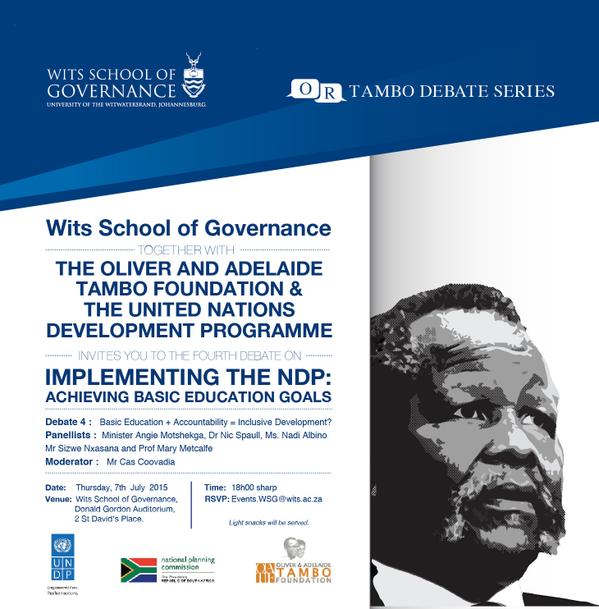
  • On the 7th of July I will be part of a debate with the Minister of Basic Education, Angie Motshekga as well as Prof Mary Metcalfe, Sizwe Nxasana and Nadi Albino. If you’re around join us – it should be an interesting debate 🙂 (to RSVP see the invite above).
  • For those of you who will be in and around JHB on 22 June (9am-1pm) come and join us for a conversation about the Annual National Assessments (invite here). I’ll be speaking together with Martin Gustafsson and Caroline Long.
  • Interesting article: “Brahm Fleisch on building a new infrastructure for learning in Gauteng
  • Applications for teacher intern bursaries are due on the 3rd of July 2015 (see here).  Only students studying through UNISA are eligible and the focus is on Maths and English. I really like the internship model of teacher training (i.e. being under a master teacher) and am keen to see this program expand.
  • Beyond benchmarks: What 20 years of TIMSS data tell us about South African education” (Reddy, Zuze et al, 2015)
  • Comprehensive Special Report on Early Literacy by EduWeek (2015) – (Thanks Kim Draper)
  • Someone dies from a shack fire every 2 days. A friend of mine, Frank Petousis, is involved with a social startup called Lumkani which builds small cheap devices which can detect shack fires and alert residents (and neighbors). I’ve donated to their Indiegogo drive to raise $50,000 to cover 3000 shacks. Go check it out!
  • On the 22nd of May 2015 Ireland took to a referendum the issue of gay marriage in the country (watch this video). Citizens voted overwhelmingly in favor of granting equal status to gay people to get married (62% voted yes).
  • 100 things to do in Cape Town during winter

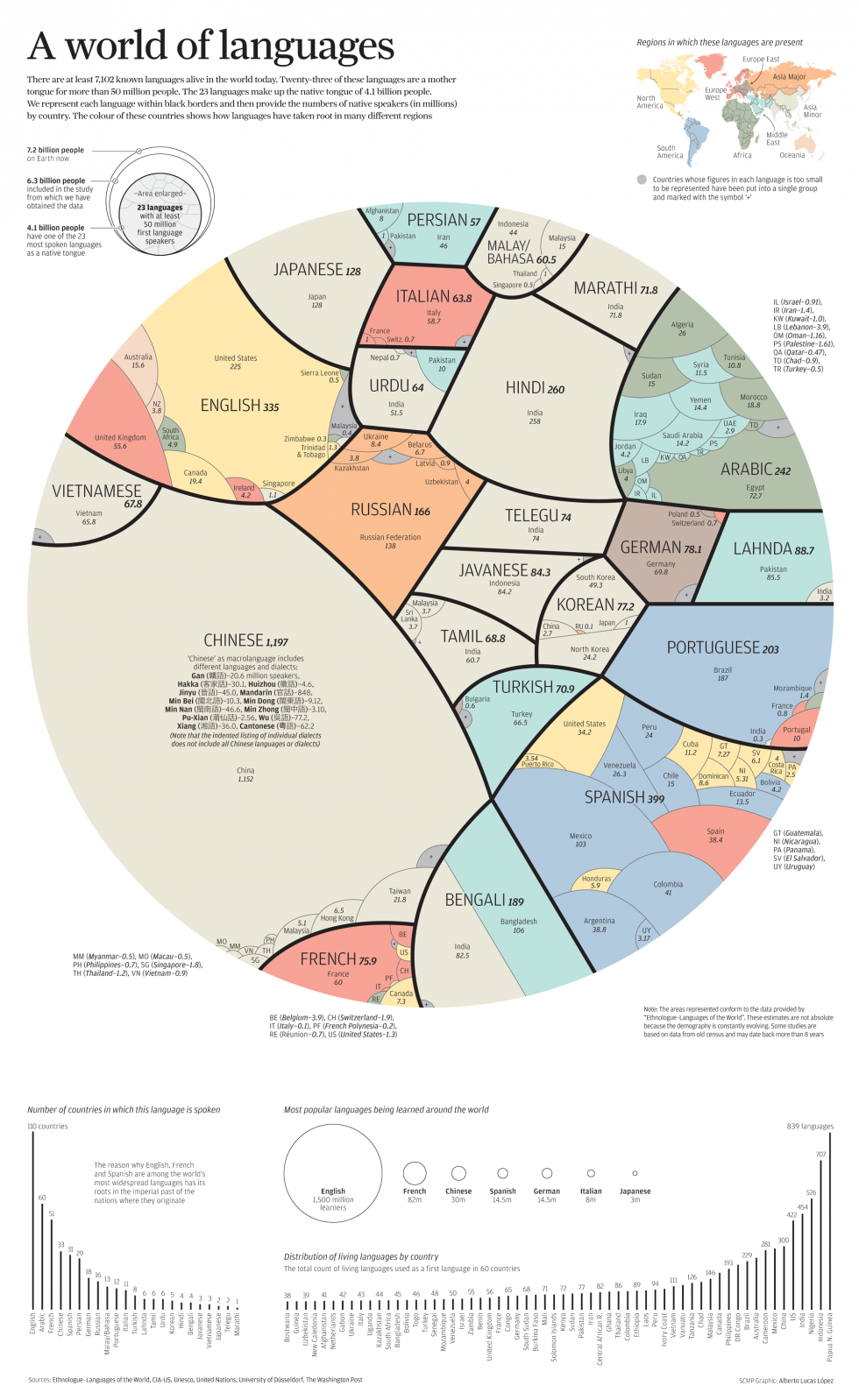
A world of languages – and how many speak them (infographic)

languages of the world

From here- http://sociologicalimagination.org/archives/17711

Reading to some purpose…

birds

“In an influential 1937 essay called “The Nature of the Firm,” the economist Ronald Coase argued that a firm would grow as long as its internal transaction costs were less than the external costs it would otherwise incur. But in the Bay Area today, Ravikant suggested, the external transaction costs for many things have got so low that there are fewer such economies.

 “For example, in the old days, we’d get breakfast and lunch brought in every day so that the engineers can work and be productive,” he said. “I might have had my office manager do that—essentially, I’ve hired someone who’s spending time doing it. Now we have a zillion different little services who bring that in-house.” The more assured Ravikant got, the faster he spoke; he started rattling off the options available. On the transportation front, “we have our Lyft and our Sidecar and our UberX and our InstantCab and our Flywheel. Two years ago, I couldn’t find a cab in this city to save my life. Now I’ve sold most of my cars and I have five different car services at my beck and call.”

The same systems that make outsourcing of small tasks more efficient have driven down the cost of launching a company. Once, an entrepreneur would go to a venture capitalist for an initial five-million-dollar funding round—money that was necessary for hardware costs, software costs, marketing, distribution, customer service, sales, and so on. Now there are online alternatives. “In 2005, the whole thing exploded,” Ravikant told me. “Hardware? No, now you just put it on Amazon or Rackspace. Software? It’s all open-source. Distribution? It’s the App Store, it’s Facebook. Customer service? It’s Twitter—just respond to your best customers on Twitter and Get Satisfaction. Sales and marketing? It’s Google AdWords, AdSense. So the cost to build and launch a product went from five million”—his marker skidded across the whiteboard—“to one million”—more arrows—“to five hundred thousand”—he made a circle—“and it’s now to fifty thousand.” As a result, the number of companies skyrocketed, and so did the number of angels: suddenly, you didn’t need to be a venture-capital firm to afford early equity.”


The youth, the upward dreams, the emphasis on life style over other status markers, the disdain for industrial hierarchy, the social benefits of good deeds and warm thoughts—only proper nouns distinguish this description from a portrait of the startup culture in the Bay Area today. It is startling to realize that urban tech life is the closest heir to the spirit of the sixties, and its creative efflorescence, that the country has so far produced.

..
Public-minded kids in San Francisco seem to have that expectation, which is partly why the startup market has had such growth, and why smart people from around the country keep flying in to try their hands at the game. The result is a rising metropolitan generation that is creative, thoughtful, culturally charismatic, swollen with youthful generosity and dreams—and fundamentally invested in the sovereignty of private enterprise.

  • Re-read Keynes’ old quote and was reminded about the power of ideas: “Practical men, who believe themselves to be quite exempt from any intellectual influence, are usually the slaves of some defunct economist”

“SADTU selling principals’ posts in exchange for cows, sheep and goats” (CityPress article)

I don’t usually repost articles on education but if these allegations are true – and Prof John Volmink’s report should identify if they are – then we really need decisive action from Motshekga or Zuma or someone who actually has power. This is a deal-breaker. You cannot have SADTU running provinces and calling the shots while children suffer as a result.

Corruption-Arrow-Sign1-630x286

“Pretoria – Rogue members of teachers’ union Sadtu have “captured” a key provincial education department, which officials in Basic Education Minister Angie Motshekga’s office say is now on the “verge of collapse”.

Investigators appointed by Motshekga to probe the jobs-for-cash racket run by union officials, which City Press exposed last year, have found that Sadtu members have “infiltrated that department and run a complex patronage system” in KwaZulu-Natal.

An investigation commissioned by Motshekga’s office and headed by Professor John Volmink has found that not only is education in KwaZulu-Natal being run by rogue union members, but Sadtu members have been found to have violated the system in the provincial education departments of Gauteng, North West, the Eastern Cape, Mpumalanga and Limpopo.

On Monday, Motshekga met KwaZulu-Natal education MEC Peggy Nkonyeni and senior officials in her department at OR Tambo International Airport to discuss the crisis.

A senior department official said the provincial department had “collapsed; there is no leadership”.

What investigators found

Other allegations Volmink’s team of 10 investigators uncovered around the country include:

. Evidence that a number of senior Sadtu members in the Eastern Cape have received cows, sheep and goats as payment for several principals’ positions throughout the province;

. That an applicant for a principal post at a Gauteng school approached his district director and showed him an SMS which proved Sadtu officials tried to extort R25 000 out of him in return for the job; and

. A Sadtu official in Limpopo’s Mopani district committed suicide after failing to secure two principal posts for teachers who had paid him R25 000 each. He killed himself after they demanded their money back.

In KwaZulu-Natal they found:

. Sadtu officials demanding that union members be appointed to 37 chief education specialist posts. Union officials insisted the department reduce the educational requirements for the posts from degrees to teaching diplomas;

. Sadtu officials have earmarked candidates to fill 15 senior managerial positions in the Ugu district in Port Shepstone;

. A Sadtu leader who is a junior teacher in the Ethekwini North region became the principal of a large school with two deputy principals in the Ilembe district after falsifying a letter of appointment;

. A senior Sadtu official in Ethekwini North illegally swapped positions with a principal of a large school in Ilembe. The “gentlemen’s deal” was struck because principals of large schools earn much more than those who run smaller schools; and

. Evidence that a school governing body member of a Pinetown school acted with Sadtu members to extort R30 000 from a teacher who had applied for the job of principal.

KZN on the verge of collapse

On Thursday, officials from the basic education department’s legal department were sent to Durban to meet senior provincial officials. Senior department sources with knowledge of the meeting said the lawyers “read the riot act to their provincial counterparts asking them to rein in Sadtu”.

Another official said: “They were very harsh on them, asking why they had not acted on Sadtu’s anarchy over the past two weeks.”

Over the past two weeks, pupils at 440 schools in the Ilembe region on the north coast and 485 schools in Ugu region on the south coast have received little teaching after regional union leaders ordered teachers to protest at district offices.

The teachers, who play loud music and disrupt work at the offices, aim to get rid of the directors.

The protest is set to intensify this week in the Ilembe region, where an unsigned notice from the office of the secretary of Sadtu’s Ethekwini North region – which was sent to members on Friday – states that all members should conduct sit-ins at district offices on Monday and shut down schools completely on Tuesday.

Three sources in the department told City Press that Ilembe district director Thembinkosi Vilakazi was visited by three Sadtu leaders from the Ethekwini North region in August last year. They demanded that she appoint them as chief education specialists in her three circuit offices in Stanger, Ndwedwe and KwaMaphumulo.

“They asked to talk to her and told her she was a comrade and should co-operate with them. They said they were prepared to support her and defend her from her enemies, but only if she gave them the positions. She told them things didn’t work like that and she couldn’t fix positions. She told them the fixing of positions was illegal and was corruption.”

He said the three told Vilakazi that if she did not agree to the deal, they would make her stay at the district miserable.

Vilakazi refused to comment.

Another senior KwaZulu-Natal official said that, while Sadtu had claimed Ugu district director Mfundo Sibiya was unfit to lead, what was at issue were the 15 senior positions advertised in the district.

“The department has endorsed interviewing panels given by Sadtu. Where have you ever seen that? Sadtu asked him to change certain people in the interviewing panels, but he refused,” said the official.

“One of the people they want, a Sadtu leader, is not even shortlisted.” Sibiya refused to comment.

Sadtu denies claims

Sadtu’s provincial secretary, Dolly Caluza, said the protests at Ilembe and Ugu had nothing to do with positions.

“There are issues our leaders are raising with the department and some of them date back to 2011. We are protesting about norms and standards and the allocation of teachers. Teachers are overworked and there is animosity because teachers are overworked,” she said.

Caluza accused Vilakazi of failing to attend meetings to resolve labour issues. She denied the protests were about positions.

Sadtu’s national secretary, Mugwena Maluleke, said anyone with evidence of corruption should approach Volmink’s team with evidence.

“One district director in KwaZulu-Natal made allegations – we asked him to submit evidence and he still hasn’t. If they don’t, it will appear that they want to run away from their responsibilities, and use Sadtu’s name to do that. People should be exposed if they are corrupt,” said Maluleke.

Directors fight back

Eight of KwaZulu-Natal’s 12 district directors met in Pietermaritzburg last week and agreed to approach Nkonyeni and Premier Senzo Mchunu to protect them from being intimidated by Sadtu members and the union’s grip on the department.

Sources close to the meeting told City Press that if Nkonyeni and Mchunu did not respond, the directors would appeal to Motshekga and President Jacob Zuma.

One director, who spoke on condition of anonymity, said: “Sadtu is running the department. We have resolved to take the fight to Sadtu. We want support from the premier and the MEC. We need support from the department of education; they must use their power to support us.

“Sadtu doesn’t give a f*** about our children’s education. Education is under siege; it is in the hands of syndicates. The ANC has to pronounce on this; we have reached the crossroads.”

Trouble brews over big jobs

Motshekga’s team’s visit comes as trouble brews over 37 chief education specialist posts.

Three senior officials close to the matter told City Press several provincial Sadtu leaders had publicly stated in meetings they had already allocated the positions to some of their members.

A senior official, who did not want to be named, said: “Sadtu wants the positions, saying they met with head of department Nkosinathi Sishi and persuaded him to advertise the positions.

“They said they would decide who was appointed. They have a list across the province.”

Three senior officials told City Press that when the positions were advertised in August last year, the prerequisite for candidates was a university degree.

But because most of Sadtu’s favoured candidates did not have degrees, the advertisement was withdrawn and the requirements were amended to a diploma.

The posts were re-advertised in March. Caluza denied the union had objected to district directors chairing interviewing panels of the 37 chief education specialist positions.

“We have not objected to directors chairing interviewing panels. We don’t decide who chairs panels, we only observe. Our role is to observe.”

KwaZulu-Natal education department spokesperson Muzi Mahlambi said the department was concerned about the disruption of classes at Ilembe and Ugu.

“We are engaging the leadership of Sadtu. We have already held three meetings with them. The engagements are so that the right of the child to learn can be protected. We have issued a circular that empowers principals to deal with teachers who are not at school.”

He said the province was confident that things would improve this week.”

//

From here.

Reading to some purpose

nasa 2

Open Stellenbosch: “Tackling language and exclusion at Stellenbosch University”

(The article below was written by the Open Stellenbosch collective and published in the City Press this Sunday the 26th of April 2015, and is also available on Daily Maverick). I’ve written about this topic myself and feel quite strongly that not enough is being done to diversify the staff and student bodies at Stellenbosch and particularly in changing the culture at the University, hence posting the article here.

“Tackling language and exclusion at Stellenbosch University”

– Open Stellenbosch

STELLENBOSCH-UNIVERSITY1-300x300-66aipc3bdj8dgyqq57lp7vrj5eq7lrofhxun14n3i42

“Many in South Africa are aware of the RhodesMustFall movement at UCT, and the problems of institutional racism it has highlighted. These problems are deeply entrenched at Stellenbosch University, where Open Stellenbosch was created to challenge the hegemony of white Afrikaans culture and the exclusion of black students and staff. Open Stellenbosch is a movement of predominantly black students and staff at the University who refuse to accept the current pace of transformation.

In 2013, only 3.5% of all professors at the University were black, while 86% were white. In fact, there are more professors named ‘Johan’ than there are black professors at our institution. Is this really what transformation looks like 20 years after Apartheid?

The fact that we as black students on campus have to take matters into our own hands to change the oppressive institutional culture at Stellenbosch is an indictment of the University management. We do not believe that those in the SRC, the Senate or the Council understand the weight of normalised oppression that we experience at this overtly white University.

Although our institution claims that “continuous transformation is part of the core being of the University”, this could not be further from our everyday reality at Stellenbosch. We are tired of empty promises and goals that are perpetually postponed. We have been having these conversations for over a decade now, and it is clear that the management at Stellenbosch has been operating in bad faith. Many promises, little action. There was the “Strategic Framework” of 1999, the “Vision 2012” document of 2000, the “Transformation Strategy” of 2008, the “Overarching Strategic Plan” of 2009, the “Quality Development Plan”, the “Employment Equity Plan”, the “Diversity Framework”, and so it goes on. These have all failed because of a wholesale lack of political will to implement them – both then and now.

Although there are many things that need to change at Stellenbosch University, as a matter of urgency we are calling for the following:

  1. No student should be forced to learn or communicate in Afrikaans and all classes must be available in English.
  2. The institutional culture at Stellenbosch University needs to change radically and rapidly to reflect diverse cultures and not only White Afrikaans culture.
  3. The University publically needs to acknowledge and actively remember the central role that Stellenbosch and its faculty played in the conceptualisation, implementation and maintenance of Apartheid.

Every day students and staff who do not understand Afrikaans are excluded from learning and participating at Stellenbosch University. As black students we are frequently asked, “Why do you come here if you can’t speak Afrikaans?” This question highlights the pervasive and problematic sense of ownership that some have over this University. Stellenbosch – like all universities – is a public institution. This is not an Afrikaans university. It is a South African university which offers instruction in Afrikaans and (to a lesser extent) English.

We have personally experienced countless instances of this institutional racism, including being forced to ask our Afrikaans-speaking peers to interpret what “Huiskomitee” members are saying in residence meetings. When we are allocated rooms, we are intentionally paired with other black students. Initiation at our residences involves explicit racism, homophobia and intimidation. It’s telling that we actively discourage our black school-leaving friends from considering Stellenbosch as a place to study. This is in an attempt to spare them the pain and humiliation of being silently subjugated by a passively hostile culture of white Afrikanerdom.

These exclusionary practices are not limited to students only. Some academics are forced to sit through meetings conducted in Afrikaans where they do not understand anything and yet are required to be there. These norms help explain why black faculty find Stellenbosch to be a hostile environment that privileges white Afrikaans culture. This privileging is most obviously reflected in the racial composition of teaching staff at the University (see graphic).

Is this what transformation looks like (3) (April 2015)

The University and its management will no doubt issue new statements, new speeches, new plans. This week we will read the latest reincarnation of a “Transformation Plan” with the Rector promising that this time it will be different. We are not interested in superficial gestures of goodwill. We want to see an end to Afrikaans-only classes. We want our University to represent our cultures as well. We want to be taught by more black faculty. After years of empty promises and hollow commitments, we no longer trust what you say. Speak to us with your actions because your words will fall on deaf ears, as ours have for over a decade.”

\\

Open Stellenbosch can be found on Twitter @OpenStellies and on Facebook at “Open Stellenbosch

Q&A with Maurita Glynn-Weissenberg

MauritaThe aim of the Q&A series is to get an inside look into some of South Africa’s leading education academics, policy-makers and activists. This is the twenty-fifth interview in the series. Maurita Glynn-Weissenberg is the founder and director of the Shine Centre.

1) How did you get into education, can you summarise your journey to get to where you are?

I started off teaching my toys as a little girl as I only ever wanted to teach. I taught in the UK and SA in both private and state schooling of which the latter were in pretty edgy neighbourhoods in both countries. Struggling to read seemed to be something that followed children irrespective of where they grew up which led me to study remedial education at UCT in 1995.

In 1998 I started volunteering two mornings a week at Observatory Junior School. A school where most of the children travel long distances at their families expense to learn in English. However, more than half the class were not nearly reading at Grade 1 (?) level by Grade 4. What struck me was the commitment from families to educate their children and how keen the children were to do well. After two years of tutoring Grade 5 and 6 children I started looking for an early intervention which took me to visit a project in Tower Hamlets, East of London, UK. Here I saw corporates giving up a lunch hour once a week to read with children and the idea of Shine was born.

2)   What does your average week look like.

In the last year I have finally moved into a position of moving out of the day-to-day operations of the Shine Programmes and concentrating on developing the right systems and policies to reach our long term vision.

Last week I spent two mornings reviewing policies and researching a few more.

I had a meeting with one of our funders to look at making some changes to our peer-learning project, met with the Chairman of another literacy organisation to discuss collaboration and spent a morning reviewing our Social Franchise.

I also attended the Year Beyond Dinner at Chrysalis Academy where we welcomed 33 amazing youth who will be Shine Learning Partners in 8 schools who benefit from the Western Cape’s MOD programme. I ended the week attending a committee meeting of RASA (Reading Association of South Africa) as we are hosting this year’s RASA Conference along with the Pan African Reading Association.

However, after having quite a serious accident in 2009 I strongly believe in balance and I do manage to pick up my children from school and walk the dog along the green belt most days.

 3)   While I’m sure you’ve read many books and articles in your career, if you had to pick one or two that have been especially influential for you which one or two would they be and why?

Systemic change begins with people changing the way they think and do things. So that is what I am most interested in. Especially as Shine’s workforce is currently 700 volunteers, 23 Centre Managers, 23 school heads, 33 youth and a head office team of 13. Our focus group is thousands of young children and their caregivers.

The book and teachings that made the greatest impact on our work and my thinking is Nancy Cline’s Time to Think. Nancy Kline has identified 10 behaviours that form a system called a Thinking Environment, a model of human interaction that dramatically improves the way people think, and thus the way they work and live. We work this model into our programme and all our meetings. Meetings are useless if people don’t listen to one another, interrupt one another, talk too much or say nothing at all.

The second book that I learnt so much from was Playful Approaches to Serious Problems by David Epston, Jennifer Freeman and Dean Lobovits.

Our volunteers are offered training by Linda van Duuren who’s incredible work is based on David Epston’s Narrative Therapy. Our children come with huge challenges in their lives and it is important that as adults we are able to listen to and respect their unique language, problem-solving and resources. David Epston’s work gives us a framework to work from.

4)   Who do you think are the current two or three most influential/eminent thinkers in your field and why?

I have recently been lucky enough to be part of some incredible thinking.

In 2011 Shine was a finalist for the Wise Awards and ever since I have been sponsored to attend the Word Innovation Summit for Education. What I love about this Summit is that they want to hear from everybody in the field and actively sponsor thousands of people from all areas of education. There is as great a respect for the voice of a field worker in a refugee camp school as the chairman of Unesco for instance. There is so much to learn from the many people around me but I do have some favourites:

Firstly, Charles Leadbeater, who is a leading authority on innovation and creativity and co-wrote Learning from the Extremes. Published early in 2010 by Cisco, Learning from the Extremes examines how social entrepreneurs around the world are devising new approaches to learning in extreme social circumstances – favelas, slums, informal settlements – when there are few teachers, schools, text books. The radically innovative approaches they develop challenge conventional wisdom about schooling and provide new insights into how the developed world should reform its education systems.

My second favourite is Professor Anil Gupta who created the Honey Bee Network to ensure recognition, respect and reward for grassroots inventors and innovators at local, national and global levels. Searching the country with colleagues, he has found countless inventions developed out of necessity, which he has documented and often shared with the global community.

My wish for this year is for a larger group of South African educationalists and policy makers to attend the Wise Summit.

5)   What do you think is the most under-researched area in education in South Africa?

 Can’t say for sure but possibly Early Childhood Development.

6)   What is the best advice you’ve been given?

I think I have learnt the most from Kathryn Torres, our current chairperson, who has partnered me on the Shine journey since 2006. I always tended to allow my visions to paralyse me whereas she is someone that thrives on getting the job done. How lucky is this relationship?

Whenever I have an idea she gets me to haul out my diary and put the next step into action. So usually by the end of that conversation I have identified who I need to speak to, have made contact and the appointment is in the diary. That is simply how new centres were established in 2009, how our Social Franchise model came about and hopefully how our new project involving peer learning will evolve .

Kathryn’s advice: ‘One step at a time.’ It’s as simple as that!

7) You founded the Shine Centre in 2000 – can you give us some information about what Shine is all about, its aims and approach and maybe some of your plans for the future?

The Shine Model

We currently have 8 Shine Centres supporting 10 primary schools and 13 Shine Chapters (our Social Franchise Model) which supports 13 primary schools in 3 provinces.

The Shine Programme runs from a centre in schools each morning. It is managed by a Shine Centre Manager and between 40 to 80 trained volunteers run the programme (depending on the need). Grade Two or Three children are partnered with a volunteer for a year and together they work through a one hour structured literacy programme, twice a week.

Children who attend the Shine Centre have been assessed by Shine to be ‘at risk’ in terms of their literacy scores. This is determined at the end of their Grade One year when Shine assesses all Grade One children. Their progress is monitored twice a year which is shared with the class teacher together with any anecdotal information that the volunteer picks up.

The Literacy Programme consists of: Paired Reading, Shared Reading, Have a Go Writing and Word Games, using 36 five-minute games specially designed by Shine. Our programme complements the school curriculum and provides individual support to children who are struggling. All volunteers receive initial training on the methodology surrounding each of these areas, as well as continuous in-depth training on key and additional skills and learning areas.

On top of that we offer eye testing and glasses to the schools, parent workshops and soon we hope to introduce a peer-learning programme to the teachers.

Importantly, everything is tied together using our Shine Ethos which is based on the principles by Nancy Cline’s Time to Think, and we believe that this is what makes our programme both unique and successful. Children are encouraged to work at their own pace in a fun, warm and nurturing environment, where appreciation and praise are used to positively reinforce progress and good behaviour.

8) I’m sure you are in a different space now than you were in 2000 when you founded Shine, what advice would you give to yourself 14 years ago?

There are things I wish I had done differently but I do believe that it’s part of what I needed to experience and learn. In 1999 I lacked confidence to even think of knocking on doors to get funding. Thus I ended up designing a project that used volunteers and the infrastructure of the school that hosted it. The first Shine Centre established in 2000 ran on the smell of an oil rag but it was quickly noted that the literacy at this school rose steadily from 50% in 2002 to 82.7%% in 2008 (Western Cape Grade 3 testing).

But if I had to choose anything it is to have the courage of my convictions. I used to second-guess myself too much. And I wish I had been a little wilder in my youth. By 21 I was already married, had built a house and had two dogs that were serious hand-breaks! (I may have made up for that in my forties.)

9) What is the most rewarding and most frustrating thing about your job?

Walking into a Shine Chapter that has had our basic support and training and seeing the powerful interaction between the Learning Partners taking place. We won the Truth and Reconciliation Prize in 2008 based on the relationships that develop during a Shine session. It is nation building – without a doubt.

The most frustrating is seeing the huge potential of the children in our schools and the seemingly insurmountable challenges that confront them in our schooling system.

10) If you ended up sitting next to the Minister of Basic Education on a plane and she asked you what you think are the three biggest challenges facing the South African ECD sector, what would you say?

  1. The difficulty of finding and tracking every informal and formal crèche and nursery school in the country let alone the cost and challenges of training, resourcing and monitoring each facility.
  2. The challenge of training in a sector where caregivers have varying background in education.
  3. The fact that parents can often only pay a minimal cost which results in children spending their day in impoverished and over-crowded facilities with little or no individual care.

 11)   If you weren’t in education what do you think you would be doing?

I’d be in HR or maybe a feng-shui consultant. My team tease me because I love nothing more than rearranging the furniture in our offices and centres. I love making a space conducive to allowing people to really feel good.

12)   Technology in education going forward – are you a fan or a sceptic?

I love the idea of children being given the power to create their own learning using technology and Dr. Sugata Mitra who started the first Hole-in-the-Wall in a slum in New Delhi proposed the following hypothesis when he delivered an inspiring presentation at WISE in 2011: The acquisition of basic computing skills by any set of children can be achieved through incidental learning provided the learners are given access to a suitable computing facility, with entertaining and motivating content and some minimal (human) guidance.

However, being the mother of two boys who attend Waldorf Schools, I still believe that the most cost–effective and meaningful medium of teaching can be and should be dynamic, warm, positive human beings who are passionate about their subject and have mastery of it.

12) If you were given a R10 million research grant what would you use it for?

As we know children across the board in South Africa have poor literacy skills, which impacts on their opportunity or ability to learn and has devastating consequences for their chance to succeed in life. I would like to research innovative ways to improve literacy in South African schools through a national peer reading programme in which children read together for set times during the day. Paired and shared peer reading programmes have been introduced in both the UK and Canada and there is sufficient positive research emerging from these countries to support introducing a Book Buddies programme in schools throughout South Africa. I would love to be able to visit and observe the most successful peer reading programmes in the world and then research ways in which these could be modified to fit into the South African context. I would like to implement a Book Buddy programme nationally and complete a longitudinal study on the effects of the programme on the children. It is my dream to see children pairing up with their Book Buddy spontaneously and reading for pleasure at any time of the school day. If children learn to read for pleasure at school this translates into a life-long love of reading, which, in turn, impacts positively on generations to come as the children become parents and read to their children.

//

*Full disclosure: my mom (Sally Spaull) is a Shine volunteer in Durban and regularly tells me how wonderful the program is 🙂

Some of the others on my “to-interview” list include Veronica McKay, Thabo Mabogoane, Yael Shalem, Linda Richter and Volker Wedekind. If you have any other suggestions drop me a mail and I’ll see what I can do.

Previous participants (with links to their Q&A’s) include, Johan MullerUrsula HoadleyStephen TaylorServaas van der BergElizabeth HenningBrahm FleischMary Metcalfe, Martin Gustafsson, Eric AtmoreDoron IsaacsJoy OliverHamsa VenkatLinda Biersteker, Jonathan ClarkeMichael MyburghPercy Moleke , Wayne Hugo, Lilli PretoriusPaula EnsorCarol MacdonaldJill Adler and Andrew EinhornCarole Bloch and Shelley O’Carroll.