Category Archives: Uncategorized

Gabi Wills on the overprioritisation of matric

dilbert

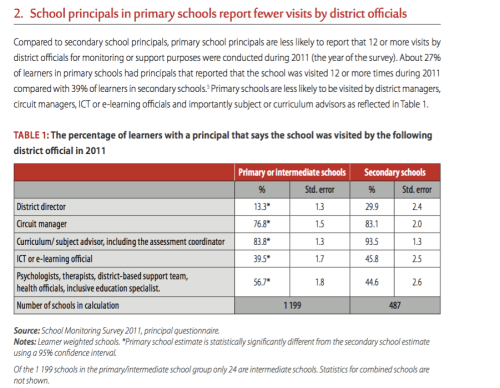
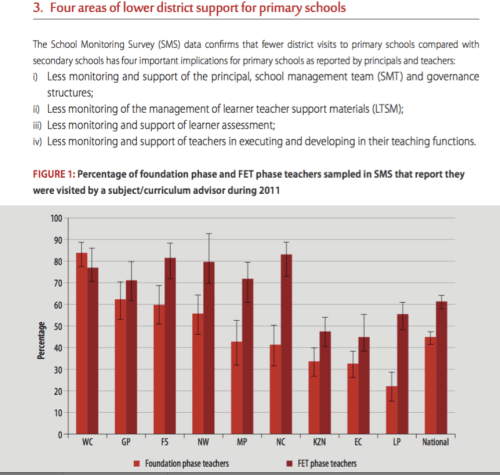
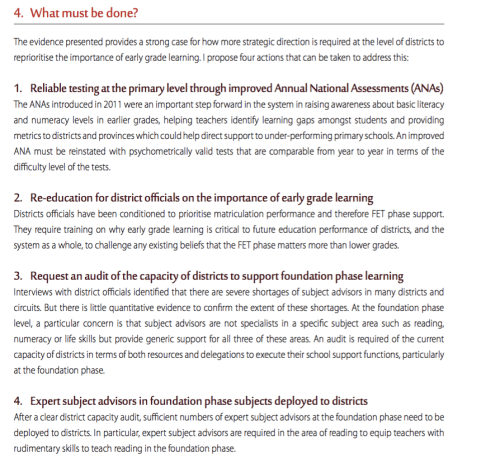
In her latest policy brief, my friend and colleague Dr Gabi Wills discusses the overprioritisation of matric/high-schools and the underprioritisation of Foundation Phase (Gr1-3) and primary schools. The full policy brief is here. She finds that high school principals are significantly more likely to have been visited by a dsitrict official than a primary school principal, leading to lower monitoring and support at this critical phase. The need to prioritise the Foundation Phase and reading specifically was the main conclusion from two major research projects that we have just finished (see here). Until we realise that we will win or lose the battle of improved educational outcomes for the poor in the primary school, and specifically in Grades 1-3, then we are doomed to go around this mountain one more time!

I include some excerpts from the policy brief below:

Screen Shot 2016-06-07 at 12.32.23 PM

Screen Shot 2016-06-07 at 12.33.00 PM.png

Screen Shot 2016-06-07 at 12.34.06 PM

I’ve moved to the OECD in Paris :)

pariss.jpg

I have now moved to Paris to work at the OECD for my TJA Fellowship on PISA data in developing countries. This is essentially an extension of my work on SACMEQ/PASEC and DHS, trying to combine surveys of achievement and attainment to get a composite measure of education system performance.  While I’m away I won’t be commenting as regularly on SA education issues as I usually do. And I will probably shift my focus to other developing countries which is the topic of my research at the OECD. I have already found a number of fascinating things about some PISA countries which I don’t think are widely known or fully appprecaited. There is more than enough included in my previous blog post (11 policy briefs, two synthesis reports and a 200+-page special issue of the SAJCE), not to mention the Volmink Report, for the media and policy-makers to focus on for the next 2 years, let alone 3 months. Keeping up with the nitty-gritty doesn’t make much sense when the underlying issues are not being addressed or taken seriously.

To be honest I’m quite glad to be taking a break from South African education and working on PISA and learning about PISA-for-Development. Clear outcomes, a competent team, and political will. That’ll be nice 🙂

Binding Constraints in Education

psppdcover

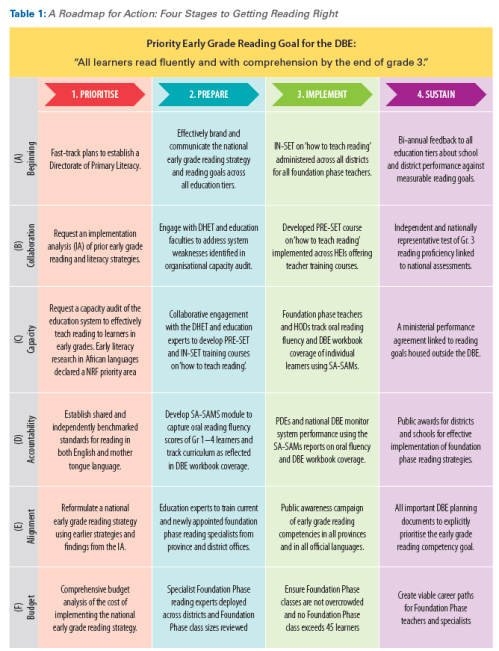
For the last two years we at RESEP have been working on two major education projects: The “Binding Constraints” project (Presidency/EU) and the “Getting Reading Right” project (Zenex Foundation). We launched the two reports on Tuesday last week (my presentation is here). Included below are the two project synthesis reports, a detailed outline on a prospective course (which needs a funder) on “Teaching Reading (& Writing) in the Foundation Phase” and 11 policy briefs. I’ve also included the “Roadmap for Reading” which provides a detailed outline of the practical steps that the Minister of Education could take if she wanted to prioritise reading in the Foundation Phase.

Projects:

  1. Identifying Binding Constraints in Education (V2) [Errata from V1 here]
  2. Laying Firm Foundations: Getting Reading Right
  3. Teaching Reading (and Writing) in the Foundation Phase: A Concept Note

Policy Briefs:

  1. Increasing the supply of teacher graduates
  2. Education datasets in South Africa
  3. Rethinking pre-grade R
  4. Is school based assessment in matric achieving its potential?
  5. Improving the calibre of school leadership in South Africa
  6. The DBE’s workbooks as a curriculum tool
  7. Adding randomised control trials (RCTs) to the education research toolkit
  8. What the ANAs tell us about socioeconomic learning gaps in South Africa
  9. Learning to read and reading to learn
  10. Excessive class sizes in the Foundation Phase
  11. Building an evidence base for inclusive education in South Africa: Focusing on learners with disabilities
  12. Limited support for the Foundation Phase: A Misallocation of district resources

reading right

All of the above are also available on the RESEP website here. The 2015 special issue of the South African Journal of Childhood Education (SAJCE) where most of the research was published is available here (ungated) for those who would like to read the full journal articles.

The presentations from the event are available here:

(I would especially encourage everyone to read through Servaas’ and Gabi’s presentations, they were exceptional!)

There is obviously a lot to be said about these two projects, some of the new research points to very tangible, actionable steps to improve the education system, decrease inequality in outcomes and arguably create a fairer and more efficient education system. Yet it is not at all clear that any of these suggestions will be followed. It was unfortunate that neither the Director General nor the Minister were able to make the report launch. I am aware that both have very busy schedules and that a lot has been happening in education in the last few months. I hope that Servaas will have an opportunity to present this research to them in the coming months. I have also been underwhelmed by the online coverage of the research.

I deliberately do not want to write about the research now since I am currently a little jaded and frustrated about the education research, funding and policy space (perhaps you can tell!). When there are clear, unambiguous and actionable steps that could be taken to improve the education system and they are not taken, this is frustrating. When funders choose to channel millions (billions?) of rands in fruitless directions toward unevaluated projects, it is frustrating. When clear priorities and needs are ignored by national government and local funders (like developing a high-quality course to teach foundation phase teachers to teach reading!), it is frustrating. And perhaps most frustrating of all is the large number of people in provincial and national government that are unable to do the jobs that they have been appointed to do. While there are a number of dedicated and competent public servants and politicians in education, the way that our system is set up means that they have to rely on people who cannot do what they are being asked to do. Those people need to be trained quickly or performance-managed out of the system. That will take courage, strategic leadership and a clear understanding that the status quo is preventing poor children from quality education. Indeed “Weak institutional functionality” or “Insufficient State Capacity” was one of our four binding constraints. Go figure.

Jobs-For-Cash report *FINALLY* released

corruption

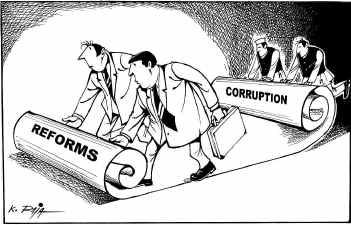
The Ministerial Task Team Report into the sale of posts – colloquially referred to as the Jobs-for-Cash report has finally be released by the DBE. Full report HERE. The report is far-reaching, frank and damning. We all owe a huge thanks to Professor Volmink and his team for their investigation and this much needed report. When corruption is so systemic, as it is in SA education, to write a report like this without fear or favour is the mark of a deep conviction that something has to change.

I have taken out a few excerpts for those who don’t have time to read the whole (285-page report:

  • “All the Deputy Directors-General in the Department of Basic Education are SADTU members and attend meetings of that Union. (p93)
  • “The Gauteng MEC said that “the major Union is in charge of education” in his Province” (p.81)
  • HOD North West – “He said that his Department has so many cases of wrongdoing that if he asked the SAPS to follow them up, it would amount to closing down the Department. ” (p87)
  • “Of the 81 cases that were investigated, 38 cases provided grounds for either reasonable suspicion requiring further investigation or point directly to wrongdoing amounting to criminal conduct. (Reasonable suspicion exists when there are objective grounds or empirical facts that form the basis for the suspicion as opposed to mere conjecture.) “ (p18)
  • North West – “When the claims were made in the City Press in April 2014, the NWDOE appointed a forensic company to investigate the claim that SADTU had influenced the appointment of senior officials in the provincial department. The report, dated 15 August 2011, was made available to the MTT. Further investigation by the MTT indicates that in 9 cases investigated by the forensic investigative company, there was no evidence to support the allegations in 2 cases. However in 6 cases SADTU officials or representatives exerted improper influence; however is no evidence of money being involved. In one case, a senior district official acted improperly in support of the promotion of a friend. In none of the cases was action taken in respect of the findings.“ (p20)
  • Gauteng – “Following claims made in City Press in May 2014, The GDE acted promptly and appointed a firm of attorneys to investigate the claims of improper influence at school level. The detailed report included information from both written and verbal statements and concluded, inter alia, that posts are being sold for cash, that the parties operate in networks, and that there is a climate of fear that keeps people from exposing these practices. The GDE then moved to take disciplinary action, but the majority of witnesses did not wish to give signed statements.This outcome is unacceptable as in this case there is evidence that a network exists that is selling posts for cash. Steps need to be taken to support the individuals who were willing to take the risk of speaking. This requires further investigation by a competent authority. It is not acceptable that a teacher who is courageous enough to report alleged corrupt acts was told must be told to go to her local police station. This cannot be acceptable. In several cases where teachers and other informants have acted with enormous courage to report gross abuse no action has been taken.” (p20)
  • “RECOMMENDATION 4: That the Department of Basic Education regain control of administering the education system in all Provinces so that clear distinctions are established between the roles and functions of the DBE and the concerns of Teacher Unions.” (p21)
  • “The deployment of officials to the Department from Unions weakens the Department because those so deployed often struggle to demonstrate that they are able to balance the complexity of competing loyalties and demands.” (p25)
  • “RECOMMENDATION 10: That both school- and office-based educators cease to be office- bearers of political parties and that educators in management posts (including school principals) be prohibited from occupying leadership positions in Teacher unions.” (p25)
  • “If ‘undue influence’ (a polite name for corruption) is a result of cadre deployment, then cadre deployment is likely to lead to corruption. It is the impression of the Task Team that such corruption is endemic to greater and lesser degrees in the entire education system and that as a first move to cleanse the system, cadre deployment should not be permitted.” (p25)
  • “RECOMMENDATION 15: That the South African Council of Educators (SACE) be reconceptualised and freed from Union and political domination.” (p28)
  • All the Deputy Directors-General in the Department of Basic Education are SADTU members and attend meetings of that Union. That being the case, it is not improbable to say that schooling throughout South Africa is run by SADTU. The significance of cadre deployment in South Africa’s education system is discussed below in Chapter Four.” (p93)
  • “Early in May, the North West’s Deputy HOD was held hostage overnight by SADTU officials over the unresolved matter of temporary teachers.” (p.82)

Some media reports are starting to emerge in Times Live and Citizen but it will be interesting once the journalists and commentators get their teeth into the detailed report.

My M&G article responding to the Statistician General

Spaull M&G 13 May

This was first published in the Mail & Guardian on the 13th of May 2016. The PDF of the article is also available as text below:

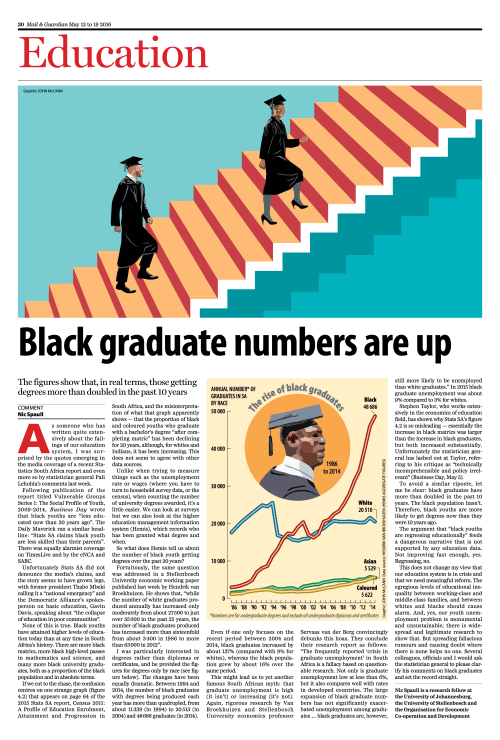
Black graduates have doubled in last 10 years – Dr Nic Spaull

As someone who has written quite extensively about the failings of our education system, I was unusually surprised by the quotes emerging in the media coverage of a recent Stats SA report and even more so by the Statistician General Pali Lehohla’s comments last week. Following publication of the report, titled “The Social Profile of Youth”, the Business Day was quick to inform us that apparently black youth were less educated now than 20 years ago.” The Daily Maverick ran a similar headline: “Stats SA claims black youth are less skilled than their parents”, with equally alarmist coverage in Times Live, ENCA, SABC etc. Unfortunately StatsSA did not denounce the media’s claims. The story seems to have grown legs, with former president Thabo Mbeki calling it a “national emergency” and the Shadow Minister of Basic Education speaking of “the collapse of education in poor communities.”

Of course none of this is true. As we shall see, Black youth have higher levels of educational attainment today than at any other point in South Africa’s history. There are more Black matrics, more black high level passes in mathematics and science, and many more Black university graduates. (Note that this is both as a proportion of the Black population and in absolute terms). In this article I will focus on black university graduates since everyone agrees that there have been large increases in black youth passing matric and achieving bachelor’s passes.

If we cut to the chase the confusion all centres on one strange graph (Figure 4.2) appearing on page 64 of the 2015 Stats SA report “Census 2011: A profile of education enrolment, attainment and progression in South Africa” and the misinterpretation of what that graph apparently shows. That graph shows that the proportion of black and coloured youth that graduate with a bachelor’s degree “after completing matric” has been declining for 20 years, while for whites and Indians it has been increasing. This is very strange and does not seem to agree with other, perhaps more reliable data sources. Unlike when trying to measure things like the unemployment rate or wages (where you have to turn to household survey data or the Census), when counting the number of university degrees awarded it’s a little easier. We can look at surveys, but we can also just look at the Higher Education Management Information System (Hemis) the record-keeping system stating who has been granted what degree and when. All degrees that are granted must be recorded on this database. So what does Hemis tell us about the number of black youth actually getting degrees over the last 20 years?

Fortuitously, this exact question was addressed in a Stellenbosch Economic Working Paper (08/16) published last week by my colleague Dr Hendrik van Broekhuizen. In that paper he shows that “while the number of White graduates produced annually has increased only moderately from about 27 500 to just over 35 000 in the past 25 years, the number of Black graduates produced has increased more than 16-fold from about 3 400 in 1986 to more than 63 000 in 2012.” For this article I was particularly interested in degrees rather than diplomas or certificates) and he kindly provided the figures for degrees only by race (see figure below). The changes have been equally dramatic. Between 1994 and 2014 the number of black graduates with degrees being produced each year has more than quadrupled, from about 11,339 (in 1994) to 20,513 (in 2004) to 48,686 graduates (in 2014). Even if one only focuses on the recent period between 2004 and 2014 Black graduates increased by about 137% (compared to 9% for whites), while the black population grew by about 16% over the same period.

This might lead us to yet another famous South African myth; that graduate unemployment is high (it isn’t) or increasing (it’s not). Again, rigorous research by Dr Van Broekhuizen and Professor Servaas van der Berg convincingly debunks this hoax. They conclude their research report as follows: “The frequently reported ‘crisis in graduate unemployment’ in South Africa is a fallacy based on questionable research. Not only is graduate unemployment low at less than 6%, but it also compares well with rates in developed countries. The large expansion of black graduate numbers has not significantly exacerbated unemployment amongst graduates….Black graduates are, however, still more likely to be unemployed than white graduates.” (Note: in 2015 black graduate unemployment was about 9% compared to 3% for whites.) [Their extended article is here]

 Another colleague of mine, Dr Stephen Taylor in his response to the Statistician General (Business Day, 29 April) has shown why Stats SA’s Figure 4.2 is so misleading (essentially the increase in black matrics was larger than the increase in black graduates, but both increased substantially). Unfortunately the SG has simply lashed out at Dr Taylor referring to his critique as “technically incomprehensible and policy irrelevant” (Business Day, 5 May). To avoid a similar riposte let me be clear: Black graduates have more than doubled in the last ten years. The black population hasn’t. Therefore, black youth are more likely to get degrees than 10 years ago. I think this is both technically comprehensible and policy relevant.

The argument that “black youth are regressing educationally” feeds a dangerous narrative that is not supported by any education data in South Africa. Not improving fast enough, yes. Regressing, no. Black youth have higher educational attainment now than at any point in South Africa’s history. This does not change my firmly held view that our education system is in crisis and that we need meaningful reform, that goes without saying. The egregious levels of educational inequality between working class and middle-class families, and between whites and blacks should cause alarm. And yes, our youth unemployment problem is monumental and unsustainable; there is widespread and legitimate research to show that. But spreading fallacious rumours and causing doubt where there is none, helps no one. Together with a number of colleagues and officials I would ask the Statistician General to please clarify his comments on black graduates and set the record straight.

//

Dr Nic Spaull is a Research Fellow at the University of Johannesburg, the University of Stellenbosch and the OECD.  

Workings for graphs (thanks Hendrik van Broekhuizen!)

Year Black Coloured Asian White
Y1986 2957 1131 1532 17601
Y1987 3153 1280 1692 19064
Y1988 3546 1349 1771 20494
Y1989 4043 1760 1930 21613
Y1990 4862 1958 1975 22747
Y1991 7115 2230 2170 23800
Y1992 8130 2270 2363 24901
Y1993 8661 2392 2621 24571
Y1994 11339 2127 3023 25538
Y1995 13123 1833 2506 16885
Y1996 15781 1785 2479 16363
Y1997 17367 1869 2713 16385
Y1998 17181 1949 2796 15650
Y1999 19093 1785 2175 15410
Y2000 20379 1909 3193 15896
Y2001 17017 1913 3430 16017
Y2002 16222 2075 3712 17094
Y2003 17234 2322 3776 17948
Y2004 20513 2640 4307 18757
Y2005 21052 2916 4505 19860
Y2006 22508 3097 4805 20732
Y2007 23356 3480 4840 20522
Y2008 25373 3677 4984 20482
Y2009 27869 3866 4774 20555
Y2010 31453 4366 4690 20456
Y2011 34209 4456 5109 20248
Y2012 40001 4778 5089 20303
Y2013 45948 5291 5748 21548
Y2014 48686 5622 5529 20510

*These include the following: General Academic Bachelor’s Degree; Professional First Bachelor’s Degree; Baccalaureus Technologiae Degree; Professional First Bachelor’s Degree; First National Diploma (3 years); First National Diploma (4 years)

Figures refer to the number of HE awards and will thus be at least as large as the number of graduates produced in each year. Includes only undergraduate degrees. (Thus excludes all UG   diplomas, and certificates

Response to the Statistician General – Dr Stephen Taylor

cat-op-ed

[Guest post – Stephen Taylor]

The Statistician General (SG) recently responded to my letter to the Business Day. A full version of what I have written is available here. I would simply reiterate what I wrote initially. In brief:

Numerous newspapers and media outlets were running with headlines such as “Black youth less educated now than 20 years ago” (Business Day) and “Stats SA claims black youth are less skilled than their parents” (Daily Maverick). The articles were referencing a recent Stats SA report as well as comments made by the SG.

My position is simple: These claims are factually incorrect and Stats SA reports and data do not actually say this. Note that I did not “adjudge a mistake” in the actual Stats SA report. I do not know exactly what the SG said at the release, which may have lead the media to run with the headlines they did, but I speculated about what I thought might have been causing the confusion.

The SG’s response has confirmed that I was right about what had caused the confusion. He had in mind a very specific “progression ratio” – the ratio of degree graduates to matriculants. This ratio may have been decreasing for black and coloured youth, but this is simply because the increase in degree graduates has not kept pace with the increase in matriculants. Importantly, both the likelihood of achieving a matric and the likelihood of achieving a degree have been fast increasing, especially for black youth. This means it cannot possibly be true that black and coloured youth are worse off educationally than their parents, which is the message the media were propagating. None of the media reports said anything about this “progression ratio” which the SG has now referred to. Instead the media were reporting that lower proportions of the entire black and coloured population were attaining a degree. And that isn’t true.

According to Higher Education data, the number of black degree graduates per year has increased more than four-fold from 11 339 in 1994 all the way to 48 686 in 2014.[Note: New SU Working Paper published by Hendrik van Broekhuizen last week on this topic]. This is much faster than population growth. For white youth, this number has essentially remained flat at roughly 20 000 graduates per year. Of course there is still a lot of inequality – these numbers mean whites are still about 6 times more likely to attain a degree than black youth.

This “progression ratio” may have some analytic value, as the SG points out. For example, it may reflect a greater policy prioritisation of secondary education relative to higher education. But this indicator must be clearly explained and it also has its limitations. I cannot imagine anyone celebrating improved educational outcomes if the numbers of black and coloured youth attaining a degree had gone down, while the numbers attaining a matric had gone down even faster, leading to an increase in the degree-to-matric progression ratio!

I know progress hasn’t been as fast as we need. But it is far from the truth to suggest educational outcomes have regressed.


Black graduates: 3 400 in 1986… 55 600 in 2011. Enough said :)

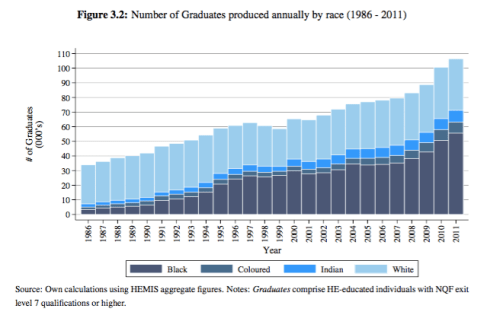
On the topic of the change in the number of black African graduates over the last twenty years (and the recent media hype) this study by my colleague and friend Dr Hendrik van Broekhuizen  is all that needs to be said:

Screen Shot 2016-05-03 at 4.23.24 PM

“In addition to the expansion of South Africa’s yearly graduate outputs, the nature of the policy changes which have affected the HE system over the past 25 years means that the demographic composition of South Africa’s stock of graduates has also changed radically over time. This is clearly evident when looking at changes in the racial composition of the graduates produced by the HE system each year. Figure 3.2 reveals that, while the number of White graduates produced annually has increased only moderately from about 27 500 to just over 35 000 in the past 25 years, the number of Black graduates produced has increased more than 16-fold from about 3 400 in 1986 to more than 55 600 in 2011. The implications of the racial differences in graduate output growth are simple: while the HE system produced 7.9 White graduates for each Black graduate in 1986, by 2011 it produced 1.6 Black graduates for every single White graduate. Figure 3.3 offers a similarly poignant illustration of the extent of change in the racial composition of South Africa’s stock of graduates by showing the respective racial shares of the total number of graduates produced in each year since 1986″ (p13).

From his 2013 Economic Society of South Africa paper.

We’re hiring a Project Administrator! (based in Stellenbosch)

help

Hi education folk

We’ve recently been awarded a grant by the UK Economic and Social Research Council (ESRC) and DFID to do research on exceptional township and rural primary schools in three provinces – Western Cape, KwaZulu-Natal and Limpopo. I will be leading the project together with a great team of co-investigators and researchers: Ursula Hoadley (UCT), Jaamia Galant (UCT), Nick Taylor (JET), Servaas van der Berg (ReSEP), Gabi Wills (ReSEP) and Linda Zuze (HSRC).

Given that we will be using a matched-pair approach, the aim of the project is to to firstly identify at least 10 high-performing township/rural schools in each of the three provinces and then match those schools to ‘typical’ neighbouring schools (thus 60 schools in total). The project will run for 2.5 years (beginning June 2016) and will involve in-depth qualitative research, administering and analysing assessments, creating new school-leadership and management instruments and analysing the data emerging from the project.

At the moment we are looking for a part time (50%) project administrator to help us with the administration relating to the project. The full job-advert can be found here. I include a short extract:

The ideal candidate should be an efficient and organised person with some experience in managing the administrative side of academic projects. They should be friendly and able to communicate well, as well as plan effectively and take initiative to solve problems as they arise. They should also be able to liaise with (1) the funders – DFID/ESRC, (2) Stellenbosch University finance and administration personnel, and (3) the 5 co- investigators as well as other researchers and field-workers. The job will include following up with government officials, managing flights and accommodation, planning reporting cycles, managing time-sheets, budgets and funding claims, proof-reading and printing questionnaires etc.

They should also be friendly 🙂 Basically we’re looking for a go-to admin guru to help us with this project. If your skills and experience are such that you would also be able to help on the non-admin research side (doing research-assistant work or interviews/assessment) then we may involve you in more than an administrative role. However this would be on top of your administrative responsibilities, and in such a case the remuneration is somewhat negotiable. It is a part-time position and it’s based at Stellenbosch University (in the Economics Department) so remuneration would be in line with university salary scales (I believe it is about post-level 11, although it would be 50% of the amount stated here) and partially dependent on qualifications and/or experience.

If you’re interested in working with this great team on an exciting new project please do apply 🙂 (and if you know of anyone who may be interested please forward this on to them!)

DEADLINE FOR APPLICATIONS: 12 May 2016


Black youths are NOT educationally worse off than 20 years ago – Dr Stephen Taylor

Screen Shot 2016-04-30 at 7.45.40 AM

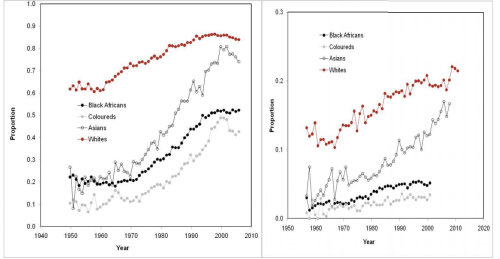
Figure 1: Proportions of the population achieving secondary education (left) and a bachelors degree (right). (Source: Stats SA (2015): CENSUS 2011: A profile of education enrolment, attainment and progression in South Africa, page 41.)

On the 18th of April the Business Day published a piece titled, “Black youth less educated now than 20 years ago.” This statement is simply wrong and unsupported by any data set. Yet the story is now gaining momentum and has been published by other news outlets, such as the Daily Maverick, reporting that “Stats SA claims black youth are less skilled than their parents.”

The article asserts that “black and coloured youths have regressed in their educational achievements” and that the proportion of black and coloured youth that complete a university degree as a share of the population has decreased. This is factually incorrect.

The article references a recent Stats SA report on the status of the youth as well as comments by the Statistician General, Pali Lohohla, as the basis for these assertions.

But in fact, the Stats SA published reports (as with all other analysis I have seen or done) indicate that the proportions of black and coloured youths who attain grade 9, grade 12, and a university degree, have all increased consistently in recent decades and are still increasing. It is thus not clear where this misconception arose.

I suspect the mistake may have arisen through a misunderstanding of a statistic which has been presented by the Statistician General recently and which appears in Stats SA’s report on educational enrolment, attainment and progression (December 2015). The statistic shows that the proportion of black and coloured youths who achieve a bachelors degree “after completing grade 12” has been declining over the last 20 to 30 years.

It needs to be understood that this statistic is the proportion of matriculants who go on to attain a degree. In other words, the denominator in this calculation is matriculants as opposed to the entire black and coloured population.

The improvement in matric attainment among black and coloured youth has been larger than the improvement in degree attainment among black and coloured youth, but – and this is the important part – there have been big improvements in both. The fact that the increase in degree completion has been slower than the increase in matric completion is not at all an indication that youth are worse off now than 20 years ago.

So the ‘bad’ news is that degree completion, although it has increased, has not kept pace with the fast increase in the attainment of matric amongst black and coloured youths. But this certainly does not mean that educational outcomes are worse than 20 years ago.

So what do the numbers actually say? The Stats SA report issued in December shows that the proportion of black people completing matric has been consistently increasing from about 20% to about 50% over the last 50 years. That report also indicates that the proportion of black people completing a degree has increased from about 2% to about 4% over the same period.

Whether you read official Stats SA reports or do your own calculations on the various Stats SA datasets – I have analysed Census data from 1996, 2001 and 2011 as well as General Household Survey data from 2002 to 2014 – it is clear that both matric attainment and degree attainment has been increasing amongst the black and coloured population.

It is also useful to consider the Department of Basic Education’s matric statistics from recent years. In 1990, there were 191 000 matric passes. By 2015 this number had more than doubled to 465 863. This increase has been driven mainly by growing numbers of black youth passing – and this growth has easily outstripped population growth, which has been about 1% a year. Even since 2008, the number of black matric passes has increased from about 250 000 to over 350 000. And the number of black people achieving a bachelors pass in matric has increased from about 60 000 to about 120 000 since 2008.

I am by no means suggesting that everything is fine in our education system. Despite the progress, there are still too many youths who do not get to grade 12, the main reason being that educational foundations laid in earlier grades have been inadequate. And completion rates at our higher education institutions should worry us. But there have been improvements in both of these areas relative to 20 years ago.

Although improved access at lower levels of education (primary and secondary school completion) has been faster than access at higher levels, paradoxically the solutions must focus on the early grades if sustainable progress is to be made.

The most alarming education statistics to me are the low proportions of children achieving basic literacy and numeracy in the early grades. International assessments of education quality point to serious deficiencies in this area, even compared to some other countries in the region. If children are not learning to read in the early grades, they will not be able to make it to higher education.

But even in the area of learning quality, the evidence points to improvement. The Trends in International Mathematics and Science study (TIMSS) showed substantial improvements in mathematics and science achievement at the grade 9 level between 2002 and 2011. However, this improvement is off a very low base.

Educational outcomes in South Africa remain far too low, especially amongst youths from poor communities. But claims that education was better under apartheid or that outcomes have deteriorated over the last 20 years are alarmist and have no basis in reality.

Dr Stephen Taylor is a researcher in the South African Department of Basic Education. His work includes impact evaluation of education interventions, measuring educational performance and equity in educational outcomes. In 2010 he completed a PhD in economics at the University of Stellenbosch, analysing educational outcomes of poor South African children.

(This article first appeared in the Business Day on Friday the 29th of April 2016)


Reading in FP Seminar (28 April, JHB) space available :)

ele

I’m currently involved in a number of research projects that look specifically at reading in the Foundation Phase in South Africa. In my view this is the cause of (and solution to) so many of the problems we see in our education system.

I thought it would be a good idea to get some of the SA reading researchers  in the same room to talk about the work they’re currently doing and talk about the way forward. So we’ve organized a half-day workshop for the 28th of April (8:30am-2:30pm). It will be an informal seminar of researchers and should be relatively small (<40 people) to make sure we have time to interact.

Prof Elbie Henning at UJ has kindly offered to host the workshop at UJ (as an aside I am now a part-time research fellow at her SARChI Chair).  See the programme below. There are a number of exciting presentations, perhaps most exciting is early feedback from Stephen Taylor et al’s RCT in the North West!

The good news is that we have additional space for 5 or 6 additional participants who would like to attend. So if you’re involved in reading research, teaching reading teachers or policy-making in the Foundation Phase and would like to come on the 28th please send me an email (nicholasspaull[at]gmail.com) with the title “Reading in FP Workshop.” Please also include a paragraph about who you are and why you’d like to attend.

Time Presenters
08:30 – 09:00  Morning tea and coffee
09:00 – 09:20 Nic Spaull, University of Johannesburg/OECD

Reading in the Foundation Phase – introduction, welcome and overview

09:25 – 09:45 TBD
09:50 – 10:10 Deborah Mampuru, University of South Africa

Reflections on the development of the African language DBE Workbook series

10:15 – 10:35 Elizabeth Pretorius, University of South Africa

Oral Reading Fluency and other components of ESL reading: What we know and what we still need to discover

10:40 – 11:00 Stephen Taylor, Department of Basic Education

Preliminary results of a Randomized Control Trial assessing an early grade reading intervention in the North West

11:00 – 11:20

Tea and coffee break

11:25 – 11:50 Elizabeth Henning, University of Johannesburg

Vision for the new NRF SARChI Chair in Integrated Studies of Learning Language, Mathematics and Science in the Primary School

11:55 – 12:20


Brahm Fleisch, Wits University

Reflections on large-scale interventions: Overview of ongoing interventions and discussion of the Triple Cocktail

12:20 – 13:20


Carol Nuga Deliwe, Department of Basic Education & Nic Spaull, University of Johannesburg/OECD

Facilitated discussion with everyone on prioritising reading in the DBE – moving from rhetoric to implementation

13:30 – 14:30

Lunch


Links I liked

14953538130_f8409d8508_z

    • Civilising in Earnest: Schools and Schooling” – Chapter 18 of Weber’s “Peasants into Frenchmen: The Modernisation of Rural France.” An incredibly insightful read about the role that education plays in unifying a country, standardising a language and promoting the dominant culture. A must read.
    • Currently I’m very interested in Catherine Snow‘s research on reading – the way she writes about reading and reading research is both accessible and sophisticated but also totally unpretentious. Start with this article: “Reading Comprehension: Reading for Learning.” I also found an online version of Adger, Snow & Christian’s (2003) “What teachers need to know about language” which looks great.
    • I recently gave a workshop/seminar at Herzlia High School in Cape Town on the topic “Assessment: Helping or Hurting the Academic Project?” where we spoke about new thinking in the assessment space, as well as expanding what we consider the academic project to be; including socio-emotional skills, grit, and 21st century skills (Creativity, Collaboration, Critical Thinking, Communication). On this note, NPR published a nice post titled “Non-academic skills are key to success. But what should we call them.”
    • Evaluation of Washington DC’s IMPACT policy (controversial teacher-rating system and concomitant replacement of ineffective teachers) had a positive impact on student outcomes
    • Pasi Sahlberg writes that Harvard grad students (and all others) should be able to write op-eds and not just academic papers. Obviously I agree. Future students consider yourselves notified.
    • BrainPickings covers Krista Tippett’s new book “Becoming Wise: An inquiry into the mystery and art of living.” I thoroughly enjoyed Krista’s interview on Design Matters.
    • Cool  TED Talk by Paulo Blikstein from Stanford on his idea of the FabLab@School at Stanford.
  • The End of the Lecture?” by Peter Struck – “In contrast a good lecture should be designed to make a student work harder to prepare for the following one. It will motivate students to carry on the really hard, self-driven work of teaching themselves. It needs to transform data into knowledge by providing a synthesis and modelling for the students how to do it. It tailors the mass of information on a subject into a comprehensible narrative that picks and chooses, making judgments and subordinating some ideas to others. It animates the raw power of the fresh ideas it conveys. In other words, what makes a good lecture in these new formats is pretty much what makes a good lecture at all. Lectures have always been hard to do well, and we would benefit from more time spent working to improve them, something that will happen only by first resisting anti-lectureism, which, as a side effect, absolves us from the task.
  • Q&A with Angela Duckworth (of ‘grit’ fame) “One thing we’re doing to learn more about what teachers are doing, what works, and how we can scale it, is we are giving grants to teachers. Teachers probably have better ideas than we do about children and how to help them. What they don’t always have is training in the scientific method, measurement, study design, and statistics. What we’re hoping to do is help those teachers test those ideas in ways that might be more systematic than they might be able to do on their own.”

Research

Minding the gap?’ A national foundation phase teacher supply and demand analysis: 2012-2020 – Green, Adendorf & Mathebula (2015)

Abstract: This paper explores the extent to which foundation phase teacher supply meets demand in South Africa, against a backdrop of considerable change in an education system endeavouring to fulfil the needs of a 21st century society while still battling with significant inequalities in the distribution of skills. The primary purpose of the paper is to use recently sourced teacher education data from a range of national databases to determine to what extent state-led interventions are assisting to meet the foundation phase teacher supply and demand challenge. The data, as well as the more qualitative aspects of their context, are analysed at the macro (national) level to present a more nuanced picture of foundation phase teacher supply and demand. The study attempts to move beyond simply basing an analysis of supply and demand on teacher attrition, and takes into account multiple variables that should be considered in supply and demand planning. It also goes beyond simply matching supply to demand in the most recent year for which data is available, to forecasting a future scenario which will need to be planned for. The paper concludes by suggesting steps that should be taken to ensure a better match between supply and demand.

Making Good Use of New Assessments: Interpreting and Using Scores From the Smarter Balanced Assessment Consortium (2015) by Linda Darling-Hammond Edward Haertel James Pellegrino. Important thinking about around new assessments.

Quasi-experimental evidence on the effects of mother tongue-based education on reading skills and early labour market outcomes (Bethlehem A. Argaw∗ Leibniz University of Hanover February 23, 2016)

 Abstract: Prior to the introduction of mother tongue based education in 1994, the language of instruction for most subjects in Ethiopia’s primary schools was the official language (Amharic) – the mother tongue of only one third of the population. This paper uses the variation in individual’s exposure to the policy change across birth cohorts and mother tongues to estimate the effects of language of instruction on reading skills and early labour market outcomes. The results indicate that the reading skills of birth cohorts that gained access to mother tongue-based primary education after 1994 improved significantly by about 11 percentage points. The provision of primary education in mother tongue halved the reading skills gap between Amharic and non-Amharic mother tongue users. The improved reading skills seem to translate into gains in the labour market in terms of the skill contents of jobs held and the type of payment individuals receive for their work. An increase in school enrollment and enhanced parental educational investment at home are identified as potential channels linking mother tongue instruction and an improvement in reading skills.

Double for Nothing? Experimental Evidence on the Impact of an Unconditional Teacher Salary Increase on Student Performance in Indonesia” (Dee et al, 2016)

Abstract: How does a large unconditional increase in salary affect employee performance in the public sector? We present the first experimental evidence on this question to date in the context of a unique policy change in Indonesia that led to a permanent doubling of base teacher salaries. Using a large-scale randomized experiment across a representative sample of Indonesian schools that affected more than 3,000 teachers and 80,000 students, we find that the doubling of pay significantly improved teacher satisfaction with their income, reduced the incidence of teachers holding outside jobs, and reduced self-reported financial stress. Nevertheless, after two and three years, the doubling in pay led to no improvements in measures of teacher effort or student learning outcomes, suggesting that the salary increase was a transfer to teachers with no discernible impact on student outcomes. Thus, contrary to the predictions of various efficiency wage models of employee behavior (including gift-exchange, reciprocity, and reduced shirking), as well as those of a model where effort on pro-social tasks is a normal good with a positive income elasticity, we find that unconditional increases in salaries of incumbent teachers had no meaningful positive impact on student learning

Links I liked and new research

backwards
Links I liked:
Research
As part of project we are doing for the EU/SA Presidency, two RESEP-affiliated researchers – Martin Gustafsson and Stephen Taylor – have published important papers extending our understanding of education in South Africa. The first looks at the spatial distribution of teachers in South Africa and pays special attention to post-provisioning, the recruitment and employment of teachers and how policy can be improved in these areas. The second looks at the impact of treating schools to a new provincial administration, exploiting a change in provincial boundaries that led to some schools ‘moving’ into different provinces.
Teacher supply and the quality of schooling in South Africa. Patterns over space and time” (Gustafsson 2016)
  • The paper addresses policy questions in South Africa’s education system using a newly merged 1999 to 2013 panel of data that includes school enrolments by grade, staff details from the payroll system, examination and test results and the geo-coordinates of schools. This combination of data, which is seldom used, at least in developing countries, permits new and important knowledge about a schooling system to be uncovered. Whilst policy conclusions are South Africa-specific, the methods would be largely transferable to other contexts. It is shown that school data can complement official population data with respect to the monitoring of within-country migration and in determining the rate of urbanisation. An approach for calculating the viability of small schools in a context of migration out of rural areas is presented, using assumptions around maximum distance to be travelled by pupils and the degree to which multi-grade teaching by teachers should be permitted. Cost reductions associated with a reduced presence of small schools, and greater economies of scale associated with larger schools are found to be smaller than what is generally assumed. Correlations between pupil under-performance and the under-staffing of schools are found to be higher at the primary than the secondary level, apparently confirming the greater importance of personal interaction with a teacher for younger pupils. Between-school movements of pupils other than those associated with urbanisation are found to be high, and highly variable across districts. This further complicates the allocation of publicly paid teachers. An approach to gauging whether teachers avoid moving to schools on the other side of provincial boundaries is presented. It is confirmed that movement across provinces, which are the employers of teachers, is restricted, creating further obstacles to efficient teacher allocation. It is confirmed that teachers tend to move to better performing schools, but that the performance signals that influence this movement are often inaccurate and a few years old.”

    Treating schools to a new administration: Evidence from South Africa of the impact of better practices in the system-level administration of schools” (Gustafsson & Taylor, 2016)

  • “School examination results are far from ideal measures of progress in schooling systems, yet if analysed with sufficient care these data, which are common in education systems, can serve this purpose. The paper partly deals with how various student selection and year-on-year comparability issues in examinations data can be dealt with. This is demonstrated using South African student-level results, aggregated to the school level, for Grade 12 mathematics in the years 2005 to 2013. This was a period during which provincial boundaries changed, creating a quasi-experiment which is amenable to impact evaluation techniques. Value-added school production functions and fixed effects models are used to establish that movement into a better performing province was associated with large student performance improvements, equal in magnitude to around a year’s worth of progress in a fast improving country. Improvements were not always immediate, however, and the data seem to confirm that substantial gains are only achieved after several years, after students have been exposed to many grades of better teaching. The institutional factors which might explain the improvements are discussed. Spending per student was clearly not a significant explanatory variable. What did seem to matter was more efficient use of non-personnel funds by the authorities, with a special focus on educational materials, the brokering of pacts between stakeholders, including teacher unions, schools and communities, and better monitoring and support by the district office. Moreover, the education department in one province in question, Gauteng, has for many years pursued an approach which is unusual in the South African context, of hiring a substantial number of senior managers within the bureaucracy on fixed term contracts, as opposed to on a permanent basis, the aim being to improve accountability and flexibility at the senior management level.”
  • I have just discovered John Jerrim’s website. He seems like an extremely prolific scholar and has done loads of research on PISA. As important, he seems to be working closely with education policy makers in the UK.
  • Duration of unemployment in youth transitions from schooling to work in Cape Town” (Mlatsheni & Leibbrandt 2015)
  • “Starting together, growing apart: Gender gaps in learning from preschool to adulthood in four developing countries” (Singh & Krutikova, 2015)
  • Durevall, Lindskog & George (2016) – Three approaches all suggest no impact of secondary school attendance on HIV incidence in South Africa #CSAE2016
  • Nice round up of economic research on Africa from the first day of CSAE s well as Day Two and Three.

The Biggest Solvable Problem in SA: Reading

book

Whenever I travel overseas I am asked the question “What is the biggest problem in South Africa?” And I typically respond, “The biggest problem or the biggest solvable problem?” In the 2000’s the biggest problem was HIV/AIDS. After hundreds of thousands of unnecessary deaths – the equivalent of a small genocide – the government ceded to the courts and offered life-saving ARVs to those infected with HIV and saved their lives. HIV was, and is, a solvable problem. Unfortunately the three biggest problems in South Africa today – too few jobs, too little growth, and too much inequality – are not easily solvable. And because we don’t exactly know how to ‘create’ jobs or growth, we don’t really know how to decease inequality much further.

Of course everyone has theories about how we can increase jobs, but the evidence is pretty thin. Depending on your political fancy and chosen economic guru there are various concoctions ranging from youth wage subsidies, eliminating red-tape, decreasing taxes, increasing taxes, digging holes, filling holes…you get the picture. Ask the top labour-economists in the country how to create jobs and you won’t get a straight answer (This is partly a provocation to said labour economists to tell us if there is in fact any coalesced consensus). You won’t even get consensus on the next three steps towards finding the answer; which is, incidentally, not a uniquely South African problem. So what to do? I think the best response is to keep cracking away at the problem; experimenting, evaluating, moving forward. But in the mean time we should also be allocating time, energy and resources to solvable problems; those we haven’t currently cracked but have a pretty good idea of how to do so. Epidemic HIV; distribute free ARVs. Crippling poverty; introduce the child support grant. Widespread malnutrition; provide free school meals to most children. The government should be heavily praised for all of these important initiatives.

But the problem I want to focus on here is the fact that most kids do not learn to read in lower-primary school. South Africa is unique among upper middle-income countries in that less than half of its primary school children learn to read for meaning in any language in lower primary school.

Irrespective of how tenuous or strong you believe the relationship is between education and economic growth, teaching all children to read well is a unanimously agreed upon goal in the 21st century. It is necessary for dignified living in a modern world, it is necessary for non-menial jobs, it is necessary for a functioning democracy. It also usually helps with ignorance, bigotry and a lack of empathy. In a modern context illiteracy is a disease that is eradicable, unlike unemployment or inequality. Like polio, illiteracy practically does not exist in most wealthy or even middle-income countries (defined here as basic reading). Illiteracy rates among those who have completed grade 4 are in the low single digits in wealthy countries like England (5%), the United States (2%) and Finland (1%) and less than 50% in most middle income countries such as Colombia (28%), Indonesia (34%), and Iran (24%). It’s difficult to get directly comparable estimates for the whole country but the best estimate from the recent pre-Progress in International Reading Literacy Study (PIRLS) surveys is about 58%. That is to say 58% of Grade 4/5 students cannot read for meaning in any language. And why is Grade 4 a critical period? The South African curriculum (like most curricula) prescribes that in the first three years of schooling children must ‘learn to read’, then from grade 4 onwards they must ‘read to learn’. The fact that almost 60% cannot learn through reading means that these children cannot really engage with the curriculum beyond grade 4. It really isn’t much more complicated than that

Reading for meaning and pleasure is, in my view, both the foundation and the pinnacle of the academic project in primary school. Receiving, interpreting, understanding, remembering, analyzing, evaluating and creating information, symbols, art, knowledge and stories encompasses pretty much all of schooling. Yet most kids in South Africa never get a firm hold on this first rung of the academic ladder. They are perpetually stumbling forward into new grades even as they fall further and further behind the curriculum.

Based on my reading of the academic literature – which may differ from others – there are three main reasons why the majority of kids don’t learn to read in lower primary school.

  1. Foundation Phase teachers (grades 1-3) do not know how to teach reading in a systematic way and pre- and in-service courses teaching this topic are unsystematic, inadequate or nonexistent.
  2. Text-poor environments; the School Monitoring Survey showed that half of schools in quintiles 1-3 (i.e. poorest 60%) had no school or classroom library or even a book corner. (Importantly, research has shown that even when there are libraries they are frequently mismanaged, have inappropriate materials and they are not integrated into reading lessons),
  3. Wasted learning time; A number of South African studies have aimed to measure opportunity-to-learn and have frequently found that less than half of the official curriculum is being covered in the year and fewer than half of the officially scheduled lessons are actually taught. In one study in the North West Grade 6 teachers only taught 40% of scheduled lessons for the year (compared to 60% among schools across the border in Botswana). It is not clear what was happening on the days where there was evidence of teaching or learning.

For me the solution is simple: we need to address these three problems: (1) decide how to teach existing and prospective teachers how to teach reading (as is done all over the world in contexts as linguistically and socioeconomically complex as our own), (2) ensure that all primary schools have a bare minimum number of books and that these are managed effectively, (3) monitor how often teachers are actually teaching and introduce meaningful training first and real consequences second for those teachers who are currently not teaching.

We may not have consensus on how to create jobs or increase growth, but there is consensus on how to teach children to read: with knowledgable teachers who have books and provide their students with enough opportunity to learn. If you want to improve matric, you need to start with reading. It’s not rocket science.

*This article first appeared in The Star on Tuesday the 29th of March 

**Image from here

Links, presentations and new research

21

Links I liked:
  • The story of Judge Lex Mpati who went from being a petrol attendant after matric to the President of the Supreme Court of Appeal and Chancellor of Rhodes University where he studied (bartending on the side to pay for his studies). Such an inspiration that we have people like this who have gone from the very bottom to the very top.
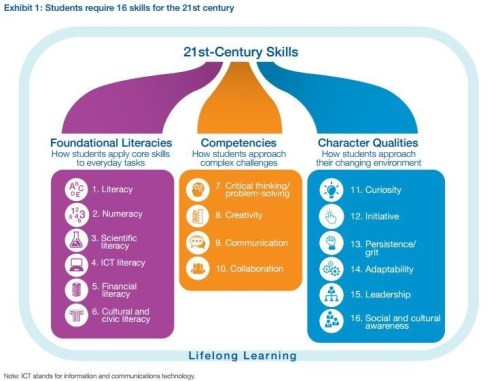
  • The World Economic Forum (WEF) has a new report out titled “New Vision for Education: Fostering Social and Emotional Learning Through Technology.” (picture above taken from here). Interesting. Would like to see more research on this. (Again I reiterate that there isn’t anyone looking at grit – ala Duckworth – in South Africa).
  • The “What Works Clearinghouse” funded by the US Department of Education is an exceptional piece of scientific wisdom. Reviewing the evidence and coming up with recommendations on “what works” – what a brilliant (and obvious/logical) idea! Anyone in SA want to take this on? 🙂  (Thanks John Aitchison for reminding me of this).
  • NATURE has published a “Twenty tips for interpreting scientific claims” – Great!
  • Great Quartz article taking a behind-the-scenes look at the Hillary Campaign and how Google’s top dog (Eric Schmidt) is funding a startup that provides analytics support.
  • Labyrinth of Lies” (2015) – great German film about prosecuting those responsible for the atrocities at Auschwitz, and this at a time soon after WW2 when key Nazi officials remained in high office in Germany. I watched this on the plane to Vancouver and was particularly moved by the scene where Jewish survivors explain what happened to them at Auschwitz (at the time this wasn’t discussed in Germany). The dialogue goes silent and all you see is the faces of the secretary transcribing the accounts in disbelief.
  • Knight Lab Timeline – Great resource to make Timelines for presentations. Thanks Shelanna Sturgess!

Some presentations I’ve given in the last month:

Some new research

  • Schooling inequality, higher education and the labour market: evidence from a graduate tracer study in the Eastern Cape, South Africa” 2015 article by Michael Rogan and John Reynolds comparing graduates from Fort Hare and Rhodes ABSTRACT: An emerging body of research has shown that there are large inequalities in access to higher education in South Africa. There remains a gap, however, in identifying how factors such as schooling background, academic performance, race and gender are linked with key higher education outcomes. In particular, the significance of these factors for first-choice degree attainment at university and in the subsequent transition to the labour market are of interest. This paper addresses these questions by presenting a descriptive and multivariate analysis of data collected through a tracer study which interviewed graduates from two Eastern Cape universities. The results suggest that schooling history, race and gender are associated with career choice and unemployment. These findings have important implications both for equity and for the efficiency of higher education institutions. The article concludes with a discussion of potential policy responses and the implications for equity in higher education.
  • Learning from Failure: why large government policy initiatives have gone so badly wrong in the past and how the chances of success in the future can be improved” by Sheringold (2015)
  • System-wide improvement of early-grade mathematics: New evidence from the Gauteng Primary Language and Mathematics StrategyB Fleisch, V Schöer, G Roberts, A Thornton – International Journal of Educational Development 2016 ABSTRACT This article reports on a two-year evaluation of the Gauteng Primary Language and Mathematics Strategy (GPLMS), an innovative system-wide reform intervention designed to improve learning outcomes in Gauteng Province, South Africa. Using data from universal testing of all learners in 2008 on a provincial systemic evaluation, as well as data from the 2011, 2012 and 2013 Annual National Assessment tests, this article investigates whether or not the GPLMS improves the numeracy skills of learners in early-grade mathematics in underperforming schools. Using as identification strategy, the natural experiment that resulted from a miscalculation of the provincial systemic evaluation test scores in 2008, which had been used to assign schools to the GPLMS intervention, the study shows that the GPLMS intervention is positively associated with improvements in early-grade mathematics performance of schools in the neighbourhood around the assignment threshold. The findings of the study contribute to the growing body of knowledge that shows the effectiveness of combining lesson plans, learner resources, and quality teacher capacity building.
  • Treating schools to a new administration: Evidence from South Africa of the impact of better practices in the system-level administration of schools M Gustafsson, S Taylor – 2016 ABSTRACT: School examination results are far from ideal measures of progress in schooling systems, yet if analysed with sufficient care these data, which are common in education systems, can serve this purpose. The paper partly deals with how various student selection and year-on-year comparability issues in examinations data can be dealt with. This is demonstrated using South African student-level results, aggregated to the school level, for Grade 12 mathematics in the years 2005 to 2013. This was a period during which provincial boundaries changed, creating a quasi-experiment which is amenable to impact evaluation techniques. Value-added school production functions and fixed effects models are used to establish that movement into a better performing province was associated with large student performance improvements, equal in magnitude to around a year’s worth of progress in a fast improving country. Improvements were not always immediate, however, and the data seem to confirm that substantial gains are only achieved after several years, after students have been exposed to many grades of better teaching. The institutional factors which might explain the improvements are discussed. Spending per student was clearly not a significant explanatory variable. What did seem to matter was more efficient use of non-personnel funds by the authorities, with a special focus on educational materials, the brokering of pacts between stakeholders, including teacher unions, schools and communities, and better monitoring and support by the district office. Moreover, the education department in one province in question, Gauteng, has for many years pursued an approach which is unusual in the South African context, of hiring a substantial number of senior managers within the bureaucracy on fixed term contracts, as opposed to on a permanent basis, the aim being to improve accountability and flexibility at the senior management level.
  • Also, this isn’t new (it’s 2012) but I’ll be buying/ordering this volume ASAP: “Handbook of International Large-Scale Assessment: Background, Technical Issues, and Methods of Data Analysis

From petrol-attendant to President of the Supreme Court of Appeals SA: Judge Lex Mpati

judge2

This is the story of Judge Lex Mpati who went from being a petrol attendant after matric to the President of the Supreme Court of Appeal and Chancellor of Rhodes University where he studied (bartending on the side to pay for his studies). Such an inspiration that we have people like this who have gone from the very bottom to the very top.

“When you drive around Grahamstown in the Eastern Cape with Judge Lex Mpati you take in the tour of his life, starting at the old garage in Beaufort Street.Here, as a young man he worked as a petrol attendant and felt proud to be earning his own money. It was his first job after completing matric at Mary Waters High School in Grahamstown. His family had sent him here from Fort Beaufort where he grew up on a farm and attended the Catholic school in town, which stopped at Grade 8.Our tour continues, and we drive on to the motel where he once worked as a bartender. He recalls how kind the owner and manager were to him when he told them he wanted to study law. They encouraged him and allowed him to fit his bartending hours around his classes and studies.

Next is the furniture shop where he once worked as a salesman. This is the only job he has ever hated because he could not bear to see people being hoodwinked into hire purchase contracts they could not afford.Judge Mpati’s first home in Grahamstown was the two-roomed home in Victoria Road in the township of Fingo Village that he shared with his mother’s brother while schooling and later with his wife Mireille.From here we head across town to Rhodes University where he achieved his dream of studying law; a dream that started when he was arrested for illegally operating as a taxi at the railway station in 1968.

“I had just completed the night shift at the garage when I decided to make some extra money as I had the use of my grandfather’s car at the time,” he explains. “It was December and a lot of people were arriving by train, so I headed for the station and offered my taxi service. I was about to drive away with my clients when the police stopped me and charged me with pirating as a taxi.”He was given the option to pay a fine or go to court and he chose the latter. “I decided to defend myself and came up with a story about how I had gone to the station to pick up family members who didn’t arrive,” he recalls. “I explained that as I was leaving some people at the station had asked for a lift. When I told them I didn’t have enough petrol to take them home, they gave me 30c for petrol, which is how I came to be in possession of the money, which was quite a bit at the time. It cost 34c per gallon for regular and 38c for super. I felt I had done fairly well when I was found Not Guilty!” he smiles.It was not his first time in the magistrate’s court. Out of interest he had sat in on several cases when he had time off from the garage.

“I attended all sorts of cases – from early political trials of student activists from Healdtown and Lovedale to criminal cases. I would sit in the back listening to the charges being put to people and agonise over how they tried to defend themselves. Mostly they were black people and not being educated they were not able to conduct a good defence.”
He would get upset when people were sent to jail simply because they couldn’t ask the state witnesses the appropriate questions. “It was clear to me that the justice system was simply not working well and too many people were going to jail. That is what pushed me to decide to do law, I felt they needed someone who could defend them.”


Judge Mpati started his law degree at Rhodes in 1979 at the age of 30, paying for his first year with his earnings as a bartender. In his second and third year he received a scholarship, which covered his studies with some change to buy books. By this time he had met, courted and married Mireille who trained as a teacher and later as a nurse.In his third year he started working as a clerk for a legal firm in Grahamstown and stayed on after he graduated.“I mainly did criminal cases, which is precisely what I wanted to do. I was fulfilling my goal of helping people and I felt very good about it,” says Judge Mpati who was admitted as an attorney in 1985. “What made me especially proud was when people from my community would come up to me and tell me I had inspired them; that they had watched me go through university and qualify and it gave them the confidence to further their studies.”In February 1989 he joined the bar. Now an advocate he worked on his own from his chambers in Grahamstown until 1993 when he took up the post of in-house counsel at the Legal Resources Centre and immersed himself in human rights work in the Eastern Cape.“It has always been important to me to contribute to the growth of a society in which we can respect each other, not as a white person or black person, but as human beings who want to contribute to peace and upliftment in our country.”

In 1997 after he had served as an acting judge for a period of eight months, he became a judge. Two years later he was invited to the Supreme Court of Appeal in Bloemfontein where he was permanently appointed in 2000. Eight years later he was appointed President.While he is based in Bloemfontein, Grahamstown is still his home and he and Mireille return whenever they can. They now live in Knowling Street, which is part of the tour, and this is where they raised their four children. Lyle (40) their eldest is a Mechanical Engineer, Dawn (38) is an attorney, Ludi (26) is in IT and Demi-Lee (21) is studying law through Unisa.Judge Mpati is now in his fifth year as the President of the Supreme Court of Appeal, which he describes it as “an extremely challenging job”.“The judges at the Supreme Court of Appeal need to be the best in the country, and we need to maintain that standard but at the same time we need to see the judiciary transform, particularly when it comes to race and gender,” he explains. “As part of the process of transforming the judiciary you appoint a combination of the best judges and judges with the best potential to reach the level at which you wish to maintain the court.”

In February this year Judge Mpati was appointed Chancellor of Rhodes University.“It feels as if my life has come full circle,” he says. “When I arrived in Grahamstown as a young boy I could never have imagined that one day I would be the Chancellor of the University I attended and of which I am so proud.”Commenting on his appointment, the Vice-Chancellor of Rhodes University Dr Saleem Badat said: “Judge Mpati personifies the values we embrace at Rhodes of rising above self, of modesty, commitment, excellence and ethical behaviour. His is an inspiring story and we are honoured to have him as our Chancellor.”

From here (via Janet Love).

Vancouver Public Library. The Force is strong with this one.

vpl-outside

I recently had the privilege of visiting the incredible Vancouver Public Library for a few hours on Sunday morning and was totally blown away (thanks Kelsey for recommending it!). I was at the CIES education conference in town during the week and in hindsight I wish I had just spent it talking to the librarians instead, documenting what, how and why they do what they do. As it turns out, while I was wandering the floors of the library I was actually in the process of missing my flight home! In the end I had to book a series of one-way flights home which turned into a long (52-hours!) and expensive journey back to Cape Town. Nevertheless, I probably wouldn’t have had time to visit VPL had I not missed my flight. C’est la vie.

If I’m honest I found parts of my VPL experience a little emotionally overwhelming. I don’t think this was because of the library itself but rather because of the Canadian values and philosophy that it embodied. Walking around Vancouver and seeing various public announcements all in multiple languages was mirrored at VPL where half of an entire floor was dedicated to books published in other languages.
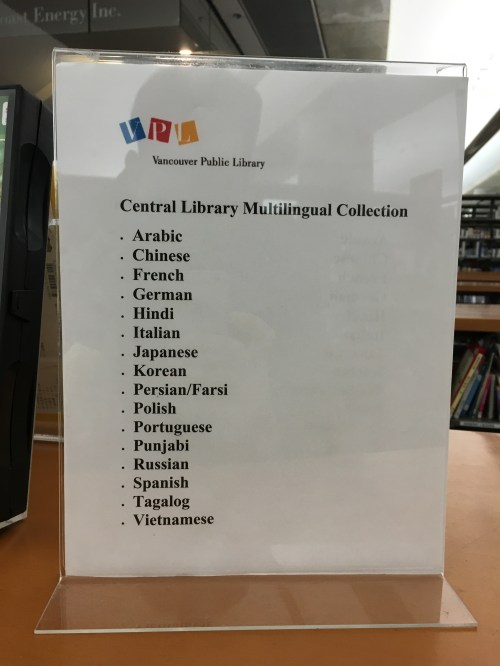

IMG_8565

IMG_8559

There were also some children’s books in other languages but not nearly as many (or as diverse) as in the adult books section.

IMG_8560

The part that I found quite emotional was the “VPL Skilled Immigration Information Centre” which helps newly resident skilled immigrants find work. They have created 8-10 page booklets on each career with information on things like starting salaries, industry websites, and who the large employers are in that field. In the handbook on ECD practitioners there was even a section on “hidden jobs” and how to access these (jobs that aren’t advertised anywhere!).
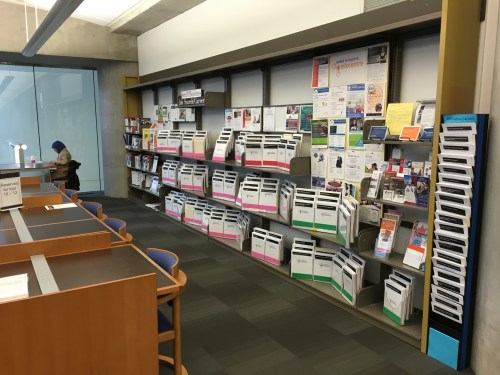
IMG_8579

Like many people I have been following the US presidential nominations and the contrast between the Canadian and American responses to the Syrian refugee crisis are just worlds apart. America has agreed to welcome 10,000 Syrian refugees while Canada is taking in 25,000 Syrian refugees (Note: American population: 319 million,  Canadian population: 35 million). But for me it actually wasn’t about the numbers it was about the tone and the attitude towards refugees (and diversity in general). This was one of the posters in the library:

IMG_8585

The day before I was taking the bus to the Capilano Suspension Bridge Park and saw a photo of a Syrian girl on the side of the bus with an explanation that the government of Canada would match dollar-for-dollar any donation Canadians made to charities supporting the Syrian refugees (Red Cross, UNICEF, Save the Children etc.), and that this was up to $100 million. Once at Capilano I was also encouraged by the way that the official guides spoke of the traditions and knowledge of the First Nations people. As we walked around the park the guides told us why the First Nation’s people named certain trees the way they did and about their cultural traditions and practices. At no point did I feel that they were being exoticised or belittled. Their insights and names were woven into the park’s signs and boards and included in the children’s treasure/science hunt maps.

Back to the library, thisScreen Shot 2016-03-19 at 3.28.49 PM disposition towards diversity was strongly emphasised. The library not only has an Author-in-Residence, but also an Aboriginal-Storyteller-in-Residence aiming to foreground and highlight the oral tradition of the aboriginal people.

Throughout the library there were references to Syria and the refugee crisis with materials, both for Canadians and Syrians. In the children’s section there was even a list of picture books about refugees from other countries to help children understand what was going on.

Screen Shot 2016-03-19 at 4.22.18 PM

I was so impressed by the work that the children’s librarians had done. There were curated reading lists for different age groups and different topics with brief explanations of each book next to a picture of the front page. The front covers of each booklet are included below:

IMG_8690

Forging the path of what a library looks like in the 21st century

Another thing I was struck by was how modern and professional everything looked. Apart from things like couches, computers, wifi and art, I got the distinct sense that the library was trying to claim for itself a space in the digital age. At the VPL Inspiration Lab there were multiple recording rooms  with specialist microphones and video-cameras, green-screens, conversion devices (digitising VHS, for example). And all of this was free. There were also pamphlets and courses on things like how to save a document, how to browse the internet, and how to use social media (presumably for the elderly).
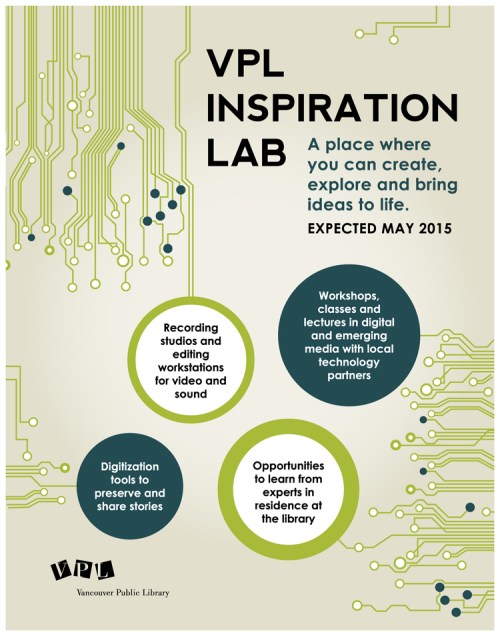
InspirationLab2

In fact while I was walking around the Inspiration Lab I saw someone giving a talk to about 12 people on ISBN numbers and how to publish your own book, and someone recording their narration of a book…
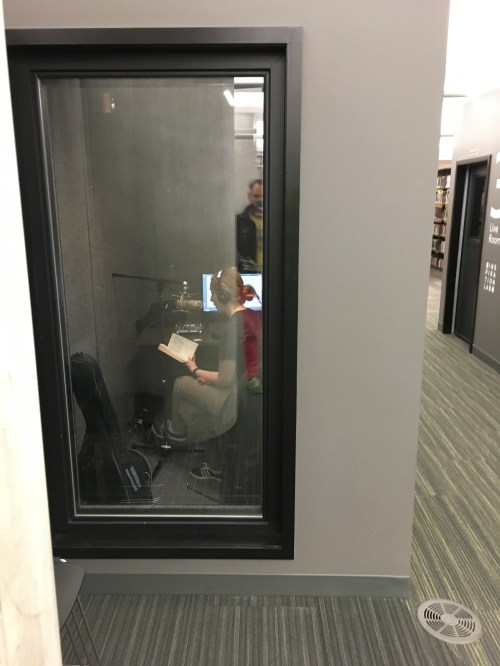
IMG_8571

And this is something that is explicitly encouraged and facilitated by the library:

Screen Shot 2016-03-19 at 3.30.17 PM

Since coming home and reading their Annual Report I quickly realised that the VPL is not the norm, either in Canada or in the OECD countries, and certainly not in South Africa. The Vancouver Public Library was ranked the best library in the world in one study. Now obviously these rankings (like all rankings) are a little dodgy, but the point is that this is one of the top libraries in the world.

My thoughts about VPL have been sloshing around in my brain for a week now and I’ve started realising a number of things about myself and public versus private goods. Growing up I think we did visit the public library a few times but it wasn’t anything spectacular or interesting. I never developed a love of public libraries or fully appreciated the role they could play in providing a social commons where books, information and knowledge were the principal means of engagement and interaction. Rather they were low-budget cranky places with old books and old people. Instead I developed a love of book-shops and book ownership. I think this was because walking around a good book shop felt welcoming and interesting; it has new books, has displays, has events (book launches, readings, discussions), it doesn’t feel grimy. But this is only because I can afford to buy the books that I like. And so here I start to see in my own life one small example of the way that the South African cogs work to perpetuate an unequal system. I don’t use a public library because they are of low quality, I buy books instead. So I never see the value of funding and using a great public library (at least until now). So here we are with thousands of wealthy people with small private libraries essentially each creating their own space that could otherwise be collectively provided by a great public library (and with public funds), which could then also be used by everyone.

I’m sure you can see that it’s not difficult to find the parallels between this and the private provision of healthcare, schooling, legal services, recreational facilities etc as compared to the public provision of these services. So it feels like we’re in a low-level equilibrium where the rich in SA can afford to fund for themselves whatever they need without any recourse to their tax money, and the poor are forced to accept whatever the government provides. This explains why many tax-payers (at least the South African tax-payers I know) see their tax as a kind of fee where you pay it with little expectation of return or service.

It costs a lot of money to fund and operate the 22 libraries that make up the Vancouver Public Library system, R527 million to be exact. Yet 94% of Vancouver residents support the use of tax dollars to fund the VPL.

If I had to say, I do not think that we can simply say “the first step is that the libraries that we do have need to better serve the communities within which they are situated.” while of course that is true, the apartheid legacy means that there are very few well-resourced libraries in the poorest areas (notably townships). I think it is an open question, and one that’s worth discussing, whether a functioning public library system that has the expertise and resources to support local residents (and especially local schools) is worth the considerable resources it would take to create such a system. The case needs to be made that (and in my view, is yet to be made) that it is possible to create such a library given our capacity and resource constraints. And secondly that it is a better use of resources than additional money on housing, child-support grants, teacher development etc.

I’m interested to hear your thoughts Equal Education, Nal’ibali, Bookery, Fundza, Bookdash and everyone in this space. Should we be funnelling millions of rands into creating functional public libraries in low-income high-density locations like Khayalitsha? Why aren’t we? Do we know how to do it? Who should lead the way?

On UFS brutality: No peace without justice

justice

“Justice requires not only the ceasing and desisting of injustice but also requires either punishment or reparation for injuries and damages inflicted for prior wrongdoing. The essence of justice is the redistribution of gains earned through the perpetration of injustice. If restitution is not made and reparations not instituted to compensate for prior injustices, those injustices are in effect rewarded. And the benefits such rewards conferred on the perpetrators of injustice will continue to “draw interest,” to be reinvested, and to be passed on to their children, who will use their inherited advantages to continue to exploit the children of the victims of the injustices of their ancestors. Consequently, injustice and inequality will be maintained across the generations as will their deleterious social, economic, and political outcomes.”

― Amos Wilson

Watching the racial dynamic cluster-fuck that is unfolding at our former White-only universities in South Africa feels like a kind of national de-ja-vu; the revisitation of the ghosts of apartheid. White brutes beating Black protesters in an attempt to protect their privileged way of life even as the legitimate demands of the working class become un-ignorable.

Land, fees, language, inequality…IMHO all of these boil down to a lack of adequate reparation and restitution at 1994. Too much fake kumbaya, too little real redistribution. As an artificial group ‘selected’ and ‘glorified’ by apartheid, White people did not offer up an unqualified admission of guilt and of unlawful enrichment as apartheid ended. Forgiveness was offered before it was asked for. Looking back over the last few years, or looking ahead at the elections to come, the topic may change but the tune is the same – people that have been consistently fucked over by colonialism, apartheid and now a self-enriching elite are eventually saying “Enough is enough, we also want a dignified existence.”

I cannot see how there can be true forgiveness and reconciliation without justice and reparations. There can be no sustainable peace and shared prosperity without justice.


In the Olden Days there were no women…

The trouble with women

From here.

New education research (SA)

Screen Shot 2016-02-21 at 1.33.10 PMImportant new research article by Stephen Taylor and Marisa von Flintel (2016) titled “Estimating the impact of language of instruction in South African primary schools: A fixed effects approach
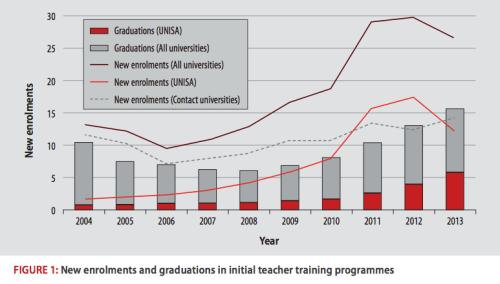
“For many children around the world, access to higher education and the labour market depends on becoming fluent in a second language. In South Africa, the majority of children do not speak English as their first language but are required to undertake their final school-leaving examinations in English. Most schools offer mother-tongue instruction in the first three grades of school and then transition to English as the language of instruction in the fourth grade. Some schools use English as the language of instruction from the first grade. In recent years a number of schools have changed their policy, thus creating within-school, cross-grade variation in the language of instruction received in the early grades. Using longitudinal data from the population of South African primary schools and a fixed-effects approach, we find that mother tongue instruction in the early grades significantly improves English acquisition, as measured in grades 4, 5 and 6.”

“A rising number of school leadership changes have been occurring in South African schools as a large proportion of incumbent principals near retirement age. While this presents opportunities to replace weaker school principals with better performing ones, these changes may also destabilise school environments and impede on learning. This paper explores how these principal change events affect school performance in the context of South Africa using a unique administrative dataset constructed by linking payroll data on the population of public school principals to national data on schools and matriculation examination outcomes. Exploiting the panel structure of the data, a school fixed effects strategy suggests that principal changes are indeed detrimental to school performance especially when leadership changes are due to principals exiting the public education system. These results are robust to using an alternative estimation strategy proposed by Heckman, Ichimura and Todd (1997) which combines propensity score matching with a difference-in-difference estimation strategy. The paper also considers two mechanisms through which school leadership changes may impact on school performance, namely through rising promotion rates and teacher turnover”

  • Two new policy briefs released by RESEP (1) “Increasing the supply of teacher graduates” (Hendrik van Broekhuizen) and (2) “Education datasets in South Africa” (Chris van Wyk).

    In the first of these, Hendrik van Broekhuizen describes teacher graduate production in South Africa in the context of existing teacher shortages and finds that universities are still not producing enough teacher graduates  to satisfy the demand for qualified new teachers in South African schools.   Importantly he also stresses the importance of UNISA in the production of new teachers –  between 2008 and 2013 UNISA accounted for half (48%) of all new enrolments in initial teacher education. Despite rising enrolments in teacher training programmes over the past decade, enrolment levels remain low. This is exacerbated by the fact that too few students complete their training programmes and too few new teacher graduates become teachers. His research highlights the need to (1) promote the teaching profession, (2) increase the absorption of new teacher graduates, (3) expand targeted funding for African-language teaching students, and (4) place greater focus on UNISA’s increasingly important role in teacher graduate production.   The full research paper can be found here. The graph below summarises the UNISA situation well…

Screen Shot 2016-02-21 at 1.29.12 PM

Important new education research

holy

    • Ursula Hoadley and Joe Muller have just published their important paper looking at assessment in South Africa “Visibility and differentiation: Systemic testing in a developing country context” (Curriculum Journal, 2016)- I prefer their earlier title “Testing testing: Investigating the epistemic potential of systemic testing” (Un-gated draft-version of that paper here).
    • Why has large-scale standardised testing attracted such a bad press? Why has pedagogic benefit to be derived from test results been downplayed? The paper investigates this question by first surveying the pros and cons of testing in the literature, and goes on to examine educators’ responses to standardised, large-scale tests in a sample of low socio-economic status (SES) schools in the Western Cape, South Africa. The paper shows that teachers and school managers have an ambivalent attitude to tests, wary of the reputational costs they can incur, but also curious about the differentiated picture test results can give them as they learn to ‘read’ the underlying codes embedded in the results. The paper concludes that a focus on what tests make visible and a recognition of the pedagogic agency of teachers points to potential pedagogic benefits of systemic tests.

    • Craig Paxton has finally finished his PhD thesis “Possibilities and constraints for improvement in rural South African schools” (UCT, 2015). This is on my to skim/read list together with Eric Schollar’s PhD (see below)
    • Part of Craig’s PhD abstract:”Rural South African schools face a complex mix of challenges, which make improvement a daunting task. Not only do schools deal with the time, place and space issues that face rural schools worldwide, but in addition they contend with a legacy of severely deprived schooling under the apartheid system. Using the framework of the Five Essential Supports, developed by the Consortium on Chicago School Research, together with Bourdieu’s notions of habitus and doxa, this thesis examines what improvement might mean in this deeply disadvantaged context. The five supports – leadership, learning climate, school-community ties, ambitious instruction and professional capacity – are contextualised to account for both the rural setting and the peculiarities of education in South Africa’s former homeland communities. Alongside this largely quantitative framework, Bourdieu’s conceptual tools are brought to bear, offering an alternative perspective that makes sense of the complex forces produced by history and rurality

    •  Pritchett’s new (2015) RISE Working Paper “Creating Education Systems Coherent for Learning Outcomes.” This has been quite an influential paper for me. Although in the South African context I would almost always add “Capacitation” to his four criteria Delegation, Financing, Information, Motivation. Lant also has a great (and scathing) critique of meta-analyses of quantitative studies:
    • If one were to take this approach of “rigorous evidence” at face value then there is rigorous evidence that nothing in the conventional wisdom actually works. There is rigorous evidence that giving out textbooks doesn’t matter, there is rigorous evidence pay for performance doesn’t matter, there is rigorous evidence that class size doesn’t matter. Of course there is also rigorous evidence that all these elements of the conventional wisdom do matter. The usual approach of doing a “systematic review” of the literature that simply counts studies (in a quality weighted basis) is not at all helpful. Suppose that context A is a system coherent for learning—so that teachers know what students should learn, that learning is measured on a regular and reliable basis and teachers are motivated to achieve high student learning—and class size is reduced. Let’s assume that learning improves (as there is RCT evidence from the USA, for instance, that this is true). Context B is a system coherent for schooling only. Class size is reduced. Let’s assume learning doesn’t improve (as there is RCT evidence from Kenya, for instance, that this is true). Suppose the only two studies in the systematic review were USA and Kenya. Then the conclusion would be that “class size improves student learning in 50 percent of the studies.” Now suppose that 8 more rigorous studies were done in the USA so that a systematic review would conclude “class size improves student learning in 90 percent of studies.” Suppose, in contrast, 8 more studies were done in Kenya. Then a systematic review of the rigorous evidence would conclude “class size improves student learning in 10 percent of the studies.” All three statements are equally worthless. The (assumed) truth is that “class size improves performance in context A but not in context B” and hence unless one knows whether the relevant context is A or B the systematic review finding of impact in 50 percent, 90 percent or 10 percent of the studied cases is irrelevant.

  • Glewwe & Muralidharan’s new (2015) RISE Working Paper “Improving School Education Outcomes in Developing Countries” they find that:
  • Interventions that focus on improved pedagogy (especially supplemental instruction to children lagging behind grade level competencies) are particularly effective, and so are interventions that improve school governance and teacher accountability