The amazing Susan Sontag on photography…

train mountain

As photographs give people imaginary possession of a past that is unreal, they also help people to take possession of space in which they are insecure … Photographs will offer indisputable evidence that the trip was made, that the program was carried out, that the fun was had. Photographs document sequences of consumption carried on outside the view of families, friends, neighbours. But dependence on the camera, as the device that makes real what one is experiencing doesn’t fade when people travel more. Taking photographs fills the same need for the cosmopolitans accumulating photo-trophies of their boat trip up the Albert Nile or their fourteen days in China as it does for the lower-middle-class vacationers taking snapshots of the Eiffel Tower or Niagara Falls. A way of certifying experience, taking photographs is also a way of refusing it – by limiting experience to a search for the photogenic, by converting experience into an image, a souvenir. Travel becomes a strategy for accumulating photographs. The very activity of taking pictures is soothing, and assuages general feelings of disorientation that are likely to be exacerbated by travel. Most tourists feel compelled to put the camera between themselves and whatever is remarkable that they encounter. Unsure of other responses, they take a picture. This gives shape to experience: stop, take a photograph, and move on. The method especially appeals to people handicapped by a ruthless work ethic – Germans, Japanese, and Americans. Using a camera appeases the anxiety which the work-driven feel about not working when they are on vacation and supposed to be having fun. They have something to do that is like a friendly imitation of work: they can take pictures” (Susan Sontag On Photography p10).

I really love this piece of cultural observation from Susan Sontag (published over 36 years ago). More than a few friends of mine have remarked how liberating it felt when they forced themselves to put their camera away for a few days while travelling. After getting over the initial fomo they recalled a far more tangible sense of being present and living the experience now rather than living it to recall later. In reading her thoughts I find myself smiling guiltily as she easily enumerates my unknown motivations for taking photographs. Whether it be ‘certifying experience’ and providing indisputable evidence that ‘fun was had’, or as a way to placate my own insecurities of being unproductive on holiday – I have been exorcised of my naïve view that photographs are just a means to remember events. Reading things like this helps me to realize that it is easier to focus on doing rather than being, but that being is more important. Doing usually produces something tangible – evidence or proof, something to show for it – what does being produce? Perhaps a life without regrets?

*For an excerpt of the book see here (PDF).
Maties diversity week

Racial breakdown - SU and UCT

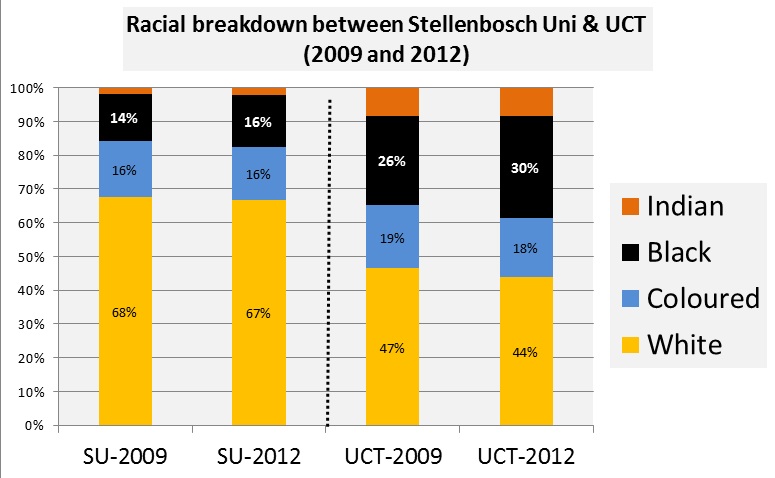
So this week is Maties Diversity Week at Stellenbosch University. While racial diversity is only one element of diversity, given that it was the primary mechanism for discrimination during apartheid, I thought it would be a good one to check. So I went looking for the racial composition of Stellenbosch University and thought I’d chuck in UCT for good measure. (UCT stats from here, SU stats from here). Obviously the major difference between UCT and SU is that SU is primarily an Afrikaans-medium university while UCT is an English-medium university*. Given the correlations between race and language, it is clearly more difficult to attract Black students to SU than it is to UCT (we could also talk about institutional culture and threshold effects but let’s not go there :). What was surprising to me is that there is a lot of talk about transformation at SU, but the numbers suggest very little transformation. In 2009 14% of the SU student population was Black, in 2012 that figure was only 16%. For UCT the figures are only slightly better growing from 26% in 2009 to 30% in 2012. As an aside, it’s helpful to remember that 80% of South Africa’s population is Black (according to the 2011 census). I was especially surprised by the nonexistent growth in the proportion of coloured students at SU (16% in 2009 and 16% in 2012). Given that most coloured students speak Afrikaans as a first language, recruiting the best and brightest coloured students seems like a no-brainer?

I do think that Stellenbosch is moving in the right direction. Recently the SU Council passed a motion that 30% of all first year residence places are reserved for previously disadvantaged students (see Res Placement Policy here), a move that was vehemently opposed by some former SU students.

The links between race, class, language and culture mean that transformation at SU was never going to be easy. Thankfully it looks like those in power at the University have their heads screwed on straight and realize that increased transformation is sorely needed. Given the tortured past that we have in South Africa, it is going to be a difficult task to balance the linguistic rights of Afrikaners with the rights to higher education of a previously disadvantaged and heavily exploited majority. One thing is crystal clear – the status quo is unsustainable and even more than that, it is undesirable.

Also see SU’s 2013 Transformation Strategy here.

*(That being said, there is a push to offer more and more courses in English as well as Afrikaans. for example, if you enrolled to do a BComm in 2013 you could do your entire course from start to finish in English).

Short interview…

unicorn

Recently I did a short interview on education in South Africa for the 2013 CSI Handbook (see here for the 2012 handbook). Although it may get edited, I suspect that it will be mostly what you see below. I’m interested to hear your answers to these questions – feel free to include them in the comments below…

  • What relationships have you discovered between access to education and quality of education in your research?
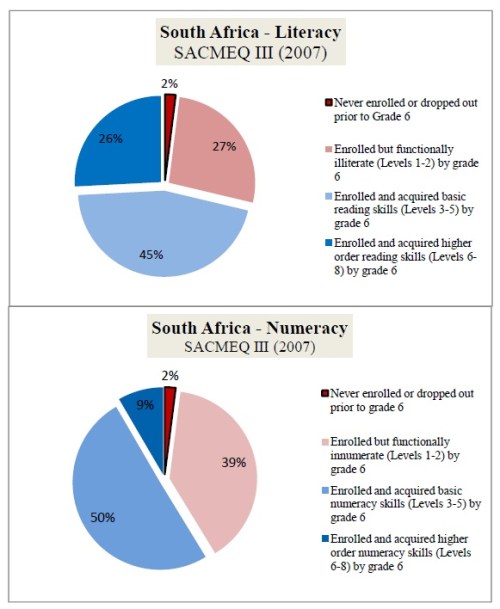
    • Access to education is a necessary but not sufficient condition for learning. Just because children are enrolled in school does not mean that they are learning, in fact, most of the evidence suggests that the majority of South African children are between one and two years behind the curriculum. So, although we have one of the highest rates of primary school enrolment in Sub-Saharan Africa (98%), hundreds of thousands of South African children are functionally illiterate. Rather than only looking at what proportion of grade 6 South African children are enrolled (98%), if we look at the proportion of South African 13 year olds that are literate, the figure is only 71% (in Tanzania it is 82% and in Kenya 87%).
  • You argue that there are two primary school education systems in South Africa and have pinpointed specific factors affecting wealthy and poor schools differently, based on analysis of SACMEQ data. What does this mean for how education interventions are implemented in different schools?
    • Almost all of the evidence we have suggests that we have two public schooling systems in South Africa, not one. The wealthiest 25% of schools are mostly functional and able to educate learners while the poorest 75% of schools are dysfunctional and unable to equip students with the numeracy and literacy skills they should be acquiring in primary school. Given that these two school systems are vastly different and that they face different problems, it’s only logical that interventions should be tailored to that particular school system. School interventions that work for poor schools that are atomized and badly run will, in all likelihood, be inappropriate and unnecessarily constraining for well-functioning schools.  
  • You’ve been vocal in asserting: “Teachers can’t teach what they don’t know”. How are teachers falling short, and why?
    • We know teacher content knowledge in South Africa is a major problem, particularly mathematics teacher content knowledge. Given that teacher content knowledge is central to teaching mathematics (and an integral part of the professional identity of the teacher), we really need to figure out how to improve both what teachers know, and how they teach. Simply getting the right answer isn’t the only concern: overly concrete mathematical methods may ‘work’ in grades one and two, but they prove problematic in higher grades.
  • Is there any empirical evidence to show that investing in teachers’ knowledge improves leaner outcomes? If not, what does improve learners’ results?
    • Internationally there is strong evidence that mathematical content knowledge for teaching does improve learner outcomes but locally there is less evidence. But that’s because very few South African studies of teacher content knowledge employ evaluation methods that are rigorous enough to draw causal conclusions, and most are very small localized studies which are not nationally representative. Perhaps the most convincing international research regarding improving learner outcomes is the importance of quality early childhood development – I think that is really where we need additional emphasis in South Africa. Assessing and raising the quality of Grade R (and pre-Grade-R) in South Africa.
  • Where are the gaps in education research in South Africa?
    • Three things we don’t really understand are 1) The impact of language switching between Grades three and four, 2) how to do in-service teacher training (almost all the existing programs don’t work), 3) what proportions of the low and unequal learning outcomes that we see at the end of Grade 3 are attributable to low quality preschool, home background and low quality Foundation Phase teaching.  

*Thanks @MarinaPape for the cool pic 🙂

Meaning, inequality, sociology and English majors…

happen

  • Such a sweet cartoon about the meaning of questions and questioning meaning 
  • Really useful World Bank tool developed by Deon Filmer. It allows you to easily get graphs and tables on educational attainment and completion for a variety of countries.
  • SACMEQ III (2007) country reports have finally been finalized and are now available for download on the SACMEQ website
  • Angus Deaton writing in the Lancet weighs in on the fight between Sen and Bhagwati by comparing their two new books. Short article and worth the read.
  • The Rise and Consequences of Inequality in the US” – Krueger’s 2012 address to the Council of Economic Advisers. Worth a read. In case you were wondering how unequal South Africa’s income is distributed, the richest 10% of South Africans earn 58% of total income, the poorest 50% earn 8% of total income, and the poorest 10% earn 0.5% of total income (from this 2012 World Bank report on inequality of opportunity in SA).
  • The latest edition of the British Journal of the Sociology of Education is on “Education and Social Mobility” – some interesting stuff in there. I’m glad the sociologists are seeing the light as far as empirical research is concerned. One quote from the intro by Brown, Reay & Vincent: “The mass of research on student identities, aspirations and experiences of school, college and university has been overlooked, partly because it is primarily based on qualitative rather than quantitative methods of data collection. While this points to a weakness in mainstream mobility studies it also points to a failure of the sociology of education to engage in broader debates around intergenerational mobility, notwithstanding its engagement with wider debates on social inequalities and social justice. It also raises questions as to whether the next generation of education researchers will have the training in quantitative methods and techniques to engage in future mobility studies” (p.638).
  • A. H. Halsey has similar sentiments when he says that “Conflicts between advocates of quantitative and qualitative methods still rage in sociology. I can claim to be among the pioneer supporters of quantitative methods but also to have been friendly towards qualitative work. Nevertheless, the neglect of statistical training still seems to me to be a barrier, not only to sociological understanding but also to the supply of competent teachers of the subject
  • Quote of the week by Adam Gopnik “So: Why should English majors exist? Well, there really are no whys to such things, anymore than there are to why we wear clothes or paint good pictures or live in more than hovels and huts or send flowers to our beloved on their birthday. No sane person proposes or has ever proposed an entirely utilitarian, production-oriented view of human purpose. We cannot merely produce goods and services as efficiently as we can, sell them to each other as cheaply as possible, and die. Some idea of symbolic purpose, of pleasure-seeking rather than rent seeking, of Doing Something Else, is essential to human existence. That’s why we pass out tax breaks to churches, zoning remissions to parks, subsidize new ballparks and point to the density of theatres and galleries as signs of urban life, to be encouraged if at all possible. When a man makes a few billion dollars, he still starts looking around for a museum to build a gallery for or a newspaper to buy. No civilization we think worth studying, or whose relics we think worth visiting, existed without what amounts to an English department—texts that mattered, people who argued about them as if they mattered, and a sense of shame among the wealthy if they couldn’t talk about them, at least a little, too. It’s what we call civilization.” From the New Yorker article “Why teach English?


Links I liked…

racial stereotypes


I’m currently in Helsinki at the UNU WIDER conference on “Inclusive Growth in Africa” – I presented my paper which combines access to education and the quality of education. Helsinki is a pretty cool city although not particularly exciting or historically important. Tallinn, which is just a 2.5 hour ferry-ride away, is much more interesting and quaint.

  • Conceptual map of learning theories in education – helpful mind-map of all the different learning theories with links to their Wikipedia pages.
  • Also using CMAP technology, check out the Grade 4 – 6 Life Sciences and Natural Sciences concept maps developed by Megan Beckett at Siyavula. On the Thunderbolt Kids website you can also download posters and textbooks for Grades 4-6.
  • The 1861 infographic that Abraham Lincoln used to see the reach of slavery in the US – here. (via FarnamStreetBlog).
  • Wonderful lecture by Eugene Peterson titled “Teach us to Care and Teach us Not to Care” (PDF)
  • The Institute of Education Sciences’ “What Works Clearinghouse” is a really interesting concept. Essentially like a meta-analysis tool to give end-users (like teachers) an overview of what the research says on a particular topic. Very interesting. I want one!
  • Great repository of CS Lewis articles – here
  • ChronoZoom – looks pretty cool 🙂

SACMEQ at a glance for 10 African countries…

SACMEQ at a glance


Towards the end of last year I got really frustrated that no one had used the SACMEQ data to create an “Education at a Glance” type of document which contained the essential statistics we can get from SACMEQ. (For those of you who don’t know, SACMEQ is a survey that is conducted in 14 African countries and tests Grade 6 students in mathematics and language and also has a bunch of other information on things like teacher content knowledge, student background, school facilities etc.) So I holed myself up in my office for a few days and did the number crunching and created “SACMEQ at a Glance (10 countries combined PDF)” for ten of the SACMEQ countries. For some reason I didn’t blog about it when I did it, so here it is 🙂

It’s been available on the RESEP website for some time now and I’ll include the decriptive blurb from there below:

“The SACMEQ at a glance series is part of an ongoing research project on data from the Southern and Eastern African Consortium for Monitoring Educational Quality (SACMEQ). The aim of these documents is to provide a two page snapshot of some important elements of the primary school system in each of the participating countries, allowing for comparisons both within and between countries. Statistics are reported for ten African countries for SACMEQ II (2000) and SACMEQ III (2007). The ten countries are: Kenya, Lesotho, Malawi, Namibia, South Africa, Swaziland, Tanzania, Uganda, Zambia and Zimbabwe. The results are also presented for three sub-groups: school location (urban and rural), gender (boys and girls), and student wealth (poorest 25% of students and wealthiest 25% of students) for each country. Some of the reported statistics include the prevalence of functional illiteracy and innumeracy, textbook access (reading and mathematics), pupil-teacher ratio, teacher content knowledge, proportion of students receiving a free school meal, as well as the proportion of schools with electricity and water, among many other statistics. These documents should be a helpful resource to researchers and policy-makers alike, providing accessible information in a comparable format.”

Choice, data, assessments and success…

yellow x

  • A wonderfully-witty article on liberty, choice and ranting manifestos about public versus private education. This is no surprise to you but it turns out I’m a bad person. (Thanks @HendrikvanB)
  • Wentworth Miller declines an invitation to be guest of honor at the St Petersberg Film Festival in Russia because he is gay. That’s certainly one way to come out 🙂
  • A NYT article that every academic in an education faculty should read (and every politician for that matter) titled “Guesses and hype give way to data in study of education” [as an aside – this is pretty funny 🙂 )
  • Motshekga announced this week that teacher assessments will go ahead, not that I think my article had anything to do with this, but I did publish an article only one week ago on this exact topic – “Teacher’s can’t teach what they don’t know
  • Quote of the week is by Victor Frankl via BrainPickings: “Don’t aim at success — the more you aim at it and make it a target, the more you are going to miss it. For success, like happiness, cannot be pursued; it must ensue, and it only does so as the unintended side-effect of one’s dedication to a cause greater than oneself or as the by-product of one’s surrender to a person other than oneself. Happiness must happen, and the same holds for success: you have to let it happen by not caring about it. I want you to listen to what your conscience commands you to do and go on to carry it out to the best of your knowledge. Then you will live to see that in the long run—in the long run, I say!—success will follow you precisely because you had forgotten to think of it.

Links for your perusal…

_be yourself

  • A couple of cool TED talks which are worth watching:
  • Whites must make sacrifices to uplift SAs poor – Thought-provoking and sobering interview with Stellenbosch Emeritus Professor Sampie Terreblanche on the state of South Africa’s unequal society, the dodgy dealings between the ANC and white-business around the time of the transition and what needs to be done to fix the situation. The status quo is not OK.
  • Damning CHE report into university performance‘ – M&G article
  • Some cool new technology/education links:
    • BioDigital Human – an interactive free web app that visualizes the human body in all its complexity. The future of biology education and medical training 🙂
    • Google Make – Think of this as Google meets Mythbusters meets STEM education. Videos about how to make moulds, build circuits and do all the cool things that kids (and adults) love to do.
    • NewsCorp’s Amplify Tablet – 3 minute video showing what the future of digitized education might look like. How exciting 🙂
  • “Understanding comes with the mixture of knowledge and experience…start to handle the world as you handle your country and your community” – Great 5 minute video with Hans Rosling.
  • Pictures tell stories that words can only hint at…inequality as seen through children’s bedrooms: Where children sleep
  • Super useful matrix of SABER reports by the World Bank showing in one table all the education reports for all the countries. Brief reports on EMIS, Accountability, Teachers etc
  • Report on Teacher Quality from the 2013 International Summit on the Teaching Profession
  •  Quote of the week: “The increasing tendency towards seeing people in terms of one dominant ‘identity’ (‘this is your duty as an American’, ‘you must commit these acts as a Muslim’, or ‘as a Chinese you should give priority to this national engagement’) is not only an imposition of an external and arbitrary priority, but also the denial of an important liberty of a person who can decide on their respective loyalties to different groups (to all of which he or she belongs).” ― Amartya SenThe Idea Of Justice

Teachers cannot teach what they do not know

Welcome to the future…

big history project

  • 21st century education has arrived. The Big History Project (above). Bill Gates throws his weight behind a brilliant history professor and creates an interactive website which has lesson plans, assessments, videos, links, worksheets, and everything you might want when teaching high school history about the big questions in life. So very happy to see this!! Now we just need this for 25 other topics/subjects and we will have a world-class education available to anyone with an internet connection! How exciting.
  • Two photos of the Shanghai skyline taken 26 years apart. Definitely the most incredible image I’ve seen this year. Pictures speak a thousand words.
  • The history of the world since 2000 BC distilled into a single graph – wow. WOW!
  • 40 maps that will help you make sense of the world – incredible!
  • Great 2 minute video animation about the Pale Blue Dot 
  • Great OECD case study on the success of education reform in Brazil: “Brazil: Encouraging lessons from a large federal system
  • Teaching teachers technology – M&G article summarizing the recent EdTech conference in SA.
  • “You become like the 5 people you spend the most time with” This awesome group photo from the Solvay International Conference on Electrons and Protons has 29 people in it, 17 had already won or would go on to win the Nobel Prize. Go Marie Curie!

We read, we lead…

batteries

Some great course outlines for those of you eager to find comprehensive reading lists on curriculum, education in developing countries and the economics of education:


Sunday reading…

the-people-dont-know-their-true-power-tc-cartoon-sad-hill-news


The arc of history is bent towards justice…

133776_600

  • A usually conservative US Supreme Court recently ruled that the Defense of Marriage Act (DOMA) is unconstitutional. Their rulings on Prop 8 also clears the way for gay marriage in California. On this note, it’s always nice to remember that while the arc of history is long, it is bent towards justice (MLKJ). What yesterday seemed ridiculous (women voting? Interracial marriage? Equal rights for black Africans) is today commonplace. The legalization of gay marriage across the States and across the world is now just a matter of when, not if. Wonderful to think that gay marriage has been legal in South Africa for almost 8 years – in 2006 the National Assembly passed the motion by a vote of 230 to 41.
  • For those of us ascribing to the Christian faith, I highly recommend this article by Prof Smedes titled: “Homosexuality and divorce, why not treat them the same?” and this letter from the Bishop of Salisbury. For those concerned with secular ethics see “Homosexuality is not immoral” by Peter Singer. I obviously have more to say on this issue so there will definitely be a post or two on this in the future…
  • On a related note, Exodus International – the largest ex-gay / pray away the gay – ministry issued an apology and shut down. Also see this The Beast article on this – I loved the quote “Mercifully, there comes a point when even the most committed of ideologues admit defeat.”
  • Really useful website “World Data on Education Seventh Edition 2010/11” – helpful country summaries for LOADS of countries…
  • Awesome website showcasing the interiors of wonderfully creative people: http://theselby.com/ – thanks Laura Rossouw
  • The wonderful Stephen Fry on loneliness and his attempted suicide.
  • Quote of the week comes from An interview with Milton Friedman:
    • “I think the major issue is how broad the evidence is on which you rest your case. Some of the modern approaches involve mining and exploring a single body of evidence within itself. When you try to apply statistical tests of significance, you never know how many degrees of freedom you have because you’re taking the best out of many tries. I believe that you have a more secure basis if, instead of relying on extremely sophisticated analysis of a small fixed body of data, you rely on cruder analysis of a much broader and wider body of data, which will include widely different circumstances. The natural experiments that come up over a wide range provide a source of evidence that is stronger and more reliable than any single very limited body of data.”

Experimentation: The only way to improve education in SA

I am currently doing some research which draws extensively from the work of Rodrik and Hausmann, particularly their “Growth Diagnostics” approach (see especially page 13). In it they talk about the importance of experimentation to figure out what works, often using China as the example par excellence. For example: “Can anyone name the (Western) economists or the piece of research that played an instrumental role in China’s reforms? What about South Korea, Malaysia or Vietnam? In none of these cases did economic research, at least as conventionally understood, play a significant role in shaping development policy…China owes a great deal of its success to a willingness to experiment pragmatically with heterodox solutions…The process of China’s policy reform consisted of diagnosing the nature of the binding constraints and identifying possible remedies in an innovative, experimental fashion with few preconceptions about what works or is appropriate” (Rodrik, 2009). Rodrik then goes on to apply this notion to Randomized Control Trials (see this excellent document on RCTs for policy):

  • “Randomized field experiments, which are legion in this area, have demonstrated considerable success with specific interventions. Importantly, some of these interventions—on school subsidies or remedial education, for example—have been replicated in a number of different contexts (Kremer and Holla, 2009). Still we have very little guidance from this literature on how we proceed to identify education interventions that are most suited to and likely to be most effective in a particular setting. We get even less help on diagnosis in other areas such as reducing corruption or increasing  manufacturing productivity which have received only spotty attention from randomizers. The best among randomized trials in development economics are of course informed by some diagnostic process, but curiously, micro-development economists are often not very explicit about the steps needed to identify the most serious failings in a given context. Nor are they very clear about how one narrows a very large list of potential solutions to a smaller number of interventions most likely to be effective” (Rodrik, 2009: 17).

Now there is much to be said on the application of this kind of logic to South Africa’s education system. If you speak to people who actually know what is going on in South Africa, you will be surprised how much they will admit to not knowing. Should we switch from mother-tongue instruction to English at grade four or grade six, or just go straight-for-English and teach in English from grade one? What is the best method of improving teacher quality in South Africa? Short in-service courses at an academic institution, teacher knowledge tests with incentives, or on-the-job training and coaching (as just a few examples)? What is the best method of raising academic achievement in Grade R and Foundation Phase? Is it graded-readers in an African language? Standardized tests? Teacher training (what training?)? In all of these instances we really don’t know what the answer is, and these are not trivial questions – they are of the utmost importance.

One of the biggest problems is that we are not willing to experiment and figure out what works. Randomized control trials (RCTs) could help us answer these questions by taking a sample of schools (say 300) and randomly allocating 100 to receive graded readers in an African language, 100 where the teachers receive teacher training and coaching, and 100 as a control (against which the ‘impact’ of the other two can be measured). This would help us answer one of the questions above. (Incidentally this is one of the few – perhaps only – RCTs that have been proposed in South Africa for education (by Stephen Taylor et al, currently on the drawing board and looking for funding I think).

One of the reasons why we have so few RCTs underway in South Africa is that RCTs are quite expensive, sometimes between R5-10 million, but not always. This is where we need to take a small diversion and emphasize that when you are spending in excess of R200 000 000 000 (R200bn+) on education, as we do in South Africa, allocating at least R150m per year for about 25 RCTs annually is really just common sense. At the moment I think there is only one RCT looking at education underway in South Africa (looking at the impact of Khan Academy here in the WC), at least that I am aware of. These impact evaluations would allow us to definitively answer questions which we really don’t know the answers to, and without RCTs, may never know the answer to. Unless we can be given the freedom and finances to experiment with reasonable proposals (and implement and test them according to high standards) we will never be able to figure out what works. Experimenting on a small scale (a few hundred schools at a time) and figuring out what works first, before going to scale, is much more sensible and cost-effective than simply rolling out untested policies which is basically our modus operandi at the moment.

The need for experimentation in South African education cannot be overstated. The Department, Presidency and Treasury all need to put their money where their mouth is and get the ball rolling on RCTs – especially in education!!

Some other useful links:

M&G 200 Young South Africans :)

  • I recently got selected as one of the M&G’s 200 Young South Africans for 2013 (*happy dance*). You can find the write-up (of which I am very fond!) here. The picture above (from the M&G site) was taken in Kalk Bay and has absolutely nothing to do with education or research…moving swiftly along….
  • Cool blog: FarnamStreetBlog (via ClintClark) – Similar to BrainPickings (which you MUST follow if you don’t already).
  • The best websites in the world – information overload (not for those of the FOMO persuasion).
  • The Bishop of Salisbury weighs in on the legalization of same-sex marriage in the UK. Sensible.
  • US views on same-sex marriage summarized in four neat graphs – basically the issue is generational and religious (no shit Sherlock).
  • Long but interesting (and informed) Politicsweb article about education in South Africa. Sean Muller (UCT) needs to be brought into the education fold me thinks…
  • Some awesome quotes (via GMVP, who refuses to have an online presence – whatevs): “There is no reason to be absolutist about either aggregated data or novelistic narrative as research methods. The tension between qualitative and quantitative methods reflects the contradiction between the impersonal and personal faces of democracy, the moral need to both respect and transcend our finitude.” (213 – 214)
  • “Stories compress characters and events, and statistics reveal patterns we would have missed otherwise. Their key difference lies at another level: in the approach to death. Stories teach us to mourn, and statistics teach us to see impersonal order. (…) Stories teach the ethic of caring, statistics the ethic of not caring. Statistical thinking is a methodological Buddhism.” (214)
  • Quote of the week by JFK: “Our gross national product counts air pollution and cigarette advertising, and ambulances to clear our highways of carnage. It counts special locks for our doors and the jails for those who break them. Yet the gross national product does not allow for the health of our children, the quality of their education, or the joy of their play. It does not include the beauty of our poetry or the strength of our marriages; the intelligence of our public debate or the integrity of our public officials… it measures everything, in short, except that which makes life worthwhile.” (can I get an Amen!?)

Make Wikipedia free on cellphones

_wiki

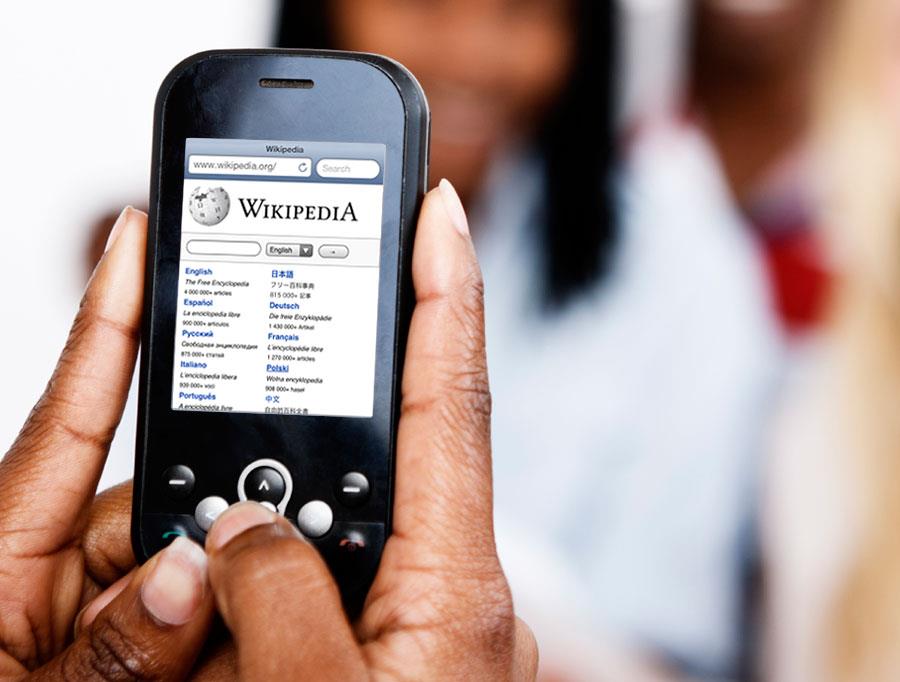
I wrote an open letter to the CEO’s of Vodacom, MTN and Cell-C asking them to make Wikipedia free on cellphones. You can find the article on the Sowetan website HERE. I include the full letter below…sharing is caring so feel free to spread far and wide…hopefully the right people see it and realize the power they have to effortlessly improve the education of millions of children. You can also like this FB page.

“THIS Youth Day, three companies have the power to change the lives of 12 million South African children with the stroke of a pen.

This may sound like the usual political rhetoric around Youth Day, but I assure you, this is probably the most tangible opportunity of 2013. The idea is simple: provide mobile access to Wikipedia free of data charges. It isn’t complicated or glamorous, but it would put the world’s knowledge in the hands of millions of South African youths, especially those without libraries or computers. “What is chlorophyll?”; “Who was Seretse Khama?”; “Where are the Canary Islands?” – four million articles on absolutely everything, all accessible through a cellphone.

So, if your name is Shameel Joosub (CEO of Vodacom), Sifiso Dabengwa (CEO of MTN), or Allan Knott-Craig (CEO of Cell-C) this could be one of the best (and most satisfying) decisions of your life. Listen to the Wikimedia Foundation or listen to the under-resourced Sinenjongo High School who have explicitly asked for free access to Wikipedia – if all else fails then listen to reason. The world is evolving in an increasingly digital way and encouraging cellphone use in education is just plain business sense. One need not remind you that these are your future customers and employees. There really isn’t a legitimate reason why not to. We already know it’s possible since British mobile operator Orange currently provides access to Wikipedia for free on its network in 20 countries across Africa and the Middle East, including Kenya, Uganda, Egypt and Tunisia.

So why not in South Africa?

I can’t imagine that the data revenues from South Africans accessing the (primarily text-based) Wikipedia Mobile are anything that would affect the bottom line, and anyway, these miniscule losses couldn’t hold a flame to the positive public relations and social capital from such an important policy. This kind of project is the very definition of corporate social investment. It was only last month that Vodacom announced a yearly net profit of R13-billion, up 23% from the previous year. This is great news for the company, employment and the economy. Making access to Wikipedia free is a drop in the ocean for these companies, but opens the world of knowledge to millions of South African children, who are themselves future customers and employees.

Perhaps the case isn’t compelling enough. So let’s look at some cold hard facts. Less than 20% of South African schools have a library or a computer centre. Where are pupils meant to go if they don’t know something?Of 100 pupils that start grade 1, only 50 will make it to matric, 40 will pass and 12 will qualify for university. Only 13% of schools have any access to the internet. If one excludes Gauteng and the Western Cape that figure plummets to 5%.The majority of pupils in South Africa come from resource-poor homes with almost no access to information. On top of this, most pupils are learning in their second language – frequently coming across concepts and words they don’t understand, what are they meant to do?All of these statistics are in stark contrast to the ubiquitous presence of cellphones in the country, with cellphone penetration reaching 98% this year.

In a 2010 research study, World Wide Worx estimated that 65% of urban cellphone users have the capacity to access the internet, with this figure likely to be even higher for the youth. This really is a hugely untapped resource.If one thinks of the enormous benefits of this easy-to-implement plan and the fact that other mobile phone companies have successfully implemented it in other African countries we need to ask; why can’t this be done in South Africa?

Vodacom, MTN and Cell-C control 99% of the mobile phone business in South Africa and with a stroke of a pen they could help change the educational landscape of the country. This is an idea whose time has come.So Mr Joosub, Mr Dabengwa and Mr Knott-Craig, what are you waiting for? Pick up your pen and change the lives of 12 million South African children.

Let go or be dragged…

_zen


So the picture here is in reference to an article I wrote for Youth Day which will hopefully be in one of the papers this weekend (provided the Stellenbosch folk at Ogilvy get crack-a-lacking). But just to make you feel special (whoever you blog-followers might be) this is the opening paragraph:

“This Youth Day three men have the power to change the lives of 12 million South African children, with the stroke of a pen. This may sound like the usual political rhetoric around Youth Day, but I assure you, this is probably the most tangible opportunity of 2013. The idea is simple: provide mobile access to Wikipedia free of data charges.  It isn’t complicated or glamorous, but it would put the world’s knowledge in the hands of millions of South African youths, youths without libraries or computers or the Internet. “What is chlorophyll?”; “Who was Seretse Khama?”; “Where are the Canary Islands?” – four million articles on absolutely everything, all accessible through a cell phone.” 

The three men are the CEOs of Vodacom, MTN and Cell-C. And for the regular interesting reading, see:

Back to basics…

lego


One night while sitting in my hotel room in Hamburg feeling frustrated and angry after reading the South African news on education I wrote this article on the Minimum Norms and Standards saga: “Don’t shoot for the stars” it’s banging the usual drum…back to basics…water, toilets and electricity before libraries, microscopes and computers. Duh? I know right. Feel free to like the M&G page or tweet – a journalist is my backup career in case I flunk academia 🙂

Back to work…

forrest man

So I’ve just got back from training in Hamburg where we looked at how to analyze international large-scale assessment databases like PIRLS, TIMSS and PISA (watch this video by the master of PISA Andreas Schleicher). I’m planning on using prePIRLS and TIMSS for one paper of my PhD so this was really useful for me. For those interested in an exhaustive list of papers published with IEA data – you can find it here – very useful resource!

Germany was great – public transport is ubiquitous, as are public parks and rain. The Stadtpark in Hamburg and the Tiergarten in Berlin were two of the highlights of my trip. If I had to be honest about what I enjoyed most about Berlin (and there is a lot to enjoy) it would be one particular cafe called St Oberholz. Just as my envy was rising, thinking that these awesomely trendy working-cafes were two-a-penny in Berlin, a local told me that even by Berlin standards this cafe was uber cool and the current place to be. The thing that made it cool for me wasn’t so much the decor or the food or the coffee (all of which are above average), it was the people who frequent it and the reason they go there [can you tell I’ve been taking a sociology course?!]. The best way to describe it is to say it is a young working-cafe. There are as many plug-points, iPads, Moleskines and MacBooks as there are people or places to sit. It’s open until midnight and is packed with young people and their earphones who are clearly doing something worthwhile – writing plays, sketching in a journal or poring over some canonical text in their chosen field. This was like a uni-cafe on steroids. As someone who loves to work in cafes and enjoys being in a productive environment it was cafe heroin. The closest thing I can think of in Cape Town is probably the coffee shops at the Woodstock Exchange.

Anyways, as usual I am more than happy to be back – travelling is awesome, but South Africa is awesomer 🙂 Time to get back into the groove and get my research back on track…onward and upward.

For those interested here’s some interesting reading…

  • Useful list of short bios of eminent thinkers in education (written by top-notch academics).
  • Who are the middle class in South Africa? Does it matter for policy?” – nice 3×3 article by my friend Justin Visagie. The actual middle group in South Africa earn between R1520 and  R4560 for the entire household. Basically when we talk of the “middle class” in South Africa we usually mean the elite. Let’s be a little more circumspect in our nomenclature folks.
  • The benefits of early childhood stimulation are hugeThis new JPAL study which is a 20-year follow-up to a randomized trial in Jamaica shows that stimulation increased the average earning of participants by 42%. Just read the abstract if you’re not a fan of technical wizardry.
  • Thoroughly interesting chapter by Henri Nouwen titled “Pentacostalism on campus” – written in the ’70s and asking questions which too few of us are currently asking. Highly recommended. (Sorry for my annotations – I wasn’t planning on scanning it but it was just too good not to).
  • Short video explaining the benefits of an extended school day in one school in America (Thanks Johan Fourie).
  • The latest Economist is on poverty trends – note to self: find time to read it!

Thoughts on the NEEDU 2013 report

sheep


For those who are in-the-know on issues surrounding South African education, you would’ve seen that Nick Taylor (ex-JET and now head of NEEDU) has recently published the first of the NEEDU reports (summarized report here). The GIF above made me think what it must’ve been like researching and writing this report – kudos to Nick & Co! I have now finished the report and these are some of the things that stand out for me:
  • I completely agree with Nick where he says “the quality of teaching and learning is best measured through direct outcomes of learning” – obvious but important to say.
  • I’m glad Nick has chosen to focus on the Foundation Phase and getting the basics of numeracy and literacy right (see this M&G article).
  • I’m also happy that one of the main findings is that teachers often don’t have the competence / subject knowledge to teach and also that the various levels of the bureaucracy are incompetent.
  • It was still based on school visits in 15 districts – there are 86 in South Africa. So it is possible that there are some issues we are missing which are more prominent in some other districts. Also they specifically chose to select districts “from areas of high population inflow” – basically only urban areas, so the validity of the findings for rural areas is sketchy – something which he says on page 5 of the summary report. As I undertand it the next NEEDU report will be for rural areas – great stuff!
  • I’m a little irritated with Angie and her speech to parliament – so much talk about monitoring and evaluation (she even ends her speech talking about it) but then allocates R14mil to NEEDU?!

All in all I think NEEDU is a much needed (and underfunded) evaluation arm of the DBE and this first report is a great start to understanding the binding constraints to education in South Africa.